
BuddhistCatholicContemplativeEvangelicalGeneral ChristianHinduJewishLatter-day SaintMuslimNew VisionsProgressive Christian
Beliefs
- Buddhist
- Catholic
- Contemplative
- Evangelical
- General Christian
- Hindu
- Jewish
- Latter-day Saint
- More Voices
- Muslim
- New Visions
- Pagan
- Progressive Christian
Topics
- Religion News
- Food and Religion
- Sports and Religion
- Religious Art
- Religious Music and Entertainment
- Religious Events
- History and Religion
- Style and Religion
- Politics and Religion
- Women in Religion
- Recreation Outdoors and Religion
- Business Finance and Religion
- Careers Workplace and Religion
- Education and Religion
- Family Parenting and Religion
- Health Fitness and Religion
- Home and Religion
- Relationships and Religion
- Technology and Religion
- Travel and Religion
Columnists
- Buddhist Columnists
- Business Finance and Religion Columnists
- Careers Workplace and Religion Columnists
- Catholic Columnists
- Contemplative Columnists
- Education and Religion Columnists
- Evangelists Columnists
- Family Parenting and Religion Columnists
- General Christian Columnists
- Health Fitness and Religion Columnists
- Hindu Columnists
- History and Religion Columnists
- Home and Religion Columnists
- Jewish Columnists
- More Voices Columnists
- Latter Day Columnists
- Muslim Columnists
- New Visions Columnists
- Nonreligious Columnists
- Pagan Columnists
- Politics and Religion Columnists
- Progressive Columnists
- Recreation Outdoors and Religion Columnists
- Relationships and Religion Columnists
- Religion News Columnists
- Religious Art Columnists
- Religious Events Columnists
- Religious Music and Entertainment Columnists
- Sports and Religion Columnists
- Style and Religion Columnists
- Technology and Religion Columnists
- Travel and Religion Columnists
- Women in Religion Columnists
Resource Library
- 2026 Calendar
- Library of World Religions
- The 100 Most Holy Places on Earth
- Patheos Answers
- Podcasts
- Videos
- Faith Leaders Database
- Anglican Episcopalian
- Bahai
- Baptist
- Buddhism
- Christianity
- Confucianism
- Eastern Orthodoxy
- Hinduism
- Holiness and Pentecostal
- ISKCON
- Islam
- Judaism
- Lutheran
- Methodist
- The Church of Jesus Christ of Latter-day Saints
- New Age
- Paganism
- Presbytarian and Reformed
- Protestantism
- Religion Behind the Scenes
- Roman Catholic
- Scientology
- Shia Islam
- Sikhism
- Sufism
- Sunni Islam
- Taoism
- Zen
- See all religions
Research Tools
 Ad-Free & Subscriber Log-In Subscription Support
Ad-Free & Subscriber Log-In Subscription Support
Follow Patheos 

- Trending:
- Forgiveness
- |
- Marriage
- |
- Consciousness
- |
- Death Penalty
- |
- Election
- |
- Halloween
 Peculiar People
- Home
- Latter-day Saint
- No, I Did Not Keep My “Maiden” Name
No, I Did Not Keep My “Maiden” Name
Last updated on: April 26, 2018 at 10:00 am by Emily Belanger
No, I Did Not Keep My “Maiden” Name 2018-04-26T05:13:18+00:00 Emily Belanger
Patheos Explore the world's faith through different perspectives on religion and spirituality! Patheos has the views of the prevalent religions and spiritualities of the world.
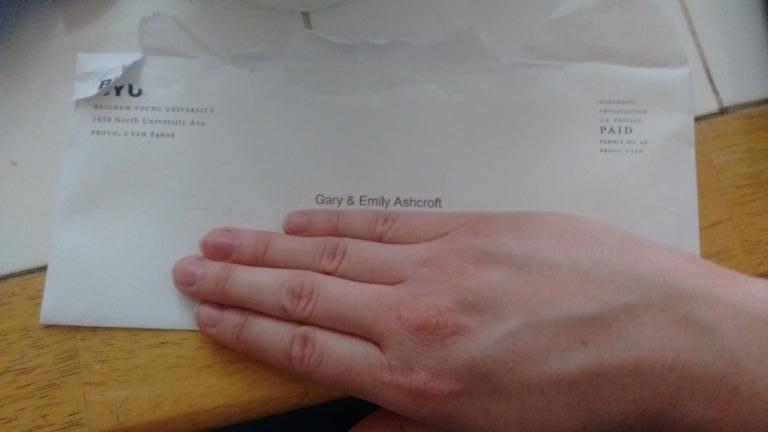
Recently my alma mater, Brigham Young, mailed a request for donations. To my great surprise, it was addressed to a woman I’ve never met: Emily Ashcroft. You see, my husband’s name is Gary Ashcroft, which leads to all sorts of mix ups where people assume I go by his last name. When we got married, generous people wrote out checks to “Gary and Emily Ashcroft” without realizing that I had no way to deposit them. And every time we move into a new ward (congregation), I have to explain to people that we are married, not cohabitating.
Usually the mistake comes from well-meaning people who’ve just barely met me. Or distant family who want to include me when they mail a Christmas card but can’t remember my name. They’ll refer to us “The Ashcrofts,” or call me “Sister Ashcroft” if we’re at church. And when I politely correct them, they immediately make the switch and call me by my real name. If they forget, I politely let them know again, and they remember the next time. That’s what decent, respectful people do: they might accidentally call you the wrong name (and what human has never accidentally called someone by the wrong name?), but once you correct them, they do their best to remember and not repeat the mistake.
Mind you, I’ve encountered some people who refused to respect my decision. Distant relatives deliberately introducing me as “Emily Ashcroft” for the sake of image, despite knowing better. People who told me that I had to share my husband’s name, or he and I weren’t a true family. People who’ve lectured me on the importance of changing my name for my husband’s sake. For the record, he does not have a problem with my decision, though he initially leaned toward the idea of us coming up with a new name together, such as “Belcroft.” if anything, the fact that I didn’t take his name gives him some extra credibility with his progressive colleagues.
Some people’s resistance to my decision is shocking. Once, I attended a congregation where my husband and I taught a children’s Sunday School class, and two parents – two! – asked me to go by my husband’s name so that the 4-year-old Sunbeams wouldn’t think my husband and I were living in sin. As you can probably guess, the Sunbeams did not assume that we were having sex outside of marriage. All they cared about was coloring pictures of Jesus. And getting animal crackers.
The fact that their mothers would make such a request in the first place stung. Having two of them bring it up on the same day, but separately, made it clear that they’d criticized my choice in private.
Other times, the mistake comes from institutions that continue to promote sexist, outdated policies, often out of mere habit. The first time that my alma mater mailed a funding request to this mysterious “Emily Ashcroft” whom I’ve never met, I called and corrected them. For the next couple years, the mail was addressed to me and my husband, including my real name. So what happened with this last letter?
Well, when I called the university, a cheerful lady informed me in a friendly but firm tone that it was the university’s policy to have one of their employees manually replace a married woman’s last name with her husband’s “because it’s tradition.” To be clear, there is no system automatically making this change – they are informed by “someone” (and she was vague about who “someone” is but said it was not the Church) about new marriages and then immediately put in the effort to change their female alums’ names, without their consent.
Strangely, she wasn’t the slightest bit apologetic about it and didn’t seem to see any irony in telling me that they were too busy to call a woman and ask before changing her name but not too busy to hunt down news of the marriage or make the change in the first place. I’ll also point out that this organization is not too busy to call me, each and every year, requesting donations.
Even worse, when I asked why they had reverted to an inaccurate name despite my phone call two years ago, here’s what I learned: the person I spoke to two years ago never corrected my name in the system’s records. They continued to list me by the inaccurate name. However, they added the note, “prefers to be addressed by maiden name.” When this department changed over to a new information system, the inaccurate name carried over, but not the note.
There’s a lot that I could say about institutional sexism and the way it drives default options in software and record-keeping. In fact, there’s a lot I said about this topic four years ago, when I first got married.
But putting aside all that stuff for just a minute, I want to make one thing unequivocally clear: no woman “keeps her maiden name.” A maiden name is the name a woman gave up when she got married and changed her name. The fact that she is married doesn’t automatically mean that her birth name is now her maiden name. It only transforms into a maiden name if she replaces it with a new, married name.
Already I can hear people saying, “But I know a woman who kept her name, and she refers to it as keeping her maiden name.” Sure, you probably do. And most likely she says it that way because it’s the easiest way to explain to you what she means. And perhaps, a few decades back, that really was the best way to refer to it. I recall using those same words 26 years ago in kindergarten, when I met a girl whose mom and dad were married but had different names.
But here’s the problem with perpetuating that term: it adds a constant qualifier to the woman’s name. It implies that the only legal name she has ever had is not her real name, but merely her “maiden name.” So when someone says, “Emily prefers to be called by her maiden name,” what they’re really saying is that I prefer to go by a fake name, an inaccurate name, a name that’s out of date. So no wonder the employee at my alma mater didn’t bother correcting my name when I complained two years ago.
Think I’m reading too much into it? Then consider this – not once has anyone said to my husband, “Oh, you kept your bachelor name.”
There are plenty of women who have maiden names, women who were given one name at birth and then took a new last name when they married. I respect the decision those women made. I respect and recognize that those women have both a maiden name and a married name. I respect their decision to drop their maiden name, hyphenate it, sub it in for their middle name, or whatever the heck they prefer.
But I’m not one of them. I’m not a Mrs. but a Ms. I don’t have a married name, which means that I don’t have a maiden name either.
I’m just – plain – me. With the only name I’ve had for my entire life. It’s blissfully simple: Ms. Emily Belanger. Same before I got married, and same now. You can add in my middle name or my middle initial if you want, but the first and last name are non-negotiable. The beauty of this name is that it doesn’t tell people a thing about my marital status any more than my husband’s name reveals his.
I have one name.
It is my birth name. It is my legal name. It is my preferred name.
It is not, and never will be, my “maiden name.”
Previous Post

April 3, 2018
Another First: An Apostle in an Interracial Marriage
Next Post

May 27, 2018 Making Ministering Holy
Browse Our Archives
Select a Category American society Art baptism Blogging Book of Mormon Book review Brigham Young Brigham Young University Bundy Catholicism Christianity Communalism Community of Christ conferences conversion correlation Culture denominations Digital History Discipline Councils diversity Doctrine Donald Trump education Emma Smith ethics family feminism fiction Film review food French Polynesia Fundamentalism Gay rights Gender global Gun politics Halloween health History Honor Code hymns Joseph Smith Kirtland Temple law of consecration massacre site military Ministering missionary moderate Mormon feminism Modern Mormonism Mormon origins Mormon War Mormonism Mormonism, politics, Romney Obama Peace politics Polygamy Pope Francis Poverty Prayer Priesthood Protestantism Race Religious freedom Revelation Reviews sacred sites Scientology Scripture Secularization See Stones sexual assault Star Wars television temples Tithing Utah violence war women's ordination
Select a Month October 2018 September 2018 August 2018 May 2018 April 2018 March 2018 February 2018 January 2018 December 2017 October 2017 September 2017 July 2017 June 2017 May 2017 April 2017 March 2017 February 2017 January 2017 November 2016 October 2016 August 2016 July 2016 June 2016 May 2016 April 2016 March 2016 February 2016 January 2016 December 2015 November 2015 October 2015 September 2015 August 2015 July 2015 June 2015 April 2015 March 2015 February 2015 January 2015 December 2014 November 2014 October 2014 September 2014 August 2014 July 2014 June 2014 May 2014 April 2014 March 2014 February 2014 January 2014 December 2013 November 2013 October 2013 September 2013 August 2013 July 2013 June 2013 May 2013 April 2013 March 2013 February 2013 January 2013 December 2012 November 2012 October 2012 September 2012 August 2012 July 2012 June 2012 May 2012 April 2012 March 2012
Follow Us!
TAKE THE
Religious Wisdom Quiz
But you, Bethlehem Ephrathah, though you are small, out of you will come a ruler over Israel. What makes this town significant?
Select your answer to see how you score.
David's hometown A place of prophecy A holy city The birthplace of the Messiah
Related posts from Peculiar People

To the People Defending the Church's Decision to...

The Women Who Enable Abusive Men

Joseph, Potiphar's Wife, and the Truth about False...

Robert Kirby and Edgy Mormon Men
TRENDING AT PATHEOS Latter-day Saint

Did Prayer Cure His Cancer? Or Was It...
At 4 AM one morning, Joshua W. Brown’s wife awoke to a...

8 Ways a Near-Death Experience Rewires the Soul
Does Consciousness Survive Physical Death? After 50 Years of Research, Dr. Raymond...

Holy Longing: What Our Restlessness Is Telling Us
“One can find so many pains when the rain is falling.” -John...

What this is NOT about. This blog is definitely not about...

Who said the Israelites were God’s chosen? That’s right, they did. Who...

The Spirit World Is the Real World: God...
A Monk’s Wisdom on Body and Spirit I sit with Brother Martin...
view all Latter-day Saint blogs
Ad-Free & Subscriber Log-In Subscription Support
- About Us
- 2026 Calendar
- Videos
- Podcasts
- Library of World Religions
- Faith In Media Tracker
- Advertise With Us
- Write for Us
- Privacy Policy
- Terms of Service
- Do Not Sell My Data
- Contact Us
- Radiant Digital
- Manage Newsletter Subscriptions
- Unsubscribe From Notifications
- Sitemap
Copyright 2008-2026, Patheos. All rights reserved.
Subscription Support Ad-Free & Subscriber Log-In
Follow Patheos