
BuddhistCatholicContemplativeEvangelicalGeneral ChristianHinduJewishLatter-day SaintMuslimNew VisionsProgressive Christian
Beliefs
- Buddhist
- Catholic
- Contemplative
- Evangelical
- General Christian
- Hindu
- Jewish
- Latter-day Saint
- More Voices
- Muslim
- New Visions
- Pagan
- Progressive Christian
Topics
- Religion News
- Food and Religion
- Sports and Religion
- Religious Art
- Religious Music and Entertainment
- Religious Events
- History and Religion
- Style and Religion
- Politics and Religion
- Women in Religion
- Recreation Outdoors and Religion
- Business Finance and Religion
- Careers Workplace and Religion
- Education and Religion
- Family Parenting and Religion
- Health Fitness and Religion
- Home and Religion
- Relationships and Religion
- Technology and Religion
- Travel and Religion
Columnists
- Buddhist Columnists
- Business Finance and Religion Columnists
- Careers Workplace and Religion Columnists
- Catholic Columnists
- Contemplative Columnists
- Education and Religion Columnists
- Evangelists Columnists
- Family Parenting and Religion Columnists
- General Christian Columnists
- Health Fitness and Religion Columnists
- Hindu Columnists
- History and Religion Columnists
- Home and Religion Columnists
- Jewish Columnists
- More Voices Columnists
- Latter Day Columnists
- Muslim Columnists
- New Visions Columnists
- Nonreligious Columnists
- Pagan Columnists
- Politics and Religion Columnists
- Progressive Columnists
- Recreation Outdoors and Religion Columnists
- Relationships and Religion Columnists
- Religion News Columnists
- Religious Art Columnists
- Religious Events Columnists
- Religious Music and Entertainment Columnists
- Sports and Religion Columnists
- Style and Religion Columnists
- Technology and Religion Columnists
- Travel and Religion Columnists
- Women in Religion Columnists
Resource Library
- 2026 Calendar
- Library of World Religions
- The 100 Most Holy Places on Earth
- Patheos Answers
- Podcasts
- Videos
- Faith Leaders Database
- Anglican Episcopalian
- Bahai
- Baptist
- Buddhism
- Christianity
- Confucianism
- Eastern Orthodoxy
- Hinduism
- Holiness and Pentecostal
- ISKCON
- Islam
- Judaism
- Lutheran
- Methodist
- The Church of Jesus Christ of Latter-day Saints
- New Age
- Paganism
- Presbytarian and Reformed
- Protestantism
- Religion Behind the Scenes
- Roman Catholic
- Scientology
- Shia Islam
- Sikhism
- Sufism
- Sunni Islam
- Taoism
- Zen
- See all religions
Research Tools
 Ad-Free & Subscriber Log-In Subscription Support
Ad-Free & Subscriber Log-In Subscription Support
Follow Patheos 

- Trending:
- Forgiveness
- |
- Marriage
- |
- Consciousness
- |
- Death Penalty
- |
- Election
- |
- Halloween
 Peculiar People
- Home
- Latter-day Saint
- The Trump Supporter Next Door
The Trump Supporter Next Door
Last updated on: November 12, 2016 at 11:12 am by Emily Belanger
The Trump Supporter Next Door 2016-11-12T11:12:23+00:00 Emily Belanger
Patheos Explore the world's faith through different perspectives on religion and spirituality! Patheos has the views of the prevalent religions and spiritualities of the world.
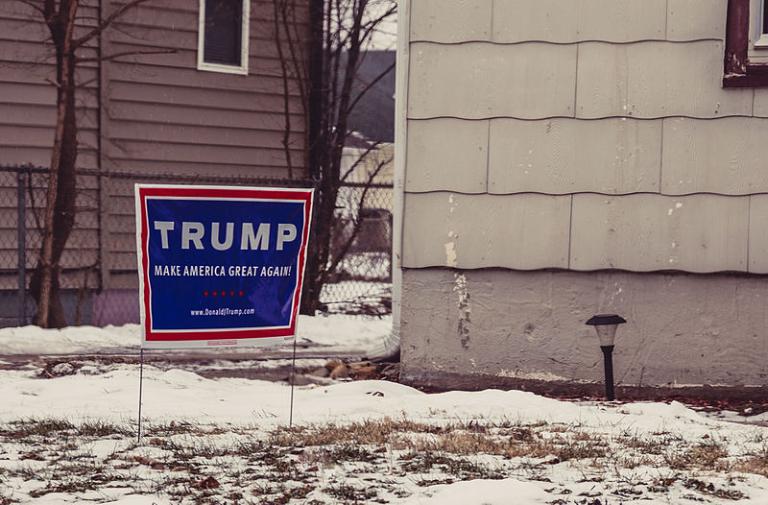
Image obtained through Creative Commons, courtesy of Wikipedia Commons
If you’ve been following the Peculiar People column over the past few months, you’ve probably noticed two things: the posts have been sparse, and nearly all of them have been anti-Trump. The emphasis on Trump wasn’t a coordinated effort on anyone’s part – personally, I’ve held back from writing more about him so that it wouldn’t seem like we’d plunged into political propaganda. But I’m acknowledging that trend because it probably won’t surprise you that I’m among the many Americans still reeling from Tuesday’s election results.
And like many, my initial reaction was to lash out at those who voted for him. I lashed out from a place of pain and also a place of shock and publicly told Trump supporters that they had broken my trust. A week ago, I honestly had no idea how many of the people close to me were voting for him. Oh, I saw early on that the acquaintance I mostly remembered for bullying me in the 6th grade was a Trump fan. Not to mention the alt right acquaintance I stay friends with mostly to hear multiple perspectives and get out of my liberal bubble. But people I was close to? It was only in the last few days before the election that I saw it – friends and family were suddenly sharing his ads on facebook or clicking “like” when someone else did.
For anyone who felt targeted by Trump’s campaign rhetoric, Tuesday’s results were painful. And I mean that in a physical way – as I watched the election results roll in, my body reacted. There was an ache in the pit of my stomach, and my throat tightened – the horrible tightness you feel in your throat before vomiting. Part of me is still surprised that I didn’t throw up. And it simply felt unreal. The kind of unreal that overwhelms you when a tragedy strikes – the house has burned down, your spouse has left you, your best friend has died, and you never saw it coming. And the worst part was that I knew it would seem like a nightmare, that I’d wake up the next morning and truly believe, for just a moment, that I had dreamt the whole thing. That there was no way the polls and Nate Silver and common sense had all been wrong. No way Trump had truly been elected – not a man who was on camera and audio bragging about using his power to get away with sexual assault and sexual harassment.
But it was real, and it remains real, and 4 days later those who opposed his candidacy are searching for a way to process not just his win but the knowledge that the people who voted for him surround us. They’re our next door neighbors. Our grandparents and aunts and uncles. Our brothers and sisters. They’re the strangers who smile and wave when we drive down a quiet road in a rural town.
To be honest, I still don’t know what to do with that knowledge. I know that my decision to initially lash out wasn’t received well. And I also don’t know how I feel about that fact. Is it wrong that I said something one Trump voter told me was “hurtful” and “unfair”? Did I throw away the opportunity for meaningful dialogue in the future? Or was it hurtful because it was fair – something they had to hear from another white person, since so few Trump supporters even live in racially diverse areas? Whatever the answer, we have both broken each other’s trust. My Trump-voting friends and family trusted that I would never let politics interfere with our relationships. They trusted I would keep an open mind, no matter how vehemently I disagreed with their voting choices. And I trusted they would never vote for a man who built his campaign by fanning the flames of racism or who treated women like objects and then publicly bragged about it. I didn’t just trust that they wouldn’t find those traits attractive (and I still can’t imagine that anyone close to me liked those traits in Trump). I also trusted that they wouldn’t vote for him despite those traits.
As a Mormon who spent the first 8 years of her adult like living in Utah, I also trusted that Utah would break party loyalty and reject Trump so soundly that, if he did win their state, it would be by a narrow margin. Despite McMullin’s popularity in Utah, Trump still won with a 16-point lead.
In a couple weeks, it will be Thanksgiving. The holiday may prove tense, especially for white opponents of Trump. For me, that reality hits close to home. My husband and I both grew up in rural towns, and we both have relatives who fit the demographics most likely to have voted for Trump: white rural voters without a college degree. We haven’t finalized our plans, but if we do wind up traveling for the holidays, I’m sure there will be talk of the election, in between complimenting a cousin or an uncle on how delicious the mashed potatoes are. I don’t know who exactly voted for Trump, but I’m no longer so naive as to assume that they’ll be the exception at the table.
So, what do the anti-Trump Americans do? Our conservative friends and relatives are already calling for us to unite with them and support the president elect. To our conservative friends and family, the call to unite is likely a plea for us to embrace them, to accept and respect the decision they made. Supporting a peaceful transition of power is paramount, but uniting under Trump’s banner is still out of the question for anyone who sees him as a genuine threat to the republic. What Trump voters see as a liberal “temper tantrum” is a rallying cry for Trump’s critics, who are already planning ways to peacefully fight his platform.
And our Trump-supporting friends and family aren’t the only people whose feelings matter, so I worry that embracing that call for unity would send a horrifying message to the vulnerable groups who now live in terror of what Trump’s candidacy has unleashed. Young American citizens whose parents are undocumented are afraid he’ll make good on his promise to put together a deportation task force. Many pro-choice women fear he will make good on his campaign comment that women who get abortions should be punished. Muslim citizens are afraid he’ll truly try to ban all Muslims from entering the country, or that his campaign-trail consideration of requiring Muslims to register will return.
And here’s the thing: we toss around words like “unity” and “trust” as if they’re inherently good things. After this week, I finally understand how mistaken that assumption is. Several decades ago, if a president who supported Jim Crow laws had won a controversial election, I have a feeling plenty friends and family would have called for unity and for the other party to support and trust the new president. Frankly, I’m starting to wonder if Donald Trump could have normalized something even that outrageous, given how much he has already normalized. After all, he initially refused to denounce the KKK on the claim that he wasn’t familiar enough with them, and throughout his campaign he called to ban an entire world religion.
Unity is important, but unity that comes at the cost of the most vulnerable is toxic.
Now that the election is over, what banner do we unite under?
Previous Post

November 8, 2016
The Case for Hillary Clinton and a Mormon Stance on Abortion
Next Post
November 28, 2016 The Fundamental Optimism of Apocalypse
Browse Our Archives
Select a Category American society Art baptism Blogging Book of Mormon Book review Brigham Young Brigham Young University Bundy Catholicism Christianity Communalism Community of Christ conferences conversion correlation Culture denominations Digital History Discipline Councils diversity Doctrine Donald Trump education Emma Smith ethics family feminism fiction Film review food French Polynesia Fundamentalism Gay rights Gender global Gun politics Halloween health History Honor Code hymns Joseph Smith Kirtland Temple law of consecration massacre site military Ministering missionary moderate Mormon feminism Modern Mormonism Mormon origins Mormon War Mormonism Mormonism, politics, Romney Obama Peace politics Polygamy Pope Francis Poverty Prayer Priesthood Protestantism Race Religious freedom Revelation Reviews sacred sites Scientology Scripture Secularization See Stones sexual assault Star Wars television temples Tithing Utah violence war women's ordination
Select a Month October 2018 September 2018 August 2018 May 2018 April 2018 March 2018 February 2018 January 2018 December 2017 October 2017 September 2017 July 2017 June 2017 May 2017 April 2017 March 2017 February 2017 January 2017 November 2016 October 2016 August 2016 July 2016 June 2016 May 2016 April 2016 March 2016 February 2016 January 2016 December 2015 November 2015 October 2015 September 2015 August 2015 July 2015 June 2015 April 2015 March 2015 February 2015 January 2015 December 2014 November 2014 October 2014 September 2014 August 2014 July 2014 June 2014 May 2014 April 2014 March 2014 February 2014 January 2014 December 2013 November 2013 October 2013 September 2013 August 2013 July 2013 June 2013 May 2013 April 2013 March 2013 February 2013 January 2013 December 2012 November 2012 October 2012 September 2012 August 2012 July 2012 June 2012 May 2012 April 2012 March 2012
Follow Us!
TAKE THE
Religious Wisdom Quiz
Who said, "The Lord is my shepherd, I shall not want"?
Select your answer to see how you score.
David Solomon Moses Paul
Related posts from Peculiar People

Sorry to Bother You: The (Human) Body as...

A Letter for My Someday-Teenage Children

Confederate Symbols and the Black Flag of ISIS:...

TRENDING AT PATHEOS Latter-day Saint

Did Prayer Cure His Cancer? Or Was It...
At 4 AM one morning, Joshua W. Brown’s wife awoke to a...

8 Ways a Near-Death Experience Rewires the Soul
Does Consciousness Survive Physical Death? After 50 Years of Research, Dr. Raymond...

Holy Longing: What Our Restlessness Is Telling Us
“One can find so many pains when the rain is falling.” -John...

What this is NOT about. This blog is definitely not about...

Who said the Israelites were God’s chosen? That’s right, they did. Who...

The Spirit World Is the Real World: God...
A Monk’s Wisdom on Body and Spirit I sit with Brother Martin...
view all Latter-day Saint blogs
Ad-Free & Subscriber Log-In Subscription Support
- About Us
- 2026 Calendar
- Videos
- Podcasts
- Library of World Religions
- Faith In Media Tracker
- Advertise With Us
- Write for Us
- Privacy Policy
- Terms of Service
- Do Not Sell My Data
- Contact Us
- Radiant Digital
- Manage Newsletter Subscriptions
- Unsubscribe From Notifications
- Sitemap
Copyright 2008-2026, Patheos. All rights reserved.
Subscription Support Ad-Free & Subscriber Log-In
Follow Patheos