
BuddhistCatholicContemplativeEvangelicalGeneral ChristianHinduJewishLatter-day SaintMuslimNew VisionsProgressive Christian
Beliefs
- Buddhist
- Catholic
- Contemplative
- Evangelical
- General Christian
- Hindu
- Jewish
- Latter-day Saint
- More Voices
- Muslim
- New Visions
- Pagan
- Progressive Christian
Topics
- Religion News
- Food and Religion
- Sports and Religion
- Religious Art
- Religious Music and Entertainment
- Religious Events
- History and Religion
- Style and Religion
- Politics and Religion
- Women in Religion
- Recreation Outdoors and Religion
- Business Finance and Religion
- Careers Workplace and Religion
- Education and Religion
- Family Parenting and Religion
- Health Fitness and Religion
- Home and Religion
- Relationships and Religion
- Technology and Religion
- Travel and Religion
Columnists
- Buddhist Columnists
- Business Finance and Religion Columnists
- Careers Workplace and Religion Columnists
- Catholic Columnists
- Contemplative Columnists
- Education and Religion Columnists
- Evangelists Columnists
- Family Parenting and Religion Columnists
- General Christian Columnists
- Health Fitness and Religion Columnists
- Hindu Columnists
- History and Religion Columnists
- Home and Religion Columnists
- Jewish Columnists
- More Voices Columnists
- Latter Day Columnists
- Muslim Columnists
- New Visions Columnists
- Nonreligious Columnists
- Pagan Columnists
- Politics and Religion Columnists
- Progressive Columnists
- Recreation Outdoors and Religion Columnists
- Relationships and Religion Columnists
- Religion News Columnists
- Religious Art Columnists
- Religious Events Columnists
- Religious Music and Entertainment Columnists
- Sports and Religion Columnists
- Style and Religion Columnists
- Technology and Religion Columnists
- Travel and Religion Columnists
- Women in Religion Columnists
Resource Library
- 2026 Calendar
- Library of World Religions
- The 100 Most Holy Places on Earth
- Patheos Answers
- Podcasts
- Videos
- Faith Leaders Database
- Anglican Episcopalian
- Bahai
- Baptist
- Buddhism
- Christianity
- Confucianism
- Eastern Orthodoxy
- Hinduism
- Holiness and Pentecostal
- ISKCON
- Islam
- Judaism
- Lutheran
- Methodist
- The Church of Jesus Christ of Latter-day Saints
- New Age
- Paganism
- Presbytarian and Reformed
- Protestantism
- Religion Behind the Scenes
- Roman Catholic
- Scientology
- Shia Islam
- Sikhism
- Sufism
- Sunni Islam
- Taoism
- Zen
- See all religions
Research Tools
 Ad-Free & Subscriber Log-In Subscription Support
Ad-Free & Subscriber Log-In Subscription Support
Follow Patheos 

- Trending:
- Forgiveness
- |
- Marriage
- |
- Consciousness
- |
- Death Penalty
- |
- Election
- |
- Halloween
 Peculiar People
- Home
- Latter-day Saint
- The Fundamental Optimism of Apocalypse
The Fundamental Optimism of Apocalypse
Last updated on: November 28, 2016 at 9:00 am by mhaycock
The Fundamental Optimism of Apocalypse 2016-11-23T19:09:26+00:00 mhaycock
Patheos Explore the world's faith through different perspectives on religion and spirituality! Patheos has the views of the prevalent religions and spiritualities of the world.
Today, we have a guest post from my friend Cameron Neilsen. Please note that this was written before November 8.
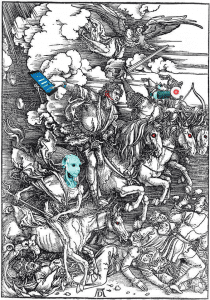 Apocalypticism is back. While the Bible-thumping, seven-seals-interpreting strain has kept a low profile compared to the 1970’s and 80’s, it has joined with secular concerns over environmental threats and economic instability to produce an entire subculture of “preppers,” ZeroHedge readers, and r/collapse Redditors. Pundits are all too apt to dismiss these groups as paranoid, superstitious conspiracy-theorists or alt-right wackos slavering to live out a The Walking Dead fantasy. Such lazy dismissals not only elide the real issues that underlie these admittedly extreme responses, but ignore the inner logic that has sustained apocalyptic discourse as a sporadic but recurring phenomenon in Western culture since ancient times.
For those who make use of them, apocalyptic tropes serve a pressing social and psychological need. It is, in its most basic form, a way of coping with a hostile world. Scholar of Christian apocalyptic rhetoric Stephen O’Leary explains it thus: “apocalyptic [rhetoric] functions as a symbolic theodicy, a mythical and rhetorical solution to the problem of evil.” In other words, when idealistic communities or individuals are confronted with a world that not only does not square with their expectations, but seems unalterably hostile to them, they begin to hope for an apocalyptic solution. Conservative Christians are not the only ones prone to this. As communists, for example, have become increasingly marginalized and removed from the levers of power, they have turned to theorists who posit that we currently live in the age of “late capitalism,” whose inevitable crisis of self-destruction will open the way to their resurgence (radical environmentalists have a similar idea, although often with much dimmer prospects for human survival). Since, outside of prophecies of utter destruction, true believers in these ideologies can but wallow in society’s total rejection of their desires, these potential apocalypses are, in a weird way, the best futures they can imagine. Believing in the collapse of (a corrupt) society is an optimistic act.
Yes, you might be saying, it makes sense for fanatics with weird marginal ideologies. But what about otherwise “normal” people? Why can’t they just accept that life comes with risks and hope for the best? Why would they prefer to contemplate disaster scenarios instead of projects for future advancement? To answer that question, let us review some of the characteristics of the near future, so far as I have been able to determine them from my regular consumption of online magazine and newspaper features:
- Robots and artificial intelligence will replace most low-skilled jobs, driving humans to push their academic abilities to the limit in an ever-accelerating drive to compete
- Society will become increasingly atomized, as most human interaction becomes mediated by digital media, community cohesion is lost, and VR becomes more attractive than reality
- Economic inequality will increase, and those who benefit from automated wealth production will be obliged to provide for those whose skills are no longer marketable
- A combination of antibiotic-resistant diseases, global warming, resource depletion, and general degeneration of the biosphere will make it harder to live a long and healthy life without technological aids, which will be beyond the resources of the world’s poorest
- Some foods (such as bananas and sushi) and activities (such as scuba diving the Great Barrier Reef) will become unavailable altogether
- All these pressures will drive those who can to get body enhancing implants, or even to have their children genetically modified
- The human lifespan will increase dramatically, with unknown social and psychological ramifications. Fortunately, doctor-assisted suicide will be more widely available
- People will be significantly less religious, and will have flexible ideas about social mores, such as polyamory
- Internet-connected devices will track your every move, reporting everything about your life to corporations and the government
Keep in mind that these are the forecasts for if everything continues to go reasonably well—nuclear war or economic collapse not included. Never mind debating as to whether any of these predictions will in fact come to pass; perhaps none of them will. What matters is that these are the sorts of future forecasts that we all are presented with in the media, for though you may not have encountered all of them and one or two may even seem appealing to some with a taste for sci-fi, the overall impression is what matters. This is the future that we are supposed to look forward to—for most people, a straight-up dystopia.
Of course, some of these uncomfortable forecasts are merely the continuation of the dramatic dislocations that have already roiled our body politic and had such dramatic effects on our current election season. It is hard not to sense a connection between the loss of faith in the future I have just sketched out and the sort of bomb-throwing mentality that has brought Donald Trump to the highest levels of our lowest national discourse. Filmmaker Michael Moore said it best in a brilliant recent speech explaining the motivation of Trump’s supporters, who he thinks may yet propel him to the Oval Office: “Trump’s election is going to be the biggest f*** you ever recorded in human history—and it will feel good.” [fn 1] (I got chills from his delivery of the last line, though I’m not sure if they were of horror or delight. Probably both—that’s just the way apocalyptic hits you.) Apocalyptic thought has a long tradition of competition between quietist and activist versions of itself, between those who would prefer to wait for the apocalypse to come for them, and those who want to trigger it themselves. Obviously, one has to feel pretty hopeless to go out and take a torch to the future. But it’s precisely that sort of frustration that is a sign of our times.
I have not come this far, however, just to take a cheap shot at Trumpism. Rather, I wish to show that apocalypticism need not be seen as an unnatural response to a chaotic society. Believing that things must get worse before they can get better, apocalyptic subcultures’ constant search for evidence to support their dire expectations of collapse is not just schadenfreude or sour grapes, but the result of the natural human craving for optimism. No matter how unlikely their scenarios may seem to outsiders, they hope for a future that will give them the opportunity to effect their ideals. (Whether or not those ideals are in fact desirable will vary by group, for Ayn Randian egoists as well as utopians can be found among their ranks.) Obviously, not all the energy expressed in this way is good (see above), but much of it is, or at least constitutes an attempt at a best possible response. One does not need to move to a decommissioned Cold War bunker in Montana to appreciate the motives behind such preparation.
If we consider apocalyptic thinking to be a symptom, then, it raises the question of underlying causes. They are not hard to find. It has become cliché to fret over our era’s crisis of confidence or opine that the West no longer embodies an attractive narrative capable of inspiring “developing nations.” Part of this is undoubtedly due to the queasy future outlined above, which assumes further freewheeling market-driven developments, unhampered by significant social consideration. In other words, the real crisis of confidence is in our ability to pilot our own economic and social system according to our values and to allow for the lives we want to lead, instead of merely following the tireless demands of market forces. This is clearly our own fault. It stems from an unwillingness to think boldly, to imagine a way of life that isn’t just an incremental development of our current one, and, above all, to question the rightful place of “economic realities” as the final court of appeal. For all its faults, apocalypticism is at least a bold thought. If you would prefer, as I suspect you do, not to see the world slide into famine, anarchy, and nuclear warfare (or even just avoid a slightly more soulless and alienating technocratic dystopia in the World of Tomorrow), then it falls on you to try to think of something better. You can hardly laugh off the doomsayers if you have not given thought yourself to the forces that are shaping our future. Perhaps a better narrative can be formed that makes good use of our presently-existing socioeconomic foundations, rendering visions of razing them superfluous. Let me know if you come up with anything—I’ll be in my bunker.
[fn 1] http://www.realclearpolitics.com/video/2016/10/26/michael_moore_trump_victory_would_be_the_biggest_fk_you_recorded_in_human_history.html
CAMERON NIELSEN is a grad student in Religious Studies at the University of Illinois at Urbana-Champaign, focusing on religion in America and comparative approaches. His current research interests include nineteenth-century Mormonism, East Asian religions, new religions, apocalypticism, and the philosophy of religion. He holds a BA in History (East Asia emphasis) from Brigham Young University – Provo. In his free time, he enjoys theologizing, customizing his Linux computers, biking, and observing the signs of the times.
Previous Post

November 12, 2016
The Trump Supporter Next Door
Next Post
January 29, 2017 Your Optimism Isn't a Virtue
Browse Our Archives
Select a Category American society Art baptism Blogging Book of Mormon Book review Brigham Young Brigham Young University Bundy Catholicism Christianity Communalism Community of Christ conferences conversion correlation Culture denominations Digital History Discipline Councils diversity Doctrine Donald Trump education Emma Smith ethics family feminism fiction Film review food French Polynesia Fundamentalism Gay rights Gender global Gun politics Halloween health History Honor Code hymns Joseph Smith Kirtland Temple law of consecration massacre site military Ministering missionary moderate Mormon feminism Modern Mormonism Mormon origins Mormon War Mormonism Mormonism, politics, Romney Obama Peace politics Polygamy Pope Francis Poverty Prayer Priesthood Protestantism Race Religious freedom Revelation Reviews sacred sites Scientology Scripture Secularization See Stones sexual assault Star Wars television temples Tithing Utah violence war women's ordination
Select a Month October 2018 September 2018 August 2018 May 2018 April 2018 March 2018 February 2018 January 2018 December 2017 October 2017 September 2017 July 2017 June 2017 May 2017 April 2017 March 2017 February 2017 January 2017 November 2016 October 2016 August 2016 July 2016 June 2016 May 2016 April 2016 March 2016 February 2016 January 2016 December 2015 November 2015 October 2015 September 2015 August 2015 July 2015 June 2015 April 2015 March 2015 February 2015 January 2015 December 2014 November 2014 October 2014 September 2014 August 2014 July 2014 June 2014 May 2014 April 2014 March 2014 February 2014 January 2014 December 2013 November 2013 October 2013 September 2013 August 2013 July 2013 June 2013 May 2013 April 2013 March 2013 February 2013 January 2013 December 2012 November 2012 October 2012 September 2012 August 2012 July 2012 June 2012 May 2012 April 2012 March 2012
Follow Us!
TAKE THE
Religious Wisdom Quiz
I am a bush that burned but was not consumed, from which God spoke to Moses. What am I?
Select your answer to see how you score.
Pillar of fire The burning bush Ark of the Covenant A holy fire
Related posts from Peculiar People

Sorry to Bother You: The (Human) Body as...


A Letter for My Someday-Teenage Children

Confederate Symbols and the Black Flag of ISIS:...
TRENDING AT PATHEOS Latter-day Saint

Did Prayer Cure His Cancer? Or Was It...
At 4 AM one morning, Joshua W. Brown’s wife awoke to a...

8 Ways a Near-Death Experience Rewires the Soul
Does Consciousness Survive Physical Death? After 50 Years of Research, Dr. Raymond...

Holy Longing: What Our Restlessness Is Telling Us
“One can find so many pains when the rain is falling.” -John...

What this is NOT about. This blog is definitely not about...

Who said the Israelites were God’s chosen? That’s right, they did. Who...

The Spirit World Is the Real World: God...
A Monk’s Wisdom on Body and Spirit I sit with Brother Martin...
view all Latter-day Saint blogs
Ad-Free & Subscriber Log-In Subscription Support
- About Us
- 2026 Calendar
- Videos
- Podcasts
- Library of World Religions
- Faith In Media Tracker
- Advertise With Us
- Write for Us
- Privacy Policy
- Terms of Service
- Do Not Sell My Data
- Contact Us
- Radiant Digital
- Manage Newsletter Subscriptions
- Unsubscribe From Notifications
- Sitemap
Copyright 2008-2026, Patheos. All rights reserved.
Subscription Support Ad-Free & Subscriber Log-In
Follow Patheos