
BuddhistCatholicContemplativeEvangelicalGeneral ChristianHinduJewishLatter-day SaintMuslimNew VisionsProgressive Christian
Beliefs
- Buddhist
- Catholic
- Contemplative
- Evangelical
- General Christian
- Hindu
- Jewish
- Latter-day Saint
- More Voices
- Muslim
- New Visions
- Pagan
- Progressive Christian
Topics
- Religion News
- Food and Religion
- Sports and Religion
- Religious Art
- Religious Music and Entertainment
- Religious Events
- History and Religion
- Style and Religion
- Politics and Religion
- Women in Religion
- Recreation Outdoors and Religion
- Business Finance and Religion
- Careers Workplace and Religion
- Education and Religion
- Family Parenting and Religion
- Health Fitness and Religion
- Home and Religion
- Relationships and Religion
- Technology and Religion
- Travel and Religion
Columnists
- Buddhist Columnists
- Business Finance and Religion Columnists
- Careers Workplace and Religion Columnists
- Catholic Columnists
- Contemplative Columnists
- Education and Religion Columnists
- Evangelists Columnists
- Family Parenting and Religion Columnists
- General Christian Columnists
- Health Fitness and Religion Columnists
- Hindu Columnists
- History and Religion Columnists
- Home and Religion Columnists
- Jewish Columnists
- More Voices Columnists
- Latter Day Columnists
- Muslim Columnists
- New Visions Columnists
- Nonreligious Columnists
- Pagan Columnists
- Politics and Religion Columnists
- Progressive Columnists
- Recreation Outdoors and Religion Columnists
- Relationships and Religion Columnists
- Religion News Columnists
- Religious Art Columnists
- Religious Events Columnists
- Religious Music and Entertainment Columnists
- Sports and Religion Columnists
- Style and Religion Columnists
- Technology and Religion Columnists
- Travel and Religion Columnists
- Women in Religion Columnists
Resource Library
- 2026 Calendar
- Library of World Religions
- The 100 Most Holy Places on Earth
- Patheos Answers
- Podcasts
- Videos
- Faith Leaders Database
- Anglican Episcopalian
- Bahai
- Baptist
- Buddhism
- Christianity
- Confucianism
- Eastern Orthodoxy
- Hinduism
- Holiness and Pentecostal
- ISKCON
- Islam
- Judaism
- Lutheran
- Methodist
- The Church of Jesus Christ of Latter-day Saints
- New Age
- Paganism
- Presbytarian and Reformed
- Protestantism
- Religion Behind the Scenes
- Roman Catholic
- Scientology
- Shia Islam
- Sikhism
- Sufism
- Sunni Islam
- Taoism
- Zen
- See all religions
Research Tools
 Ad-Free & Subscriber Log-In Subscription Support
Ad-Free & Subscriber Log-In Subscription Support
Follow Patheos 

- Trending:
- Forgiveness
- |
- Marriage
- |
- Consciousness
- |
- Death Penalty
- |
- Election
- |
- Halloween
 Peculiar People
- Home
- Latter-day Saint
- Review: The Mormon Jesus
Review: The Mormon Jesus
Last updated on: June 23, 2016 at 6:41 pm by mhaycock
Review: The Mormon Jesus 2016-06-23T18:41:31+00:00 mhaycock
Patheos Explore the world's faith through different perspectives on religion and spirituality! Patheos has the views of the prevalent religions and spiritualities of the world.
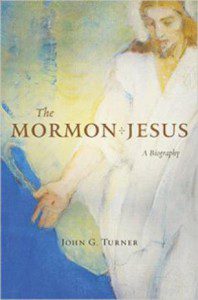 Perhaps my devotional life’s greatest flaw is that I forget about Jesus. Intellectually, of course, I know that I cannot ignore the Savior when speaking about theology, but much of the time my musings tend to amble away toward questions of divine-human ontology, creation, exaltation, and eternal family relationships instead.
Therefore, I was curious what John Turner would have to say in his The Mormon Jesus, published by Harvard University Press last month. Through his Brigham Young: Pioneer Prophet and a handful of personal interactions, I knew Turner to be a careful, charitable observer of Mormonism, sensitive to the latest developments in Mormon historical scholarship and the subtle social tensions over the representation of the LDS faith in academic work.
The Mormon Jesus did not disappoint. Though subtitled “A Biography,” Turner does not try to assemble a harmonized Mormon version of Jesus’s life story (though he does pay especial attention to James E. Talmage’s Jesus the Christ, which attempted just that). Instead, Turner expertly weaves the thread of Jesus Christ through various themes, exploring how Mormons’ visions of Christ differed from their neighbors’ and their predecessors’ and how those visions evolved over the decades.
What is more, the themes are varied and comprehensive enough that I would almost be comfortable recommending this book as a historical–though not chronological–introduction to Mormonism for the theologically inclined. In order, Turner deals with Jesus in the Book of Mormon and Mormon readings of the Bible, visions, records of His words, eschatology, metaphysics, temple rites, concepts of sexuality and marriage, and art, race, and masculinity. Each topic is presented with ample context and, as I have come to expect from Turner, warranted nuance. For instance, Turner notes that early Mormon concepts of Jesus were almost indistinguishable from contemporary Christian ones, a fact that might discomfit some Mormon readers. On the other hand, recognizing the ambiguity in the texts and the proliferation of similar ideologies throughout antebellum America and Europe, he declines to indict LDS scripture as the origin of Mormon racist folklore.
I was most surprised–pleasantly, to be sure!–by Turner’s inclusion of two of my personal hobby horses, masculinity studies and Mormon theology of sexuality. In the latter case, his chapter was excellent enough that I do not feel that I need to independently research the question of Jesus and reproduction for future projects, as to do so would now be somewhat redundant. In the former, he demonstrates well how images of Christ have changed over time to align with developing ideals of manliness, from Arnold Friberg’s muscular Christ appearing to the Nephites in glory to Greg Olson’s Jesus, seated with a young girl and contemplating a butterfly.
Turner’s analysis of Jesus also brings to light the very tension that sometimes allows me to overlook Him: some core aspects of Mormonism are less tightly tethered to Christ than others. This causes Mormon theology to act more like a binary star system of variable brightness than a single sun. One member of this binary system is, of course, Jesus, with the accompanying themes of baptism, adoption, atonement, and so forth. To Turner, the other star includes “polygamy, theocracy, and the Latter-day Saint self-understanding as God’s new Israel.” In my own view, the wholesale loss of theologies that connected Christ and his atonement inherently to families (for instance, that Christ was married, and that salvation came through the patriarchal order, descending from Christ to men’s wives) means that at present, the relationship between the atonement and eternal families is at best incidental. In the anemic words of Preach My Gospel, Christ’s atonement “blesses families” because it enables each member of the family to take advantage of individual forgiveness and sanctification. This tenuous link is all that holds together the metaphysical vision of families, temples, and theosis on one hand and the christological vision of individuals, the sacrament, and salvation on the other.
Church authorities seem to have gotten wind of this tension. Most visible among their efforts to tie the Church of Jesus Christ of Latter-day Saints to Jesus Christ was the 1996 redesign of the logo to focus on those two words, but more subtle shifts in emphases have accompanied it. The recent LDS theological swing back to Christ, is only one reason Turner says that “Mormonism is a vibrant new branch of Christianity, one in which temples, ordinances, and prophet have taken their place alongside a Jesus who is both utterly Christian and distinctively Mormon.” However, this shift also enables people to claim–with reason!–that Christ, in opposition to the family, is the center of the Church. I hope that the second edition of Turner’s book will be able to include a chapter on Mormon efforts to re-integrate Christocentric theology with temple metaphysics.
Like Peculiar People on Facebook:
Previous Post

June 17, 2016
Stop Praying for us, and Acknowledge That You Helped Create Omar Mateen
Next Post

July 4, 2016 Hell and Zion: A Review of "Undertale"
Browse Our Archives
Select a Category American society Art baptism Blogging Book of Mormon Book review Brigham Young Brigham Young University Bundy Catholicism Christianity Communalism Community of Christ conferences conversion correlation Culture denominations Digital History Discipline Councils diversity Doctrine Donald Trump education Emma Smith ethics family feminism fiction Film review food French Polynesia Fundamentalism Gay rights Gender global Gun politics Halloween health History Honor Code hymns Joseph Smith Kirtland Temple law of consecration massacre site military Ministering missionary moderate Mormon feminism Modern Mormonism Mormon origins Mormon War Mormonism Mormonism, politics, Romney Obama Peace politics Polygamy Pope Francis Poverty Prayer Priesthood Protestantism Race Religious freedom Revelation Reviews sacred sites Scientology Scripture Secularization See Stones sexual assault Star Wars television temples Tithing Utah violence war women's ordination
Select a Month October 2018 September 2018 August 2018 May 2018 April 2018 March 2018 February 2018 January 2018 December 2017 October 2017 September 2017 July 2017 June 2017 May 2017 April 2017 March 2017 February 2017 January 2017 November 2016 October 2016 August 2016 July 2016 June 2016 May 2016 April 2016 March 2016 February 2016 January 2016 December 2015 November 2015 October 2015 September 2015 August 2015 July 2015 June 2015 April 2015 March 2015 February 2015 January 2015 December 2014 November 2014 October 2014 September 2014 August 2014 July 2014 June 2014 May 2014 April 2014 March 2014 February 2014 January 2014 December 2013 November 2013 October 2013 September 2013 August 2013 July 2013 June 2013 May 2013 April 2013 March 2013 February 2013 January 2013 December 2012 November 2012 October 2012 September 2012 August 2012 July 2012 June 2012 May 2012 April 2012 March 2012
Follow Us!
TAKE THE
Religious Wisdom Quiz
True or False: Romans teaches that whoever calls on the name of the Lord will be saved.
Select your answer to see how you score.
FALSE TRUE
Related posts from Peculiar People

Sorry to Bother You: The (Human) Body as...


A Letter for My Someday-Teenage Children
TRENDING AT PATHEOS Latter-day Saint

Did Prayer Cure His Cancer? Or Was It...
At 4 AM one morning, Joshua W. Brown’s wife awoke to a...

8 Ways a Near-Death Experience Rewires the Soul
Does Consciousness Survive Physical Death? After 50 Years of Research, Dr. Raymond...

Holy Longing: What Our Restlessness Is Telling Us
“One can find so many pains when the rain is falling.” -John...

What this is NOT about. This blog is definitely not about...

Who said the Israelites were God’s chosen? That’s right, they did. Who...

The Spirit World Is the Real World: God...
A Monk’s Wisdom on Body and Spirit I sit with Brother Martin...
view all Latter-day Saint blogs
Ad-Free & Subscriber Log-In Subscription Support
- About Us
- 2026 Calendar
- Videos
- Podcasts
- Library of World Religions
- Faith In Media Tracker
- Advertise With Us
- Write for Us
- Privacy Policy
- Terms of Service
- Do Not Sell My Data
- Contact Us
- Radiant Digital
- Manage Newsletter Subscriptions
- Unsubscribe From Notifications
- Sitemap
Copyright 2008-2026, Patheos. All rights reserved.
Subscription Support Ad-Free & Subscriber Log-In
Follow Patheos