
BuddhistCatholicContemplativeEvangelicalGeneral ChristianHinduJewishLatter-day SaintMuslimNew VisionsProgressive Christian
Beliefs
- Buddhist
- Catholic
- Contemplative
- Evangelical
- General Christian
- Hindu
- Jewish
- Latter-day Saint
- More Voices
- Muslim
- New Visions
- Pagan
- Progressive Christian
Topics
- Religion News
- Food and Religion
- Sports and Religion
- Religious Art
- Religious Music and Entertainment
- Religious Events
- History and Religion
- Style and Religion
- Politics and Religion
- Women in Religion
- Recreation Outdoors and Religion
- Business Finance and Religion
- Careers Workplace and Religion
- Education and Religion
- Family Parenting and Religion
- Health Fitness and Religion
- Home and Religion
- Relationships and Religion
- Technology and Religion
- Travel and Religion
Columnists
- Buddhist Columnists
- Business Finance and Religion Columnists
- Careers Workplace and Religion Columnists
- Catholic Columnists
- Contemplative Columnists
- Education and Religion Columnists
- Evangelists Columnists
- Family Parenting and Religion Columnists
- General Christian Columnists
- Health Fitness and Religion Columnists
- Hindu Columnists
- History and Religion Columnists
- Home and Religion Columnists
- Jewish Columnists
- More Voices Columnists
- Latter Day Columnists
- Muslim Columnists
- New Visions Columnists
- Nonreligious Columnists
- Pagan Columnists
- Politics and Religion Columnists
- Progressive Columnists
- Recreation Outdoors and Religion Columnists
- Relationships and Religion Columnists
- Religion News Columnists
- Religious Art Columnists
- Religious Events Columnists
- Religious Music and Entertainment Columnists
- Sports and Religion Columnists
- Style and Religion Columnists
- Technology and Religion Columnists
- Travel and Religion Columnists
- Women in Religion Columnists
Resource Library
- 2026 Calendar
- Library of World Religions
- The 100 Most Holy Places on Earth
- Patheos Answers
- Podcasts
- Videos
- Faith Leaders Database
- Anglican Episcopalian
- Bahai
- Baptist
- Buddhism
- Christianity
- Confucianism
- Eastern Orthodoxy
- Hinduism
- Holiness and Pentecostal
- ISKCON
- Islam
- Judaism
- Lutheran
- Methodist
- The Church of Jesus Christ of Latter-day Saints
- New Age
- Paganism
- Presbytarian and Reformed
- Protestantism
- Religion Behind the Scenes
- Roman Catholic
- Scientology
- Shia Islam
- Sikhism
- Sufism
- Sunni Islam
- Taoism
- Zen
- See all religions
Research Tools
 Ad-Free & Subscriber Log-In Subscription Support
Ad-Free & Subscriber Log-In Subscription Support
Follow Patheos 

- Trending:
- Forgiveness
- |
- Marriage
- |
- Consciousness
- |
- Death Penalty
- |
- Election
- |
- Halloween
 Peculiar People
- Home
- Latter-day Saint
- Drones and Realism in the Middle East
Drones and Realism in the Middle East
Last updated on: February 10, 2016 at 12:39 am by Nic Jensen
Drones and Realism in the Middle East 2016-02-10T00:39:14+00:00 Nic Jensen
Patheos Explore the world's faith through different perspectives on religion and spirituality! Patheos has the views of the prevalent religions and spiritualities of the world.
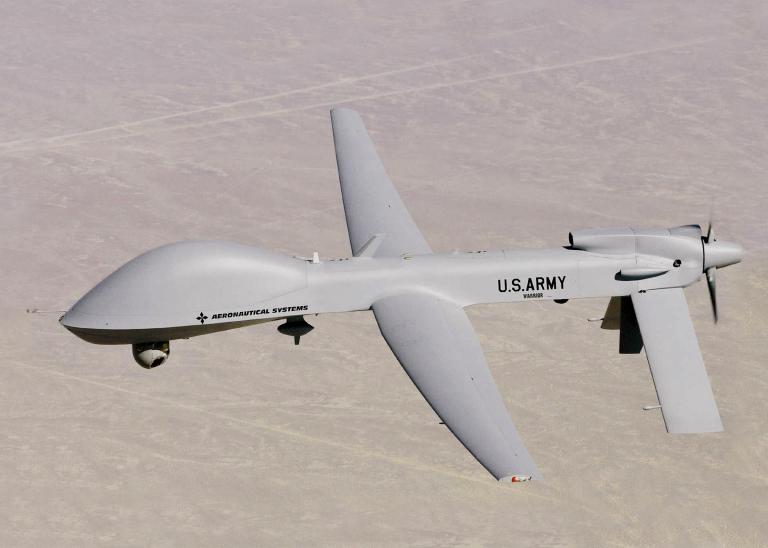
Photo Courtesy of U.S. Army–Wikimedia Commons
Drones, also known as unmanned aerial vehicles (UAV) by the military, have become a contentious issue within American foreign affairs. Neoconservatives have called for stronger military engagement within the Middle East, with those on the left wishing to back away from any military intervention within the region. Though these opinions are not often based within political theory. Realism has been used as a guide within American foreign policy for multiple presidential administrations, and consulting realist political theory within the actions of the last two presidential administrations may help us understand how America should engage in the Middle East currently. This is especially true when one analyzes the Bush Administration policies.
Realists understand that war is a tragedy, but it is deeply understood that war is inevitable within the current system of international relations. In classical realist Kenneth Waltz’s iconic three images of war, he finds war to be a product of human nature, a product of state behavior, and a product of the anarchic international system (615-628). Realism as a school of thought within international relations theory is often at odds with the liberal view of war and peace. Mostly disconnected from the American colloquial usage of liberalism, a president’s political party affiliation has little impact on their affiliation with classical liberalism or classical realism. In other words, both modern day American political parties include various tenants of both classical liberalism and realism.
The overarching focus of realism is the garnering of political power and authority, especially within the anarchic international system. However, in light of how tragic and serious war and violent conflict is, it is also understood within the realist school of thought that war should be avoided if possible; realists recognize and analyze the context of conflict, and if a conflict should be elevated militarily. Additionally, realists also recognize the overreach of political power by state actors. In analyzing the realist school of thought, we can apply the label of realist on past and current presidents, or understand these policymakers as being driven by another school of political thought. Though both President Bush and President Obama have used military capabilities in the Middle East, we can decipher these actions as in line with realism, classifying these presidents as realists or not.
Evaluating the military actions of both the Obama Administration and the Bush Administration we can decipher how “realist” both presidents were. In the case of President Bush, the invasion of Iraq was set preemptively against the backdrop of possible usage of weapons of mass destruction (WMD) by Iraqi leader Saddam Hussein, which some deemed to be irrational and unpredictable. At first glance, one could assume this action to be based within offensive realism; however, when analyzed it is not so cut and dry. Only a couple of months prior to the invasion of Iraq newsmagazine Foreign Relations published an article outlining how unnecessary a war with Iraq would be, directly from the realist perspective. The article, written by John J. Mearsheimer and Stephen M. Walt, deduced that Saddam Hussein ought to be treated and thought of as a rational state actor, concluding that alternatives to violent conflict exist and should be pursued (50-59). Additionally, Brian C. Schmidt and Michael C. Williams in the Security Studies Journal conclude that the neoconservative Bush Doctrine was far from being based within realism, but ultimately realist political theorists and scientists were unable to stop the American invasion of Iraq.

By Steve Jurvetson from Menlo Park, USA
The Obama Administration’s drone program has also come under immense scrutiny. However, evaluating President Obama as a realist or not with usage of the drone strikes is more complex in my opinion. The use of drones has allowed for no direct American involvement in conflicts that have sprung from the Iraq invasion and the Arab Spring movement within the Middle East and North African states (MENA). From the realist perspective, this is both allowing for American military authority to grow within international relations, but has also avoided a direct violent conflict that endangers American troops. The use of drones is both legally debated and morally gray. Though realists recognize morality, the use of military capabilities, such as the drone program, is used to further American interests within MENA states; specifically targeting high ranking members of known terrorist organizations.
President Bush deployed American troops to Iraq and various Middle East regions. President Obama withdrew troops from the Iraq campaign and has opted for a less aggressive use of American military capabilities. The Bush Administration was fueled by neoconservative rhetoric, but some argue was more legitimate use of the executive war powers than President Obama’s use of drone technology. The drone program is centered around secrecy and run by the Central Intelligence Administration (CIA) through executive authority. However, we see parallels within the aggressive foreign policy that has dominated international relations within MENA states over multiple decades. The main focus of each administration was to eliminate forces and organizations that would wish to do America harm. Clearly, the Bush Administration prescribed to neoconservative theory and rhetoric, and is easily concluded as not being within the realm of classical realism. The question persists–did realism fail to prevent the Iraq War? Furthermore, is the drone program in line with classical realist theory?
The Obama Administration may be more realist in its use of alternatives to direct military involvement in MENA states, but this is very much up for debate; furthermore, understanding the security dilemma, we can also conclude that the use of drone technology is a result of the proliferation of terrorist organizations such as ISIS/ISIL.
Realism has influenced American foreign policy for decades, but many would argue that realists failed to sufficiently argue for a nonviolent option within the Iraq conflict. As a result, President Obama has made use of technology that has only one equal alternative, which would be to invade Syria and Iraq to fight against ISIS/ISIL, which should hardly be an American effort alone. The drone program may not be ideal; however, it has shown to be successful and is a rational option compared to other options that are being offered by neoconservatives.
—————————————————————————————————-
Mearsheimer, John J., and Stephen Walt. “An Unnecessary War.” Foreign Policy 134 (January-February 2003): 51-59.
Schmidt, Brian C. and Michael C. Williams. 2008. “The Bush Doctrine and the Iraq War: Neoconservatives Versus Realists,” Security Studies 17(2): 191-220.
Waltz, Kenneth. “The Origins of War in Neorealist Theory.” Journal of Interdisciplinary History 18.4 (1988): 615-28. JSTOR. Web. 26 Jan. 2016.
Like Peculiar People on Facebook
Previous Post

January 18, 2016
The Courage and Light of Martin Luther King, Jr.
Next Post
February 15, 2016 Emergent Theology: Steven Peck's "Evolving Faith"
Browse Our Archives
Select a Category American society Art baptism Blogging Book of Mormon Book review Brigham Young Brigham Young University Bundy Catholicism Christianity Communalism Community of Christ conferences conversion correlation Culture denominations Digital History Discipline Councils diversity Doctrine Donald Trump education Emma Smith ethics family feminism fiction Film review food French Polynesia Fundamentalism Gay rights Gender global Gun politics Halloween health History Honor Code hymns Joseph Smith Kirtland Temple law of consecration massacre site military Ministering missionary moderate Mormon feminism Modern Mormonism Mormon origins Mormon War Mormonism Mormonism, politics, Romney Obama Peace politics Polygamy Pope Francis Poverty Prayer Priesthood Protestantism Race Religious freedom Revelation Reviews sacred sites Scientology Scripture Secularization See Stones sexual assault Star Wars television temples Tithing Utah violence war women's ordination
Select a Month October 2018 September 2018 August 2018 May 2018 April 2018 March 2018 February 2018 January 2018 December 2017 October 2017 September 2017 July 2017 June 2017 May 2017 April 2017 March 2017 February 2017 January 2017 November 2016 October 2016 August 2016 July 2016 June 2016 May 2016 April 2016 March 2016 February 2016 January 2016 December 2015 November 2015 October 2015 September 2015 August 2015 July 2015 June 2015 April 2015 March 2015 February 2015 January 2015 December 2014 November 2014 October 2014 September 2014 August 2014 July 2014 June 2014 May 2014 April 2014 March 2014 February 2014 January 2014 December 2013 November 2013 October 2013 September 2013 August 2013 July 2013 June 2013 May 2013 April 2013 March 2013 February 2013 January 2013 December 2012 November 2012 October 2012 September 2012 August 2012 July 2012 June 2012 May 2012 April 2012 March 2012
Follow Us!
TAKE THE
Religious Wisdom Quiz
Who said, "The Lord is my shepherd, I shall not want"?
Select your answer to see how you score.
Moses David Paul Solomon
Related posts from Peculiar People

Sorry to Bother You: The (Human) Body as...


A Letter for My Someday-Teenage Children

Confederate Symbols and the Black Flag of ISIS:...
TRENDING AT PATHEOS Latter-day Saint

Did Prayer Cure His Cancer? Or Was It...
At 4 AM one morning, Joshua W. Brown’s wife awoke to a...

8 Ways a Near-Death Experience Rewires the Soul
Does Consciousness Survive Physical Death? After 50 Years of Research, Dr. Raymond...

Holy Longing: What Our Restlessness Is Telling Us
“One can find so many pains when the rain is falling.” -John...

What this is NOT about. This blog is definitely not about...

Who said the Israelites were God’s chosen? That’s right, they did. Who...

The Spirit World Is the Real World: God...
A Monk’s Wisdom on Body and Spirit I sit with Brother Martin...
view all Latter-day Saint blogs
Ad-Free & Subscriber Log-In Subscription Support
- About Us
- 2026 Calendar
- Videos
- Podcasts
- Library of World Religions
- Faith In Media Tracker
- Advertise With Us
- Write for Us
- Privacy Policy
- Terms of Service
- Do Not Sell My Data
- Contact Us
- Radiant Digital
- Manage Newsletter Subscriptions
- Unsubscribe From Notifications
- Sitemap
Copyright 2008-2026, Patheos. All rights reserved.
Subscription Support Ad-Free & Subscriber Log-In
Follow Patheos