
BuddhistCatholicContemplativeEvangelicalGeneral ChristianHinduJewishLatter-day SaintMuslimNew VisionsProgressive Christian
Beliefs
- Buddhist
- Catholic
- Contemplative
- Evangelical
- General Christian
- Hindu
- Jewish
- Latter-day Saint
- More Voices
- Muslim
- New Visions
- Pagan
- Progressive Christian
Topics
- Religion News
- Food and Religion
- Sports and Religion
- Religious Art
- Religious Music and Entertainment
- Religious Events
- History and Religion
- Style and Religion
- Politics and Religion
- Women in Religion
- Recreation Outdoors and Religion
- Business Finance and Religion
- Careers Workplace and Religion
- Education and Religion
- Family Parenting and Religion
- Health Fitness and Religion
- Home and Religion
- Relationships and Religion
- Technology and Religion
- Travel and Religion
Columnists
- Buddhist Columnists
- Business Finance and Religion Columnists
- Careers Workplace and Religion Columnists
- Catholic Columnists
- Contemplative Columnists
- Education and Religion Columnists
- Evangelists Columnists
- Family Parenting and Religion Columnists
- General Christian Columnists
- Health Fitness and Religion Columnists
- Hindu Columnists
- History and Religion Columnists
- Home and Religion Columnists
- Jewish Columnists
- More Voices Columnists
- Latter Day Columnists
- Muslim Columnists
- New Visions Columnists
- Nonreligious Columnists
- Pagan Columnists
- Politics and Religion Columnists
- Progressive Columnists
- Recreation Outdoors and Religion Columnists
- Relationships and Religion Columnists
- Religion News Columnists
- Religious Art Columnists
- Religious Events Columnists
- Religious Music and Entertainment Columnists
- Sports and Religion Columnists
- Style and Religion Columnists
- Technology and Religion Columnists
- Travel and Religion Columnists
- Women in Religion Columnists
Resource Library
- 2026 Calendar
- Library of World Religions
- The 100 Most Holy Places on Earth
- Patheos Answers
- Podcasts
- Videos
- Faith Leaders Database
- Anglican Episcopalian
- Bahai
- Baptist
- Buddhism
- Christianity
- Confucianism
- Eastern Orthodoxy
- Hinduism
- Holiness and Pentecostal
- ISKCON
- Islam
- Judaism
- Lutheran
- Methodist
- The Church of Jesus Christ of Latter-day Saints
- New Age
- Paganism
- Presbytarian and Reformed
- Protestantism
- Religion Behind the Scenes
- Roman Catholic
- Scientology
- Shia Islam
- Sikhism
- Sufism
- Sunni Islam
- Taoism
- Zen
- See all religions
Research Tools
 Ad-Free & Subscriber Log-In Subscription Support
Ad-Free & Subscriber Log-In Subscription Support
Follow Patheos 

- Trending:
- Forgiveness
- |
- Marriage
- |
- Consciousness
- |
- Death Penalty
- |
- Election
- |
- Halloween
 Peculiar People
- Home
- Latter-day Saint
- Narnia, the Solstice, and Heaven
Narnia, the Solstice, and Heaven
Last updated on: May 30, 2016 at 5:19 am by mhaycock
Narnia, the Solstice, and Heaven 2016-05-30T05:19:57+00:00 mhaycock
Patheos Explore the world's faith through different perspectives on religion and spirituality! Patheos has the views of the prevalent religions and spiritualities of the world.

Exit here for Narnia, photo courtesy of TERTPO/Flickr Commons
I.
Some of my fascination with The Last Battle, the last in C.S. Lewis’s Chronicles of Narnia, might stem from the draw of the bittersweetness of finality and my awe (in the dual senses of “awesome” and “awful”) at apocalypse. But good portion of it derives from Narnia’s heaven, one of the most compelling visions of a literal, Christian heaven in literature.
Mr. Tumnus explains a key aspect of this heaven: there, “no good thing is destroyed.” At its most straightforward, Mr. Tumnus is referring to physical objects; the sight that prompts his remark is that of the Professor’s old house, to which the Pevensie children were exiled during the Blitz, through which they first encountered Narnia, and which had been demolished in the Earth they’d known. The geography itself is proper in both senses of rightness and belonging: as Jewel the Unicorn declares, “I have come home at last! This is my real country! I belong here. This is the land I have been looking for all my life, though I never knew it till now.”
What is more, all the characters we have come to know and love over the course of the previous six books, even those who had passed away sometime in Narnia’s deep history, here live on in communion. Narnia’s heaven preserves, sanctifies, and celebrates all good human (and nonhuman!) relationships; here, the same sociality that existed in the mortal world is inseparably coupled with a new glory.
(And contrary to most Mormon talk of heaven, relationships outside of nuclear families have a significant place in Lewis’s afterlife. The reunions of long-separated friends he depicts overwhelm me.)
Lewis also described heavenly life as the “Great Story which no one on earth has read: which goes on forever: in which every chapter is better than the one before” and for which “all their life in this world and all their adventures in Narnia had only been the cover and the title page.” When I was young and not yet familiar with the traditional Christian theology to which Lewis adhered, I took this as an intimation of eternal progression and, very Mormonly, was disappointed that Lewis never bothered to write these amazing adventures.
When I first read through the Bible in high school, I discovered Revelation 21:4, which encapsulated what I loved about Lewis’s Narnian heaven: “And God shall wipe away all tears from their eyes; and there shall be no more death, neither sorrow, nor crying, neither shall there be any more pain: for the former things are passed away.”
Not only would nothing good find its end, but evil and suffering were barred forever from entry.
II.
I spent the last months of 2015 preparing to act in a Christmas production about, among other things, Death.
The Christmas Revels is a production like no other: an amateur chorus with some professional actors and musicians, all in sumptuous costume, singing songs, dancing dances, and engaging the audience in, well, revelry. And though it is called the Christmas Revels, each annual production hearkens back to the reason for the placement of Christmas in December: the northern hemisphere’s winter solstice. As Susan Cooper’s poem, recited near the end of each show, goes:
So the Shortest Day came and the year died
And everywhere down the centuries of the snow-white world
Came people singing, dancing,
To drive the dark away.

Reveling (credit to Shep Ferguson)
This year’s Christmas Revels in Washington, DC, doubled down on the symbolism of the cycles of nature. In it, a medieval royal court and village host a solstice celebration to which they invite mysterious woodland creatures and their queen. The raucous party that ensues comes to an abrupt end with the entrance of a spectral horse and his snow-dusted, skull-faced rider.
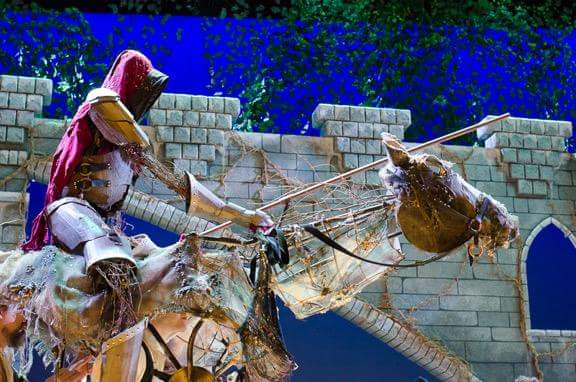
Puppet created by Alex Vernon, photo credit to Shep Ferguson
The woodland folk kneel in deference—they know who the rider is—but the others reel back in terror. The King, duty-bound to protect his people, challenges the interloper to battle. To the horror of his subjects, the chill wind from the rider’s lance fells the king.
(Yes, this is a Christmas show.)
Seeing the king fallen, the king’s fool engages the horse and his rider with silliness and the ghostly visitors depart in laughter. But the king, already mortally wounded, retreats to a tomb in the hill, disappearing underground. Snow begins to fall as the sun sets on the shortest day.
Interrupting the mourning and uncertainty, the woodland queen’s fool tells us that the king might return with the coming of spring.
In this valley of the shadow of death, the end of Act 1, a soloist emerges to sing Sidney Carter’s “Lord of the Dance,” which recounts in the first person Jesus’s life, death, and resurrection. After the verses, the cast of the show joins hands in lines and dances down through the aisles of the theater out to the lobby, bringing along any audience members who wish to join them. It was this scene that inspired Peter Smith, a theater manager, to write,
I have no idea—any more than anyone else has, of course—of what happens at the moment of death. But if it is something other than encountering oblivion, I realize that I cannot conceive of anything I would more joyfully welcome than having my hand taken by someone—a complete stranger, perhaps from the other side of the globe—who had died in the millisecond before me, someone who brings me into a very wide aisle and an infinitely long chain of people who are reveling in a dance which is a dance of life rather than a dance of death, people who are all connected, through their handholding, not only to one another but also, at the point where the line begins, to the one who is indeed the Lord of the Dance.
The planet spins and death turns to rebirth. There are tears and will always be. For all human purposes, the seasons turn in an eternal round. But just as we bear winter by means of friends’ company and joviality, even so can we bear death and sorrow. We mourn and rejoice together:
And when the new year’s sunshine blazed awake
They shouted, revelling.
III.
I had a troubling epiphany one day in college.
On one hand, Revelation 21:4—especially in Lewis’s hands—promises an ultimate end to sorrow.
On the other, Enoch saw God weep over the suffering and misery of his children, and the Mormon doctrine of the co-specificity of God and humankind teaches that, as we are of the same species, and humans’ destiny is not to partake in the presence of a wholly other being or to acquire the traits of Deity, but to become gods.
If we are to become gods and yet gods weep, what are we to make of Narnia’s heaven, which promises us freedom from tears? What are we to make of Revelation 21:4 if God sorrows, cries, and hurts?
I do not claim any ability to ultimately resolve this tension, but there are a few options I can think of.
Perhaps further light and knowledge abrogate the linear chronology of Revelation and replace it with the cycles of growth through which eternal progression operates, and we must forgive the aspiration of the sufferer to be forever free of pain and trouble.
And perhaps the Revels and the solstice celebrations—yes, celebrations in, and even of, the darkest hour!—can provide us with a needed interpretive tool: society. In the Mormon heaven, we are sealed to one another, ritually bound. And we covenant to mourn with those that mourn, to comfort those who stand in need of comfort.
Perhaps the secret of heaven is that someone next to you is willing to wipe away your tears. And when you’re ready, they’ll offer a smile and a hand to pull you on in the eternal dance.
Previous Post

January 11, 2016
This Seems Relevant
Next Post

January 11, 2016 In His Final Performance, David Bowie Embraced Death
Browse Our Archives
Select a Category American society Art baptism Blogging Book of Mormon Book review Brigham Young Brigham Young University Bundy Catholicism Christianity Communalism Community of Christ conferences conversion correlation Culture denominations Digital History Discipline Councils diversity Doctrine Donald Trump education Emma Smith ethics family feminism fiction Film review food French Polynesia Fundamentalism Gay rights Gender global Gun politics Halloween health History Honor Code hymns Joseph Smith Kirtland Temple law of consecration massacre site military Ministering missionary moderate Mormon feminism Modern Mormonism Mormon origins Mormon War Mormonism Mormonism, politics, Romney Obama Peace politics Polygamy Pope Francis Poverty Prayer Priesthood Protestantism Race Religious freedom Revelation Reviews sacred sites Scientology Scripture Secularization See Stones sexual assault Star Wars television temples Tithing Utah violence war women's ordination
Select a Month October 2018 September 2018 August 2018 May 2018 April 2018 March 2018 February 2018 January 2018 December 2017 October 2017 September 2017 July 2017 June 2017 May 2017 April 2017 March 2017 February 2017 January 2017 November 2016 October 2016 August 2016 July 2016 June 2016 May 2016 April 2016 March 2016 February 2016 January 2016 December 2015 November 2015 October 2015 September 2015 August 2015 July 2015 June 2015 April 2015 March 2015 February 2015 January 2015 December 2014 November 2014 October 2014 September 2014 August 2014 July 2014 June 2014 May 2014 April 2014 March 2014 February 2014 January 2014 December 2013 November 2013 October 2013 September 2013 August 2013 July 2013 June 2013 May 2013 April 2013 March 2013 February 2013 January 2013 December 2012 November 2012 October 2012 September 2012 August 2012 July 2012 June 2012 May 2012 April 2012 March 2012
Follow Us!
TAKE THE
Religious Wisdom Quiz
What does "Jabez" mean in Hebrew?
Select your answer to see how you score.
Sorrow The Lord Saves Strength Victory
Related posts from Peculiar People

A Letter for My Someday-Teenage Children

Confederate Symbols and the Black Flag of ISIS:...

TRENDING AT PATHEOS Latter-day Saint

Did Prayer Cure His Cancer? Or Was It...
At 4 AM one morning, Joshua W. Brown’s wife awoke to a...

8 Ways a Near-Death Experience Rewires the Soul
Does Consciousness Survive Physical Death? After 50 Years of Research, Dr. Raymond...

Holy Longing: What Our Restlessness Is Telling Us
“One can find so many pains when the rain is falling.” -John...

What this is NOT about. This blog is definitely not about...

Who said the Israelites were God’s chosen? That’s right, they did. Who...

The Spirit World Is the Real World: God...
A Monk’s Wisdom on Body and Spirit I sit with Brother Martin...
view all Latter-day Saint blogs
Ad-Free & Subscriber Log-In Subscription Support
- About Us
- 2026 Calendar
- Videos
- Podcasts
- Library of World Religions
- Faith In Media Tracker
- Advertise With Us
- Write for Us
- Privacy Policy
- Terms of Service
- Do Not Sell My Data
- Contact Us
- Radiant Digital
- Manage Newsletter Subscriptions
- Unsubscribe From Notifications
- Sitemap
Copyright 2008-2026, Patheos. All rights reserved.
Subscription Support Ad-Free & Subscriber Log-In
Follow Patheos