
BuddhistCatholicContemplativeEvangelicalGeneral ChristianHinduJewishLatter-day SaintMuslimNew VisionsProgressive Christian
Beliefs
- Buddhist
- Catholic
- Contemplative
- Evangelical
- General Christian
- Hindu
- Jewish
- Latter-day Saint
- More Voices
- Muslim
- New Visions
- Pagan
- Progressive Christian
Topics
- Religion News
- Food and Religion
- Sports and Religion
- Religious Art
- Religious Music and Entertainment
- Religious Events
- History and Religion
- Style and Religion
- Politics and Religion
- Women in Religion
- Recreation Outdoors and Religion
- Business Finance and Religion
- Careers Workplace and Religion
- Education and Religion
- Family Parenting and Religion
- Health Fitness and Religion
- Home and Religion
- Relationships and Religion
- Technology and Religion
- Travel and Religion
Columnists
- Buddhist Columnists
- Business Finance and Religion Columnists
- Careers Workplace and Religion Columnists
- Catholic Columnists
- Contemplative Columnists
- Education and Religion Columnists
- Evangelists Columnists
- Family Parenting and Religion Columnists
- General Christian Columnists
- Health Fitness and Religion Columnists
- Hindu Columnists
- History and Religion Columnists
- Home and Religion Columnists
- Jewish Columnists
- More Voices Columnists
- Latter Day Columnists
- Muslim Columnists
- New Visions Columnists
- Nonreligious Columnists
- Pagan Columnists
- Politics and Religion Columnists
- Progressive Columnists
- Recreation Outdoors and Religion Columnists
- Relationships and Religion Columnists
- Religion News Columnists
- Religious Art Columnists
- Religious Events Columnists
- Religious Music and Entertainment Columnists
- Sports and Religion Columnists
- Style and Religion Columnists
- Technology and Religion Columnists
- Travel and Religion Columnists
- Women in Religion Columnists
Resource Library
- 2026 Calendar
- Library of World Religions
- The 100 Most Holy Places on Earth
- Patheos Answers
- Podcasts
- Videos
- Faith Leaders Database
- Anglican Episcopalian
- Bahai
- Baptist
- Buddhism
- Christianity
- Confucianism
- Eastern Orthodoxy
- Hinduism
- Holiness and Pentecostal
- ISKCON
- Islam
- Judaism
- Lutheran
- Methodist
- The Church of Jesus Christ of Latter-day Saints
- New Age
- Paganism
- Presbytarian and Reformed
- Protestantism
- Religion Behind the Scenes
- Roman Catholic
- Scientology
- Shia Islam
- Sikhism
- Sufism
- Sunni Islam
- Taoism
- Zen
- See all religions
Research Tools
 Ad-Free & Subscriber Log-In Subscription Support
Ad-Free & Subscriber Log-In Subscription Support
Follow Patheos 

- Trending:
- Forgiveness
- |
- Marriage
- |
- Consciousness
- |
- Death Penalty
- |
- Election
- |
- Halloween
 Peculiar People
- Home
- Latter-day Saint
- These Arguments are Weak.
These Arguments are Weak.
Last updated on: November 18, 2015 at 9:34 pm by mhaycock
These Arguments are Weak. 2015-11-18T21:34:04+00:00 mhaycock
Patheos Explore the world's faith through different perspectives on religion and spirituality! Patheos has the views of the prevalent religions and spiritualities of the world.
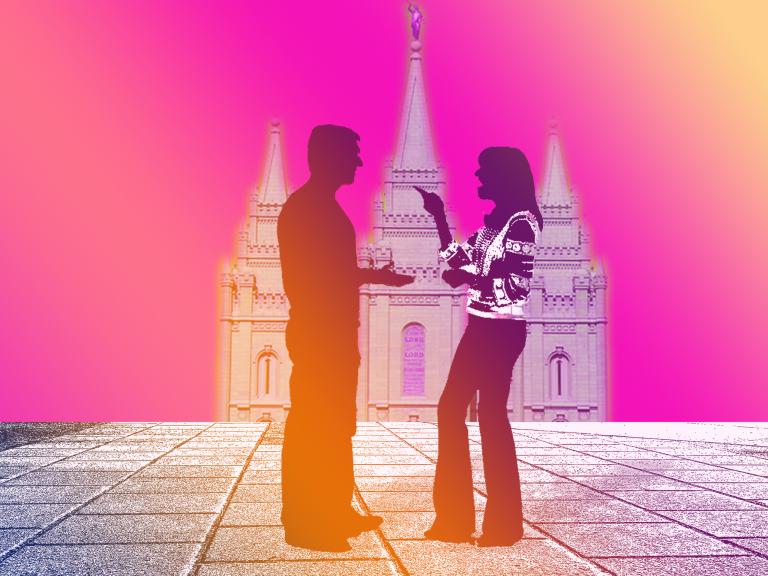
Wikimedia Commons. Alterations by JJ Feinauer
That “Insight into new LDS Church policies on same-sex couples and their children” post, written by a Michael Worley on Kathryn Skaggs’s blog, is making the rounds. Others like him have been circulating. People seem to think they offer compelling arguments. But beyond its presumption (the author has no special insight into God’s and Church leaders’ minds, but claims he does) and its condescension (“Bill Nye voice”) lie false analogies and rickety rationalizations.
Before I analyze Worley’s arguments, however, I’ll recognize the two small points he makes that are actually good.
- The LDS Church already regulates baptisms pretty stringently–often for good reasons. This idea runs counter to the premise of many opponents of the policy that the Church treats 8 years as the unconditional age of accountability.
- The policy on children’s ordinances has its immediate precedent in the policy regarding the baptism of children from polygamous families, in force since the 1920s. If you want to learn about this, however, visit Ardis Parshall’s actually good post about it. (To his credit, Worley has also linked to Ardis’s post.)
The rest of the essay, unfortunately, holds water like a sieve.
I.
Worley’s main contention is that close regulation of minors’ baptisms protects the Church, the families of young wannabe Mormons, and those young wannabe Mormons themselves. What are they being protected from?
On the minors’ part, according to Worley, mainly loss of food and shelter. In a world where disowning and shunning because of religious change still occurs, this isn’t an unwarranted fear. However, there are plenty of stories we tell of valiant, pioneering young saints who stand tall on their own or with the Church’s aid when their families reject their new faith. And missionaries regularly encourage tepid investigators to disregard their families’ objections to their baptisms in the face of incontrovertibly confirmed truth. Furthermore, it’s likely that exile from home applies mostly to older children. As when General Authorities tell us not to write them and then regularly quote personal letters from Saints who wrote them, this is an unresolved case of diametrically opposed but concurrent messages.
Maintaining access to the bare necessities is hardly the only reason that baptizing children without parental support is discouraged, too; children without familial support have a much harder time remaining active in the LDS Church, and the last thing the Church wants is generations of people baptized at age 9 and inactive ever after. And that’s not even getting into the perverse phenomenon of “baseball baptisms”–opportunistic “conversions” of minors merely to add to missionaries’ running tallies.
After all this, the “protect the children” rationale finally collapses when you learn that even if a gay couple were to be fully supportive of a child’s baptism, that child would still have to appeal to the First Presidency–not a stake president or even an area authority–to get baptized.
Of course, this could be the result of another valid rationale–preserving doctrinal or cultural purity, for instance. But needing to switch rationales reveals the relative weakness of those justifications. If a purpose of “protecting the children”–a social or sociological rationale–gives way to a purpose of “preserving purity”–a doctrinal rationale–it’s valid to question how much moral work “protect the children” did in the first place. Likewise, switching one’s purpose from preserving purity to protecting the children makes doctrine a tool of sociology, weakening it by opening it up to valid sociological critique. Unfortunately, this sort of debilitating rationale-switching is extremely common in LDS discourse on homosexuality (see: Prop 8, Elder Christofferson yesterday).
II.
This leads Worley headfirst into one of his false equivalencies. Acknowledging that “those who are adults and were raised by same-sex couples” must still receive approval for their baptism from the First Presidency, he compares their situation to that of Muslims wishing to become Mormon. Save in that these regulations supposedly “protect the candidate” “by helping them be baptized in an environment where they can spiritually grow”–whatever that means–I don’t even know how he thinks these are similar.
For one, even if the policy on converts from Islam is widespread, it is unofficial. It’s not in the Handbook. And depending on discretion, prospective Muslim converts only have to be interviewed by a mission president or an area authority seventy. On the other hand, the policy on the children of gay parent(s) is in Handbook 1 and they must be recommended for baptism by a bishop or a stake president to the First Presidency for approval.
But that’s the simple bit. The discrepancy in formality is especially glaring when the risks taken by each convert are juxtaposed.
I have an ex-Muslim Mormon friend. When he converted, he knew he was risking his life. Let me repeat: he knew his conversion could result in death. To avoid, well, death, he had to cut off all contact with his Arab family, change his legal name, and resolve to never return to his homeland.
This dire situation in no way resembles that of adult children of at least one homosexual parent. There’s no militia threatening honor killings of gay couples’ adult children turned Mormon.
And though I’m not a betting man, if we want to talk about the physical safety of minors, I’d be willing to lay good money on it that the danger of disowning, abuse, or death is much less for an LDS convert of gay parentage than a gay child of LDS parentage. Sadly.
That’s why Church leaders have had to condemn parents who disown and abuse their LGBT children.
Because Mormons do that sort of thing often enough to warrant such exhortations.
I’ll admit–anecdotal evidence here–I haven’t heard of the inverse occurring. Have you?
III.
The polygamy question deserves the most attention, as it’s the very model that the Church transposed onto gay marriages to create the new policy. Basically, the Church has decided that polygamous marriage and gay marriage are similar enough in some essential (and unspecified) way to merit the same treatment. Rosalynde Welch has expressed the problems with this move better than I could:
I have two objections to this line of thought: the first that our rather draconian treatment of plural marriage stems from the difficult historical events surrounding the end of the practice, and from the Church’s institutional need to definitively separate itself from fundamentalist sects. Because there is no threat of schism from a gay-marriage Mormon sect, there is no need to adopt the same draconian institutional response to individual gay marriages. The second objection would be that the pain this policy causes to gay families is substantially higher than the pain it causes to polygamous families. Plural marriage is embedded in an existing, competing faith community, and to enter plural marriage is to enter this community; few polygamous families seek baptism or mission service in the LDS Church for their children. Gay marriage for Latter-day Saints is not embedded in an existing, competing faith community, and many families who place great value on baptism and mission service in the LDS Church will find themselves caught in this policy if it is enforced consistently according to its plain language.
The pain caused is particularly acute when you realize that the Church leaves it unclear whether anyone with a single parent in a homosexual relationship will be subject to the new regulations. Children of divorced couples, one of whom is now with a partner of the same sex, might be subject to the rule. The gay parent might not even have to have custody of the child for the prohibition on children’s ordinances to activate. And all this might depend on bishop roulette: some bishops might undertake rooting out children in such situations with less fervor than others.
(Interestingly, making each such child appeal to the First Presidency might be an attempt to avoid the unpredictable influence of local leaders on these decisions.)
This, then, is the most pressing question the Church must face: what is the category polygamy and gay marriage both fit into, and why are they both so grave as to warrant First Presidency approval of children’s baptisms?
However, while the threat of gay marriage schism is minimal (there were twosuch schismatic groups, but they were small and died out), the fear of watering down some essential part of marriage or gender doctrine through widespread acceptance of gay marriage would be a much larger concern. Unfortunately, the theology of heterosexuality and gender in the LDS Church is, like much else, almost completely amorphous, with little hope of clarification. (Those eager to import natural law should be acutely aware of and struggle vigorously in conflicts between Mormon metaphysics and the Hellenized Christian metaphysics upon which such ideas are based.)
Without such a clarification, we’re likely left with a category of “the inoperability of ordinances performed in defiance of proper priesthood authority.” (See Ardis’s first point in her addendum.) My theologian soul wants more than that, though.
IV.
Worley’s other concern is the characterically Mormon bugbear of “contention,” trotted out much more often as a method of shutting down uncomfortable conversation than as a purely charitable call for one’s interlocutor to put aside anger. Conflict and secrecy poison human relationships, Worley argues, and if there’s anything the Church abhors, it’s conflict and secrecy. Thus, Worley posits that familial tranquility–via lack of tension, disagreement, or confusion–is the primary objective of restrictions on minors’ conversions.
What would cause conflicts dire enough to warrant First Presidency approval for children’s baptisms and forbid infants’ blessings?
Worley explains (in “Bill Nye voice”): “The church does a TON to protect children and spouses from being taught one thing at home and another thing at church.”
And later he adds: “Conflicts are inevitable if a child is taught that those the child’s legal guardians are sinners— and the only way for them to stop being sinners is by ending their relationship.”
These assertions are build on sandy foundations.
The first one posits that the Church defers to parental authority to a degree that one could–not inaccurately–call moral relativism. The Church, accordingly to Worley, avoids preaching anything that might cause cognitive dissonance in children. Sit on that for a second. … You’ve probably thought of a very common counterexample already. Here are two of mine. Does the Church refuse to baptize the children of unabashed alcoholics in order to sidestep the conflict between the Church’s Word of Wisdom and the parents’ acceptance of other forms of spirits? Does the Church remain silent when a child witnesses her father beating her mother, citing an unwillingness to leave the child confused as to whether her father’s behavior is acceptable? God forbid!
(Note: I use these examples to demonstrate that the Church is perfectly fine with intrafamilial cognitive dissonance sometimes–and, indeed, even encourages it. I am not comparing gay marriage to alcoholism and spousal abuse.)
The second is even more baffling. First, the Church seldom shies away from condemning sin to avoid conflict. For Worley to suggest otherwise in the midst of a conflict-ridden controversy occasioned solely by the Church condemning a particular sin evinces a singular lack of contextual awareness.
What is more, there are plenty of situations beyond gay marriage in which rectifying a child’s legal guardians’ sins would require their separation–and in which children can still be blessed and baptized without First Presidency approval. Missionaries regularly teach unmarried couples, some of whom certainly have children, that they either have to separate or get married in order to comply with the Law of Chastity get baptized. (Marriage, of course, is the preference, but when proven unworkable, separation is the only option.) I knew a family on my mission in which the mother and father had been excommunicated for living together while married to other people–but whose children had all been baptized. Children of adulterers, drug abusers, and murderers do not require First Presidency approval, on the recommendation of a bishop, to get baptized. And the Church willingly and enthusiastically condemns all those sins without concern for ominous intrafamilial “conflict.”
Again, the Church should try to explain what makes gay marriage and polygamy a special category of sin. They’re not moral theologians, though, so I don’t expect that any explanation will be forthcoming.
Update: as expected, Elder Christofferson’s interview said that the Church regards same-sex marriage as a special type of sin–not what defines that particular type and makes it so egregious.
We’re left to speculate. But recognize that we’re speculating, awaiting further light and knowledge.
V.
But let’s take a moment, step back, and steelman Worley’s arguments about conflict and protecting the children by combining them. That is, let’s do the opposite of attacking a strawman version of his arguments (however close to being strawman arguments they are) and instead make them stronger, then taking on the strengthened form of the arguments.
Children can face significant turmoil when they are told that the purpose of life is for families to be together forever–but that theirs, which does not fit the mold, cannot. One LDS friend of mine, for instance, agonized about the doctrine of eternal families. Her father had been severely abusive of her mother and they had divorced; they had never gotten sealed in the temple. There was little prospect of her mother, irascible and abusive in her own right, getting remarried or sealed–not to mention that my friend wasn’t keen on spending eternity with her father–so my friend was left without connections in the eternities. My friend was around 20 when she was having these feelings, and they’re the sort of thing that can pursue a person throughout an entire life. Placing higher barriers on Church entry for people who might be thus afflicted–even past age 18–might spare them that turmoil. However, simply erecting higher barriers would not prevent all emotional turmoil even in someone who has surpassed the barrier.
I am also certain that the Church does not want its ordinances weaponized in interparental conflicts for children’s loyalties. In the instance of a child having divorced parents, one of whom is in a homosexual relationship, there is the possibility that the a parent could use the child’s baptism (or the denial thereof) at age 8 to drive a wedge between the child and the other parent. Postponing the ordinance until age 18 makes it the child’s legal choice, not the manipulations of a parent on whom the child depends for material and emotional support. Of course, there might still be conflicts for children’s loyalties after 18, but custody is in the past.
VI.
And some independent notes on Elder Christofferson’s interview.
He repeats Worley’s assertion that this is about preventing cognitive dissonance in children. (Maybe Worley, as his post seemed to presume, does have a backdoor into the minds of the Brethren.) In any case, my objections to this line of reasoning still stand: the Church doesn’t prevent cognitive dissonance in other respects, and it’s mere sociology, important but relatively weak. That this rationale comes from an apostle’s lips doesn’t evaporate its problems.
He says that the situation with polygamous families is analogous to that of gay families, explaining that children from such families must disavow polygamy before they serve missions. This makes sense. Missionaries have demonstrated a propensity toward doctrinal extremism and immature mining of LDS historical sources that together have led to some missionaries preaching polygamy to be the order of heaven (see France, 1958). It’s good to make that clear. However, that the Church still practices polygyny in temple sealings–including the marriages of Elders Nelson and Oaks–doesn’t help dissuade such overzealous wannabe Brighams. I’ve met a good number of active, orthodox LDS members who believe polygamy is not only morally acceptable but even laudable. In contrast:
- there aren’t any apostles currently in gay marriages;
- the Church doesn’t have a history celebrating, praising, and exalting gay marriage that it’s trying to jettison; and
- I’ve never heard of any missionaries preaching that gay marriage is a-okay by the LDS Church, and doubt that they would after all the Sturm und Drang.
In short, please stop treating Worley’s post as if it’s an answer to the questions raised by the new policy or some especial revelation. It’s not; quite the contrary. Its explanations are vague platitudes, its answers are nothing of the sort, its comparisons are flawed, and its rationales are easily deflated. Perhaps worst, it claims self-evident insight into the Lord’s workings–that one of its points was later restated by an apostle does not excuse its presumption–while speaking to those confused and hurt as if they’re little children in need of a primer.
Feel free to quote Elder Christofferson when he reiterates Worley’s points, but the Kingdom of God and its leaders deserve to be represented by more thoughtful spokespeople than Worley. Don’t cite him or others like him.
Previous Post

November 7, 2015
I Won't Go to Church Unless Everyone is Welcome
Next Post

November 7, 2015 Why Didn't We Do This By Common Consent?
Browse Our Archives
Select a Category American society Art baptism Blogging Book of Mormon Book review Brigham Young Brigham Young University Bundy Catholicism Christianity Communalism Community of Christ conferences conversion correlation Culture denominations Digital History Discipline Councils diversity Doctrine Donald Trump education Emma Smith ethics family feminism fiction Film review food French Polynesia Fundamentalism Gay rights Gender global Gun politics Halloween health History Honor Code hymns Joseph Smith Kirtland Temple law of consecration massacre site military Ministering missionary moderate Mormon feminism Modern Mormonism Mormon origins Mormon War Mormonism Mormonism, politics, Romney Obama Peace politics Polygamy Pope Francis Poverty Prayer Priesthood Protestantism Race Religious freedom Revelation Reviews sacred sites Scientology Scripture Secularization See Stones sexual assault Star Wars television temples Tithing Utah violence war women's ordination
Select a Month October 2018 September 2018 August 2018 May 2018 April 2018 March 2018 February 2018 January 2018 December 2017 October 2017 September 2017 July 2017 June 2017 May 2017 April 2017 March 2017 February 2017 January 2017 November 2016 October 2016 August 2016 July 2016 June 2016 May 2016 April 2016 March 2016 February 2016 January 2016 December 2015 November 2015 October 2015 September 2015 August 2015 July 2015 June 2015 April 2015 March 2015 February 2015 January 2015 December 2014 November 2014 October 2014 September 2014 August 2014 July 2014 June 2014 May 2014 April 2014 March 2014 February 2014 January 2014 December 2013 November 2013 October 2013 September 2013 August 2013 July 2013 June 2013 May 2013 April 2013 March 2013 February 2013 January 2013 December 2012 November 2012 October 2012 September 2012 August 2012 July 2012 June 2012 May 2012 April 2012 March 2012
Follow Us!
TAKE THE
Religious Wisdom Quiz
Who was Mary's cousin?
Select your answer to see how you score.
Rachel Sarah Elizabeth Leah
Related posts from Peculiar People

Sorry to Bother You: The (Human) Body as...


A Letter for My Someday-Teenage Children

Confederate Symbols and the Black Flag of ISIS:...
TRENDING AT PATHEOS Latter-day Saint

Did Prayer Cure His Cancer? Or Was It...
At 4 AM one morning, Joshua W. Brown’s wife awoke to a...

8 Ways a Near-Death Experience Rewires the Soul
Does Consciousness Survive Physical Death? After 50 Years of Research, Dr. Raymond...

Holy Longing: What Our Restlessness Is Telling Us
“One can find so many pains when the rain is falling.” -John...

What this is NOT about. This blog is definitely not about...

Who said the Israelites were God’s chosen? That’s right, they did. Who...

The Spirit World Is the Real World: God...
A Monk’s Wisdom on Body and Spirit I sit with Brother Martin...
view all Latter-day Saint blogs
Ad-Free & Subscriber Log-In Subscription Support
- About Us
- 2026 Calendar
- Videos
- Podcasts
- Library of World Religions
- Faith In Media Tracker
- Advertise With Us
- Write for Us
- Privacy Policy
- Terms of Service
- Do Not Sell My Data
- Contact Us
- Radiant Digital
- Manage Newsletter Subscriptions
- Unsubscribe From Notifications
- Sitemap
Copyright 2008-2026, Patheos. All rights reserved.
Subscription Support Ad-Free & Subscriber Log-In
Follow Patheos