
BuddhistCatholicContemplativeEvangelicalGeneral ChristianHinduJewishLatter-day SaintMuslimNew VisionsProgressive Christian
Beliefs
- Buddhist
- Catholic
- Contemplative
- Evangelical
- General Christian
- Hindu
- Jewish
- Latter-day Saint
- More Voices
- Muslim
- New Visions
- Pagan
- Progressive Christian
Topics
- Religion News
- Food and Religion
- Sports and Religion
- Religious Art
- Religious Music and Entertainment
- Religious Events
- History and Religion
- Style and Religion
- Politics and Religion
- Women in Religion
- Recreation Outdoors and Religion
- Business Finance and Religion
- Careers Workplace and Religion
- Education and Religion
- Family Parenting and Religion
- Health Fitness and Religion
- Home and Religion
- Relationships and Religion
- Technology and Religion
- Travel and Religion
Columnists
- Buddhist Columnists
- Business Finance and Religion Columnists
- Careers Workplace and Religion Columnists
- Catholic Columnists
- Contemplative Columnists
- Education and Religion Columnists
- Evangelists Columnists
- Family Parenting and Religion Columnists
- General Christian Columnists
- Health Fitness and Religion Columnists
- Hindu Columnists
- History and Religion Columnists
- Home and Religion Columnists
- Jewish Columnists
- More Voices Columnists
- Latter Day Columnists
- Muslim Columnists
- New Visions Columnists
- Nonreligious Columnists
- Pagan Columnists
- Politics and Religion Columnists
- Progressive Columnists
- Recreation Outdoors and Religion Columnists
- Relationships and Religion Columnists
- Religion News Columnists
- Religious Art Columnists
- Religious Events Columnists
- Religious Music and Entertainment Columnists
- Sports and Religion Columnists
- Style and Religion Columnists
- Technology and Religion Columnists
- Travel and Religion Columnists
- Women in Religion Columnists
Resource Library
- 2026 Calendar
- Library of World Religions
- The 100 Most Holy Places on Earth
- Patheos Answers
- Podcasts
- Videos
- Faith Leaders Database
- Anglican Episcopalian
- Bahai
- Baptist
- Buddhism
- Christianity
- Confucianism
- Eastern Orthodoxy
- Hinduism
- Holiness and Pentecostal
- ISKCON
- Islam
- Judaism
- Lutheran
- Methodist
- The Church of Jesus Christ of Latter-day Saints
- New Age
- Paganism
- Presbytarian and Reformed
- Protestantism
- Religion Behind the Scenes
- Roman Catholic
- Scientology
- Shia Islam
- Sikhism
- Sufism
- Sunni Islam
- Taoism
- Zen
- See all religions
Research Tools
 Ad-Free & Subscriber Log-In Subscription Support
Ad-Free & Subscriber Log-In Subscription Support
Follow Patheos 

- Trending:
- Forgiveness
- |
- Marriage
- |
- Consciousness
- |
- Death Penalty
- |
- Election
- |
- Halloween
 Peculiar People
- Home
- Latter-day Saint
- The Politics of Monsters
The Politics of Monsters
Last updated on: October 28, 2015 at 9:45 pm by Cody Ray Shafer
The Politics of Monsters 2015-10-28T21:45:53+00:00 Cody Ray Shafer
Patheos Explore the world's faith through different perspectives on religion and spirituality! Patheos has the views of the prevalent religions and spiritualities of the world.
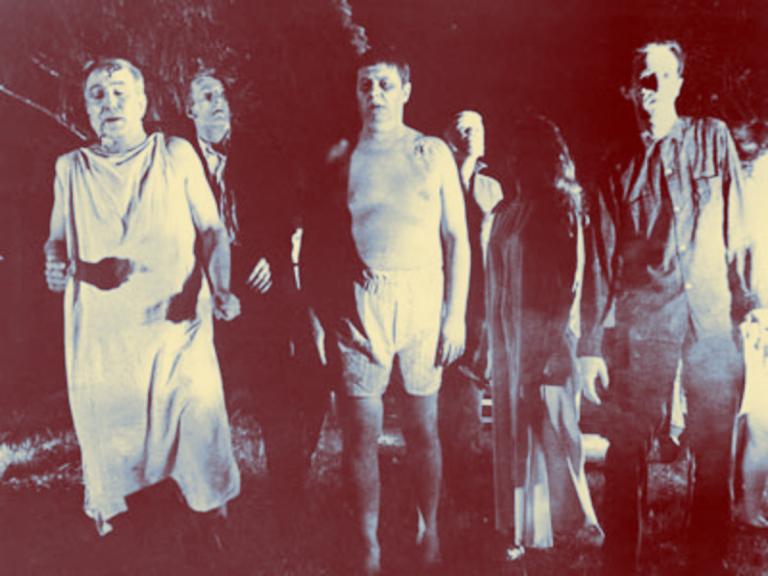
An artist’s depiction of American consumers. (George A. Romero’s “Night of the Living Dead,” Wikimedia Commons).
Editors Note: This post isn’t about Mormonism, since it is an unpublished blog for a non-religious publication. However, I think it’s an idea still worth exploring, and since Halloween is around the corner, why not?
Let’s talk about monsters. Specifically, zombies. Monsters in books or film tend to serve a purpose, to reimagine some abstract fear into a corporeal entity. Beings like Frankenstein’s monster or Dracula challenge our hubris over science, or our relationship with lust and nature. Zombies reach into our actual fears about society and, ultimately, each other. This is what first launched zombies into the pop culture zeitgeist with George A. Romero’s Night of the Living Dead almost fifty years ago.
But Night of the Living Dead was a long time ago. What are zombies such a fashionable monster in the post 9/11 world? The Walking Dead has been both cashing in on the trend, while also making the best of it. But it is a trend, and that’s not meant as a criticism so much as an insight into the nature of the genre itself.
So what is it about these monsters that intrigue modern audiences more than werewolves or Frankenstein? For some reason, we collectively eat up anything zombie-related—movies, tv, comics, whatever—with the same fevered hunger of a fresh corpse chowing down on their first bloody platter of brains.
For insights into how zombies reflect modern society we should look no further than 2002 and Danny Boyle’s film 28 Days Later* (released a year before The Walking Dead comics hit the shelves). This film introduced a new way of using zombies to examine anxieties about everyday life that are unique to our modern world. Just like Romero used zombies to deconstruct American consumerism at the height of an economic boom, Boyle used the tropes Romero established to reflect anxieties of a world built faced with both terrorism and technological superiority.
The rage victims from 28 Days Later are in many ways more terrifying than classical zombies precisely because they are still alive. The zombies in the Dead films are slow because a slow-moving threat is unexpected, but inevitable. There are, of course, arguments about whether or not the undead should even be capable of running with rotting muscles and brittle bones, but the psychological aspect is much more important and much more central to Romero’s films. See, the Dead films were produced and released over decades, and portray society’s collapse essentially in real time. We are given no indication that the fictional time difference between 1968’s Night of the Living Dead and its 1978 sequel Dawn of the Dead is shorter than the films’ release dates. It’s not until Day of the Dead, released in 1985, that the chaos of the dead rising from their graves results in a global catastrophe of apocalyptic proportions. That’s almost two decades after the zombies claim their first victims. Like the ghouls themselves, the societal decay is creeping along, slowly, and growing more putrid and horrible with each installment.
Contrast that to the modern zombie phenomena. Nowadays, the word “zombie” is usually followed immediately by “apocalypse.” But the concept of immediate dissolution of society thanks to an outbreak of zombies wasn’t really introduced until 28 Days Later. In fact, it’s the whole premise—an exploration of how quickly society could collapse if something so dangerous spread that fast. The running and screaming rage-victims are a literal manifestation of that, but there’s a bigger fear in play as well. There is one significant difference between the zombie fear of commercialism reflected in the masses of undead in Romero’s films and the current wave of zombie obsession that is so often accompanied by complete infrastructure breakdown. One key element missing from Romero’s classic films but present in the 21st century.
It’s the internet. Of course.
Or technology in general. When 28 Days Later was released, Y2K was fresh on everyone’s mind—a singular even that could theoretically wipe out all of civilization in one move. It wasn’t the fear of the even that scared everyone into obsession and stocking up on duct tape and water bottles, but the unknown reality of life afterward. Hence, the action in 28 Days Later takes place a month after the event. It was a perfect embodiment of our uniquely 21st century fears of what society would become—post Y2K, post 9/11, post-internet.
I’m not suggesting 28 Days Later was the first story or film to evoke the zombie apocalypse. The aforementioned Living Dead films had dealt with the subject three times before Boyle’s film. But it was 28 Days Later that suggested the decline of civilization could occur within a matter of weeks. The Walking Dead assumes this premise as an obvious development in the wake of the unexplained rising dead. Similar to 28 Days Later, Rick wakes up in a hospital, abandoned, and has to find what’s left of society. The show doesn’t give a clear timeline of Rick’s hospital stay, but considering he couldn’t have survived long in a coma without constant medical supervision, it’s a safe to assume that The Walking Dead’s society collapses at least as quickly as 28 Days Later.
What does this translate to the audience? It speaks to the fragility of our infrastructure, now that it is built on the Internet. When communication and information is instantaneous, it’s only logical that the something catastrophic were to take place, our society would crumble into a bleak nightmare just as immediately. It also illustrates how reliant we are on this external network. In Dawn of the Dead, television crews and radio programs carry on in both an important storytelling mode but also as disconnected narratives. In 21st century zombie films, the loss of instant media is part of the devastation. There is no longer a means to connect to fellow survivors. Which leads us to an even more primal fear: ourselves.
See, the villains in the post-apocalyptic zombie films are never the zombies themselves, but other survivors. The setting is an experiment in human nature and morality. In 28 Day Later—released during the wake of 9/11 and the U.S.’ military reaction—the villains are the military, who take liberties with the power their strength gives them. But in The Walking Dead, the villains are closer and more personal, often finding power in the aftermath of the walkers that they never exercised during peacetime.
The post-apocalyptic wasteland brings out the best in some of us, and the worst in others, but most importantly it forces us to reckon with a sense of human interaction that we might feel uncomfortable with during a time when most social interactions take place behind the safety of pre-constructed digital network. Lopping off a rotting corpse skull with a shovel is child’s play compare to the absolute horror of talking to a stranger. The Walking Dead scares us not because the dead come back to life, but because in the wake of a total civilization collapse, we might have to venture out and talk to our neighbors. The reason we don’t do that now is because we secretly fear the kind of people they might really be. The Walking Dead validates those fears.
Like I said before, The Walking Dead is probably the peak of modern zombie hype, both in artistic terms and simply by scale. It utilizes an aesthetic made popular by George A. Romero, and builds on the paranoia 28 Days Later embodied. However, despite their similarities—even in choices of opening sequences—they are uniquely different stories. 28 Days Later is an artistic statement both in its use of a then-dated zombie motif, resurrecting it for future creators to jump in on the craze. Incidentally, The Walking Dead creator Robert Kirman was working on the first issue of the comics while 28 Days Later was in production. Whatever was happening in the world that led both creators to illustrate similar visions of a ghoul-infested dystopia, the only thing we know for sure is we’re left to consume the results like the horde of mindless zombies we are.
* Of course, purists will argue that the monsters in 28 Days Later aren’t zombies in the same sense as the walkers, and they’re right. The walkers on television visually and stylistically have much more in common with Night of the Living Dead. But the catch all term “zombie” doesn’t have to refer solely to the living dead, but rather a horde of humans (or former-humans) who are no longer capable of individuality, where the threat is not intellectual but from the sheer population of the danger.
Previous Post

October 26, 2015
From the Archives: Ghost Stories
Next Post

October 29, 2015 Is Brigham Young's Hearse Residing in Disneyland?
Browse Our Archives
Select a Category American society Art baptism Blogging Book of Mormon Book review Brigham Young Brigham Young University Bundy Catholicism Christianity Communalism Community of Christ conferences conversion correlation Culture denominations Digital History Discipline Councils diversity Doctrine Donald Trump education Emma Smith ethics family feminism fiction Film review food French Polynesia Fundamentalism Gay rights Gender global Gun politics Halloween health History Honor Code hymns Joseph Smith Kirtland Temple law of consecration massacre site military Ministering missionary moderate Mormon feminism Modern Mormonism Mormon origins Mormon War Mormonism Mormonism, politics, Romney Obama Peace politics Polygamy Pope Francis Poverty Prayer Priesthood Protestantism Race Religious freedom Revelation Reviews sacred sites Scientology Scripture Secularization See Stones sexual assault Star Wars television temples Tithing Utah violence war women's ordination
Select a Month October 2018 September 2018 August 2018 May 2018 April 2018 March 2018 February 2018 January 2018 December 2017 October 2017 September 2017 July 2017 June 2017 May 2017 April 2017 March 2017 February 2017 January 2017 November 2016 October 2016 August 2016 July 2016 June 2016 May 2016 April 2016 March 2016 February 2016 January 2016 December 2015 November 2015 October 2015 September 2015 August 2015 July 2015 June 2015 April 2015 March 2015 February 2015 January 2015 December 2014 November 2014 October 2014 September 2014 August 2014 July 2014 June 2014 May 2014 April 2014 March 2014 February 2014 January 2014 December 2013 November 2013 October 2013 September 2013 August 2013 July 2013 June 2013 May 2013 April 2013 March 2013 February 2013 January 2013 December 2012 November 2012 October 2012 September 2012 August 2012 July 2012 June 2012 May 2012 April 2012 March 2012
Follow Us!
TAKE THE
Religious Wisdom Quiz
How do you show your love for God?
Select your answer to see how you score.
All of these Looking Forward to Heaven Prayer Keeping His Commandments
Related posts from Peculiar People

Sorry to Bother You: The (Human) Body as...


Trump Should Learn from Andrew Jackson: Keep Church...

A Hillbilly, a Professor, and a Mormon Mayor...
TRENDING AT PATHEOS Latter-day Saint

Did Prayer Cure His Cancer? Or Was It...
At 4 AM one morning, Joshua W. Brown’s wife awoke to a...

8 Ways a Near-Death Experience Rewires the Soul
Does Consciousness Survive Physical Death? After 50 Years of Research, Dr. Raymond...

Holy Longing: What Our Restlessness Is Telling Us
“One can find so many pains when the rain is falling.” -John...

What this is NOT about. This blog is definitely not about...

Who said the Israelites were God’s chosen? That’s right, they did. Who...

The Spirit World Is the Real World: God...
A Monk’s Wisdom on Body and Spirit I sit with Brother Martin...
view all Latter-day Saint blogs
Ad-Free & Subscriber Log-In Subscription Support
- About Us
- 2026 Calendar
- Videos
- Podcasts
- Library of World Religions
- Faith In Media Tracker
- Advertise With Us
- Write for Us
- Privacy Policy
- Terms of Service
- Do Not Sell My Data
- Contact Us
- Radiant Digital
- Manage Newsletter Subscriptions
- Unsubscribe From Notifications
- Sitemap
Copyright 2008-2026, Patheos. All rights reserved.
Subscription Support Ad-Free & Subscriber Log-In
Follow Patheos