
BuddhistCatholicContemplativeEvangelicalGeneral ChristianHinduJewishLatter-day SaintMuslimNew VisionsProgressive Christian
Beliefs
- Buddhist
- Catholic
- Contemplative
- Evangelical
- General Christian
- Hindu
- Jewish
- Latter-day Saint
- More Voices
- Muslim
- New Visions
- Pagan
- Progressive Christian
Topics
- Religion News
- Food and Religion
- Sports and Religion
- Religious Art
- Religious Music and Entertainment
- Religious Events
- History and Religion
- Style and Religion
- Politics and Religion
- Women in Religion
- Recreation Outdoors and Religion
- Business Finance and Religion
- Careers Workplace and Religion
- Education and Religion
- Family Parenting and Religion
- Health Fitness and Religion
- Home and Religion
- Relationships and Religion
- Technology and Religion
- Travel and Religion
Columnists
- Buddhist Columnists
- Business Finance and Religion Columnists
- Careers Workplace and Religion Columnists
- Catholic Columnists
- Contemplative Columnists
- Education and Religion Columnists
- Evangelists Columnists
- Family Parenting and Religion Columnists
- General Christian Columnists
- Health Fitness and Religion Columnists
- Hindu Columnists
- History and Religion Columnists
- Home and Religion Columnists
- Jewish Columnists
- More Voices Columnists
- Latter Day Columnists
- Muslim Columnists
- New Visions Columnists
- Nonreligious Columnists
- Pagan Columnists
- Politics and Religion Columnists
- Progressive Columnists
- Recreation Outdoors and Religion Columnists
- Relationships and Religion Columnists
- Religion News Columnists
- Religious Art Columnists
- Religious Events Columnists
- Religious Music and Entertainment Columnists
- Sports and Religion Columnists
- Style and Religion Columnists
- Technology and Religion Columnists
- Travel and Religion Columnists
- Women in Religion Columnists
Resource Library
- 2026 Calendar
- Library of World Religions
- The 100 Most Holy Places on Earth
- Patheos Answers
- Podcasts
- Videos
- Faith Leaders Database
- Anglican Episcopalian
- Bahai
- Baptist
- Buddhism
- Christianity
- Confucianism
- Eastern Orthodoxy
- Hinduism
- Holiness and Pentecostal
- ISKCON
- Islam
- Judaism
- Lutheran
- Methodist
- The Church of Jesus Christ of Latter-day Saints
- New Age
- Paganism
- Presbytarian and Reformed
- Protestantism
- Religion Behind the Scenes
- Roman Catholic
- Scientology
- Shia Islam
- Sikhism
- Sufism
- Sunni Islam
- Taoism
- Zen
- See all religions
Research Tools
 Ad-Free & Subscriber Log-In Subscription Support
Ad-Free & Subscriber Log-In Subscription Support
Follow Patheos 

- Trending:
- Forgiveness
- |
- Marriage
- |
- Consciousness
- |
- Death Penalty
- |
- Election
- |
- Halloween
 Peculiar People
- Home
- Latter-day Saint
- Mitt Romney Still Doesn’t Want to Talk About Race in the Mormon Church
Mitt Romney Still Doesn’t Want to Talk About Race in the Mormon Church
Last updated on: October 20, 2015 at 9:39 pm by J. Paul Valley
Mitt Romney Still Doesn’t Want to Talk About Race in the Mormon Church 2015-10-20T21:39:44+00:00 J. Paul Valley
Patheos Explore the world's faith through different perspectives on religion and spirituality! Patheos has the views of the prevalent religions and spiritualities of the world.
The White House/Wikimedia Commons
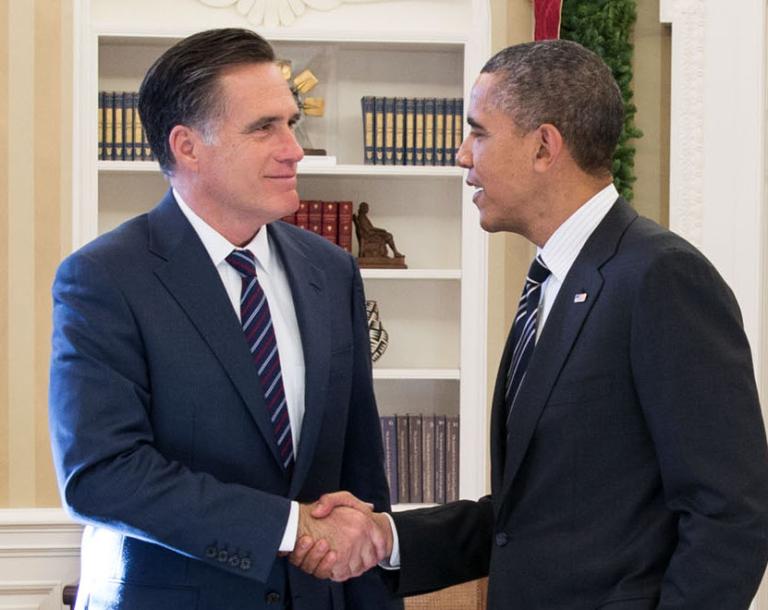
So the guy who was in charge of getting Barack Obama elected both times, David Axelrod, recently sat down for an interview with Mitt Romney. Romney, you might remember, was pretty convinced that Obama didn’t deserve a second term in office. So much so that he ran against him. You might also recall that Romney lost.
So the man who basically orchestrated what may turn out to be the final word in Mitt Romney’s political career just had a cordial chat with him for about an hour, and then uploaded this interview to the Internet for all to hear.
The world of politics is a strange place.
The interview was released as an episode of Axelrod’s podcast for the University of Chicago Institute of Politics about four days ago, but was brought to my attention by Colin Campbell’s article over at Business Insider. The interview dishes out many interesting tidbits about Romney’s life and attitudes toward various political issues. They pontificate on the impact of partisan media, Donald Trump’s controversial statements on immigration, and Romney’s deep affinity for Paul Ryan.
If you are one of those who hold out that maybe Romney is some sort of closet liberal, you will be disappointed by this interview. He still seems pretty convinced that the Democratic platform is predicated on the notion of just handing out stuff for votes. He also tosses around some Margaret Thatcher quotes and says he feels Hillary didn’t defend capitalism with enough vigor in the Democratic debate.
Plus, you get to hear the former governor say the word “poor” in his own special way (pooher) which is always a delight.
Some of the best stuff —and the stuff I want to focus on — comes out toward the beginning, when Romney talks about his life as the son of George Romney, who Axelrod says was a personal inspiration to him as a child and “a progressive force within the Republican party.” They comb through George’s notorious comments concerning the Vietnam War, his relationship to the rest of his party, and his record on civil rights.
According to Mitt, George was particularly concerned about education and “concentrations of economic power,” and he comes across as pretty liberal. Axelrod kind of eats this up, and uses tales of Romney Sr. to prod Mitt about the shifting face of modern conservatism.
The part Mormons are probably most interested in is when Axelrod starts talking about George’s views on race. Axelrod says he was personally very inspired by George’s progressive attitudes on race, particularly when it came to housing policy. This was also something discussed at length recently at the Black, White and Mormon conference at the University of Utah. Suffice it to say that Romney did indeed stake a lot of his own political capital on fighting against housing segregation in Michigan.
“He had such fundamental guiding principles that he never varied from them,” Romney said of his father, “and one of them was that we were all created equal … It was simply unthinkable (to George) that in the United States of America that African Americans would not have the same opportunities and the same prospects for happiness as white Americans.”
Romney’s admiration for his father’s inclusive attitude was basically a perfect setup for Axelrod to bring up Mormonism. That seems to have made Romney kind of uncomfortable.
“He was a devout practitioner of his faith,” Axelrod interjected, explaining that the LDS Church took a position against some of his initiatives in Michigan. “There’s no doubt that he was ahead of the Church on issues of race,” Axelrod said.
Romney comes across as very dismissive of this notion, basically arguing that his father’s position — that all of God’s children are created equal — was also held by the LDS Church. Romney then quickly shifts the discussion to his father’s concerns about Barry Goldwater’s opposition to the Civil Rights Act, etc.
You can tell that Axelrod doesn’t quite buy this, which he shouldn’t, because it simply is not true. The fact of the matter is, there were plenty of leaders within the The Church’s hierarchy that did not accept the notion that all God’s children were created equal. Opposition to the Civil Rights Movement was most certainly present in Mormon leadership.
In fact, Delbert L. Stapley, who served as an Apostle in the LDS Church from 1950 to 1978 (he died about a month before the temple and priesthood ban was lifted) once wrote a letter to George, expressing his concern for the Governor’s attitudes on race. They have the whole letter up at Mormon Matters, but here’s the gist:
Now, don’t think I am against the Negro people, because I have several in my employ. We must understand and recognize their status and then, accordingly, provide for them. I just don’t think we can get around the Lord’s position in relation to the Negro without punishment for our acts; going contrary to that which He has revealed. The Lord will not permit His purposes to be frustrated by man.
Stapley’s letter makes three things very clear: 1.Governor Romney is free to advocated for whatever political policies he deems fair; 2. The Lord has placed black people in a state inferior to white people; 3. If we mess with the societal structures the Lord has put in place, we will lose the Lord’s favor.
He also makes clear that this is a position held by “several others.” He is presumably referring to other leaders in the LDS Church, considering the nature of the letter. This letter shows, at the very least, a feeling of unease among church leadership due to Romney’s progressive stance on race, and it is an unease that they believe to be supported by doctrine and revelation. Stapely spends much of the letter quoting from Joseph Smith and explaining the nature of God’s justice. Edward J. Blum and Paul Harvey touched on this in a piece they did for The Atlantic in 2012, which is worth checking out.
The lesson I take away from this is that we clearly still have a long way to go when we discuss the history racial discrimination in Mormonism. That was also a major takeaway for me from the Black, White and Mormon conference. Something that came up multiple times on those panel discussions is the idea that, despite the fact that the Church has produced the LDS Topics essay on race it still doesn’t seem like many members have actually confronted the realities of historic racism within the church. In fact, it seems as if most members haven’t even bothered to read the essay.
Has Romney read it?
This is not a peripheral issue. We talk a lot about faith crisis these days, and for many of our members the greatest faith crisis comes from the fact that members refuse to acknowledge our own history of racism. When I listened to this interview, hearing the most famous Mormon in America dismiss the idea that the church could have been better on this issue (more like his father, Axelrod implied) was hugely disappointing. I also don’t think this approach is terribly helpful.
Anyway, all in all it’s a pretty interesting conversation for anyone who finds Romney even remotely fascinating as a politician, and Axelrod dishes out a great interview. There are other Mormon tidbits that make their way in there, and Romney refers to his time as Bishop and Stake President as being a “pastor,” which is still weird to me. Are the terms “Bishop” and “Stake President” really that hard to explain?
You can check out the whole interview here.
Previous Post

October 20, 2015
A Mormon Perspective on the New Star Wars: The Force Awakens Trailer
Next Post

October 22, 2015 Did Back to the Future Really Predict 9/11?
Browse Our Archives
Select a Category American society Art baptism Blogging Book of Mormon Book review Brigham Young Brigham Young University Bundy Catholicism Christianity Communalism Community of Christ conferences conversion correlation Culture denominations Digital History Discipline Councils diversity Doctrine Donald Trump education Emma Smith ethics family feminism fiction Film review food French Polynesia Fundamentalism Gay rights Gender global Gun politics Halloween health History Honor Code hymns Joseph Smith Kirtland Temple law of consecration massacre site military Ministering missionary moderate Mormon feminism Modern Mormonism Mormon origins Mormon War Mormonism Mormonism, politics, Romney Obama Peace politics Polygamy Pope Francis Poverty Prayer Priesthood Protestantism Race Religious freedom Revelation Reviews sacred sites Scientology Scripture Secularization See Stones sexual assault Star Wars television temples Tithing Utah violence war women's ordination
Select a Month October 2018 September 2018 August 2018 May 2018 April 2018 March 2018 February 2018 January 2018 December 2017 October 2017 September 2017 July 2017 June 2017 May 2017 April 2017 March 2017 February 2017 January 2017 November 2016 October 2016 August 2016 July 2016 June 2016 May 2016 April 2016 March 2016 February 2016 January 2016 December 2015 November 2015 October 2015 September 2015 August 2015 July 2015 June 2015 April 2015 March 2015 February 2015 January 2015 December 2014 November 2014 October 2014 September 2014 August 2014 July 2014 June 2014 May 2014 April 2014 March 2014 February 2014 January 2014 December 2013 November 2013 October 2013 September 2013 August 2013 July 2013 June 2013 May 2013 April 2013 March 2013 February 2013 January 2013 December 2012 November 2012 October 2012 September 2012 August 2012 July 2012 June 2012 May 2012 April 2012 March 2012
Follow Us!
TAKE THE
Religious Wisdom Quiz
In the Parable of the Pearl of Great Price, what does the merchant do?
Select your answer to see how you score.
Sells all to buy the pearl Builds a bigger barn Buys many pearls Finds a lost coin
Related posts from Peculiar People

Sorry to Bother You: The (Human) Body as...


A Letter for My Someday-Teenage Children

Confederate Symbols and the Black Flag of ISIS:...
TRENDING AT PATHEOS Latter-day Saint

Did Prayer Cure His Cancer? Or Was It...
At 4 AM one morning, Joshua W. Brown’s wife awoke to a...

8 Ways a Near-Death Experience Rewires the Soul
Does Consciousness Survive Physical Death? After 50 Years of Research, Dr. Raymond...

Holy Longing: What Our Restlessness Is Telling Us
“One can find so many pains when the rain is falling.” -John...

What this is NOT about. This blog is definitely not about...

Who said the Israelites were God’s chosen? That’s right, they did. Who...

The Spirit World Is the Real World: God...
A Monk’s Wisdom on Body and Spirit I sit with Brother Martin...
view all Latter-day Saint blogs
Ad-Free & Subscriber Log-In Subscription Support
- About Us
- 2026 Calendar
- Videos
- Podcasts
- Library of World Religions
- Faith In Media Tracker
- Advertise With Us
- Write for Us
- Privacy Policy
- Terms of Service
- Do Not Sell My Data
- Contact Us
- Radiant Digital
- Manage Newsletter Subscriptions
- Unsubscribe From Notifications
- Sitemap
Copyright 2008-2026, Patheos. All rights reserved.
Subscription Support Ad-Free & Subscriber Log-In
Follow Patheos