
BuddhistCatholicContemplativeEvangelicalGeneral ChristianHinduJewishLatter-day SaintMuslimNew VisionsProgressive Christian
Beliefs
- Buddhist
- Catholic
- Contemplative
- Evangelical
- General Christian
- Hindu
- Jewish
- Latter-day Saint
- More Voices
- Muslim
- New Visions
- Pagan
- Progressive Christian
Topics
- Religion News
- Food and Religion
- Sports and Religion
- Religious Art
- Religious Music and Entertainment
- Religious Events
- History and Religion
- Style and Religion
- Politics and Religion
- Women in Religion
- Recreation Outdoors and Religion
- Business Finance and Religion
- Careers Workplace and Religion
- Education and Religion
- Family Parenting and Religion
- Health Fitness and Religion
- Home and Religion
- Relationships and Religion
- Technology and Religion
- Travel and Religion
Columnists
- Buddhist Columnists
- Business Finance and Religion Columnists
- Careers Workplace and Religion Columnists
- Catholic Columnists
- Contemplative Columnists
- Education and Religion Columnists
- Evangelists Columnists
- Family Parenting and Religion Columnists
- General Christian Columnists
- Health Fitness and Religion Columnists
- Hindu Columnists
- History and Religion Columnists
- Home and Religion Columnists
- Jewish Columnists
- More Voices Columnists
- Latter Day Columnists
- Muslim Columnists
- New Visions Columnists
- Nonreligious Columnists
- Pagan Columnists
- Politics and Religion Columnists
- Progressive Columnists
- Recreation Outdoors and Religion Columnists
- Relationships and Religion Columnists
- Religion News Columnists
- Religious Art Columnists
- Religious Events Columnists
- Religious Music and Entertainment Columnists
- Sports and Religion Columnists
- Style and Religion Columnists
- Technology and Religion Columnists
- Travel and Religion Columnists
- Women in Religion Columnists
Resource Library
- 2026 Calendar
- Library of World Religions
- The 100 Most Holy Places on Earth
- Patheos Answers
- Podcasts
- Videos
- Faith Leaders Database
- Anglican Episcopalian
- Bahai
- Baptist
- Buddhism
- Christianity
- Confucianism
- Eastern Orthodoxy
- Hinduism
- Holiness and Pentecostal
- ISKCON
- Islam
- Judaism
- Lutheran
- Methodist
- The Church of Jesus Christ of Latter-day Saints
- New Age
- Paganism
- Presbytarian and Reformed
- Protestantism
- Religion Behind the Scenes
- Roman Catholic
- Scientology
- Shia Islam
- Sikhism
- Sufism
- Sunni Islam
- Taoism
- Zen
- See all religions
Research Tools
 Ad-Free & Subscriber Log-In Subscription Support
Ad-Free & Subscriber Log-In Subscription Support
Follow Patheos 

- Trending:
- Forgiveness
- |
- Marriage
- |
- Consciousness
- |
- Death Penalty
- |
- Election
- |
- Halloween
 Peculiar People
- Home
- Latter-day Saint
- The Restoration and War
The Restoration and War
Last updated on: June 5, 2014 at 4:05 pm by sbryant
The Restoration and War 2014-06-05T16:05:55+00:00 sbryant
Patheos Explore the world's faith through different perspectives on religion and spirituality! Patheos has the views of the prevalent religions and spiritualities of the world.
Written on Memorial Day, 2014
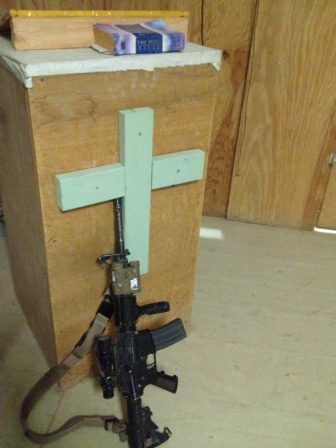
A weapon leaning against my pulpit in Shukvani, Afghanistan. Not an uncommon sight in a war chapel.
This is my first Memorial Day home after combat. In Afghanistan, I prayed over the injured, the dying, and the dead—and I suppose it’s fitting to pray for all of them again, today. I’m not as haunted by the dead as I am by these words, which I often heard when a casualty came in and a Marine or Sailor would respond, “Don’t worry, Chaps: it’s only an Afghan.” I suppose the moral wounds are greater than the physical.
As a military chaplain endorsed by Community of Christ, I’m always uneasy with my church’s mandate to proclaim peace, and with my commission in a war-fighting force, even if I am a noncombatant. But Memorial Day reminds me that even those opposed to war (should) support the individual humanity of the warfighter, and especially the fallen. In 1971, Johnny Cash, reflecting on a USO trip to Vietnam, sang this about honoring the warfighter while hating the war:
We did our best to let them know that we cared
For every last one of them that’s over there.
Whether we belonged over there or not,
Somebody over here loves them and needs them.[i]
In the same spirit, Dr. Jonathan Shay wrote this in Achilles in Vietnam: Combat Trauma and the Undoing of Character:
Learn the psychological damage that war does, and work to prevent war. There is no contradiction between hating war and honoring the soldier. Learn how war damages the mind and spirit, and work to change those things in military institutions and culture that needlessly create or worsen these injuries.[ii]
For those who think their Christianity excuses them from ministry to warriors, from getting tangled up in the difficulties of war, I remind them that even Jesus ministered to those in the military.[iii] Nothing in our Christianity excuses us from engaging war and serving warfighters, and, in fact, quite the opposite is true in my opinion.
Still, one of the most difficult questions posed to me during my interview to become a chaplain reverberates to this day: “What business does an emerging peace church have endorsing a military chaplain?” And my response still is, “If we truly believe in proclaiming peace, and in promoting Zion, where better should we be than those caught in the midst of war?”
Mirroring the difficult task of proclaiming peace in the midst of war, the Restoration has a nebulous tradition with war. The Book of Mormon might as well be subtitled “Another Testament of Jesus Christ, and War.” If Mormon only published “the hundreth part” of the available records to him,[iv] I have to wonder why so much war? Except, if I accept him as a literal historical figure, I’d have to wonder if war and death had been such a part of his life that he had to record it, mark it. Like a war veteran with PTSD who only sees war images when presented with Rorschach inkblots, all too often Mormon tells the story of Christ and God’s people through war. I find myself falling into the same trap, peace and war becoming so terribly intertwined at times, though I have only seen the hundreth part of what Mormon saw.
In our history as a people, we’ve seen several wars and responded in various ways. The Mormon War was the worst persecution we’ve experienced, and it brought out the worst in us. To avoid its repeat, we formed a militia in Nauvoo, which invited the very thing it sought to dissuade—reminding me of another Johnny Cash song, “Don’t Take your Guns to Town,” or the words of Christ, “live by the sword, die by the sword.”
After the death of Joseph Smith Junior, Brigham Young (from a utilitarian perspective) wisely utilized the Mexican-American War—known as the US Invasion of Mexico, on the other side of the border. Ironically, a decade later, US troops would march on Young’s Zion. For those in the Utah Territory, the Civil War provided some respite from government attention. For the Reorganization, though—which came into being during the Civil War, and lacked the geographical isolation of Young and his Saints—the Civil War was formative to thought and trajectory.
Joseph Smith III was an abolitionist. In his memoirs, he records, “I was not a politician, but I had strong opinions in regard to such subjects as human slavery, and felt it incumbent upon me to fearlessly express my views and to do what I could to help the Nation overcome what I so plainly recognized as an evil.”[v] But the young Prophet-President of the Reorganization, while feeling a patriotic duty to serve in the military and for the cause, was hesitant about war, stating “There were moral issues interwoven, to which we felt it our duty to give careful consideration.”
He states that early members of the Reorganization understood the doctrines of the Restoration to not “warrant the shedding of human blood except it became necessary in defense of our families of ourselves,” and even then “contemplated only as a last resort.” Still, he adds, “[i]n spite of this firm conviction, our spirits stirred deeply to the call of patriotic duty.” Torn between war and peace, ideals and realities, he continues that “[p]rayers for guidance were fervently offered unto the Lord,” and:
When the answer came, it was clear, definite, and unmistakable, and was borne in upon our souls with great distinctiveness. In substance it was as follows: Do not enlist. Enlisting makes your military serve an individual and voluntary action, whereby you might shed blood while in the service. Wait; if drafted, the responsibility is lifted. In such case do not hesitate to take your places in the ranks and to do your full duty as good soldiers and citizens, supporting the government to the best of your powers. In such an event do not shirk any duty the service requires, even should it mean the shedding of human blood, for through the conscription the deed becomes a national sin instead of a person one. The Nation as a whole will have to suffer for its sins, but you will not be held personally under moral obligations in the matter if you do not voluntarily enlist.[vi]
While I appreciate this sentiment, and believe it to be inspired, I still accept that the understanding of Joseph Smith III is clearly represented in this revelation alongside the voice of the Lord. Further, as a non-canonized revelation, I have no qualms in critiquing it. Though a nation might have war sins, these sins are born collectively by individual people, especially by those who do the dirty work. Perhaps it’s true, psychologically, that being drafted and then having to kill another person might assuage moral responsibility; but I suspect that it would intensify the moral injury of having to commit the act, of being forced to do things that you hold to be morally reprehensible. PTSD is the outgrowth especially of moral injury, but also of physical injury, fatigue and wear, and shock and fear—and waiting to be enlisted frees you from none of that. Sin is anything that alienates us from God’s plan of happiness; and we needn’t be the sinner to be alienated from that happiness God would have us enjoy.
War is the epitome of sin.
Personally, I can say that, even as a non-combatant who is surely free of any sins of war, I carry the scars of war regardless of the names at the top of the bill. But more than my little trip to the desert, it is the injured, dead, and traumatized civilians in war zones, though all sinless, who truly bear the sins of war on their bodies and souls. In them we see the face of the suffering Christ.
I would hope that our understanding in Community of Christ on war, sin, and agency has matured over the years—and surely it has, though I think we need to continue to hash out our position on these very issues. Some things never change: We still wrestle with Joseph Smith III’s dilemma, and we still uphold his inspired response, remaining committed to peace. In recent years, Community of Christ has pursued peace in a variety of ways, and continues to emerge as a peace church. We have a long way to go, but I firmly believe that we are on the path.[vii]
I wonder about my fellow veterans in Community of Christ, their views on military service, and on belonging to a peace church. I wonder about the position of the church on military service in the future, as we further explore Zion and what it means to “renounce war and proclaim peace” (D&C 98:16; CofC D&C 95:3d). As one Army chaplain with PTSD recounted in his memoir, “…violence simply leads to more violence,” and “we are poorly equipped as humans to judge who should deserve to die. I hate war.”[viii] And to that I say ‘Amen.’ I believe that the day is coming when we can no longer, in good conscience, support any form of violence; but even more so, actively oppose it, in line with the cross of Christ as a radical rejection of the efficacy of violence. Will we reach a point where we uphold something like Joseph Smith III’s revelation, that military service should be avoided unless drafted? I think it’s quite possible.

Chaplain Bryant (left) and RP1 at OP Athens. RP carried a weapon, to protect me. At his feet is a stack of Bibles that we brought to the Marines and Sailors assigned to this little outpost.
Especially on this Memorial Day, my own personal dissonance is a little more punctuated, as someone called to proclaim peace as a member of a war-fighting force. There are no easy answers here, something I know better than most, as I prepare to go and pray for the dead and their loved ones one more time, and all over again.
[i] “Singin’ in Vietnam Talkin’ Blues,” from the Album Man in Black, Columbia Records, 1971
[ii] Jonathan Shay, Achilles in Vietnam: Combat Trauma and the Undoing of Character (Simon & Schuster: 1995), page xxxiii
[iii] Matt. 8:5-13
[iv] Words of Mormon 1:5 (1:8 CofC)
[v] The Memoirs of President Joseph Smith III (Herald House: 1979), page 85
[vi] Ibid, page 90
[vii] On whether or not Community of Christ is truly succeeding at being a peace church beyond just rhetoric, see the exchange between Dr. Matthew Bolton and his father Apostle Andrew Bolton:
http://saintsherald.com/2009/04/30/the-community-of-christ-is-not-a-peace-church/
http://saintsherald.com/2009/05/15/the-community-of-christ-is-becoming-a-peace-church/
[viii] Roger Benimoff, Faith under Fire (Broadway Books, 2010), page 233
Previous Post

May 29, 2014
On Translation Theories and the Interpretation of the Book of Mormon
Next Post
June 9, 2014 Kirtland Temple: An Excerpt from the Book
Browse Our Archives
Select a Category American society Art baptism Blogging Book of Mormon Book review Brigham Young Brigham Young University Bundy Catholicism Christianity Communalism Community of Christ conferences conversion correlation Culture denominations Digital History Discipline Councils diversity Doctrine Donald Trump education Emma Smith ethics family feminism fiction Film review food French Polynesia Fundamentalism Gay rights Gender global Gun politics Halloween health History Honor Code hymns Joseph Smith Kirtland Temple law of consecration massacre site military Ministering missionary moderate Mormon feminism Modern Mormonism Mormon origins Mormon War Mormonism Mormonism, politics, Romney Obama Peace politics Polygamy Pope Francis Poverty Prayer Priesthood Protestantism Race Religious freedom Revelation Reviews sacred sites Scientology Scripture Secularization See Stones sexual assault Star Wars television temples Tithing Utah violence war women's ordination
Select a Month October 2018 September 2018 August 2018 May 2018 April 2018 March 2018 February 2018 January 2018 December 2017 October 2017 September 2017 July 2017 June 2017 May 2017 April 2017 March 2017 February 2017 January 2017 November 2016 October 2016 August 2016 July 2016 June 2016 May 2016 April 2016 March 2016 February 2016 January 2016 December 2015 November 2015 October 2015 September 2015 August 2015 July 2015 June 2015 April 2015 March 2015 February 2015 January 2015 December 2014 November 2014 October 2014 September 2014 August 2014 July 2014 June 2014 May 2014 April 2014 March 2014 February 2014 January 2014 December 2013 November 2013 October 2013 September 2013 August 2013 July 2013 June 2013 May 2013 April 2013 March 2013 February 2013 January 2013 December 2012 November 2012 October 2012 September 2012 August 2012 July 2012 June 2012 May 2012 April 2012 March 2012
Follow Us!
TAKE THE
Religious Wisdom Quiz
True or False: Romans teaches that whoever calls on the name of the Lord will be saved.
Select your answer to see how you score.
FALSE TRUE
Related posts from Peculiar People

Sorry to Bother You: The (Human) Body as...

Confederate Symbols and the Black Flag of ISIS:...

First-Order Myopia: What Donald Trump Can Learn from...
Unbridling Mormon Illustration: "From the Dust" - 2...
TRENDING AT PATHEOS Latter-day Saint

Did Prayer Cure His Cancer? Or Was It...
At 4 AM one morning, Joshua W. Brown’s wife awoke to a...

8 Ways a Near-Death Experience Rewires the Soul
Does Consciousness Survive Physical Death? After 50 Years of Research, Dr. Raymond...

Holy Longing: What Our Restlessness Is Telling Us
“One can find so many pains when the rain is falling.” -John...

What this is NOT about. This blog is definitely not about...

Who said the Israelites were God’s chosen? That’s right, they did. Who...

The Spirit World Is the Real World: God...
A Monk’s Wisdom on Body and Spirit I sit with Brother Martin...
view all Latter-day Saint blogs
Ad-Free & Subscriber Log-In Subscription Support
- About Us
- 2026 Calendar
- Videos
- Podcasts
- Library of World Religions
- Faith In Media Tracker
- Advertise With Us
- Write for Us
- Privacy Policy
- Terms of Service
- Do Not Sell My Data
- Contact Us
- Radiant Digital
- Manage Newsletter Subscriptions
- Unsubscribe From Notifications
- Sitemap
Copyright 2008-2026, Patheos. All rights reserved.
Subscription Support Ad-Free & Subscriber Log-In
Follow Patheos