
BuddhistCatholicContemplativeEvangelicalGeneral ChristianHinduJewishLatter-day SaintMuslimNew VisionsProgressive Christian
Beliefs
- Buddhist
- Catholic
- Contemplative
- Evangelical
- General Christian
- Hindu
- Jewish
- Latter-day Saint
- More Voices
- Muslim
- New Visions
- Pagan
- Progressive Christian
Topics
- Religion News
- Food and Religion
- Sports and Religion
- Religious Art
- Religious Music and Entertainment
- Religious Events
- History and Religion
- Style and Religion
- Politics and Religion
- Women in Religion
- Recreation Outdoors and Religion
- Business Finance and Religion
- Careers Workplace and Religion
- Education and Religion
- Family Parenting and Religion
- Health Fitness and Religion
- Home and Religion
- Relationships and Religion
- Technology and Religion
- Travel and Religion
Columnists
- Buddhist Columnists
- Business Finance and Religion Columnists
- Careers Workplace and Religion Columnists
- Catholic Columnists
- Contemplative Columnists
- Education and Religion Columnists
- Evangelists Columnists
- Family Parenting and Religion Columnists
- General Christian Columnists
- Health Fitness and Religion Columnists
- Hindu Columnists
- History and Religion Columnists
- Home and Religion Columnists
- Jewish Columnists
- More Voices Columnists
- Latter Day Columnists
- Muslim Columnists
- New Visions Columnists
- Nonreligious Columnists
- Pagan Columnists
- Politics and Religion Columnists
- Progressive Columnists
- Recreation Outdoors and Religion Columnists
- Relationships and Religion Columnists
- Religion News Columnists
- Religious Art Columnists
- Religious Events Columnists
- Religious Music and Entertainment Columnists
- Sports and Religion Columnists
- Style and Religion Columnists
- Technology and Religion Columnists
- Travel and Religion Columnists
- Women in Religion Columnists
Resource Library
- 2026 Calendar
- Library of World Religions
- The 100 Most Holy Places on Earth
- Patheos Answers
- Podcasts
- Videos
- Faith Leaders Database
- Anglican Episcopalian
- Bahai
- Baptist
- Buddhism
- Christianity
- Confucianism
- Eastern Orthodoxy
- Hinduism
- Holiness and Pentecostal
- ISKCON
- Islam
- Judaism
- Lutheran
- Methodist
- The Church of Jesus Christ of Latter-day Saints
- New Age
- Paganism
- Presbytarian and Reformed
- Protestantism
- Religion Behind the Scenes
- Roman Catholic
- Scientology
- Shia Islam
- Sikhism
- Sufism
- Sunni Islam
- Taoism
- Zen
- See all religions
Research Tools
 Ad-Free & Subscriber Log-In Subscription Support
Follow Patheos 

- Trending:
- Advent
- |
- Forgiveness
- |
- Thanksgiving
- |
- Election
- |
- Seasonal Holidays
- |
- Marriage
 Peculiar People
- Home
- Latter-day Saint
- A Mormon Massacre Site and Places within a Space
A Mormon Massacre Site and Places within a Space
Last updated on: May 14, 2012 at 6:54 pm by David Howlett
A Mormon Massacre Site and Places within a Space 2012-05-14T18:54:28+00:00 David Howlett
Patheos Explore the world's faith through different perspectives on religion and spirituality! Patheos has the views of the prevalent religions and spiritualities of the world.
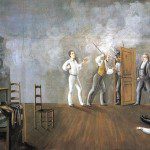
The LDS church has purchased the site of the most infamous event of the 1838 Mormon War in Missouri—the site of the Haun’s Mill Massacre. The previous owner of the site, the Community of Christ (formerly known as the Reorganized Church of Jesus Christ of Latter Day Saints), announced the sale of the historic ground in an April 3, 2012 e-mail. Originally approached by the Mormon Historic Sites Foundation about the purchase over a year ago, the Community of Christ eventually sold Haun’s Mill and three other historic properties to subsidiaries owned by the LDS church for $41.5 million. [1] The news of the Haun’s Mill sale has generated a fair amount of interest from the members of the many churches descended from Joseph Smith, Jr.’s restoration movement. [2] While the physical site of Haun’s Mill now resembles a rather unremarkable farmer’s field with several small memorial markers dotting its landscape, as a massacre site, it constitutes a piece of America’s “shadowed ground,” or a place of violence and tragedy that has been “sanctified” by a community. [3] A piece of shadowed ground, like a massacre site, invites any number of narratives about it as people try to make sense of the events once enacted there. Due to the “surplus of meaning” that people assign to it, a massacre site may occupy the same physical space but be a very different place for varying groups and individuals. The Mormon churches in particular have “created” very different Haun’s Mills as they have used the site to illustrate strikingly different church teachings.
Take two recent examples. In 2008, LDS Apostle and First Counselor in the First Presidency Henry B. Eyring recounted that “when tensions ran high in northern Missouri in the fall of 1838, the Prophet Joseph Smith called for all the Latter-day Saints to gather to Far West [Missouri] for protection. . . He specifically counseled Jacob Haun, founder of a small settlement called Haun’s Mill.” Eyring noted that Haun failed to follow Smith’s orders to move his group. As most in Eyring’s readership well knew, Jacob Haun’s small community was overwhelmed by a force of 200 Missouri militia men who marched into the Northern Missouri settlement on October 30, 1838. After facing off with the militia for a few eerie moments, Mormon men and boys ran to hastily defend their community. The Mormons were summarily gunned down, even after attempting surrender. Seventeen Mormons died at Haun’s Mill; their grief-stricken family members buried their bodies in an unfinished well on the site. [4] In Joseph Smith’s official church history, the founding prophet stated after the massacre that, “Up to this day God had given me wisdom to save the people who took counsel. None had ever been killed who abode by my counsel.” Eyring quoted this statement in his 2008 article and then added that “the Prophet [Joseph Smith] recorded the sad truth that innocent lives could have been saved at Haun’s Mill had his counsel been received and followed.” [5] While individual LDS members may take issue with Eyring’s interpretation of the causes of the massacre, his narrative illustrates a general LDS need, in 1838 and now, to explain the horror of the massacre within a universe where a providential God orders all things, directs God’s servants, and people suffer by their disobedience to such authorities.
In contrast to Eyring’s use of the massacre as a lesson about obedience to God’s servants, Community of Christ Apostle Andrew Bolton stated in a 2009 documentary that “two days before the massacre they [the residents at Haun’s Mill] reiterated their commitment to live in peace with their neighbors. This was a genuine, authentic group that didn’t want any part of the violence and suffered horrible tragedy. [The violence, Bolton notes, was committed by some members of the Mormon church hierarchy, Mormon militia men from other areas, non-Mormon Missouri militia men, and some Missouri state officials in the days before the massacre.] The lesson from Haun’s Mill is the innocent get hurt whenever there is human violence. It spills over, and there is tragedy.” [6] For Bolton, Haun’s Mill serves as a cautionary tale about the tragic consequences of humans taking up the sword against their neighbors. Combatants do not just suffer. Those caught between the combatants inevitably suffer, too. It is a lesson fit for the contemporary Community of Christ’s mission of promoting “communities of love, hope, joy, and peace.” Apparently, though, with a strained denominational budget and a shrinking North American membership, it is a lesson that will not be told onsite by the Community of Christ in the future.
To borrow terms from Heraclitus and Thomas Tweed, as no one can step into the same river twice, no one can step into the same historic site twice, too. [7] Places are necessarily social and transformed from space to place by people through stories. And those narratives have different strategic uses. In this way, places always change as stories about them and the interest groups that visit them change. Haun’s Mill, like all significant historic sites, has been made by the narratives people tell about it. Now that the LDS church possesses the massacre site, I think it is unlikely that LDS General Authorities (leaders in the highest levels of church administration) will continue to tell “the disobedience to counsel” story about Haun’s Mill. Why invest millions of dollars to buy a site if it is simply an example of how people disobeyed the voice of God’s anointed? There are certainly other narratives about Haun’s Mill that LDS church officials have used in the past beyond the disobedience narrative. For instance, contemporary adult Sunday school materials in the LDS church place Haun’s Mill squarely within a persecution narrative that portrays innocent Northern Missouri saints suffering at the hands of rapacious, violent Missouri mobs. This is a story of the Haun’s Mill Mormons as martyrs.[8] We might speculate if the Community of Christ’s narrative of the dangers of warfare on the innocent will crossover into LDS interpretation of the site in the future. Liberal churches, like the Community of Christ, do poorly in America, but liberal ideas are wonderfully successful, so say a few sociologists.[9] We shall see. For the present, the LDS church has no plans to physically develop Haun’s Mill as it has done with other Mormon historic sites. [10] However, that will not stop Mormon groups from producing new narratives about the site. Such new narratives will inevitably continue the creation of multiple Haun’s Mills, even as the physical space remains a small muddy field in Northern Missouri.
[1] The other sites included in the sale were the Far West, Missouri burial grounds; the unrestored Joseph Smith, Sr. and Lucy Mack Smith home in Kirtland, Ohio; and 6,000 acres of farm land in Jackson County, Missouri. Of the $41.5 million from the sale, more than $9 million will be placed in an endowment to preserve existing Community of Christ historic properties in Kirtland, Ohio and Nauvoo, Illinois. Steve Veazey and Steve Jones, e-mail to Community of Christ staff, in possession of the author, April 3, 2012.
[2] For instance, see the comments here on a Deseret News article about the sale.
[3] Kenneth E. Foote, Shadowed Ground: America’s Landscapes of Violence and Tragedy (Austin: University of Texas Press, 2003).
[4] For two scholarly accounts of the massacre and its causes, see Stephen C. Leseur, The 1838 Mormon War in Missouri (Columbia, Missouri: University of Missouri Press, 1988), 162-168 and Thomas M. Spencer, “ ‘Was This Really Missouri Civilization’: The Haun’s Mill Massacre in Missouri and Mormon History,” in The Missouri Mormon Experience, ed. by Thomas M. Spencer (Columbia, Missouri: University of Missouri Press, 2010), 100-113.
[5] Henry B. Eyring, “Safety in Counsel,” Ensign, Jun 2008, 4-9.
[6] Andrew Bolton, as quoted in Trouble in Zion (2009).
[7] With some modification, I’m borrowing this idea from Thomas A. Tweed, America’s Church: The National Shrine and Catholic Presence in the Nation’s Capital (New York: Oxford University Press, 2011), 241.
[8] Patrick Q. Mason, The Mormon Menace: Violence and Anti-Mormonism in the Postbellum South (New York: Oxford University Press, 2011), 153, 233 n.8.
[9] Mark Chaves, American Religion: Contemporary Trends (Princeton: Princeton University Press, 2011), 92-93.
[10] Jamshid Ghazi Askar, “LDS Church Buys Farmland, Haun’s Mill, Far West, Kirtland Property from Community of Christ,” Deseret News (5 May 2012).
Previous Post

May 9, 2012
Mormonism and Public Discourse on Religion
Next Post
May 16, 2012 My Emergency Shelf
Browse Our Archives
Select a Category American society Art baptism Blogging Book of Mormon Book review Brigham Young Brigham Young University Bundy Catholicism Christianity Communalism Community of Christ conferences conversion correlation Culture denominations Digital History Discipline Councils diversity Doctrine Donald Trump education Emma Smith ethics family feminism fiction Film review food French Polynesia Fundamentalism Gay rights Gender global Gun politics Halloween health History Honor Code hymns Joseph Smith Kirtland Temple law of consecration massacre site military Ministering missionary moderate Mormon feminism Modern Mormonism Mormon origins Mormon War Mormonism Mormonism, politics, Romney Obama Peace politics Polygamy Pope Francis Poverty Prayer Priesthood Protestantism Race Religious freedom Revelation Reviews sacred sites Scientology Scripture Secularization See Stones sexual assault Star Wars television temples Tithing Utah violence war women's ordination
Select a Month October 2018 September 2018 August 2018 May 2018 April 2018 March 2018 February 2018 January 2018 December 2017 October 2017 September 2017 July 2017 June 2017 May 2017 April 2017 March 2017 February 2017 January 2017 November 2016 October 2016 August 2016 July 2016 June 2016 May 2016 April 2016 March 2016 February 2016 January 2016 December 2015 November 2015 October 2015 September 2015 August 2015 July 2015 June 2015 April 2015 March 2015 February 2015 January 2015 December 2014 November 2014 October 2014 September 2014 August 2014 July 2014 June 2014 May 2014 April 2014 March 2014 February 2014 January 2014 December 2013 November 2013 October 2013 September 2013 August 2013 July 2013 June 2013 May 2013 April 2013 March 2013 February 2013 January 2013 December 2012 November 2012 October 2012 September 2012 August 2012 July 2012 June 2012 May 2012 April 2012 March 2012
Follow Us!
TAKE THE
Religious Wisdom Quiz
I am a runaway slave who became a brother. Paul pleaded for my master to receive me back in love. Who am I?
Select your answer to see how you score.
Timothy Philemon Onesimus Titus
Related posts from Peculiar People

A Letter for My Someday-Teenage Children

Confederate Symbols and the Black Flag of ISIS:...

First-Order Myopia: What Donald Trump Can Learn from...
TRENDING AT PATHEOS Latter-day Saint

Did Prayer Cure His Cancer? Or Was It...
At 4 AM one morning, Joshua W. Brown’s wife awoke to a...

8 Ways a Near-Death Experience Rewires the Soul
Does Consciousness Survive Physical Death? After 50 Years of Research, Dr. Raymond...

Holy Longing: What Our Restlessness Is Telling Us
“One can find so many pains when the rain is falling.” -John...

What this is NOT about. This blog is definitely not about...

Who said the Israelites were God’s chosen? That’s right, they did. Who...

The Spirit World Is the Real World: God...
A Monk’s Wisdom on Body and Spirit I sit with Brother Martin...
view all Latter-day Saint blogs
Ad-Free & Subscriber Log-In Subscription Support
- About Us
- 2026 Calendar
- Videos
- Podcasts
- Library of World Religions
- Faith In Media Tracker
- Advertise With Us
- Write for Us
- Privacy Policy
- Terms of Service
- Do Not Sell My Data
- Contact Us
- Radiant Digital
- Manage Newsletter Subscriptions
- Unsubscribe From Notifications
- Sitemap
Copyright 2008-2026, Patheos. All rights reserved.
Subscription Support Ad-Free & Subscriber Log-In
Follow Patheos