
BuddhistCatholicContemplativeEvangelicalGeneral ChristianHinduJewishLatter-day SaintMuslimNew VisionsProgressive Christian
Beliefs
- Buddhist
- Catholic
- Contemplative
- Evangelical
- General Christian
- Hindu
- Jewish
- Latter-day Saint
- More Voices
- Muslim
- New Visions
- Pagan
- Progressive Christian
Topics
- Religion News
- Food and Religion
- Sports and Religion
- Religious Art
- Religious Music and Entertainment
- Religious Events
- History and Religion
- Style and Religion
- Politics and Religion
- Women in Religion
- Recreation Outdoors and Religion
- Business Finance and Religion
- Careers Workplace and Religion
- Education and Religion
- Family Parenting and Religion
- Health Fitness and Religion
- Home and Religion
- Relationships and Religion
- Technology and Religion
- Travel and Religion
Columnists
- Buddhist Columnists
- Business Finance and Religion Columnists
- Careers Workplace and Religion Columnists
- Catholic Columnists
- Contemplative Columnists
- Education and Religion Columnists
- Evangelists Columnists
- Family Parenting and Religion Columnists
- General Christian Columnists
- Health Fitness and Religion Columnists
- Hindu Columnists
- History and Religion Columnists
- Home and Religion Columnists
- Jewish Columnists
- More Voices Columnists
- Latter Day Columnists
- Muslim Columnists
- New Visions Columnists
- Nonreligious Columnists
- Pagan Columnists
- Politics and Religion Columnists
- Progressive Columnists
- Recreation Outdoors and Religion Columnists
- Relationships and Religion Columnists
- Religion News Columnists
- Religious Art Columnists
- Religious Events Columnists
- Religious Music and Entertainment Columnists
- Sports and Religion Columnists
- Style and Religion Columnists
- Technology and Religion Columnists
- Travel and Religion Columnists
- Women in Religion Columnists
Resource Library
- 2026 Calendar
- Library of World Religions
- The 100 Most Holy Places on Earth
- Patheos Answers
- Podcasts
- Videos
- Faith Leaders Database
- Anglican Episcopalian
- Bahai
- Baptist
- Buddhism
- Christianity
- Confucianism
- Eastern Orthodoxy
- Hinduism
- Holiness and Pentecostal
- ISKCON
- Islam
- Judaism
- Lutheran
- Methodist
- The Church of Jesus Christ of Latter-day Saints
- New Age
- Paganism
- Presbytarian and Reformed
- Protestantism
- Religion Behind the Scenes
- Roman Catholic
- Scientology
- Shia Islam
- Sikhism
- Sufism
- Sunni Islam
- Taoism
- Zen
- See all religions
Research Tools
 Ad-Free & Subscriber Log-In Subscription Support
Ad-Free & Subscriber Log-In Subscription Support
Follow Patheos 

- Trending:
- Forgiveness
- |
- Marriage
- |
- Consciousness
- |
- Death Penalty
- |
- Election
- |
- Halloween
 Peace and Pekoe
- Home
- Catholic
- A Tale of Two Husbands: Gerald Wynands (Four Weeks of Fine Men #2)
A Tale of Two Husbands: Gerald Wynands (Four Weeks of Fine Men #2)
Last updated on: May 22, 2018 at 10:53 am by Kate Cousino
A Tale of Two Husbands: Gerald Wynands (Four Weeks of Fine Men #2) 2018-05-22T10:53:35-04:00 Kate Cousino
Patheos Explore the world's faith through different perspectives on religion and spirituality! Patheos has the views of the prevalent religions and spiritualities of the world.
To continue yesterday’s post, let me introduce you to Gerald Wynands, my grandmother’s second husband.
Gerald was a Dutch immigrant himself. By the time he met Anna, he’d already worked his way up from laboring on other people’s farms to investing, with a partner, in a farm of his own. Having got the new farm up and running to his satisfaction, Gerald left it in the capable hands of his business partner and took a trip to see more of this gigantic nation.
His travels took him out west, reconnecting with relatives and friends along the way. Anna and Gerald had some family connections in common, and they sent him her way with the suggestion that, as he had a car, he might make himself useful and offer to drive Anna and her children around.
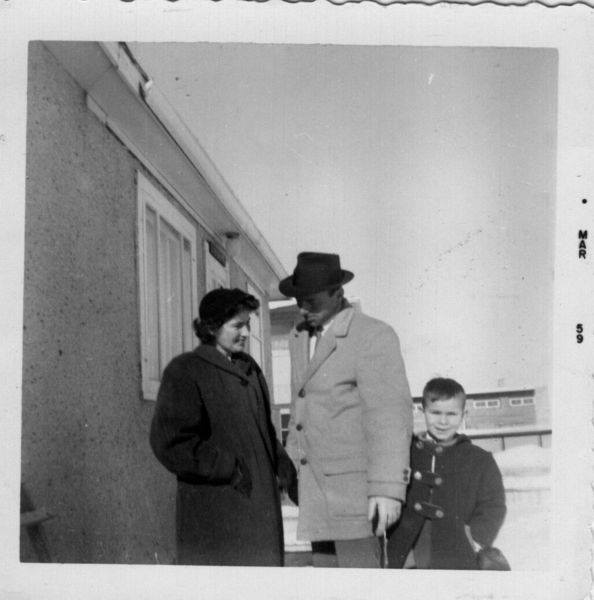
Gerald was amenable to the suggestion.
There’s no indication that Opa ever thought he was getting anything but a fantastic package when he wooed and wed a single mother of three children. My mother recalls that she could never see any difference between how Opa treated the children he gained by marriage and the daughter and son that came after. They were all his children.
Opa Wynands embraced responsibility throughout his life. He’d grown up poor, in a rural area. Like Jan, Gerald came from a farming family. Unlike the Feddemas, the Wynands didn’t own the land they worked on. There wasn’t much in the way of extra comforts or security, and Opa rather sheepishly admitted, later in life, that his time in a German work camp during the war had been a step up. He’d always been poor, and in the camps that housed Dutch laborers there was (by policy) at least always plenty of food and the occasional entertainment or social outing.
Gerald’s ambition was to someday, somewhere, farm his own land and see his hard work support the people he loved. When he brought his new wife and children home to his farm in Ontario, these dreams took on substance. No longer was it “someday, somewhere,” it was “now, here, with Anna, with Truus and Adrian and Eduard.”
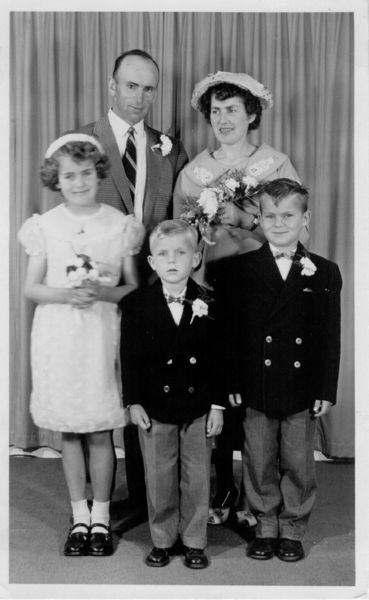
Opa’s life is marked by the embrace of responsibility and generosity. If you’ve been keeping track, my mother wound up with four extra siblings–five children in total. But there’s rarely as few as five children in the pictures from her childhood on the farm. There were always neighbors and friends around. Oma and Opa’s home was always welcoming to visitors.
Then, as their own children grew, Oma and Opa opened their home to foster children, who my mother recalls were “part of our family, little sisters and brothers who received their share of the love, fun and teasing that are so much a part of family life.” One of the last children they fostered was my cousin–adopted by my uncle and aunt after Oma and Opa fostered him.
The scarcity in Gerald’s childhood could have made him grasping and fearful of losing what he’d gained through his hard work–but instead his life was marked with an open-handedness that only expanded to include more people–his wife and her family and her deceased husband’s family, his neighbors and community and the children he fostered, his children’s spouses and their families, grandchildren and great-grandchildren and so many more.
This is the inheritance I have from my Opa Wynands.
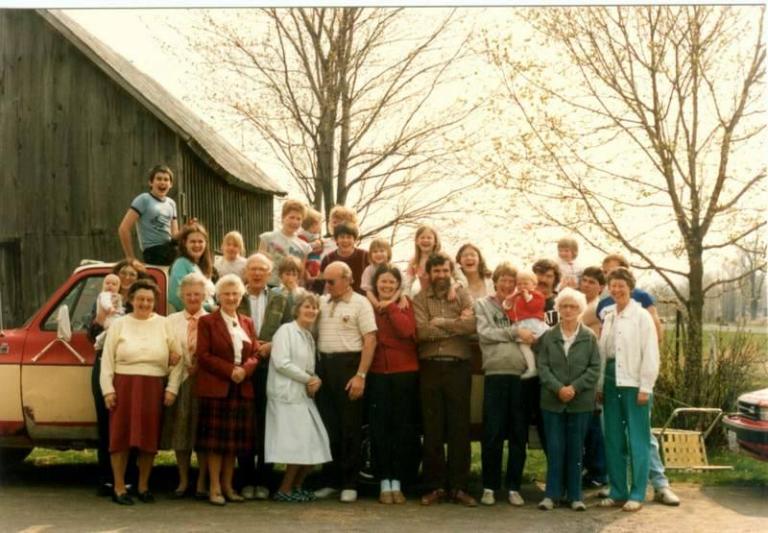
That’s a picture taken during a family gathering when I was a child. (I’m one of the many blond children, good luck figuring out which one!)
When I look at this photo, I see aunts and uncles and cousins. I see my aunt’s mother-in-law and grandmother-in-law on the far left. I see my paternal grandmother on the far right, standing beside my uncle’s mother-in-law–and her parents are standing over beside Oma and Opa. (Keeping track? That’s Opa’s wife, children, and grandchildren; his children’s spouses, his children’s spouse’s parents, and several of his children’s spouse’s parent’s parents.)
Opa taught us, by example, that there is nothing small about family, nothing burdensome in hospitality, and nothing constricting about responsibility.
Previous Post

May 21, 2018
A Tale of Two Husbands: Jan Feddema (Four Weeks of Fine Men #1)
Next Post

May 23, 2018 Formed in Friendship: Brian and Caden (Four Weeks of Fine Men #3)
Browse Our Archives
Select a Category ADHD Blog Business Body and Soul Books Faith Faith in Action Family Feminism Fertility Awareness Friendship Geekiness Guest Post History Hope Just For Fun Love Marriage Memory Mental Exercise Movies Parenting Personalism Poetry Prayer Quotes Scripture Seven Quick Takes Striving for Holiness Television The Stories We Tell The World Uncategorized
Select a Month September 2018 August 2018 July 2018 June 2018 May 2018 April 2018 February 2018 January 2018 December 2017 November 2017 October 2017 September 2017 August 2017 July 2017 June 2017 May 2017 April 2017 March 2017 February 2017 January 2017 December 2016 November 2016 October 2016 August 2016 June 2016 March 2016 January 2016 November 2015 October 2015 August 2015 July 2015 May 2015 April 2015 February 2015 December 2014 November 2014 September 2014 August 2014 July 2014 June 2014 May 2014 April 2014 March 2014 February 2014 December 2013 November 2013 October 2013 September 2013 August 2013 July 2013 June 2013 May 2013 March 2013 February 2013 January 2013 December 2012 November 2012 June 2012 May 2012 April 2012 March 2012 February 2012 January 2012 August 2011 December 2010 November 2010 October 2010 September 2010 August 2010 June 2010 May 2010 April 2010 November 2009 October 2009 August 2009 July 2009 June 2009 May 2009 April 2009
Follow Us!
TAKE THE
Religious Wisdom Quiz
Who said, "Though he slay me, yet will I hope in him"?
Select your answer to see how you score.
Isaiah David Job Peter
Support this
Column


Related posts from Peace and Pekoe


Feeling Betrayed by the Church? Look to the...
Why "This Is Us" Is the Medicine We...
TRENDING AT PATHEOS Catholic

Creation, Preservation, and Teleology in Catholic Theology
As I write this, it is very early Monday morning. Like millions...

The Parable Of The Sower And The Word...
One of Christ’s most famous parables is that of the sower who...

Rejecting Doom: Christian Hope And Human Action
Christianity is a religion of hope. We are to have hope and...

Why I Choose the Eucharist Over the Sermon
Choose the Eucharist, Not the Sermon What are we supposed to get...

5 Design Elements Found in Spiritually Rooted Homes
Putting Spirituality Into Home Decor Our homes are more than our living...

Credo: A Story of God Told with the...
About 10 years ago, I began to imagine a personal "Credo" that...
view all Catholic blogs
Ad-Free & Subscriber Log-In Subscription Support
- About Us
- 2026 Calendar
- Videos
- Podcasts
- Library of World Religions
- Faith In Media Tracker
- Advertise With Us
- Write for Us
- Privacy Policy
- Terms of Service
- Do Not Sell My Data
- Contact Us
- Radiant Digital
- Manage Newsletter Subscriptions
- Unsubscribe From Notifications
- Sitemap
Copyright 2008-2026, Patheos. All rights reserved.
Subscription Support Ad-Free & Subscriber Log-In
Follow Patheos