
BuddhistCatholicContemplativeEvangelicalGeneral ChristianHinduJewishLatter-day SaintMuslimNew VisionsProgressive Christian
Beliefs
- Buddhist
- Catholic
- Contemplative
- Evangelical
- General Christian
- Hindu
- Jewish
- Latter-day Saint
- More Voices
- Muslim
- New Visions
- Pagan
- Progressive Christian
Topics
- Religion News
- Food and Religion
- Sports and Religion
- Religious Art
- Religious Music and Entertainment
- Religious Events
- History and Religion
- Style and Religion
- Politics and Religion
- Women in Religion
- Recreation Outdoors and Religion
- Business Finance and Religion
- Careers Workplace and Religion
- Education and Religion
- Family Parenting and Religion
- Health Fitness and Religion
- Home and Religion
- Relationships and Religion
- Technology and Religion
- Travel and Religion
Columnists
- Buddhist Columnists
- Business Finance and Religion Columnists
- Careers Workplace and Religion Columnists
- Catholic Columnists
- Contemplative Columnists
- Education and Religion Columnists
- Evangelists Columnists
- Family Parenting and Religion Columnists
- General Christian Columnists
- Health Fitness and Religion Columnists
- Hindu Columnists
- History and Religion Columnists
- Home and Religion Columnists
- Jewish Columnists
- More Voices Columnists
- Latter Day Columnists
- Muslim Columnists
- New Visions Columnists
- Nonreligious Columnists
- Pagan Columnists
- Politics and Religion Columnists
- Progressive Columnists
- Recreation Outdoors and Religion Columnists
- Relationships and Religion Columnists
- Religion News Columnists
- Religious Art Columnists
- Religious Events Columnists
- Religious Music and Entertainment Columnists
- Sports and Religion Columnists
- Style and Religion Columnists
- Technology and Religion Columnists
- Travel and Religion Columnists
- Women in Religion Columnists
Resource Library
- 2026 Calendar
- Library of World Religions
- The 100 Most Holy Places on Earth
- Patheos Answers
- Podcasts
- Videos
- Faith Leaders Database
- Anglican Episcopalian
- Bahai
- Baptist
- Buddhism
- Christianity
- Confucianism
- Eastern Orthodoxy
- Hinduism
- Holiness and Pentecostal
- ISKCON
- Islam
- Judaism
- Lutheran
- Methodist
- The Church of Jesus Christ of Latter-day Saints
- New Age
- Paganism
- Presbytarian and Reformed
- Protestantism
- Religion Behind the Scenes
- Roman Catholic
- Scientology
- Shia Islam
- Sikhism
- Sufism
- Sunni Islam
- Taoism
- Zen
- See all religions
Research Tools
 Ad-Free & Subscriber Log-In Subscription Support
Ad-Free & Subscriber Log-In Subscription Support
Follow Patheos 

- Trending:
- Forgiveness
- |
- Marriage
- |
- Consciousness
- |
- Death Penalty
- |
- Election
- |
- Halloween
 Peace and Pekoe
- Home
- Catholic
- A Tale of Two Husbands: Jan Feddema (Four Weeks of Fine Men #1)
A Tale of Two Husbands: Jan Feddema (Four Weeks of Fine Men #1)
Last updated on: May 21, 2018 at 9:56 am by Kate Cousino
A Tale of Two Husbands: Jan Feddema (Four Weeks of Fine Men #1) 2018-05-21T09:56:42-04:00 Kate Cousino
Patheos Explore the world's faith through different perspectives on religion and spirituality! Patheos has the views of the prevalent religions and spiritualities of the world.
I’d like to kick off my four weeks of fine men by telling you all a bit about two men whose ordinary choices shaped the family and world I was born into.
This is the story of the first of my two maternal grandfathers.
This is my grandmother, Anna van Bakelen, and her first husband, Jan Feddema.
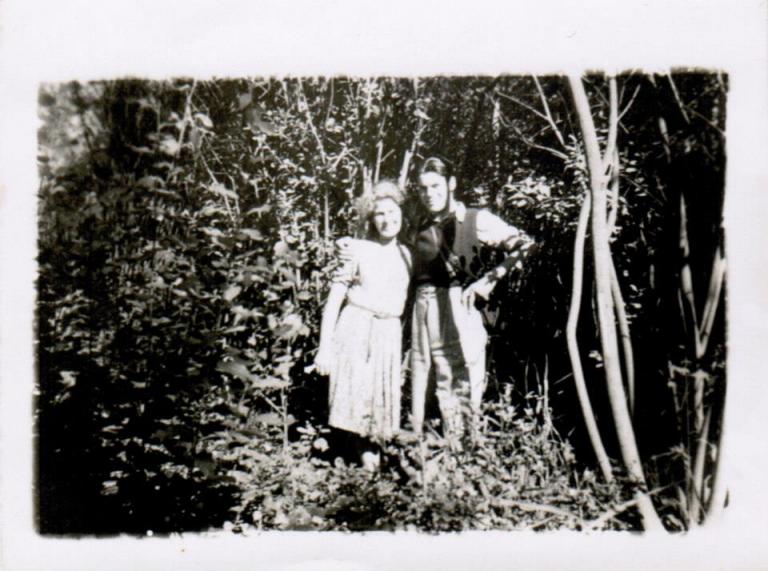
While the setting for their romance may seem pretty dramatic to us–they fell in love and courted during the German occupation of the Netherlands–Anna and Jan were no different from many of their peers. Anna was a city girl whose mother owned a beauty salon in Amsterdam. Jan was a country kid from a farming family who learned a trade. They waited for the war to end and dreamed of the life they would build together.
When the war ended, Jan and Anna married and had a daughter–my mother. Soon afterward, Anna became pregnant again. Things were hard in the Netherlands during the post-war reconstruction era, and Jan and Anna were concerned about the opportunities their children would have. Some of Jan’s relatives had already emigrated to Canada, and when their second child–a son–was born, Jan and Anna decided to emigrate as well.
This is pretty much all I know about my maternal grandfather. Jan (Johannes) Feddema was a farm kid. He fell in love during a war, and waited faithfully for the day he could marry. He trained as a welder to be able to support his new family. He chose to move away from everything he knew to give his children a better life.
Aside from that, I have one story of my Opa Feddema. One day, after their move to Western Canada, while walking home to his wife after a long day of work, Opa Feddema spotted the evening light reflecting off something shiny in the trash. When he got home, he showed his bride his discovery–a glass saltshaker with a steel top.
When Oma told me the story, she couldn’t help but laugh. “He had to rescue it. He said, ‘Look at this! Stainless steel! This could last a hundred years, and someone just–pffff–threw it away like trash!’ So now whenever I think ‘I don’t need this old saltshaker, I should get rid of it,’ I remember what he said and then I can’t throw it out.”
Opa Feddema lived only a short while in Canada–long enough to see another son born–and then he died of a heart attack, or maybe a stroke.
Why start my “four weeks of fine men” with my Opa Feddema?
It seems like a lot of men have trouble choosing between the various possible paths in front of them. It’s hard to commit to any one course when you don’t know where it will lead. What we suffer now is not a paucity of choices, but paralysis in the face of too many choices. Every commitment to a course of study, a new hobby, a cause, a skill, or a woman makes the field of choices a little smaller. What if some other path would have been easier, more prosperous, richer, better?
And then some toxic forms of masculinity embrace passivity as a sort of petulant middle finger in the face of looming responsibility–I can’t be responsible for the consequences of the choices I refuse to make. There is always an excuse, a reason not to set a new direction or make a life-changing decision. Passivity feels safer.
But a life of meaning requires more.
Opa Feddema never knew where his decisions would lead. He fell in love during a war, when the very future of Europe was in question. He moved his family across the globe, not knowing what awaited them in Canada. He set the foundations for a life that he didn’t get to finish building. He lived a life of purpose and direction, and, from the stories and photos, a fair bit of gusto.
His choices–to dare to hope and plan in the midst of the darkness of war, to wait, to change everything to build the life he envisioned for his children–shaped his children’s futures, and through them, my own.
Opa Feddema didn’t live to raise his children to adulthood. He didn’t get to walk my mother down the aisle. He didn’t live to see where his choices would lead.
But he lived.
And his salt-shaker has a place of honor in my home.
After all, like his legacy, it could easily last a hundred years.
Previous Post

May 20, 2018
Four Weeks of Fine Men
Next Post

May 22, 2018 A Tale of Two Husbands: Gerald Wynands (Four Weeks of Fine Men #2)
Browse Our Archives
Select a Category ADHD Blog Business Body and Soul Books Faith Faith in Action Family Feminism Fertility Awareness Friendship Geekiness Guest Post History Hope Just For Fun Love Marriage Memory Mental Exercise Movies Parenting Personalism Poetry Prayer Quotes Scripture Seven Quick Takes Striving for Holiness Television The Stories We Tell The World Uncategorized
Select a Month September 2018 August 2018 July 2018 June 2018 May 2018 April 2018 February 2018 January 2018 December 2017 November 2017 October 2017 September 2017 August 2017 July 2017 June 2017 May 2017 April 2017 March 2017 February 2017 January 2017 December 2016 November 2016 October 2016 August 2016 June 2016 March 2016 January 2016 November 2015 October 2015 August 2015 July 2015 May 2015 April 2015 February 2015 December 2014 November 2014 September 2014 August 2014 July 2014 June 2014 May 2014 April 2014 March 2014 February 2014 December 2013 November 2013 October 2013 September 2013 August 2013 July 2013 June 2013 May 2013 March 2013 February 2013 January 2013 December 2012 November 2012 June 2012 May 2012 April 2012 March 2012 February 2012 January 2012 August 2011 December 2010 November 2010 October 2010 September 2010 August 2010 June 2010 May 2010 April 2010 November 2009 October 2009 August 2009 July 2009 June 2009 May 2009 April 2009
Follow Us!
TAKE THE
Religious Wisdom Quiz
What sign marked the houses to be spared during Passover?
Select your answer to see how you score.
A lit candle A red ribbon A dove symbol Blood on doorposts
Support this
Column


Related posts from Peace and Pekoe

A Way Wherein There Is No Ecstasy


Feeling Betrayed by the Church? Look to the...
Why "This Is Us" Is the Medicine We...
TRENDING AT PATHEOS Catholic

Creation, Preservation, and Teleology in Catholic Theology
As I write this, it is very early Monday morning. Like millions...

The Parable Of The Sower And The Word...
One of Christ’s most famous parables is that of the sower who...

Rejecting Doom: Christian Hope And Human Action
Christianity is a religion of hope. We are to have hope and...

Why I Choose the Eucharist Over the Sermon
Choose the Eucharist, Not the Sermon What are we supposed to get...

5 Design Elements Found in Spiritually Rooted Homes
Putting Spirituality Into Home Decor Our homes are more than our living...

Credo: A Story of God Told with the...
About 10 years ago, I began to imagine a personal "Credo" that...
view all Catholic blogs
Ad-Free & Subscriber Log-In Subscription Support
- About Us
- 2026 Calendar
- Videos
- Podcasts
- Library of World Religions
- Faith In Media Tracker
- Advertise With Us
- Write for Us
- Privacy Policy
- Terms of Service
- Do Not Sell My Data
- Contact Us
- Radiant Digital
- Manage Newsletter Subscriptions
- Unsubscribe From Notifications
- Sitemap
Copyright 2008-2026, Patheos. All rights reserved.
Subscription Support Ad-Free & Subscriber Log-In
Follow Patheos