
BuddhistCatholicContemplativeEvangelicalGeneral ChristianHinduJewishLatter-day SaintMuslimNew VisionsProgressive Christian
Beliefs
- Buddhist
- Catholic
- Contemplative
- Evangelical
- General Christian
- Hindu
- Jewish
- Latter-day Saint
- More Voices
- Muslim
- New Visions
- Pagan
- Progressive Christian
Topics
- Religion News
- Food and Religion
- Sports and Religion
- Religious Art
- Religious Music and Entertainment
- Religious Events
- History and Religion
- Style and Religion
- Politics and Religion
- Women in Religion
- Recreation Outdoors and Religion
- Business Finance and Religion
- Careers Workplace and Religion
- Education and Religion
- Family Parenting and Religion
- Health Fitness and Religion
- Home and Religion
- Relationships and Religion
- Technology and Religion
- Travel and Religion
Columnists
- Buddhist Columnists
- Business Finance and Religion Columnists
- Careers Workplace and Religion Columnists
- Catholic Columnists
- Contemplative Columnists
- Education and Religion Columnists
- Evangelists Columnists
- Family Parenting and Religion Columnists
- General Christian Columnists
- Health Fitness and Religion Columnists
- Hindu Columnists
- History and Religion Columnists
- Home and Religion Columnists
- Jewish Columnists
- More Voices Columnists
- Latter Day Columnists
- Muslim Columnists
- New Visions Columnists
- Nonreligious Columnists
- Pagan Columnists
- Politics and Religion Columnists
- Progressive Columnists
- Recreation Outdoors and Religion Columnists
- Relationships and Religion Columnists
- Religion News Columnists
- Religious Art Columnists
- Religious Events Columnists
- Religious Music and Entertainment Columnists
- Sports and Religion Columnists
- Style and Religion Columnists
- Technology and Religion Columnists
- Travel and Religion Columnists
- Women in Religion Columnists
Resource Library
- 2026 Calendar
- Library of World Religions
- The 100 Most Holy Places on Earth
- Patheos Answers
- Podcasts
- Videos
- Faith Leaders Database
- Anglican Episcopalian
- Bahai
- Baptist
- Buddhism
- Christianity
- Confucianism
- Eastern Orthodoxy
- Hinduism
- Holiness and Pentecostal
- ISKCON
- Islam
- Judaism
- Lutheran
- Methodist
- The Church of Jesus Christ of Latter-day Saints
- New Age
- Paganism
- Presbytarian and Reformed
- Protestantism
- Religion Behind the Scenes
- Roman Catholic
- Scientology
- Shia Islam
- Sikhism
- Sufism
- Sunni Islam
- Taoism
- Zen
- See all religions
Research Tools
 Ad-Free & Subscriber Log-In Subscription Support
Ad-Free & Subscriber Log-In Subscription Support
Follow Patheos 

- Trending:
- Forgiveness
- |
- Marriage
- |
- Consciousness
- |
- Death Penalty
- |
- Election
- |
- Halloween
 Peace and Pekoe
- Home
- Catholic
- What a fictional wizard taught me about fear, faith, and friendship
What a fictional wizard taught me about fear, faith, and friendship
Last updated on: April 6, 2018 at 7:36 pm by Kate Cousino
What a fictional wizard taught me about fear, faith, and friendship 2018-04-06T19:36:20-04:00 Kate Cousino
Patheos Explore the world's faith through different perspectives on religion and spirituality! Patheos has the views of the prevalent religions and spiritualities of the world.
This is a post about a wizard named Harry, and a lesson I needed to re-learn.
(No, not the “you’re-a-wizard-Harry” you’re probably thinking of. A different wizard named Harry.)
I’ve been reading an urban fantasy series, the Dresden Files. Re-reading, actually. The joy of re–reading a familiar book is the mental space it creates for appreciating or critiqueing the author’s craft and depth (or shallowness) of insight. The first time around, I’m just enjoying the story. The second time around, I can think about why I enjoy it and what the author is doing. By the third time around, I guess I’m finally ready to think about what I’m getting from the book and what it has to teach me about myself.
So this morning I woke up thinking about the motivations of a couple of fictional characters. The titular character, Harry Dresden, is a wizard and a private investigator in Chicago. Echoing Marlowe and all the great noir detectives, Dresden is more than a little touched by the same darkness he stands against.
One of his friends is a Knight of the Cross–a holy warrior, essentially, whose mission is to counter the influence of a number of fallen angels. He’s also Catholic and deeply informed and motivated by his faith.
(The introduction of this character was interesting to me to begin with–the author is not, to my knowledge, a person of faith, and certainly not a Catholic. He gets some of the details of his angelology and theology wrong, but succeeds in making this Knight, Michael, a human, fully-realized character motivated by deep faith and conviction, without resorting to stereotypes or prejudice. As you’ll see momentarily.)
In the course of the books, Harry becomes tainted by the influence–the “shadow” or echo or imprint–of one of the fallen angels it is Michael’s task to oppose. He is so afraid of losing Michael’s respect and friendship should he learn that Harry is living daily with this spirit’s temptations that he avoids his friend.
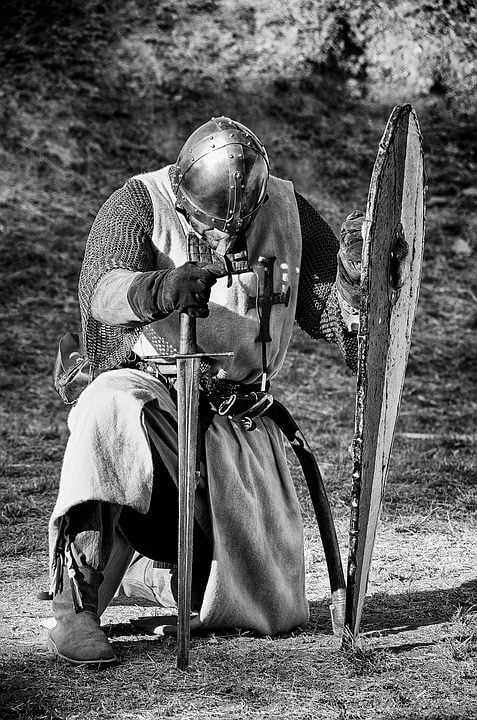
To be fair, “Holy Knight” can conjure up some pretty scary associations. (Photo via MaxPixel)
But when he finally finds the courage to tell Michael his secret….nothing happens. Michael’s response to Dresden’s compromise with a dark influence is compassion and the offer of aid and friendship–not rejection or revulsion.
What Dresden has been told but obviously never understood is that Michael’s primary mission is not to kill or fight those marked by darkness–it’s to save them. With Michael, “hate the sin, love the sinner” is no empty platitude.
Michael’s convictions allow him to see souls worth saving in even those who become literally monstrous in service to evil. Every violent victory over the earthly allies of the fallen also represents a defeat, a soul who could not be reached.
***
It’s not hard for me to figure out why this bit of story-telling and characterization was at the forefront of my mind this morning. Last night, I spent several hours working on a draft of a post about the tendency of ideological communities to polarise. This polarization leads to (and is fostered by) increasingly extreme responses to those perceived to be tainted by malign and dangerous outside influences. Relational complexities are waved away; association is endorsement, compassion is complicity.
I also tangled in the comments boxes on some Facebook posts over the justness of judging and ostracizing others based on their social media connections. Specifically, I’ve argued that while everyone has to make their own judgments about who they associate with, a lot of factors go into those choices, and characterizing them as black and white, me-vs-them value judgments is too simplistic.
This binary dichotomy is more or less the attitude Harry expects to encounter in Michael. He expects his association with the shade of a fallen angel to create tension and distrust, and a loss of friendship. He’s fought against the Fallen alongside Michael before, he’s fought against the shade’s temptations, and he has refused to free or ally himself with the actual fallen angel. But he doesn’t really expect Michael to appreciate any of these distinctions.
And can we blame him? Michael’s ability to still see and value the good of his friend comes from a depth of faith most of us don’t have. He is afraid for Harry rather than afraid of his proximity to darkness. When he tells Harry that he can be free of the presence and temptations of the fallen angel’s shadow, but he would have to voluntarily cease to exercise his magical powers–the power that is Harry’s primary tool to defend innocents and the powerless–he is offering him a choice, not an ultimatum. There’s no conditional attached.
Michael and Harry, of course, are fictional characters. My frightened FB friends are not. They may not be able to be all I want them to be. It may be unreasonable to hope for openness from those who feel threatened, and understanding from those who feel misunderstood.
As much as I would like to be like Michael Carpenter and rise above fear, I fall short of the mark. Fear is everywhere. It might be genuine concern and principal that motivates me to argue against false dichotomies and ideological purity tests, but it’s fear that makes me dig in my heels to argue the point against a friend–fear for them and of them, fear of losing friends to the extremes, of being counted an enemy where I was once welcomed as an ally. Of being left to stand alone.
I cannot compel my friends to lay down their defences to avoid the dangers I see accompanying them. I can only present my case and allow myself to be challenged to live accordingly.
I’m not wizard or knight, and my influence and power are small. I feel vulnerable; I get scared. Whoever else I write for, whatever power or inspiration you, my reader, may find in my words or ideas, the most important test is whether my ideas have the power to inspire and challenge me.
I hope I am able to pass that test, when it comes to the final tally.
Previous Post

February 28, 2018
It's Not About You
Next Post

April 20, 2018 The Romantic Myth of the Ethno-National Underdog
Browse Our Archives
Select a Category ADHD Blog Business Body and Soul Books Faith Faith in Action Family Feminism Fertility Awareness Friendship Geekiness Guest Post History Hope Just For Fun Love Marriage Memory Mental Exercise Movies Parenting Personalism Poetry Prayer Quotes Scripture Seven Quick Takes Striving for Holiness Television The Stories We Tell The World Uncategorized
Select a Month September 2018 August 2018 July 2018 June 2018 May 2018 April 2018 February 2018 January 2018 December 2017 November 2017 October 2017 September 2017 August 2017 July 2017 June 2017 May 2017 April 2017 March 2017 February 2017 January 2017 December 2016 November 2016 October 2016 August 2016 June 2016 March 2016 January 2016 November 2015 October 2015 August 2015 July 2015 May 2015 April 2015 February 2015 December 2014 November 2014 September 2014 August 2014 July 2014 June 2014 May 2014 April 2014 March 2014 February 2014 December 2013 November 2013 October 2013 September 2013 August 2013 July 2013 June 2013 May 2013 March 2013 February 2013 January 2013 December 2012 November 2012 June 2012 May 2012 April 2012 March 2012 February 2012 January 2012 August 2011 December 2010 November 2010 October 2010 September 2010 August 2010 June 2010 May 2010 April 2010 November 2009 October 2009 August 2009 July 2009 June 2009 May 2009 April 2009
Follow Us!
TAKE THE
Religious Wisdom Quiz
What does "Genesis" mean?
Select your answer to see how you score.
Law Origin or beginning History Wisdom
Support this
Column


Related posts from Peace and Pekoe

A Way Wherein There Is No Ecstasy



Feeling Betrayed by the Church? Look to the...
TRENDING AT PATHEOS Catholic

Rejecting Doom: Christian Hope And Human Action
Christianity is a religion of hope. We are to have hope and...

It’s What Comes From Within Which Matters
One of the most difficult things for us to understand is why...

Why I Choose the Eucharist Over the Sermon
Choose the Eucharist, Not the Sermon What are we supposed to get...

5 Design Elements Found in Spiritually Rooted Homes
Putting Spirituality Into Home Decor Our homes are more than our living...

Credo: A Story of God Told with the...
About 10 years ago, I began to imagine a personal "Credo" that...

The Anatomy of Divine Revelation in Catholic Thought
The claim that God has made Himself known to human beings is...
view all Catholic blogs
Ad-Free & Subscriber Log-In Subscription Support
- About Us
- 2026 Calendar
- Videos
- Podcasts
- Library of World Religions
- Faith In Media Tracker
- Advertise With Us
- Write for Us
- Privacy Policy
- Terms of Service
- Do Not Sell My Data
- Contact Us
- Radiant Digital
- Manage Newsletter Subscriptions
- Unsubscribe From Notifications
- Sitemap
Copyright 2008-2026, Patheos. All rights reserved.
Subscription Support Ad-Free & Subscriber Log-In
Follow Patheos