
BuddhistCatholicContemplativeEvangelicalGeneral ChristianHinduJewishLatter-day SaintMuslimNew VisionsProgressive Christian
Beliefs
- Buddhist
- Catholic
- Contemplative
- Evangelical
- General Christian
- Hindu
- Jewish
- Latter-day Saint
- More Voices
- Muslim
- New Visions
- Pagan
- Progressive Christian
Topics
- Religion News
- Food and Religion
- Sports and Religion
- Religious Art
- Religious Music and Entertainment
- Religious Events
- History and Religion
- Style and Religion
- Politics and Religion
- Women in Religion
- Recreation Outdoors and Religion
- Business Finance and Religion
- Careers Workplace and Religion
- Education and Religion
- Family Parenting and Religion
- Health Fitness and Religion
- Home and Religion
- Relationships and Religion
- Technology and Religion
- Travel and Religion
Columnists
- Buddhist Columnists
- Business Finance and Religion Columnists
- Careers Workplace and Religion Columnists
- Catholic Columnists
- Contemplative Columnists
- Education and Religion Columnists
- Evangelists Columnists
- Family Parenting and Religion Columnists
- General Christian Columnists
- Health Fitness and Religion Columnists
- Hindu Columnists
- History and Religion Columnists
- Home and Religion Columnists
- Jewish Columnists
- More Voices Columnists
- Latter Day Columnists
- Muslim Columnists
- New Visions Columnists
- Nonreligious Columnists
- Pagan Columnists
- Politics and Religion Columnists
- Progressive Columnists
- Recreation Outdoors and Religion Columnists
- Relationships and Religion Columnists
- Religion News Columnists
- Religious Art Columnists
- Religious Events Columnists
- Religious Music and Entertainment Columnists
- Sports and Religion Columnists
- Style and Religion Columnists
- Technology and Religion Columnists
- Travel and Religion Columnists
- Women in Religion Columnists
Resource Library
- 2026 Calendar
- Library of World Religions
- The 100 Most Holy Places on Earth
- Patheos Answers
- Podcasts
- Videos
- Faith Leaders Database
- Anglican Episcopalian
- Bahai
- Baptist
- Buddhism
- Christianity
- Confucianism
- Eastern Orthodoxy
- Hinduism
- Holiness and Pentecostal
- ISKCON
- Islam
- Judaism
- Lutheran
- Methodist
- The Church of Jesus Christ of Latter-day Saints
- New Age
- Paganism
- Presbytarian and Reformed
- Protestantism
- Religion Behind the Scenes
- Roman Catholic
- Scientology
- Shia Islam
- Sikhism
- Sufism
- Sunni Islam
- Taoism
- Zen
- See all religions
Research Tools
 Ad-Free & Subscriber Log-In Subscription Support
Ad-Free & Subscriber Log-In Subscription Support
Follow Patheos 

- Trending:
- Forgiveness
- |
- Marriage
- |
- Consciousness
- |
- Death Penalty
- |
- Election
- |
- Halloween
 Peace and Pekoe
- Home
- Catholic
- Monuments, Racism, Redemption, and Charlottesville: Seven Stories of How Things Can Be between Men (and Women) on this Earth
Monuments, Racism, Redemption, and Charlottesville: Seven Stories of How Things Can Be between Men (and Women) on this Earth
Last updated on: August 18, 2017 at 2:37 pm by Kate Cousino
Monuments, Racism, Redemption, and Charlottesville: Seven Stories of How Things Can Be between Men (and Women) on this Earth 2017-08-18T14:37:36-04:00 Kate Cousino
Patheos Explore the world's faith through different perspectives on religion and spirituality! Patheos has the views of the prevalent religions and spiritualities of the world.

This has been an awfully depressing week, with the news out of Charlottesville overshadowing everything. Fortunately, as ever when humanity is awful, there are wonderful points of light that shine through, shedding clarity and lighting the way forward. Here are seven thought-provoking stories and links about race, history, hatred, love, and redemption I came across this week, plus something I wrote that I hope also sheds more light than darkness.
— 1 —
In a piece of grace, this link was in one of my Facebook memories this week, offering light and hope while I struggled to absorb and understand events in Charlottesville. It tells of the friendship that began between African-American runner Jesse Owens and German runner Luz Long during the charged atmosphere of the 1936 Summer Olympics in Germany.
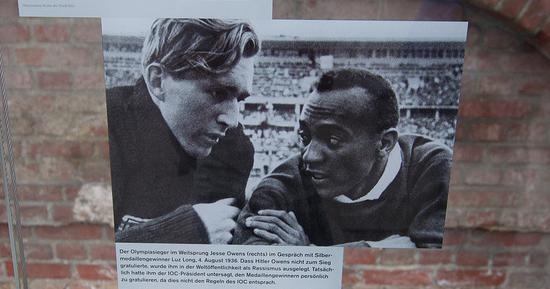
Luz Long and Jesse Owens, from a display in Berlin. Photo via flickr.
Their friendship continued through correspondence over the years that followed, culminating in Long’s heartbreaking last letter to Jesse, written from North Africa where he was stationed with the German Army and where he died.
My heart tells me, if I be honest with you, that this is the last letter I shall ever write. If it is so, I ask you something. It is a something so very important to me. It is you go to Germany when this war done, someday find my Karl, and tell him about his father. Tell him, Jesse, what times were like when we not separated by war. I am saying—tell him how things can be between men on this earth.
I think we could all do with a reminder of how things can be between men and women of goodwill, no matter how many differences seem to separate us.
— 2 —
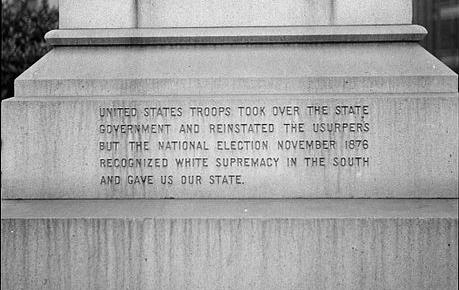
Photo of Liberty Place Monument by Dorothea Lange, via wikimedia.
There may be one good thing–depending on your perspective–to come from the horror good people felt at the sight of unhooded, openly racist white nationalists, neo-nazis, and white supremacists marching and chanting “blood and soil” in Charlottesville, VA last weekend.
It’s beginning to look like it has definitively settled the question of whether confederate monuments ought to be removed from places of honour. From TIME:
The deadly white nationalist rally in Charlottesville, Virginia, is fueling another re-evaluation of Confederate statues in cities across the nation, accelerating their removal in much the same way that a 2015 mass shooting by a white supremacist renewed pressure to take down the Confederate flag from public property.
“We should not glorify a part of our history in front of our buildings that really is a testament to America’s original sin,” Gainesville Mayor Lauren Poe said Monday after the statue known as “Old Joe” was returned to the United Daughters of the Confederacy, which erected it in 1904.
As Erin of Bearing Blog wrote, the day after the rally in Charlottesville, in a post entitled, “Yesterday changed my mind,”
If Confederate monuments and the graves of fallen soldiers are to be a rallying point for swastika flags and chants of “Blut und Boden”;
If anti-Black and anti-Jew and anti-immigrant cheers are to rise from crowds, encircling the bronze hooves of poor effigied horses bearing graven images of white supremacy on their backs;
then tear them all up, and shove them every one–the more beautifully executed and artistic, the more damning, because white people really did pour their creativity, their resources, and their capacity for beauty into memorials to crushing faces with boots–shove them all into the museums, where people with sense can make rules about maximum occupancy, noise levels, and weapons.
I thought we needed to have it all out in the open, where we would all be forced to reckon with our past. It turns out that we are not wise enough or kind enough as a people to handle it. We must, it seems, put them under armed glass after all.
— 3 —
![By Gil (Own work) [CC BY 2.0 (http://creativecommons.org/licenses/by/2.0)], via Wikimedia Commons](https://wp-media.patheos.com/blogs/sites/754/2017/08/1024px-Troll_Warning-e1503079567516.jpg)
Troll Warning image by Gil (Own work) [CC BY 2.0], via Wikimedia Commons

Given the ubiquity of “ironic” trolling online, and the blurriness of the line between “irony” and actual racist contempt, I can only hope–for the sake of my children’s generation, who spend so much time online–that NYMag is right that we are seeing the beginning of the end of the “ironic nazi.”
When you break it down, the only thing people can do on the internet — contained entirely to the internet — is talk. It is all discourse, and hypotheticals, and bluster, and trolling. But it can do real harm, because as soon as that conversation spills into tangible space, the hypothetical vanishes.
As this…I’ll call him a “Nazi bro”…discovered, there are more immediate and tangible consequences to trolling like a Nazi “just for the fun” in real life.
I’d never heard of alt-right YouTube celebrities Baked Alaska or Millenial Matt before this week, but I was, like a lot of parents, horrified the first time my son clicked away from the (parentally screened and approved) gameplay videos of StampyCat and iBallisticSquid and stumbled into the very popular gameplay videos and reviews of foul-mouthed Internet celebrity PewDiePie.
PewDiePie lost a Disney contract in February over his use of racial slurs and Holocaust humor. Late to the game, he’s decided this week to distance himself from the Daily Stormers and alt-right “racialists” who came to his defence then, weakly declaring that “Nazi memes are not even that funny anymore.”
They weren’t funny to begin with, bro.
— 4 —
All of the above made me doubly grateful to see this Medium piece from half of my family’s favourite YouTube duo. From Rhett McLaughlin, Thoughts on Confederate Statues from a Southern White Male.
Growing up in the South, I was told (and unfortunately believed) a number of things about the Confederacy. Of course, I heard the common Southern sentiment that the Civil War was about states’ rights and definitely not slavery, but I was also told that the Confederate generals were upstanding and honorable men, while the Union generals consisted of morally corrupt misfits. I was told that many Southern slaveowners treated their slaves well (aside from the whole “forcing them to be slaves” part, I guess). I even heard that the Northern, non-slave-holding states were just as racist and oppressive as the South (maybe even more so).
The fact that none of this was true didn’t matter […]
This same revisionist and racist mindset is what fueled the erecting of Confederate memorials throughout the South. The vast majority of them were built between 1895 and World War I, a time of violent persecution of black people as well as the systemic and government-sanctioned oppression of Jim Crow laws. Some statues were put up during the civil rights movement. Their message was clear: the South belongs to whites.
In light of today’s controversy over these Confederate memorials, I keep hearing people say that their removal is an attempt to erase history. This misses the point entirely. The memorials themselves were an attempt to erase history….
— 5 —

Shabbat image via Pixabay
More hopeful yet, here is a story published last year that escaped my notice until this week. It is, at its heart, another story of “how things can be between people on this earth,” as well as a story about change, about autonomy from one’s family, and about redemption. The piece is about the ideological journey of Derek Black, son of Stormfront founder Don Black and godson to David Duke, after students at his college learned of his role in white nationalist media and activism.
“Ostracizing Derek won’t accomplish anything,” one student wrote.
“We have a chance to be real activists and actually affect one of the leaders of white supremacy in America. This is not an exaggeration. It would be a victory for civil rights.”
“Who’s clever enough to think of something we can do to change this guy’s mind?”
One of Derek’s acquaintances from that first semester decided he might have an idea. He started reading Stormfront and listening to Derek’s radio show. Then, in late September, he sent Derek a text message.
“What are you doing Friday night?” he wrote.
[…]
“You have never clarified, Derek,” one of his Shabbat friends wrote to him. “You’ve never said, ‘Hey all, this is what I do believe and this is what I don’t.’ It’s not the job of someone who’s potentially scared/intimidated by someone else to approach that person to see if they are in fact scary/intimidating.”
“I guess I only value the opinions of people I know,” Derek wrote back, and now he was beginning to count his Shabbat friends among those he knew and respected.
I encourage you to read the entire Washington Post piece here.
— 6 —
And then there are people who seem to have come into the world with a sense of justice and of humanity in equal measure, like Heather Heyer, the woman killed this last weekend, as described by her mother in this interview with NBC.
“I always encouraged her to be strong and strong-minded — even though that wasn’t always easy to raise — but I was always proud of what she was doing,” Bro said as her voice began to crack.
“She was a fun-loving person and tenderhearted person,” she added, “but at times she could be tough as nails, too.”
I rarely watch videos–I much prefer to read transcripts and have the luxury of moving through a statement at my own pace–but I’m glad I watched this one.
Had I not, I would have missed her mother’s account of the form Heather’s advocacy took before she was killed. Her mother quotes Heather as a person who was always trying to understand, always asking, “Please tell me why you’re here. Please tell me what you’re doing.”
“And that’s what she was doing that day. When she was killed, she was doing that with people, saying, tell me why you’re here.”
In the face of all the anger and hate and fear on display in Charlottesville last Friday and Saturday, Heather Heyer was out there trying to understand, trying to connect to these people–seeing them as people, in defiance of their refusal to see personhood in every human being.
That took my breath away.
— 7 —

Broken heart image via Peakpx
I realized yesterday that there had not yet been a Personalist Project response to Charlottesville–a horrible oversight, given the mission of the Personalist Project and the nature of personalism. So I wrote this reflection on the intimidating challenge of personalistic ethics and the imperative but individual moral call that stands before each of us in the face of evil. A sample:
Let me say that again: Racism, white supremacy, and bigotry of any kind are utterly incompatible with Christian Personalism.
To be a personalist is to know that every individual is valuable in and of him or herself, regardless of how we categorise and label ourselves or others.
[…]And here, I think, may be what Personalism has to add to the public conversation that is going on in every corner of social media this week.
Because if every “I” is of unspeakable worth, every person is a subject, an “infinite abyss of existence,”—then how do we respond to purveyors of hate?
How do we value the personhood of white nationalist James Fields, who killed Heather Heyer and injured 19 other people when he drove his car into a crowd of counter-protesters last Saturday in Charlottesville?
How do we balance the need, the obligation to stand in solidarity with those targeted by the hateful rhetoric and actions of white nationalists and neo-nazis, with the call to love our enemies?
Continue reading at The Personalist Project.
And to check out other Quick Takes, visit This Ain’t The Lyceum.
Previous Post

August 13, 2017
A Litany for Charlottesville
Next Post

August 22, 2017 Kill Your Heroes: The Fall of Joss Whedon's Feminism
Browse Our Archives
Select a Category ADHD Blog Business Body and Soul Books Faith Faith in Action Family Feminism Fertility Awareness Friendship Geekiness Guest Post History Hope Just For Fun Love Marriage Memory Mental Exercise Movies Parenting Personalism Poetry Prayer Quotes Scripture Seven Quick Takes Striving for Holiness Television The Stories We Tell The World Uncategorized
Select a Month September 2018 August 2018 July 2018 June 2018 May 2018 April 2018 February 2018 January 2018 December 2017 November 2017 October 2017 September 2017 August 2017 July 2017 June 2017 May 2017 April 2017 March 2017 February 2017 January 2017 December 2016 November 2016 October 2016 August 2016 June 2016 March 2016 January 2016 November 2015 October 2015 August 2015 July 2015 May 2015 April 2015 February 2015 December 2014 November 2014 September 2014 August 2014 July 2014 June 2014 May 2014 April 2014 March 2014 February 2014 December 2013 November 2013 October 2013 September 2013 August 2013 July 2013 June 2013 May 2013 March 2013 February 2013 January 2013 December 2012 November 2012 June 2012 May 2012 April 2012 March 2012 February 2012 January 2012 August 2011 December 2010 November 2010 October 2010 September 2010 August 2010 June 2010 May 2010 April 2010 November 2009 October 2009 August 2009 July 2009 June 2009 May 2009 April 2009
Follow Us!
TAKE THE
Religious Wisdom Quiz
True or False: Believers are sealed with the Holy Spirit as a guarantee of their inheritance.
Select your answer to see how you score.
FALSE TRUE
Support this
Column


Related posts from Peace and Pekoe

A Way Wherein There Is No Ecstasy



Feeling Betrayed by the Church? Look to the...
TRENDING AT PATHEOS Catholic

Rejecting Doom: Christian Hope And Human Action
Christianity is a religion of hope. We are to have hope and...

It’s What Comes From Within Which Matters
One of the most difficult things for us to understand is why...

Why I Choose the Eucharist Over the Sermon
Choose the Eucharist, Not the Sermon What are we supposed to get...

5 Design Elements Found in Spiritually Rooted Homes
Putting Spirituality Into Home Decor Our homes are more than our living...

Credo: A Story of God Told with the...
About 10 years ago, I began to imagine a personal "Credo" that...

The Anatomy of Divine Revelation in Catholic Thought
The claim that God has made Himself known to human beings is...
view all Catholic blogs
Ad-Free & Subscriber Log-In Subscription Support
- About Us
- 2026 Calendar
- Videos
- Podcasts
- Library of World Religions
- Faith In Media Tracker
- Advertise With Us
- Write for Us
- Privacy Policy
- Terms of Service
- Do Not Sell My Data
- Contact Us
- Radiant Digital
- Manage Newsletter Subscriptions
- Unsubscribe From Notifications
- Sitemap
Copyright 2008-2026, Patheos. All rights reserved.
Subscription Support Ad-Free & Subscriber Log-In
Follow Patheos