
BuddhistCatholicContemplativeEvangelicalGeneral ChristianHinduJewishLatter-day SaintMuslimNew VisionsProgressive Christian
Beliefs
- Buddhist
- Catholic
- Contemplative
- Evangelical
- General Christian
- Hindu
- Jewish
- Latter-day Saint
- More Voices
- Muslim
- New Visions
- Pagan
- Progressive Christian
Topics
- Religion News
- Food and Religion
- Sports and Religion
- Religious Art
- Religious Music and Entertainment
- Religious Events
- History and Religion
- Style and Religion
- Politics and Religion
- Women in Religion
- Recreation Outdoors and Religion
- Business Finance and Religion
- Careers Workplace and Religion
- Education and Religion
- Family Parenting and Religion
- Health Fitness and Religion
- Home and Religion
- Relationships and Religion
- Technology and Religion
- Travel and Religion
Columnists
- Buddhist Columnists
- Business Finance and Religion Columnists
- Careers Workplace and Religion Columnists
- Catholic Columnists
- Contemplative Columnists
- Education and Religion Columnists
- Evangelists Columnists
- Family Parenting and Religion Columnists
- General Christian Columnists
- Health Fitness and Religion Columnists
- Hindu Columnists
- History and Religion Columnists
- Home and Religion Columnists
- Jewish Columnists
- More Voices Columnists
- Latter Day Columnists
- Muslim Columnists
- New Visions Columnists
- Nonreligious Columnists
- Pagan Columnists
- Politics and Religion Columnists
- Progressive Columnists
- Recreation Outdoors and Religion Columnists
- Relationships and Religion Columnists
- Religion News Columnists
- Religious Art Columnists
- Religious Events Columnists
- Religious Music and Entertainment Columnists
- Sports and Religion Columnists
- Style and Religion Columnists
- Technology and Religion Columnists
- Travel and Religion Columnists
- Women in Religion Columnists
Resource Library
- 2026 Calendar
- Library of World Religions
- The 100 Most Holy Places on Earth
- Patheos Answers
- Podcasts
- Videos
- Faith Leaders Database
- Anglican Episcopalian
- Bahai
- Baptist
- Buddhism
- Christianity
- Confucianism
- Eastern Orthodoxy
- Hinduism
- Holiness and Pentecostal
- ISKCON
- Islam
- Judaism
- Lutheran
- Methodist
- The Church of Jesus Christ of Latter-day Saints
- New Age
- Paganism
- Presbytarian and Reformed
- Protestantism
- Religion Behind the Scenes
- Roman Catholic
- Scientology
- Shia Islam
- Sikhism
- Sufism
- Sunni Islam
- Taoism
- Zen
- See all religions
Research Tools
 Ad-Free & Subscriber Log-In Subscription Support
Ad-Free & Subscriber Log-In Subscription Support
Follow Patheos 

- Trending:
- Forgiveness
- |
- Marriage
- |
- Consciousness
- |
- Death Penalty
- |
- Election
- |
- Halloween
 Peace and Pekoe
- Home
- Catholic
- The Diversity Hollywood Will Never Tolerate
The Diversity Hollywood Will Never Tolerate
Last updated on: July 13, 2017 at 12:59 pm by Kate Cousino
The Diversity Hollywood Will Never Tolerate 2017-07-13T12:59:09-04:00 Kate Cousino
Patheos Explore the world's faith through different perspectives on religion and spirituality! Patheos has the views of the prevalent religions and spiritualities of the world.
“On Camazotz we are all happy because we are all alike. Differences create problems.” – Charles Wallace, under the influence of IT
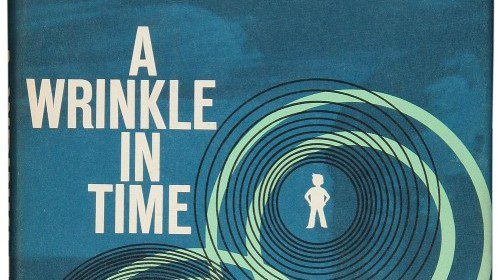
I am spitting nails at the just-released publicity photos for A Wrinkle in Time.
At first glance, the casting for the under-production Wrinkle in Time movie might seem in keeping with the book’s themes of nonconformity and the value of difference. In the book, it is the main characters’ differences which carry them through their adventures, and the enemy they confront, IT, champions conformity (through submission to the will of IT, of course.)
The director of the new film decided to take this theme and run with it by introducing “diverse” casting–making the Murray family mixed-race and casting Mrs. Whatsit, Mrs. Who, and Mrs. Which with women of different ages and ethnicities: Reese Witherspoon, Mindy Kaling, and Oprah Winfrey.
But…how diverse is this casting, really? And is this the kind of diversity L’Engle was thinking about when she made her heroine plain and mousy and her Seraphim appear like eccentric old women?
The casting of Meg is, aside from the change in race, a very conventional case of “Hollywood Homely” where glasses and messy hair are expected to make us believe an attractive, symmetrical, clear-complexioned face is actually plain or ugly.
But take a closer look at the casting of the Seraphs, Mrs. Who, Mrs. Which, and Mrs. Whatsit.
Here is how those characters are described in the book:
Mrs. Whatsit: a rag bag with sparse greyish hair and “her nose a round, soft blob, her mouth puckered like an autumn apple.”
Mrs. Which: the only time she materializes, she makes herself look like a “Halloween witch.” So, I’m assuming, not otherworldly glamour.
And Mrs. Who is a “plump little woman” in “enormous glasses” whose appearance is apparently otherwise so nondescript as to not warrant description.
In L’Engle’s vision, the three Seraphs appear unconventionally plain and old–the kind of women our society completely disregards and renders invisible–and I think this choice is both intentional and important on L’Engle’s part. Mrs. Which’s visual pun during her one materialized appearance sets up a contrast that makes it obvious that the appearances of the other two is not actually an example of a “witch trope.” There is a statement here about who we value and who we disregard, a purposeful toying with the bag lady and the dull grandmother.
Casting minority women could have underlined and accentuated that subversive little statement about the invisible and disregarded. But what does it do to cast conventionally Hollywood smooth-featured, symmetrically attractive POC instead? What does it say that the director cast two minority women who have already gained mainstream visibility, who already have widely-watched mainstream shows bearing their names? Oprah and Mindy Kaling are talented, but are they the only talented POC to choose from? Or were they chosen because they are the opposite of invisible and overlooked?
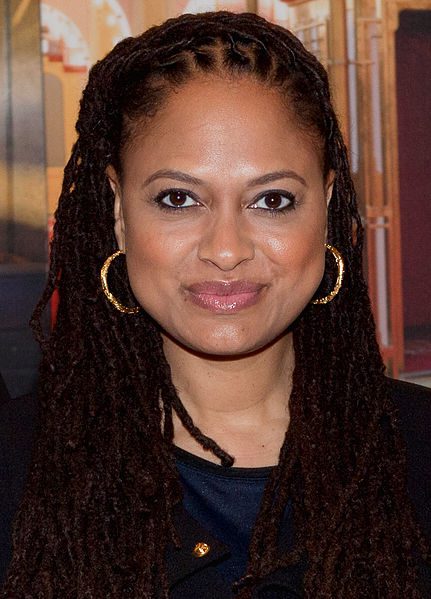
Director Ava DuVernay, via Wikimedia Commons
Here’s an actual quote from the director on her casting choices: “And in the women themselves, could we just reflect a fuller breadth of femininity?”
…Oh, right. That fuller breadth of femininity in which women are never allowed to look frail or old.
There’s nothing in the book to stop someone from casting these characters diversely. But it’s not real diversity to let Hollywood prejudices against old or plain women drive character casting.
It’s been suggested that perhaps the characters will be made up to look older during the initial scenes, and that the movie stills just show their appearance off-Earth. After all, the Seraph are incorporeal–the bodies they show up in are only representational. In the book, Mrs. Whatsit changes form once and appears as something resembling a centaur–actually, she is described as having “a head resembling a man’s, but a man with a perfection of dignity and virtue…” This is not a description of female pulchritude, but a kind of beauty beyond gender or cultural standards.
Even if we accepted a level of change to the story that would have all three Seraph incorporate in a different form from their initial ones, the pictures shown are far too this-world to be otherworldly the way Mrs. Whatsit’s centaur form is described, and it would be an even greater mistake to make the natural forms of the Seraph conform to narrow Hollywood standards. The message that sends is no better: this is the only kind of beauty that is real. There is nothing further. There is nothing greater. There is nothing that transcends.
***
I’m a strong-featured woman. My face is asymmetrical, my complexion is muddy, and my nose…well, my nose has a great personality.
When I first read Wrinkle in Time as a young teen, I was Meg, in all kinds of ways. I never felt smart enough or pretty enough or normal enough to fit in. I was awkward and impulsive and hot-tempered. I was different in an era that championed uniqueness and non-conformity-but I wasn’t the right kind of different.
And I knew from the moment the “tramp” Mrs. Whatsit entered the Murray kitchen in her layers and layers of wraps and scarves and her little sparse bun that the book I held in my hands was going to have something to say about the overlooked people, the oddball people, the not-the-right-kind-of-different people.
In a climactic moment in the book, as Meg prepares to face her fears and go back by herself to save her little brother, Mrs. Who–still looking old and ordinary and unremarkable in her spectacles–tells Meg something she “must try to understand not word by word, but in a flash…Listen, Meg. Listen well.
The foolishness of God is wiser than men, and the weakness of God is stronger than men. For ye see your calling, brethren, how that not many wise men after the flesh, not many mighty, not many noble, are called, but God hath chosen the foolish things of the world to confound the wise; and God hath chosen the weak things of the world to confound the things which are mighty. And base things of the world, and things which are despised, hath God chosen, yea, and things which are not, to bring to nought things that are.”
Not many wise men, not many mighty, not many noble.
Not those with star power, names, magazine covers.
God chooses the foolish, the weak, the base, and the despised.
He chooses the overlooked and the oddball. He chooses the unseen and unrepresented. And they “confound the things which are mighty” in this world.
Hollywood included.
A Wrinkle in Time book cover image via https://www.flickr.com/photos/hermitosis/17025412760
Previous Post

July 11, 2017
The Gift of the Ordinary
Next Post

July 25, 2017 Life Is Pain: Carrying in Our Bodies the Dying of Jesus
Browse Our Archives
Select a Category ADHD Blog Business Body and Soul Books Faith Faith in Action Family Feminism Fertility Awareness Friendship Geekiness Guest Post History Hope Just For Fun Love Marriage Memory Mental Exercise Movies Parenting Personalism Poetry Prayer Quotes Scripture Seven Quick Takes Striving for Holiness Television The Stories We Tell The World Uncategorized
Select a Month September 2018 August 2018 July 2018 June 2018 May 2018 April 2018 February 2018 January 2018 December 2017 November 2017 October 2017 September 2017 August 2017 July 2017 June 2017 May 2017 April 2017 March 2017 February 2017 January 2017 December 2016 November 2016 October 2016 August 2016 June 2016 March 2016 January 2016 November 2015 October 2015 August 2015 July 2015 May 2015 April 2015 February 2015 December 2014 November 2014 September 2014 August 2014 July 2014 June 2014 May 2014 April 2014 March 2014 February 2014 December 2013 November 2013 October 2013 September 2013 August 2013 July 2013 June 2013 May 2013 March 2013 February 2013 January 2013 December 2012 November 2012 June 2012 May 2012 April 2012 March 2012 February 2012 January 2012 August 2011 December 2010 November 2010 October 2010 September 2010 August 2010 June 2010 May 2010 April 2010 November 2009 October 2009 August 2009 July 2009 June 2009 May 2009 April 2009
Follow Us!
TAKE THE
Religious Wisdom Quiz
Which branch of Christianity believes in the doctrine of transubstantiation?
Select your answer to see how you score.
Protestants Evangelicals Orthodox Catholics
Support this
Column


Related posts from Peace and Pekoe

A Way Wherein There Is No Ecstasy



Feeling Betrayed by the Church? Look to the...
TRENDING AT PATHEOS Catholic

Rejecting Doom: Christian Hope And Human Action
Christianity is a religion of hope. We are to have hope and...

It’s What Comes From Within Which Matters
One of the most difficult things for us to understand is why...

Why I Choose the Eucharist Over the Sermon
Choose the Eucharist, Not the Sermon What are we supposed to get...

5 Design Elements Found in Spiritually Rooted Homes
Putting Spirituality Into Home Decor Our homes are more than our living...

Credo: A Story of God Told with the...
About 10 years ago, I began to imagine a personal "Credo" that...

The Anatomy of Divine Revelation in Catholic Thought
The claim that God has made Himself known to human beings is...
view all Catholic blogs
Ad-Free & Subscriber Log-In Subscription Support
- About Us
- 2026 Calendar
- Videos
- Podcasts
- Library of World Religions
- Faith In Media Tracker
- Advertise With Us
- Write for Us
- Privacy Policy
- Terms of Service
- Do Not Sell My Data
- Contact Us
- Radiant Digital
- Manage Newsletter Subscriptions
- Unsubscribe From Notifications
- Sitemap
Copyright 2008-2026, Patheos. All rights reserved.
Subscription Support Ad-Free & Subscriber Log-In
Follow Patheos