
BuddhistCatholicContemplativeEvangelicalGeneral ChristianHinduJewishLatter-day SaintMuslimNew VisionsProgressive Christian
Beliefs
- Buddhist
- Catholic
- Contemplative
- Evangelical
- General Christian
- Hindu
- Jewish
- Latter-day Saint
- More Voices
- Muslim
- New Visions
- Pagan
- Progressive Christian
Topics
- Religion News
- Food and Religion
- Sports and Religion
- Religious Art
- Religious Music and Entertainment
- Religious Events
- History and Religion
- Style and Religion
- Politics and Religion
- Women in Religion
- Recreation Outdoors and Religion
- Business Finance and Religion
- Careers Workplace and Religion
- Education and Religion
- Family Parenting and Religion
- Health Fitness and Religion
- Home and Religion
- Relationships and Religion
- Technology and Religion
- Travel and Religion
Columnists
- Buddhist Columnists
- Business Finance and Religion Columnists
- Careers Workplace and Religion Columnists
- Catholic Columnists
- Contemplative Columnists
- Education and Religion Columnists
- Evangelists Columnists
- Family Parenting and Religion Columnists
- General Christian Columnists
- Health Fitness and Religion Columnists
- Hindu Columnists
- History and Religion Columnists
- Home and Religion Columnists
- Jewish Columnists
- More Voices Columnists
- Latter Day Columnists
- Muslim Columnists
- New Visions Columnists
- Nonreligious Columnists
- Pagan Columnists
- Politics and Religion Columnists
- Progressive Columnists
- Recreation Outdoors and Religion Columnists
- Relationships and Religion Columnists
- Religion News Columnists
- Religious Art Columnists
- Religious Events Columnists
- Religious Music and Entertainment Columnists
- Sports and Religion Columnists
- Style and Religion Columnists
- Technology and Religion Columnists
- Travel and Religion Columnists
- Women in Religion Columnists
Resource Library
- 2026 Calendar
- Library of World Religions
- The 100 Most Holy Places on Earth
- Patheos Answers
- Podcasts
- Videos
- Faith Leaders Database
- Anglican Episcopalian
- Bahai
- Baptist
- Buddhism
- Christianity
- Confucianism
- Eastern Orthodoxy
- Hinduism
- Holiness and Pentecostal
- ISKCON
- Islam
- Judaism
- Lutheran
- Methodist
- The Church of Jesus Christ of Latter-day Saints
- New Age
- Paganism
- Presbytarian and Reformed
- Protestantism
- Religion Behind the Scenes
- Roman Catholic
- Scientology
- Shia Islam
- Sikhism
- Sufism
- Sunni Islam
- Taoism
- Zen
- See all religions
Research Tools
 Ad-Free & Subscriber Log-In Subscription Support
Ad-Free & Subscriber Log-In Subscription Support
Follow Patheos 

- Trending:
- Forgiveness
- |
- Marriage
- |
- Consciousness
- |
- Death Penalty
- |
- Election
- |
- Halloween
 Peace and Pekoe
- Home
- Catholic
- The Given Life (a book review)
The Given Life (a book review)
Last updated on: May 1, 2017 at 4:00 pm by Kate Cousino
The Given Life (a book review) 2017-05-01T16:00:05-04:00 Kate Cousino
Patheos Explore the world's faith through different perspectives on religion and spirituality! Patheos has the views of the prevalent religions and spiritualities of the world.
Photo of the Cumberland River in Kentucky via Good Free Photos
“We live the given life, and not the planned.” – Wendell Berry

I first fell in love with the words and wisdom of Wendell Berry, Kentucky’s tireless poet, essayist, and advocate for agrarian values, while standing in the stacks of Powell’s book store in Portland, Oregon, on a bright and cool spring day a decade ago. I bought a small book of essays—Sex, Economy, Freedom & Community—while in the city to attend a friend’s wedding. I read the entire volume over the course of my flight back to New Orleans, inciting a conversation about work, unions, agrarianism, and community with my seatmate.
With little money for book purchases, I soon exhausted the local library’s stock of Berry books and novels, and have only returned to him sporadically over the intervening years. Understandably, I jumped on the opportunity to get my hands on a review copy of a book about Wendell Berry that was described to me as taking, “a deeper look into Berry’s life which he has chosen to live out in a Gospel-based manner taken from Scripture.”
A book about the Christian roots and spirituality of Wendell Berry? Sign me up!
Here then, are my thoughts on Wendell Berry and the Given Life by Ragan Sutterfield. 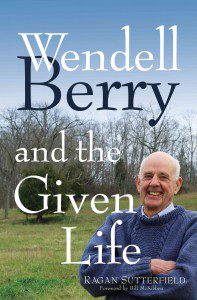
This attractive and unintimidatingly light volume lives up to the description I was given. It is, indeed, a book interested in drawing out the spiritual themes and ideas strewn throughout the work of a long and productive lifetime. Sutterfield has done his research, and excerpts from Berry’s writings liberally pepper the pages of this book, which is itself divided up into thematic chapters addressing different aspects of Berry’s thought: Givenness, Humility, Love, Work, Membership, and so on. There are so many wonderfully expressive and thought-provoking Berry quotes in each chapter that my reading was drastically slowed by the repeated compulsion to set Sutterfield’s writing about Berry down to hunt down the cited essays and works and read the quotes passages in their original contexts.
Sutterfield quotes MacIntyre early in his book, with a reference made especially timely by Rod Dreher’s current publicity rush: “we are waiting…for another—doubtless very different—St. Benedict.” Rather than lay out a treatise to rival the Benedict Option, Sutterfield proposes a more modest goal: “this is a book that hopes to show that Wendell Berry presents us with the sort of coherent vision for the lived moral and spiritual life that we need now.”
Berry, as Sutterfield describes him, stands for the rejection of various harmful dualisms, all of the things that present as distinct and separate those things that ought in reality to coexist in a fruitful unity: soul and body, mankind and the earth, the lover and the beloved, heavenly and earthly economies, work and prayer, giving and receiving, belonging and freedom, solitude and communion. Foremost among these, Berry rejects the characterisation of man and environment as existing in competition with one another. Sutterfield quotes Berry,
“If we want to save the land, we must save the people who belong to the land. If we want to save the people, we must save the land the people belong to.” Our lives are entangled and bound up with each other–people and land and other creatures–so that they can only find their flourishing when the whole flourishes together. In fact, this connection of all things is at our very essence as creatures: “From the point of view of Genesis 1 or the 104th Psalm, we would say that all are of one kind, one kinship, one nature, because all are creatures.”
If I were to pull one recurring theme from Sutterfield’s treatment of Berry, it would be this understanding of man as a creature among creatures, a subject of his subjects. The “given life” is a mutual giving; creation is given to us, and we are given to creation.
In each chapter, Sutterfield excels at putting his fingers on the ideal Berry quote to illustrate the chosen theme. If I have any criticism, it is that Sutterfield is less adept at placing Berry’s thought within the context of human history. While he draws adequately enough from time to time on modern thinkers like Pope Francis or Deitrich Bonhoeffer, and makes the expected educated references to Aristotle and Aquinas, a quick browse of the endnotes for Wendell Berry and the Given Life would give the impression that Berry’s thought is itself rootless, a discontinuity in a Christian incarnational theology awaiting to be discovered anew by Berry and his acolytes.
This may be the result of Berry’s own tendency to dismiss “institutional Christianity” in favour of a more free-form, less “abstracted” religious feeling and practice. There’s a possible blind spot here that I would love to see addressed someday–Berry’s (and Sutterfield’s) criticisms of modernity deserve to be placed in a richer historical and theological context.
This criticism aside–or perhaps it is wishful thinking, the way one always desires someone else to do the work of researching and writing about the topics which are of personal interest–Sutterfield’s volume succeeds admirably, if not as a critical text, then as an endearingly but not overly discursive introduction to the thoughts and writings of Wendell Berry. As an admirer, I can only be happy to see another volume to point readers to the compelling, challenging, and–I will accept Sutterfield’s proposal of the adjective–prophetic works of Wendell Berry.
Previous Post

April 29, 2017
Reminder to Self
Next Post

May 4, 2017 At the Personalist Project: The Personal is Political...is Personal
Browse Our Archives
Select a Category ADHD Blog Business Body and Soul Books Faith Faith in Action Family Feminism Fertility Awareness Friendship Geekiness Guest Post History Hope Just For Fun Love Marriage Memory Mental Exercise Movies Parenting Personalism Poetry Prayer Quotes Scripture Seven Quick Takes Striving for Holiness Television The Stories We Tell The World Uncategorized
Select a Month September 2018 August 2018 July 2018 June 2018 May 2018 April 2018 February 2018 January 2018 December 2017 November 2017 October 2017 September 2017 August 2017 July 2017 June 2017 May 2017 April 2017 March 2017 February 2017 January 2017 December 2016 November 2016 October 2016 August 2016 June 2016 March 2016 January 2016 November 2015 October 2015 August 2015 July 2015 May 2015 April 2015 February 2015 December 2014 November 2014 September 2014 August 2014 July 2014 June 2014 May 2014 April 2014 March 2014 February 2014 December 2013 November 2013 October 2013 September 2013 August 2013 July 2013 June 2013 May 2013 March 2013 February 2013 January 2013 December 2012 November 2012 June 2012 May 2012 April 2012 March 2012 February 2012 January 2012 August 2011 December 2010 November 2010 October 2010 September 2010 August 2010 June 2010 May 2010 April 2010 November 2009 October 2009 August 2009 July 2009 June 2009 May 2009 April 2009
Follow Us!
TAKE THE
Religious Wisdom Quiz
Who dreamed about the sun, moon, and stars bowing to him?
Select your answer to see how you score.
Elijah Adam Joseph Daniel
Support this
Column


Related posts from Peace and Pekoe

A Way Wherein There Is No Ecstasy


Feeling Betrayed by the Church? Look to the...
TRENDING AT PATHEOS Catholic

Rejecting Doom: Christian Hope And Human Action
Christianity is a religion of hope. We are to have hope and...

It’s What Comes From Within Which Matters
One of the most difficult things for us to understand is why...

Why I Choose the Eucharist Over the Sermon
Choose the Eucharist, Not the Sermon What are we supposed to get...

5 Design Elements Found in Spiritually Rooted Homes
Putting Spirituality Into Home Decor Our homes are more than our living...

Credo: A Story of God Told with the...
About 10 years ago, I began to imagine a personal "Credo" that...

The Anatomy of Divine Revelation in Catholic Thought
The claim that God has made Himself known to human beings is...
view all Catholic blogs
Ad-Free & Subscriber Log-In Subscription Support
- About Us
- 2026 Calendar
- Videos
- Podcasts
- Library of World Religions
- Faith In Media Tracker
- Advertise With Us
- Write for Us
- Privacy Policy
- Terms of Service
- Do Not Sell My Data
- Contact Us
- Radiant Digital
- Manage Newsletter Subscriptions
- Unsubscribe From Notifications
- Sitemap
Copyright 2008-2026, Patheos. All rights reserved.
Subscription Support Ad-Free & Subscriber Log-In
Follow Patheos