
BuddhistCatholicContemplativeEvangelicalGeneral ChristianHinduJewishLatter-day SaintMuslimNew VisionsProgressive Christian
Beliefs
- Buddhist
- Catholic
- Contemplative
- Evangelical
- General Christian
- Hindu
- Jewish
- Latter-day Saint
- More Voices
- Muslim
- New Visions
- Pagan
- Progressive Christian
Topics
- Religion News
- Food and Religion
- Sports and Religion
- Religious Art
- Religious Music and Entertainment
- Religious Events
- History and Religion
- Style and Religion
- Politics and Religion
- Women in Religion
- Recreation Outdoors and Religion
- Business Finance and Religion
- Careers Workplace and Religion
- Education and Religion
- Family Parenting and Religion
- Health Fitness and Religion
- Home and Religion
- Relationships and Religion
- Technology and Religion
- Travel and Religion
Columnists
- Buddhist Columnists
- Business Finance and Religion Columnists
- Careers Workplace and Religion Columnists
- Catholic Columnists
- Contemplative Columnists
- Education and Religion Columnists
- Evangelists Columnists
- Family Parenting and Religion Columnists
- General Christian Columnists
- Health Fitness and Religion Columnists
- Hindu Columnists
- History and Religion Columnists
- Home and Religion Columnists
- Jewish Columnists
- More Voices Columnists
- Latter Day Columnists
- Muslim Columnists
- New Visions Columnists
- Nonreligious Columnists
- Pagan Columnists
- Politics and Religion Columnists
- Progressive Columnists
- Recreation Outdoors and Religion Columnists
- Relationships and Religion Columnists
- Religion News Columnists
- Religious Art Columnists
- Religious Events Columnists
- Religious Music and Entertainment Columnists
- Sports and Religion Columnists
- Style and Religion Columnists
- Technology and Religion Columnists
- Travel and Religion Columnists
- Women in Religion Columnists
Resource Library
- 2026 Calendar
- Library of World Religions
- The 100 Most Holy Places on Earth
- Patheos Answers
- Podcasts
- Videos
- Faith Leaders Database
- Anglican Episcopalian
- Bahai
- Baptist
- Buddhism
- Christianity
- Confucianism
- Eastern Orthodoxy
- Hinduism
- Holiness and Pentecostal
- ISKCON
- Islam
- Judaism
- Lutheran
- Methodist
- The Church of Jesus Christ of Latter-day Saints
- New Age
- Paganism
- Presbytarian and Reformed
- Protestantism
- Religion Behind the Scenes
- Roman Catholic
- Scientology
- Shia Islam
- Sikhism
- Sufism
- Sunni Islam
- Taoism
- Zen
- See all religions
Research Tools
 Ad-Free & Subscriber Log-In Subscription Support
Ad-Free & Subscriber Log-In Subscription Support
Follow Patheos 

- Trending:
- Forgiveness
- |
- Marriage
- |
- Consciousness
- |
- Death Penalty
- |
- Election
- |
- Halloween
 Peace and Pekoe
- Home
- Catholic
- More Dangerous Than Bullets, continued
More Dangerous Than Bullets, continued
Last updated on: February 16, 2017 at 10:00 am by Kate Cousino
More Dangerous Than Bullets, continued 2017-02-15T14:44:29-04:00 Kate Cousino
Patheos Explore the world's faith through different perspectives on religion and spirituality! Patheos has the views of the prevalent religions and spiritualities of the world.
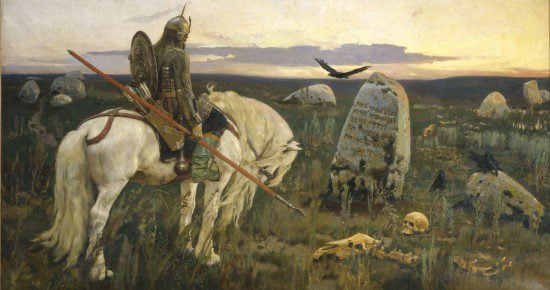
Knight at the Crossroads, by Viktor Vasnetsov – Public Domain
In my earlier post, I asked, “How does a modern, educated, middle-class child become an ideologically-motivated potential killer?”
If you were to put together a mental image of someone vulnerable to radicalization, what would that look like? Young, isolated, lonely? Mentally ill? Uneducated, under-employed?
We have ideas and expectations about who is–and therefore, who ISN’T–at risk for falling down the rabbit-hole of extremism and violence, but are these impressions accurate?
Fortunately, I’m far from the first or only person to ask that question.
A study looking at over 100 individuals indicted for ISIS-related activities in the US concluded that potential terrorists are not always very different from the rest of us:
As a group, the individuals mirror average Americans more than people think. The common perception of a terrorist as a young, single, unemployed, disenfranchised male is wrong: The average age of the 112 individuals is 27 years old, with almost a third over 30; more than 40 percent were in a relationship, with a third being married; while nearly two-thirds had been to college.
Three-quarters had jobs or were in school—figures similar to the U.S. population as a whole.
The vast majority of the 112 individuals are U.S. citizens. Nearly two-thirds were born in the United States, and nearly 20 percent were naturalized citizens. […]
A significant proportion includes converts from outside established Muslim communities. About 30 percent of the individuals are converts to Islam, including 43 percent of U.S.-born indictees.
So maybe we aren’t looking at maladjusted underemployed loners? But what about non-ISIS extremists? And what about less obvious traits, like mental illness or amorality?
A different set of researchers looked at ideas, themes, and beliefs common among different groups of extremists.
Saucier and his colleagues…examined the published materials of 13 militant extremist groups, which they defined as groups that combine fanatical beliefs and values and advocacy of extremist means, including violence.
The extremists came from across regions, religions and cultures. They ranged from the Baader-Meinhof Gang (Germany) to Meir Kahane and followers (Palestine and Israel) to the Lord’s Resistance Army (Uganda) to the Tamil Tigers (Sri Lanka) to Aum Shinrikyo (Japan) to the Shining Path(Peru) to home-grown U.S. extremists like the Unabomber and Timothy McVeigh.
The researchers then extracted 16 key themes that occurred over and over in the texts.
When they asked British and Serbian college students to rank their agreement with the ideas and attitudes identified, they had mixed results. Positively, Serbian undergraduates were not more likely to endorse these extremist base beliefs than were British students, despite that country’s tumultuous history. On the other hand,
In survey after survey, students generally failed to strongly dissociate themselves from the sentiments.
“If, in fact, extremist thinking is something bizarre, you’d expect people to disagree with the statements,” said Gerard Saucier, a professor of psychology at the University of Oregon and the lead researcher on the study. “What you get instead is that they’re failing to disavow them. A typical showing is a mixture of agree and disagree.”
What are these attitudes and ideas that underlie so many extremist groups despite different religious, cultural, and ideological self-identification? What does Timothy McVeigh have in common with Baader-Meinhof and the Tamil Tigers?
What is it that Alexandre Bissonnette and Damien Clairmont very likely had in common, even though they came to identify with opposing religious and cultural identities?
Taken together, the themes cohere into what Saucier and colleagues describe as a “seductive narrative”: The modern world has fallen into a catastrophic state. The ordinary mechanisms of change are no longer valid. Only extreme, violent measures can save things. This is a war of us against them, a war of good versus evil, a war of necessity. Any and all means are not only justified, they are glorified. God is on our side. In the end utopia will be restored.
These sound like extreme beliefs, don’t they? But Saucier found that while ordinary students were reluctant to endorse all of these, they were just as reluctant to disavow them. This initial openness may leave many people vulnerable to growing extremism under the influence of online and offline peer groups, mainstreaming of extreme positions and rhetoric, increasing ideological division, and social and political confusion.
If there is one thing the stories of Bissonnette, Clairmont, and so many others have in common, it is perhaps that they are too much like the rest of us–broken, lost, and searching for something to believe in.
As anthropologist Scott Atran says,
[T]he popular notion of a “clash of civilizations” between Islam and the West is woefully misleading. Violent extremism represents not the resurgence of traditional cultures, but their collapse, as young people unmoored from millennial traditions flail about in search of a social identity that gives personal significance and glory.
Bissonnette was tormented by bullies as a youth and became increasingly detached from the communities around him. Clairmont fell into adolescent depression that only lifted when he adopted the new belief system and fight that gave his comfortable adolescent life a larger purpose.
These are not unusual stories. What is unusual is not the lives these young men lived, but that their cries for identity and relevance were heard by extreme groups, answered,…and weaponized.
Previous Post

February 15, 2017
And now for something completely frivolous
Next Post

February 17, 2017 At The Personalist Project: Tin Pacifists and the Search for Meaning
Browse Our Archives
Select a Category ADHD Blog Business Body and Soul Books Faith Faith in Action Family Feminism Fertility Awareness Friendship Geekiness Guest Post History Hope Just For Fun Love Marriage Memory Mental Exercise Movies Parenting Personalism Poetry Prayer Quotes Scripture Seven Quick Takes Striving for Holiness Television The Stories We Tell The World Uncategorized
Select a Month September 2018 August 2018 July 2018 June 2018 May 2018 April 2018 February 2018 January 2018 December 2017 November 2017 October 2017 September 2017 August 2017 July 2017 June 2017 May 2017 April 2017 March 2017 February 2017 January 2017 December 2016 November 2016 October 2016 August 2016 June 2016 March 2016 January 2016 November 2015 October 2015 August 2015 July 2015 May 2015 April 2015 February 2015 December 2014 November 2014 September 2014 August 2014 July 2014 June 2014 May 2014 April 2014 March 2014 February 2014 December 2013 November 2013 October 2013 September 2013 August 2013 July 2013 June 2013 May 2013 March 2013 February 2013 January 2013 December 2012 November 2012 June 2012 May 2012 April 2012 March 2012 February 2012 January 2012 August 2011 December 2010 November 2010 October 2010 September 2010 August 2010 June 2010 May 2010 April 2010 November 2009 October 2009 August 2009 July 2009 June 2009 May 2009 April 2009
Follow Us!
TAKE THE
Religious Wisdom Quiz
Who led the Israelites into the Promised Land?
Select your answer to see how you score.
Caleb Joshua Aaron Moses
Support this
Column


Related posts from Peace and Pekoe

A Way Wherein There Is No Ecstasy


Feeling Betrayed by the Church? Look to the...

Why "This Is Us" Is the Medicine We...
TRENDING AT PATHEOS Catholic

Rejecting Doom: Christian Hope And Human Action
Christianity is a religion of hope. We are to have hope and...

It’s What Comes From Within Which Matters
One of the most difficult things for us to understand is why...

Why I Choose the Eucharist Over the Sermon
Choose the Eucharist, Not the Sermon What are we supposed to get...

5 Design Elements Found in Spiritually Rooted Homes
Putting Spirituality Into Home Decor Our homes are more than our living...

Credo: A Story of God Told with the...
About 10 years ago, I began to imagine a personal "Credo" that...

The Anatomy of Divine Revelation in Catholic Thought
The claim that God has made Himself known to human beings is...
view all Catholic blogs
Ad-Free & Subscriber Log-In Subscription Support
- About Us
- 2026 Calendar
- Videos
- Podcasts
- Library of World Religions
- Faith In Media Tracker
- Advertise With Us
- Write for Us
- Privacy Policy
- Terms of Service
- Do Not Sell My Data
- Contact Us
- Radiant Digital
- Manage Newsletter Subscriptions
- Unsubscribe From Notifications
- Sitemap
Copyright 2008-2026, Patheos. All rights reserved.
Subscription Support Ad-Free & Subscriber Log-In
Follow Patheos