
BuddhistCatholicContemplativeEvangelicalGeneral ChristianHinduJewishLatter-day SaintMuslimNew VisionsProgressive Christian
Beliefs
- Buddhist
- Catholic
- Contemplative
- Evangelical
- General Christian
- Hindu
- Jewish
- Latter-day Saint
- More Voices
- Muslim
- New Visions
- Pagan
- Progressive Christian
Topics
- Religion News
- Food and Religion
- Sports and Religion
- Religious Art
- Religious Music and Entertainment
- Religious Events
- History and Religion
- Style and Religion
- Politics and Religion
- Women in Religion
- Recreation Outdoors and Religion
- Business Finance and Religion
- Careers Workplace and Religion
- Education and Religion
- Family Parenting and Religion
- Health Fitness and Religion
- Home and Religion
- Relationships and Religion
- Technology and Religion
- Travel and Religion
Columnists
- Buddhist Columnists
- Business Finance and Religion Columnists
- Careers Workplace and Religion Columnists
- Catholic Columnists
- Contemplative Columnists
- Education and Religion Columnists
- Evangelists Columnists
- Family Parenting and Religion Columnists
- General Christian Columnists
- Health Fitness and Religion Columnists
- Hindu Columnists
- History and Religion Columnists
- Home and Religion Columnists
- Jewish Columnists
- More Voices Columnists
- Latter Day Columnists
- Muslim Columnists
- New Visions Columnists
- Nonreligious Columnists
- Pagan Columnists
- Politics and Religion Columnists
- Progressive Columnists
- Recreation Outdoors and Religion Columnists
- Relationships and Religion Columnists
- Religion News Columnists
- Religious Art Columnists
- Religious Events Columnists
- Religious Music and Entertainment Columnists
- Sports and Religion Columnists
- Style and Religion Columnists
- Technology and Religion Columnists
- Travel and Religion Columnists
- Women in Religion Columnists
Resource Library
- 2026 Calendar
- Library of World Religions
- The 100 Most Holy Places on Earth
- Patheos Answers
- Podcasts
- Videos
- Faith Leaders Database
- Anglican Episcopalian
- Bahai
- Baptist
- Buddhism
- Christianity
- Confucianism
- Eastern Orthodoxy
- Hinduism
- Holiness and Pentecostal
- ISKCON
- Islam
- Judaism
- Lutheran
- Methodist
- The Church of Jesus Christ of Latter-day Saints
- New Age
- Paganism
- Presbytarian and Reformed
- Protestantism
- Religion Behind the Scenes
- Roman Catholic
- Scientology
- Shia Islam
- Sikhism
- Sufism
- Sunni Islam
- Taoism
- Zen
- See all religions
Research Tools
 Ad-Free & Subscriber Log-In Subscription Support
Ad-Free & Subscriber Log-In Subscription Support
Follow Patheos 

- Trending:
- Forgiveness
- |
- Marriage
- |
- Consciousness
- |
- Death Penalty
- |
- Election
- |
- Halloween
 Paths Through The Forests
- Home
- About
- Comment Guidelines
- Look & Find
- Holidays, Rituals & History
- Creating Connections
- Cultural Quandaries
- Crafts
- Quiz & Questionnaire
- Guest Posts
- Publications
- Archive Index
- Home
- Pagan
- The Story Behind The Ehoah Phrases – Words To Draw Connections With Our Place In The Cosmos
The Story Behind The Ehoah Phrases – Words To Draw Connections With Our Place In The Cosmos
Last updated on: December 19, 2016 at 12:54 am by Rua Lupa
The Story Behind The Ehoah Phrases – Words To Draw Connections With Our Place In The Cosmos 2016-12-19T00:54:24-04:00 Rua Lupa
Patheos Explore the world's faith through different perspectives on religion and spirituality! Patheos has the views of the prevalent religions and spiritualities of the world.
Those who have followed this blog for a while would have inevitably came across this,
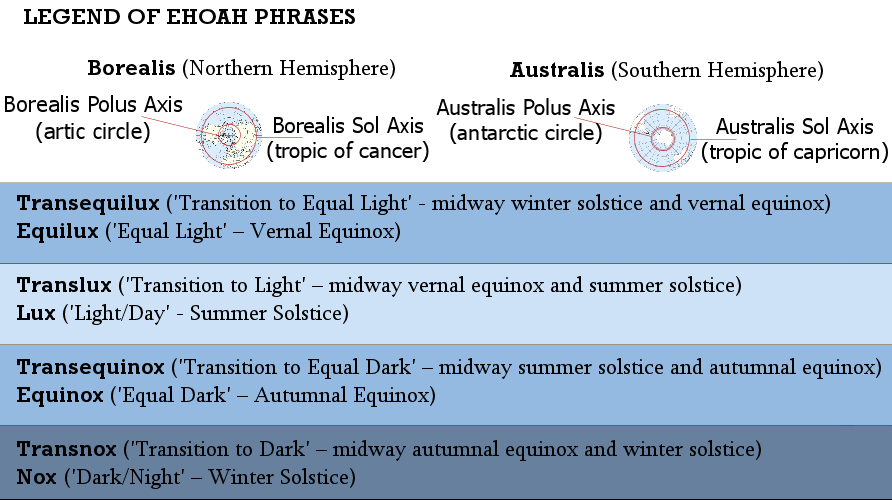
Image Credit: Rua Lupa
And the just as inevitable question arises, “Where did that come from?”
Then I begin thinking, “Now where the heck do I start this explanation?”
I suppose it starts, like anything else, with the beginning. Back to when I was a college student in the Wildlife Technician Program to be exact – being about 6 years ago from today. Having been studying nature with such intensity for sometime tends to rub off on you in life outside of school studies, and when studying nature and discussing nature with colleagues we have to speak in specifics so the message gets across efficiently t0 get our work done. The specificity is accomplished with a wonderful tool – the scientific language, also known as Latin. In my case it was through taxonomy and astronomy that it was applied.
I hear some people say that it isn’t needed, we already have names for those things. Usually this is from someone who hasn’t worked in these fields, because if they had they would likely have encountered the very problem that essentially caused the scientific language to become established. Primarily being common names being different from place to place. Where I am the most common example is Ironwood, which is known by my American counterparts as American Hop Hornbeam. But people wouldn’t know that we were talking about the same tree if we used those common names, so those in the wildlife studies universally called this tree Ostrya virginiana. No matter where you go on earth, if you say that name to another person who works with wildlife (particularly in temperate climates), they’ll know what tree that is. It just takes a bit of practice and memorization to nail it down.
So from there I started to consider how other things could use the scientific language to make understanding easier and unexpectedly found myself considering it with my frustrations with studies in astronomy and how it related to our planetary environment – trying to think big picture.
Now I am sure you’re thinking what I was thinking at the time too, “Surely they already have that covered and I am just over thinking it.” So I had continued for quite a while thinking that I was over thinking it, but I couldn’t shake the thought that it could become simpler than how it currently was. So I finally took a stab at it and came up with the Ehoah Phrases you saw at the beginning of this post.
So now comes the why. Why was there any sense that it could be made simpler, this just looks more confusing. It may look confusing at first, but its use cuts a lot of corners when it comes to discussing the topic of solar-earth events (also called Solterra Events).
For example, why is the Tropic of Capricorn called what it is? Then you’d have to go into this whole explanation on the cycle of the constellations, its angles between them and the earth, then add the subtext that its now out of its original alignment so it doesn’t have the original accuracy and had to be adjusted for and will continue needing adjusting for into the future.

Original Image by Przemyslaw “Blueshade” Idzkiewicz, used under Creative Commons. Adapted by Rua Lupa.
Now, for the Borealis Sol Axis – why is it called that? Borealis is for the Northern Hemisphere (one word instead of two), and Sol Axis is for the farthest north the sun and earth reach 90 degrees (This is important because it is at that point that the northern hemisphere experiences its longest day of the year, and between the two Sol Axis of each hemisphere is the Tropics where the season’s light and temperature difference remains mostly consistent). This is also something that remains consistent overtime and wouldn’t need readjusting in the future.
So in essence I’ve moved the references away from the less reliable distant stars, to the more direct, reliable, and relied upon host star – our sun, Sol. The source of energy for all life on earth (except perhaps for some extremophiles). The main Latitude lines around our planet that have the most significance to us are there in the first place because of the planetary relationship with the sun and thus named them accordingly. The Solar-Earth Event names are no different.
Some reading this may likely already recognize the words Lux and Nox – Latin used elsewhere in popular books and movies. They simply mean Light/Day and Dark/Night. Why are they used here? Well, the yearly cycle has four major annual Solar-Earth events that most of the world experiences – The longest day, the longest night and midway between each. It very much is like our daily cycles in life – Night, Dawn, Day, and Dusk. So they are likewise named – capitalized to emphasize that it is a specific event. Equinox already exists, meaning Equal Night, but you have to define which by adding an extra descriptor – Vernal (Spring) Equinox or Autumnal (Autumn) Equinox. This is easily bypassed by changing the second component to the name – Equinox stays ‘equal dark’ for the dusk of the year (the autumnal equinox), and Equilux for ‘equal light’ for the dawn of the year. From there the events in between these main four have Trans added followed by the upcoming Solar-Earth Event, simply meaning ‘transition to (add solar-earth event)’.
So in total you use 9 individual component words to make up all the names: Borealis, Australis, Polus, Sol, Axis, Equi, Lux, Nox, and Trans. You could also add Equator to the mix for a total of 10.
This compared to Northern, Southern, Hemisphere, Tropic, Capricorn, Cancer, Antarctic, Arctic, Circle; Summer,Winter/June,December/Northern,Southern; Solstice, Vernal, Autumnal, Equinox, Cross-quarter (then add all the variable names of the cross-quarters which we’ll just count as four more for simplicity’s sake) – totaling about 21 word components minimum. Which looks more confusing now?
Lastly, how do you reference the whole planet’s solar-earth experience when it only describes what the one hemisphere is experiencing (The northern summer solstice as Borealis Lux, while the southern hemisphere is experiencing winter solstice as Australis Nox)? That is where using just solstice and equinox comes in handy, but when it comes to the cross-quarters it can get tricky. So the approach I’ve taken is using the names for where the earth is experiencing the most sun and follow that through the year. So it goes, Australis Lux, Borealis Transequilux, Borealis Equilux, Borealis Translux, Borealis Lux, Australis Transequilux, Australis Equilux, Austrails Translux, and it cycles through again. Basically using only the ‘lux’ named events.
The intention was for this to be for universal use, like how the scientific language is already used, and that common names would remain. Even having these names have common name versions such as Nox being The Long Night in English, La Longue Nuit en Francais, y La Larga Noche en Español. Or to that effect. In the end it is meant to helps us see the bigger picture of our interconnections on this planet and with our host star.
So there you have it, the explanation behind the Ehoah Phrases.
Addendum: Caniformia – Ursa 7 / 12015 H.E. (March 26/2015)
The Ehoah Phrases had been renamed ‘Solterrestriale Vocabulum’ / ‘Solar-Earth Terms’ and been released into the Public Domain.
Previous Post

January 21, 2015
Wordless Wednesday: Black Stripes
Next Post
January 28, 2015 Wordless Wednesday: Our World
Browse Our Archives
Select a Category Crafts Creating Connections Cultural Quandaries Earth Matters Earthly Rites Ecopsychology Fur and Feather Guest Posts Look & Find Natural Reflections Nature in the News Nature-based Holidays Nearby Nature Permaculture Quiz & Questionnaire Rituals & Ceremonies Science & Spirit The Sacred in Suburbia Uncategorized Wordless Wednesday
Select a Month January 2017 December 2016 November 2016 October 2016 September 2016 August 2016 June 2016 April 2016 March 2016 February 2016 January 2016 December 2015 November 2015 October 2015 September 2015 August 2015 July 2015 June 2015 May 2015 April 2015 March 2015 February 2015 January 2015 December 2014 November 2014 October 2014 September 2014 August 2014 July 2014 June 2014 May 2014 April 2014 March 2014 February 2014 January 2014 December 2013 November 2013 October 2013 September 2013 August 2013 July 2013 June 2013 May 2013 April 2013 March 2013 February 2013 January 2013 December 2012 November 2012 October 2012 September 2012 August 2012 July 2012 June 2012 May 2012 April 2012 March 2012 February 2012 January 2012 December 2011 November 2011
Follow Us!
TAKE THE
Religious Wisdom Quiz
What does "Immanuel" mean, as in Isaiah's prophecy?
Select your answer to see how you score.
Prince of peace God with us God reigns God will save
Related posts from Paths Through The Forests

The Paradox of Tolerance Led To Fascism In...

Coalition Urges Facebook To Be Transparent About Censorship,...


Saegoah Pursuits: Creative Eco-Friendly Gift Wrapping
TRENDING AT PATHEOS Pagan

I was recently chatting with someone on Instagram. She asked me what...

While there are many people who share their results, the end of...

On July 23, I saw Christopher Nolan's The Odyssey which is Homer’s...

As I write this two big events have just finished up. One...

Restoring the Watershed of Divine Love
Perhaps cooperation is not something we manufacture through legislation, ideology, or moral...

Many UUs don’t pray because of bad experiences in a previous religion,...
view all Pagan blogs
Ad-Free & Subscriber Log-In Subscription Support
- About Us
- 2026 Calendar
- Videos
- Podcasts
- Library of World Religions
- Faith In Media Tracker
- Advertise With Us
- Write for Us
- Privacy Policy
- Terms of Service
- Do Not Sell My Data
- Contact Us
- Radiant Digital
- Manage Newsletter Subscriptions
- Unsubscribe From Notifications
- Sitemap
Copyright 2008-2026, Patheos. All rights reserved.
Subscription Support Ad-Free & Subscriber Log-In
Follow Patheos