
BuddhistCatholicContemplativeEvangelicalGeneral ChristianHinduJewishLatter-day SaintMuslimNew VisionsProgressive Christian
Beliefs
- Buddhist
- Catholic
- Contemplative
- Evangelical
- General Christian
- Hindu
- Jewish
- Latter-day Saint
- More Voices
- Muslim
- New Visions
- Pagan
- Progressive Christian
Topics
- Religion News
- Food and Religion
- Sports and Religion
- Religious Art
- Religious Music and Entertainment
- Religious Events
- History and Religion
- Style and Religion
- Politics and Religion
- Women in Religion
- Recreation Outdoors and Religion
- Business Finance and Religion
- Careers Workplace and Religion
- Education and Religion
- Family Parenting and Religion
- Health Fitness and Religion
- Home and Religion
- Relationships and Religion
- Technology and Religion
- Travel and Religion
Columnists
- Buddhist Columnists
- Business Finance and Religion Columnists
- Careers Workplace and Religion Columnists
- Catholic Columnists
- Contemplative Columnists
- Education and Religion Columnists
- Evangelists Columnists
- Family Parenting and Religion Columnists
- General Christian Columnists
- Health Fitness and Religion Columnists
- Hindu Columnists
- History and Religion Columnists
- Home and Religion Columnists
- Jewish Columnists
- More Voices Columnists
- Latter Day Columnists
- Muslim Columnists
- New Visions Columnists
- Nonreligious Columnists
- Pagan Columnists
- Politics and Religion Columnists
- Progressive Columnists
- Recreation Outdoors and Religion Columnists
- Relationships and Religion Columnists
- Religion News Columnists
- Religious Art Columnists
- Religious Events Columnists
- Religious Music and Entertainment Columnists
- Sports and Religion Columnists
- Style and Religion Columnists
- Technology and Religion Columnists
- Travel and Religion Columnists
- Women in Religion Columnists
Resource Library
- 2026 Calendar
- Library of World Religions
- The 100 Most Holy Places on Earth
- Patheos Answers
- Podcasts
- Videos
- Faith Leaders Database
- Anglican Episcopalian
- Bahai
- Baptist
- Buddhism
- Christianity
- Confucianism
- Eastern Orthodoxy
- Hinduism
- Holiness and Pentecostal
- ISKCON
- Islam
- Judaism
- Lutheran
- Methodist
- The Church of Jesus Christ of Latter-day Saints
- New Age
- Paganism
- Presbytarian and Reformed
- Protestantism
- Religion Behind the Scenes
- Roman Catholic
- Scientology
- Shia Islam
- Sikhism
- Sufism
- Sunni Islam
- Taoism
- Zen
- See all religions
Research Tools
 Ad-Free & Subscriber Log-In Subscription Support
Ad-Free & Subscriber Log-In Subscription Support
Follow Patheos 

- Trending:
- Forgiveness
- |
- Marriage
- |
- Consciousness
- |
- Death Penalty
- |
- Election
- |
- Halloween
 Paths Through The Forests
- Home
- About
- Comment Guidelines
- Look & Find
- Holidays, Rituals & History
- Creating Connections
- Cultural Quandaries
- Crafts
- Quiz & Questionnaire
- Guest Posts
- Publications
- Archive Index
- Home
- Pagan
- Cultural Quandaries: Death
Cultural Quandaries: Death
Last updated on: December 20, 2016 at 9:05 pm by Rua Lupa
Cultural Quandaries: Death 2016-12-20T21:05:44-04:00 Rua Lupa
Patheos Explore the world's faith through different perspectives on religion and spirituality! Patheos has the views of the prevalent religions and spiritualities of the world.
It is late autumn/early winter here in borealis, the northern hemisphere, and it is in this portion of the world right now that we experience the shortening days and lengthening nights with the northern pole tilting away from the sun. Life that are able to migrate move southward with the view of the sun, some migrate up rivers lay eggs and perish, much of life that remains goes dormant, and the vegetation withers into the ground. The fields and forests become quiet and much more empty. Leaves of deciduous trees have fallen leaving the trees bare, revealing the skeleton that was once obscured not so long ago. Many cultures throughout borealis have a common response to these stark changes this time of year. A response of contemplating the inevitable point in time when life quiets and dissipates like this season, death. Death of those who have come before us, who have recently died, and our own demise.

Dead Salmon in Creek. Image Credit: Rua Lupa
Death is often an uncomfortable topic and thus is little discussed. Unfortunately this can lead to unintended consequences, namely what to do about a loved one who has died leaving no will of their wishes once they’ve gone. A result of both the individual and those around them not taking the time to discuss the inevitable. Once tight friends and family can be fractured and bitter when attempting to resolve the situation of what to do with the body and with what their beloved has left behind. I think that if you love your friends and family you would take the time to discuss it with them and have everything prepared ahead of time and so the topic must be breached – how to deal with death?
There are a great many ways of approaching this, but I think it best to keep to what is confirmable.
All life dies, and that is part of the circle of life. What does that even mean? Isn’t life linear? You’re born, you live and you die? Well no. Death is just one part of the cycle. So how does it then connect to life again? Perhaps it is best to start with life and how life is able to be.
You, me, the birds, those trees, that bug, are all alive, but how? What sustains life? To live we must obtain sustenance with the right proportions of nutrient to be healthy, not to mention being active. Each organism, including ourselves, requires a specific set of nutrients to function, without these essential nutrients life becomes susceptible to disease that lead to death. So for us humans, we need carbohydrates, fats, dietary fiber, minerals, proteins, vitamins, and water. Where do we get it? Water we usually get directly, otherwise and everything else is mostly from other animals, and plants – killing and eating plants and other dead animals to sustain our own lives. But without plants life on earth as we know it cannot exist.

Life Energy. Image Source: field-studies-council.org
Plants are the primary producers that feed base nutrients and all energy into the earth’s ecosystem via harvesting the energy of the sun and taking in nutrients from its surrounding environment. Eventually being consumed by other life forms which they themselves become consumed by other life. Plants obtain carbon, hydrogen and oxygen from the air while every other essential nutrient required by plants are obtained from the soil. Being the primary macronutrients: nitrogen (N), phosphorus (P), potassium (K); the three secondary macronutrients: calcium (Ca), sulphur (S), magnesium (Mg); and the micronutrients/trace minerals: boron (B), chlorine (Cl), manganese (Mn), iron (Fe), zinc (Zn), copper (Cu), molybdenum (Mo), nickel (Ni). So without these nutrients in soil or water, plants wouldn’t exist and the majority of life on earth wouldn’t exist. So where does soil come from?

From Death to Soil – A Salmon’s Body Found By A Creek. Image Credit: Rua Lupa
All soil is rotted material of dead plants or animals – that’s right, that soil under your feet is from dead stuff. What gardeners who cultivate this rotted dead call compost. But it is also the most diverse and complex ecosystem on the planet. There are at least 50 million genus of bacteria and 50 million genus of fungi in the soil which break down the dead matter and make the components accessible to other life forms. Plant life is then able to draw up these nutrients from the dead, sustaining itself and other creatures both of whom eventually die themselves, continuing the cycle. So without the dead, there wouldn’t be soil, without soil there wouldn’t be plants, without plants the majority of life on earth wouldn’t exist, ergo without death there would be no life as we know it.
Beyond all this there is an additional component often forgotten in the process. The sun. Without the sun the plants wouldn’t even have a source of energy to tap into in the first place – which started the whole evolutionary path that we are on. We rely on solar energy to be alive just as much as we rely on water and the nutrients of the earth to be alive. And beyond that, the nutrient rich earth, with its water, and the sun would themselves not be here if it weren’t for previous earlier generation stars exploding, scattering their enriched components into the cosmos.

From a dead ancient star (a nebula) to our solar system. Image Source: plymouth.edu
Components made of carbon, nitrogen, oxygen and all the fundamental ingredients of life itself. These components gathered in dust clouds that condensed to make up the celestial bodies in our solar system. So life wouldn’t exist if it weren’t for the death of stars.
It is then ultimately that in the death, new life is supported through the components that had made it up. Just as our own lives are supported from the components of the dead plants and animals we consume. Cycling again, and again and again forever more and those components can spread throughout, not only our region, but the whole planet and even into the rest of the cosmos.
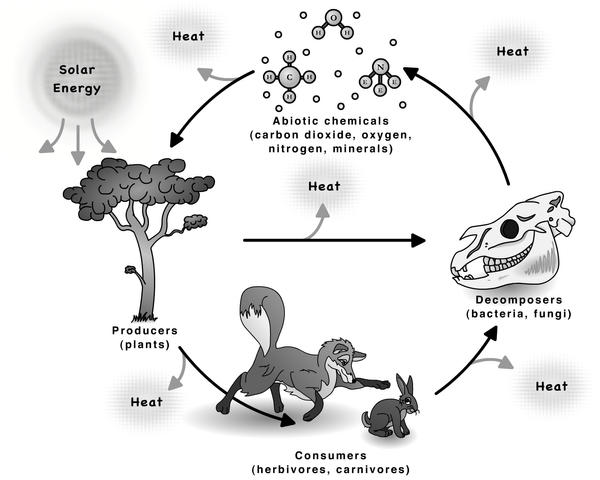
The Circle of Life. Image Credit: TaintedEnterprises
The components that make up you and me and everything else around us was once part of something else, somethings that were alive and all of which from the stars and may eventually become stars again. Death is a beautiful thing.
And it can remain a beautiful thing in our ceremonies and rituals for the dead. Unfortunately this fantastic part of the life cycle is often repressed in our current modern customs. Embalming the body (suffusing it with toxic substances so that bacteria cannot break it down and killing the bacteria that are there) and placing it in a reinforced coffin is common practice which further prevents decomposition and not to mention taking up a lot of space in the ground. Although cremation takes up less space and can spread its components, it also releases the toxins dioxin, hydrochloric acid, and carbon dioxide into the atmosphere. It also takes a lot of energy to super heat a cremation oven for 3 hours and the majority of its potential nutrient to the earth is lost in this alteration processes. So that isn’t really an ideal option either. (for a deeper look into these and virtually every other option out there follow this link, a number of which won’t be mentioned here but are solid options)

Image Source: naturallyearthfriendly.com
One of the most ideal options is the most ‘old school’ way of doing things – burying the dead as they are. Thus encouraging the natural decomposition process. There are various ways of approaching this, some of which being, wrapping the body in a shroud or favourite blanket and/or placing the body in a felt, wicker, or wooden plank coffin. Ideally the body would be buried in a place that allows for a tree or other vegetation to be planted or let grow over the burial mound. There is an increasing number of resources and options for such burial grounds – often called green or natural burials. You can even have the burial on private property with a permit – also known as home burials (search ‘burial permit’ for your area). These methods of approach are the most affordable and simple way of going about death. A very poetic touch would be to grow a food producing plant on top of the burial to enable direct participation in the circle of life.
Promession is another, arguably the most environmentally responsible way of disposing the body. It involves dry freezing the body, shattering it to dust, removing medically added components from remains which can then be recycled and thus not waste the material or contaminate the soil, and scattering/burying the rest in top soil – becoming completely decomposed into soil in as little as 12 months.

Natural Burial Ground. Image Source: beatree.com
So consider your death a positive adventure as exploring and finalizing what you want for yourself can be a very fun and creative experience, and by having it ready keeps peace of mind for you and loved ones when the moment comes.
If you want to learn about this and other customs and rituals
related to Ehoah follow this link.

Next Post

November 25, 2013 United Watersheds of America?
Browse Our Archives
Select a Category Crafts Creating Connections Cultural Quandaries Earth Matters Earthly Rites Ecopsychology Fur and Feather Guest Posts Look & Find Natural Reflections Nature in the News Nature-based Holidays Nearby Nature Permaculture Quiz & Questionnaire Rituals & Ceremonies Science & Spirit The Sacred in Suburbia Uncategorized Wordless Wednesday
Select a Month January 2017 December 2016 November 2016 October 2016 September 2016 August 2016 June 2016 April 2016 March 2016 February 2016 January 2016 December 2015 November 2015 October 2015 September 2015 August 2015 July 2015 June 2015 May 2015 April 2015 March 2015 February 2015 January 2015 December 2014 November 2014 October 2014 September 2014 August 2014 July 2014 June 2014 May 2014 April 2014 March 2014 February 2014 January 2014 December 2013 November 2013 October 2013 September 2013 August 2013 July 2013 June 2013 May 2013 April 2013 March 2013 February 2013 January 2013 December 2012 November 2012 October 2012 September 2012 August 2012 July 2012 June 2012 May 2012 April 2012 March 2012 February 2012 January 2012 December 2011 November 2011
Follow Us!
TAKE THE
Religious Wisdom Quiz
In 1 Peter, what will the proven genuineness of faith result in?
Select your answer to see how you score.
Salvation Eternal life Praise, glory and honor when Jesus is revealed Blessings
Related posts from Paths Through The Forests

The Paradox of Tolerance Led To Fascism In...

Coalition Urges Facebook To Be Transparent About Censorship,...

Saegoah Pursuits: Creative Eco-Friendly Gift Wrapping
TRENDING AT PATHEOS Pagan

I was recently chatting with someone on Instagram. She asked me what...

While there are many people who share their results, the end of...

On July 23, I saw Christopher Nolan's The Odyssey which is Homer’s...

As I write this two big events have just finished up. One...

Restoring the Watershed of Divine Love
Perhaps cooperation is not something we manufacture through legislation, ideology, or moral...

Many UUs don’t pray because of bad experiences in a previous religion,...
view all Pagan blogs
Ad-Free & Subscriber Log-In Subscription Support
- About Us
- 2026 Calendar
- Videos
- Podcasts
- Library of World Religions
- Faith In Media Tracker
- Advertise With Us
- Write for Us
- Privacy Policy
- Terms of Service
- Do Not Sell My Data
- Contact Us
- Radiant Digital
- Manage Newsletter Subscriptions
- Unsubscribe From Notifications
- Sitemap
Copyright 2008-2026, Patheos. All rights reserved.
Subscription Support Ad-Free & Subscriber Log-In
Follow Patheos