
BuddhistCatholicContemplativeEvangelicalGeneral ChristianHinduJewishLatter-day SaintMuslimNew VisionsProgressive Christian
Beliefs
- Buddhist
- Catholic
- Contemplative
- Evangelical
- General Christian
- Hindu
- Jewish
- Latter-day Saint
- More Voices
- Muslim
- New Visions
- Pagan
- Progressive Christian
Topics
- Religion News
- Food and Religion
- Sports and Religion
- Religious Art
- Religious Music and Entertainment
- Religious Events
- History and Religion
- Style and Religion
- Politics and Religion
- Women in Religion
- Recreation Outdoors and Religion
- Business Finance and Religion
- Careers Workplace and Religion
- Education and Religion
- Family Parenting and Religion
- Health Fitness and Religion
- Home and Religion
- Relationships and Religion
- Technology and Religion
- Travel and Religion
Columnists
- Buddhist Columnists
- Business Finance and Religion Columnists
- Careers Workplace and Religion Columnists
- Catholic Columnists
- Contemplative Columnists
- Education and Religion Columnists
- Evangelists Columnists
- Family Parenting and Religion Columnists
- General Christian Columnists
- Health Fitness and Religion Columnists
- Hindu Columnists
- History and Religion Columnists
- Home and Religion Columnists
- Jewish Columnists
- More Voices Columnists
- Latter Day Columnists
- Muslim Columnists
- New Visions Columnists
- Nonreligious Columnists
- Pagan Columnists
- Politics and Religion Columnists
- Progressive Columnists
- Recreation Outdoors and Religion Columnists
- Relationships and Religion Columnists
- Religion News Columnists
- Religious Art Columnists
- Religious Events Columnists
- Religious Music and Entertainment Columnists
- Sports and Religion Columnists
- Style and Religion Columnists
- Technology and Religion Columnists
- Travel and Religion Columnists
- Women in Religion Columnists
Resource Library
- 2026 Calendar
- Library of World Religions
- The 100 Most Holy Places on Earth
- Patheos Answers
- Podcasts
- Videos
- Faith Leaders Database
- Anglican Episcopalian
- Bahai
- Baptist
- Buddhism
- Christianity
- Confucianism
- Eastern Orthodoxy
- Hinduism
- Holiness and Pentecostal
- ISKCON
- Islam
- Judaism
- Lutheran
- Methodist
- The Church of Jesus Christ of Latter-day Saints
- New Age
- Paganism
- Presbytarian and Reformed
- Protestantism
- Religion Behind the Scenes
- Roman Catholic
- Scientology
- Shia Islam
- Sikhism
- Sufism
- Sunni Islam
- Taoism
- Zen
- See all religions
Research Tools
 Ad-Free & Subscriber Log-In Subscription Support
Ad-Free & Subscriber Log-In Subscription Support
Follow Patheos 

- Trending:
- Forgiveness
- |
- Marriage
- |
- Consciousness
- |
- Death Penalty
- |
- Election
- |
- Halloween
 Paths Through The Forests
- Home
- About
- Comment Guidelines
- Look & Find
- Holidays, Rituals & History
- Creating Connections
- Cultural Quandaries
- Crafts
- Quiz & Questionnaire
- Guest Posts
- Publications
- Archive Index
- Home
- Pagan
- Challenges Face the Columbia River
Challenges Face the Columbia River
Last updated on: November 30, 2012 at 3:02 am by Lupa Greenwolf
Challenges Face the Columbia River 2012-11-30T03:02:51-04:00 Lupa Greenwolf
Patheos Explore the world's faith through different perspectives on religion and spirituality! Patheos has the views of the prevalent religions and spiritualities of the world.
It’s no surprise that the watersheds of streams and rivers often mark the boundaries and definitions of bioregions. While ponds and lakes are lovely in their own right, moving water moves us in a way no still, quiet pool does. In a way, rivers, streams, creeks and their ilk are the bloodstream of the land, carrying necessary nutrients and other resources to ecosystems all along their lengths. We humans have made great use of their capacity for locomotion; every day we move everything from timber to wheat, vehicles to people, up and down their liquid tracks.
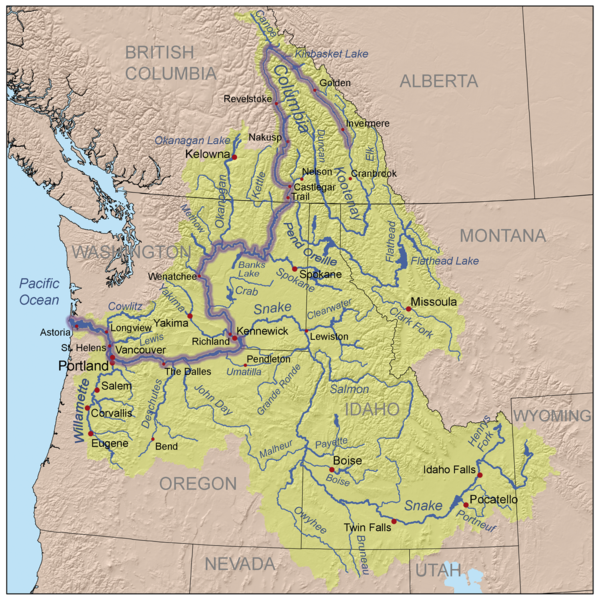
By Kmusser on Wikipedia
The Columbia River, the largest river in the Pacific Northwest, is at the heart of this ecoregion. It starts far north in British Columbia and winds its way down through Washington until it creates the Washington-Oregon border. Born in the Rocky Mountains, it then carries much-needed water to desert territories before crossing the Cascades into temperate rain forest, and finally emptying out into the Pacific Ocean. So much depends upon this single river, just from an ecological standpoint.
Human dependence abounds as well. Industries use the waterway to carry goods up and down its length. Many communities rely on the series of hydroelectric dams placed across it over the years. Recreation is on the rise; residents and visitors alike fish, boat, windsurf, and otherwise enjoy the broad expanse of water. Tourist locations along the river, such as Multnomah Falls, increase local revenue.
For all the value we place on the Columbia, some have been taking it for granted. Foreign coal interests plan to move thousands of tons of coal per year via barges and uncovered train cars. This not only raises the amount of barge traffic on the river, which can be dangerous to people using the river recreationally, but also puts more of an environmental strain through barge pollution and loose coal dust in the air and water. The exporters aren’t allowed in just yet; the potential environmental impact has yet to be assessed, and the issue is up for public comment.
Attacking the river from another angle, the Nestle Corporation wants to set up a bottling plant taking water directly from a spring that feeds into the river. This would necessitate building the bottling plant, with all the pollution that entails, plus providing yet another potential source of pollutants going into the Columbia itself. There’s a public comment event on Dec. 7 here in Portland; I’ll see about posting follow-up as I plan to go. As of 29 November, the public meeting has been canceled–more information here.
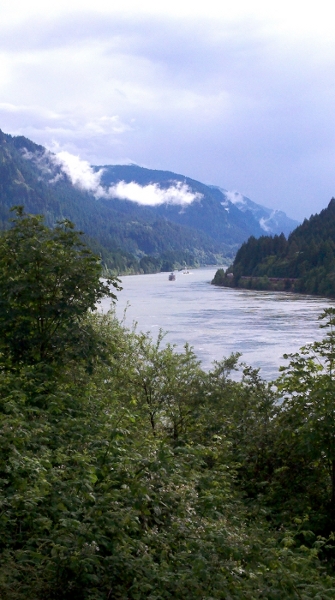
Barge on the Columbia River at Hood River. Photo by Lupa, 2012.
Existing industries have taken their toll as well. News recently came to light that Teck Resources poured heavy metals and other pollutants into the river for an entire century. Projected cleanup of this and other companies’ accumulated pollution is estimated to cost upwards of $1 billion. And further up the river at the Hanford site, radioactive waste from San Francisco company Bechtel was leaked very close to the Columbia, posing a significant risk to the watershed and river. The facility, which is currently under construction, has demonstrated a number of other flaws and shortcomings which could increase the risk of leaking nuclear waste in addition to the 520 gallons already released.
For all these assaults, the Columbia isn’t without its defenders. Friends of the Columbia Gorge engage in activism, as well as organized educational hikes along the many trails in the Gorge. Nestle’s attempts in particular are countered by the Keep Nestle Out of the Gorge Coalition; among others, this coalition includes Bark, an organization dedicated to protecting the wilderness around Mt. Hood. For those who prefer to protect the river, its tributaries and watersheds through hands-on volunteering, there are organizations like the Lower Columbia River Estuary Partnership, SOLV, Columbia Riverkeper, and Willamette Riverkeeper, among others.
I could say that the Columbia River is fortunate to run through an area that is so full of people conscious about sustainability and environmental issues. To an extent this is true, but there are too many reasons the river needs protection in the first place. Our industries, while beneficial in many ways, were not originally created with the environment in mind. Instead a linear ideal of progress, ever higher and more complex, took the center stage. And while the stretch of the Columbia between Portland and the Cascades has a lot of advocates, this is just a small portion of the river itself, much of which has been affected by dams, industries, and more.
Perhaps Woody Guthrie’s words in “Talking Columbia” were taken a bit too optimistically when he sang how the dams on the river:
“Run a thousand factories for Uncle Sam.
…
Makin’ ever’thing from sewing machines to fertilizer
Atomic bedrooms!… Plastic!
Everything’s gonna be made out of plastic!
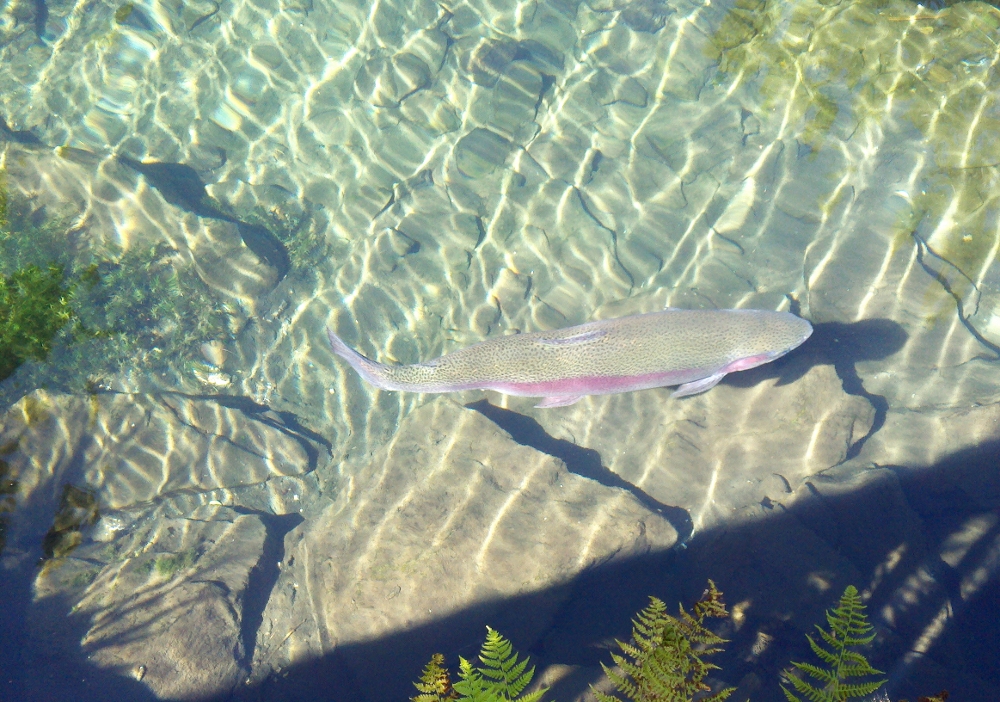
Salmon’s smaller cousin, rainbow trout, in a tributary of the Columbia. Photo by Lupa, 2012.
Yet just before then he sings “Salmon! That’s a good river!” Salmon do make a good river, but between the many challenges of the dams, and the pollution and habitat loss caused by other industries, the Columbia salmon are struggling to survive. So are the many other animals and plants that live in and near the river and its tributaries.
It will take all of us–volunteers, nonprofit organizations, and other advocates–to keep the Columbia from being degraded beyond repair. We’re not defeated yet, though. A recent study by the Oregon Department of Environmental Quality shows that while there is plenty of work to do, some factors such as water quality could be much worse (our river hasn’t caught on fire yet, for example). There is hope, and we can hang onto that as we continue our efforts to save the Columbia River.
Previous Post

November 27, 2012
Thoughts on Tree Planting
Browse Our Archives
Select a Category Crafts Creating Connections Cultural Quandaries Earth Matters Earthly Rites Ecopsychology Fur and Feather Guest Posts Look & Find Natural Reflections Nature in the News Nature-based Holidays Nearby Nature Permaculture Quiz & Questionnaire Rituals & Ceremonies Science & Spirit The Sacred in Suburbia Uncategorized Wordless Wednesday
Select a Month January 2017 December 2016 November 2016 October 2016 September 2016 August 2016 June 2016 April 2016 March 2016 February 2016 January 2016 December 2015 November 2015 October 2015 September 2015 August 2015 July 2015 June 2015 May 2015 April 2015 March 2015 February 2015 January 2015 December 2014 November 2014 October 2014 September 2014 August 2014 July 2014 June 2014 May 2014 April 2014 March 2014 February 2014 January 2014 December 2013 November 2013 October 2013 September 2013 August 2013 July 2013 June 2013 May 2013 April 2013 March 2013 February 2013 January 2013 December 2012 November 2012 October 2012 September 2012 August 2012 July 2012 June 2012 May 2012 April 2012 March 2012 February 2012 January 2012 December 2011 November 2011
Follow Us!
TAKE THE
Religious Wisdom Quiz
Who said, "My God, my God, why have you forsaken me?"
Select your answer to see how you score.
Jesus Isaiah David Job
Related posts from Paths Through The Forests

The Paradox of Tolerance Led To Fascism In...

Holiday Problems In the Classroom

Pagan, But Not What You're Assuming
TRENDING AT PATHEOS Pagan

I was recently chatting with someone on Instagram. She asked me what...

While there are many people who share their results, the end of...

On July 23, I saw Christopher Nolan's The Odyssey which is Homer’s...

As I write this two big events have just finished up. One...

Restoring the Watershed of Divine Love
Perhaps cooperation is not something we manufacture through legislation, ideology, or moral...

Many UUs don’t pray because of bad experiences in a previous religion,...
view all Pagan blogs
Ad-Free & Subscriber Log-In Subscription Support
- About Us
- 2026 Calendar
- Videos
- Podcasts
- Library of World Religions
- Faith In Media Tracker
- Advertise With Us
- Write for Us
- Privacy Policy
- Terms of Service
- Do Not Sell My Data
- Contact Us
- Radiant Digital
- Manage Newsletter Subscriptions
- Unsubscribe From Notifications
- Sitemap
Copyright 2008-2026, Patheos. All rights reserved.
Subscription Support Ad-Free & Subscriber Log-In
Follow Patheos