
BuddhistCatholicContemplativeEvangelicalGeneral ChristianHinduJewishLatter-day SaintMuslimNew VisionsProgressive Christian
Beliefs
- Buddhist
- Catholic
- Contemplative
- Evangelical
- General Christian
- Hindu
- Jewish
- Latter-day Saint
- More Voices
- Muslim
- New Visions
- Pagan
- Progressive Christian
Topics
- Religion News
- Food and Religion
- Sports and Religion
- Religious Art
- Religious Music and Entertainment
- Religious Events
- History and Religion
- Style and Religion
- Politics and Religion
- Women in Religion
- Recreation Outdoors and Religion
- Business Finance and Religion
- Careers Workplace and Religion
- Education and Religion
- Family Parenting and Religion
- Health Fitness and Religion
- Home and Religion
- Relationships and Religion
- Technology and Religion
- Travel and Religion
Columnists
- Buddhist Columnists
- Business Finance and Religion Columnists
- Careers Workplace and Religion Columnists
- Catholic Columnists
- Contemplative Columnists
- Education and Religion Columnists
- Evangelists Columnists
- Family Parenting and Religion Columnists
- General Christian Columnists
- Health Fitness and Religion Columnists
- Hindu Columnists
- History and Religion Columnists
- Home and Religion Columnists
- Jewish Columnists
- More Voices Columnists
- Latter Day Columnists
- Muslim Columnists
- New Visions Columnists
- Nonreligious Columnists
- Pagan Columnists
- Politics and Religion Columnists
- Progressive Columnists
- Recreation Outdoors and Religion Columnists
- Relationships and Religion Columnists
- Religion News Columnists
- Religious Art Columnists
- Religious Events Columnists
- Religious Music and Entertainment Columnists
- Sports and Religion Columnists
- Style and Religion Columnists
- Technology and Religion Columnists
- Travel and Religion Columnists
- Women in Religion Columnists
Resource Library
- 2026 Calendar
- Library of World Religions
- The 100 Most Holy Places on Earth
- Patheos Answers
- Podcasts
- Videos
- Faith Leaders Database
- Anglican Episcopalian
- Bahai
- Baptist
- Buddhism
- Christianity
- Confucianism
- Eastern Orthodoxy
- Hinduism
- Holiness and Pentecostal
- ISKCON
- Islam
- Judaism
- Lutheran
- Methodist
- The Church of Jesus Christ of Latter-day Saints
- New Age
- Paganism
- Presbytarian and Reformed
- Protestantism
- Religion Behind the Scenes
- Roman Catholic
- Scientology
- Shia Islam
- Sikhism
- Sufism
- Sunni Islam
- Taoism
- Zen
- See all religions
Research Tools
 Ad-Free & Subscriber Log-In Subscription Support
Ad-Free & Subscriber Log-In Subscription Support
Follow Patheos 

- Trending:
- Forgiveness
- |
- Marriage
- |
- Consciousness
- |
- Death Penalty
- |
- Election
- |
- Halloween
 Paths Through The Forests
- Home
- About
- Comment Guidelines
- Look & Find
- Holidays, Rituals & History
- Creating Connections
- Cultural Quandaries
- Crafts
- Quiz & Questionnaire
- Guest Posts
- Publications
- Archive Index
- Home
- Pagan
- On the Impermanence of Mountains
On the Impermanence of Mountains
Last updated on: July 11, 2012 at 9:19 am by Lupa Greenwolf
On the Impermanence of Mountains 2012-07-11T09:19:14-04:00 Lupa Greenwolf
Patheos Explore the world's faith through different perspectives on religion and spirituality! Patheos has the views of the prevalent religions and spiritualities of the world.
Scale is everything.
When we walk across a grassy field, we push the plants aside and brush away errant insects. Except for a few curious children, naturalists, and field biologists, that is the extent of our interaction with that ecosystem, unless we happen to see a deer, bird or other such vertebrate. We’re not required to engage with the moment to moment dramas of tiny invertebrates at our feet. We don’t keep a watchful eye out for marauding dragonflies ready to swoop down to attack as fiercely as any tiger. A sapling is, to us, not a tower so high that it is a region unto itself. All around us animals live and die, and we barely notice because they are so small, and we so large. Therefore, because it is no threat to us, we do not feel the need to exterminate the dragonfly in the same way we have done to the tiger.
This doesn’t make the dragonfly and its neighbors any less important on an immediate level. In fact, some of the smallest beings create the crucial foundations to all the ecosystems that we and other large beings rely on. The ocean would be empty without plankton; plants couldn’t grow without tiny fungal filaments at their roots. Even though most of these beings had lifespans that are only a few breaths of our own, without them we couldn’t be here. Still, for the most part we take them for granted.
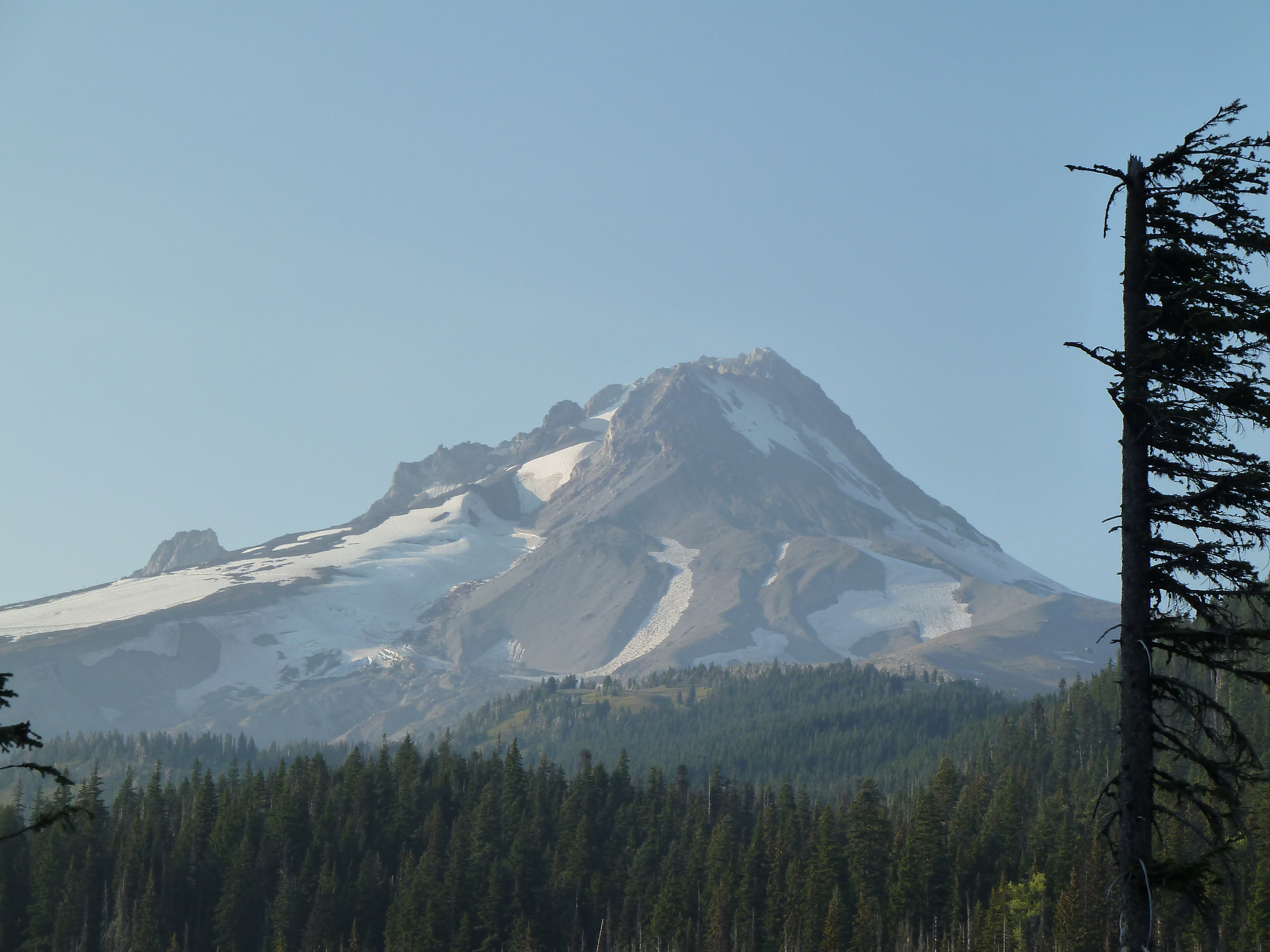
Mt. Hood. Photo by Lupa, 2011.
We look to the mountains instead, and honor them over the insects. Mountains have long been a symbol of permanence, ancient ages, and the ability to withstand the rigors of time. This is largely due to the comparatively great lengths of time most of them have been in place, and that most mountains that existed when we were each born will still be there when we die. So we admire them, and we aspire to be like them.
But even the mountains are on the move. They have lifespans, and they die. Erosion wears them away, and they may explode to make way for new volcanic progeny. And many of them aren’t so old. Mt. Hood, my closest giant neighbor, is a scant half a million years old. It has seen no more living dinosaurs and trilobites than I have.
What does this tell me? Simply this: that this world is far from a static thing. Instead, it is made of beings and phenomena that all move forward at their own paces. While the mountain slowly crumbles over millenia, the field mouse is hoping to evade the owl’s talons a few more weeks to deliver one more litter of young. To us, the mouse lives a much shorter life than the mountain. But if you look at the life of the Universe as a whole, the lifespan of a mountain is only scarcely longer than that of a mouse or a mayfly–or a man.
Why is this important? Why does it mean so much to me that the world I know, even the stones, are temporary? Even our Earth is far from the oldest thing in the Universe and will someday die. Shouldn’t this be a depressing thought?
On an immediate scale, yes, it is sad to think of species going extinct in our time when it could have been prevented. And for all the breathtaking beauty of a volcanic eruption, there is still the violent destruction of many lives. The big picture does not negate these.
But spirituality is, in part, a yearning to find meaning in being a part of something much bigger than we are. We feel less isolated and accidental when we have something to look up to (like a mountain, or a deity). Me, I feel the greatest wonder when I think that this sliver of time that I inhabit, with its frogs and nematodes and lilies and craters and magma, is part of the scene shifting in a much, much larger story. I don’t feel sadness, in that moment, that I barely get to witness any of it. I cease to be the center of my universe, and instead I strive to comprehend even the barest scale of the Universe as a whole in time and space.
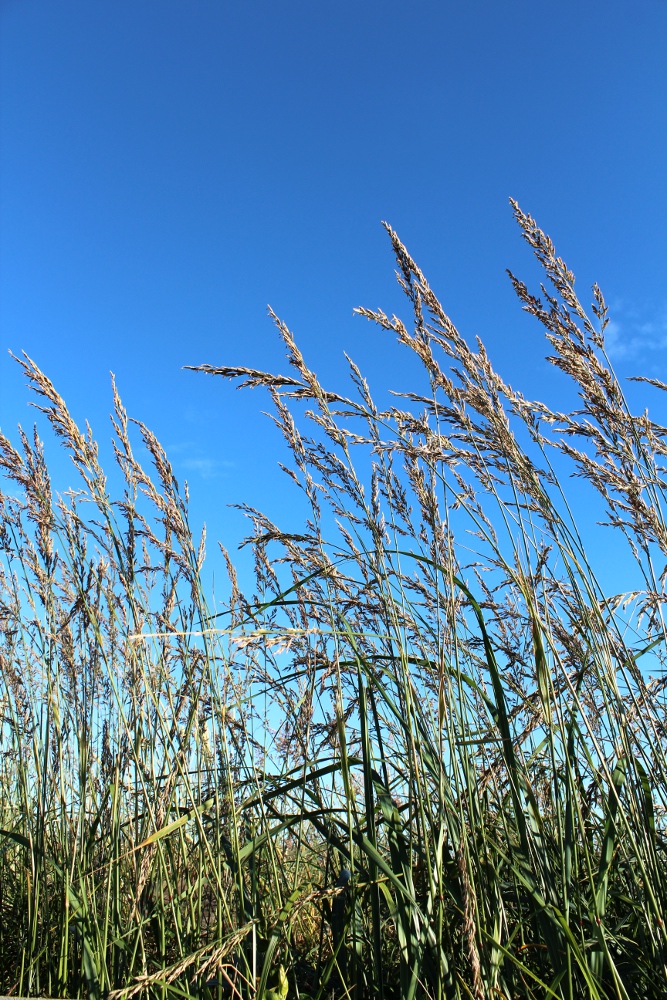
Oregon coast beach grass. Photo by Lupa, 2012.
Of course, I can’t wrap my head around it all, but there’s something of a joy in that as well. It means that I am a part of something that is, for all intents and purposes, limitless, and for someone who finds wonder and curiosity in the diversity of existence, that’s an incredible realization. I let go of the ideal of permanence and instead embrace the grand, ongoing flow. I have the privilege of being a part of that vast cosmic dance through space and time, where my partners aren’t just the rats and snowflakes and dragonflies and saplings and lakes of the here and now, but dinosaurs and trilobites, lava flows and solar storms–and the strange beings that may evolve from us one day. I dance with electrons in frenzied orbits, and I dance with entire galaxies circling through the night sky.
And then they all become important, precious, and worthy of honor while I am here. Mt. Hood in all its majesty is one beautiful dance partner; the tendril of fungus wrapped around a root filament of the cherry tree outside my window is another. The grassy field is suddenly stunning in her verdant gown with the dragonfly pendant so tantalizingly close to the grasshopper brooch, while further off the whitetail doe and the red fox wait their turn.
My dance card is full to overflowing with all manner of beings; I shall never dance alone in this life.
Previous Post

July 5, 2012
The Power of Positive Greening
Next Post
August 13, 2012 The Dangers of Talking Plants
Browse Our Archives
Select a Category Crafts Creating Connections Cultural Quandaries Earth Matters Earthly Rites Ecopsychology Fur and Feather Guest Posts Look & Find Natural Reflections Nature in the News Nature-based Holidays Nearby Nature Permaculture Quiz & Questionnaire Rituals & Ceremonies Science & Spirit The Sacred in Suburbia Uncategorized Wordless Wednesday
Select a Month January 2017 December 2016 November 2016 October 2016 September 2016 August 2016 June 2016 April 2016 March 2016 February 2016 January 2016 December 2015 November 2015 October 2015 September 2015 August 2015 July 2015 June 2015 May 2015 April 2015 March 2015 February 2015 January 2015 December 2014 November 2014 October 2014 September 2014 August 2014 July 2014 June 2014 May 2014 April 2014 March 2014 February 2014 January 2014 December 2013 November 2013 October 2013 September 2013 August 2013 July 2013 June 2013 May 2013 April 2013 March 2013 February 2013 January 2013 December 2012 November 2012 October 2012 September 2012 August 2012 July 2012 June 2012 May 2012 April 2012 March 2012 February 2012 January 2012 December 2011 November 2011
Follow Us!
TAKE THE
Religious Wisdom Quiz
Who said, "Lord, to whom shall we go? You have the words of eternal life"?
Select your answer to see how you score.
James Paul Peter John
Related posts from Paths Through The Forests

The Paradox of Tolerance Led To Fascism In...

Coalition Urges Facebook To Be Transparent About Censorship,...


Connecting to Nature in Human-Centered Places
TRENDING AT PATHEOS Pagan

I was recently chatting with someone on Instagram. She asked me what...

While there are many people who share their results, the end of...

On July 23, I saw Christopher Nolan's The Odyssey which is Homer’s...

As I write this two big events have just finished up. One...

Restoring the Watershed of Divine Love
Perhaps cooperation is not something we manufacture through legislation, ideology, or moral...

Many UUs don’t pray because of bad experiences in a previous religion,...
view all Pagan blogs
Ad-Free & Subscriber Log-In Subscription Support
- About Us
- 2026 Calendar
- Videos
- Podcasts
- Library of World Religions
- Faith In Media Tracker
- Advertise With Us
- Write for Us
- Privacy Policy
- Terms of Service
- Do Not Sell My Data
- Contact Us
- Radiant Digital
- Manage Newsletter Subscriptions
- Unsubscribe From Notifications
- Sitemap
Copyright 2008-2026, Patheos. All rights reserved.
Subscription Support Ad-Free & Subscriber Log-In
Follow Patheos