
BuddhistCatholicContemplativeEvangelicalGeneral ChristianHinduJewishLatter-day SaintMuslimNew VisionsProgressive Christian
Beliefs
- Buddhist
- Catholic
- Contemplative
- Evangelical
- General Christian
- Hindu
- Jewish
- Latter-day Saint
- More Voices
- Muslim
- New Visions
- Pagan
- Progressive Christian
Topics
- Religion News
- Food and Religion
- Sports and Religion
- Religious Art
- Religious Music and Entertainment
- Religious Events
- History and Religion
- Style and Religion
- Politics and Religion
- Women in Religion
- Recreation Outdoors and Religion
- Business Finance and Religion
- Careers Workplace and Religion
- Education and Religion
- Family Parenting and Religion
- Health Fitness and Religion
- Home and Religion
- Relationships and Religion
- Technology and Religion
- Travel and Religion
Columnists
- Buddhist Columnists
- Business Finance and Religion Columnists
- Careers Workplace and Religion Columnists
- Catholic Columnists
- Contemplative Columnists
- Education and Religion Columnists
- Evangelists Columnists
- Family Parenting and Religion Columnists
- General Christian Columnists
- Health Fitness and Religion Columnists
- Hindu Columnists
- History and Religion Columnists
- Home and Religion Columnists
- Jewish Columnists
- More Voices Columnists
- Latter Day Columnists
- Muslim Columnists
- New Visions Columnists
- Nonreligious Columnists
- Pagan Columnists
- Politics and Religion Columnists
- Progressive Columnists
- Recreation Outdoors and Religion Columnists
- Relationships and Religion Columnists
- Religion News Columnists
- Religious Art Columnists
- Religious Events Columnists
- Religious Music and Entertainment Columnists
- Sports and Religion Columnists
- Style and Religion Columnists
- Technology and Religion Columnists
- Travel and Religion Columnists
- Women in Religion Columnists
Resource Library
- 2026 Calendar
- Library of World Religions
- The 100 Most Holy Places on Earth
- Patheos Answers
- Podcasts
- Videos
- Faith Leaders Database
- Anglican Episcopalian
- Bahai
- Baptist
- Buddhism
- Christianity
- Confucianism
- Eastern Orthodoxy
- Hinduism
- Holiness and Pentecostal
- ISKCON
- Islam
- Judaism
- Lutheran
- Methodist
- The Church of Jesus Christ of Latter-day Saints
- New Age
- Paganism
- Presbytarian and Reformed
- Protestantism
- Religion Behind the Scenes
- Roman Catholic
- Scientology
- Shia Islam
- Sikhism
- Sufism
- Sunni Islam
- Taoism
- Zen
- See all religions
Research Tools
 Ad-Free & Subscriber Log-In Subscription Support
Ad-Free & Subscriber Log-In Subscription Support
Follow Patheos 

- Trending:
- Forgiveness
- |
- Marriage
- |
- Consciousness
- |
- Death Penalty
- |
- Election
- |
- Halloween
 Paths Through The Forests
- Home
- About
- Comment Guidelines
- Look & Find
- Holidays, Rituals & History
- Creating Connections
- Cultural Quandaries
- Crafts
- Quiz & Questionnaire
- Guest Posts
- Publications
- Archive Index
- Home
- Pagan
- Je Ne Sais Quoi
Je Ne Sais Quoi
Last updated on: May 17, 2012 at 1:37 pm by Lupa Greenwolf
Je Ne Sais Quoi 2012-05-17T13:37:31-04:00 Lupa Greenwolf
Patheos Explore the world's faith through different perspectives on religion and spirituality! Patheos has the views of the prevalent religions and spiritualities of the world.
I have been reading through a collection of Aldo Leopold’s classic nature writing, A Sand County Almanac as well as some essays from Round River. Leopold was a naturalist who appreciated the beings of the wilderness both as he relied on them for food and fuel, but also as autonomous animals, plants and places. One of the themes that has resonated strongly with me is that of poignant loss. Throughout his writings, he mourned the extinction of native species, whether from a particular habitat or in entirety. He wrote a remarkable eulogy on the extinction of the Passenger pigeon, and spoke the finals days of a solitary old grizzly bear that was the last of its kind on a mountain in Arizona. And, of course, there was his famous description of killing a wolf and her pup for no reason other than that they were wolves, and how deeply that affected him.
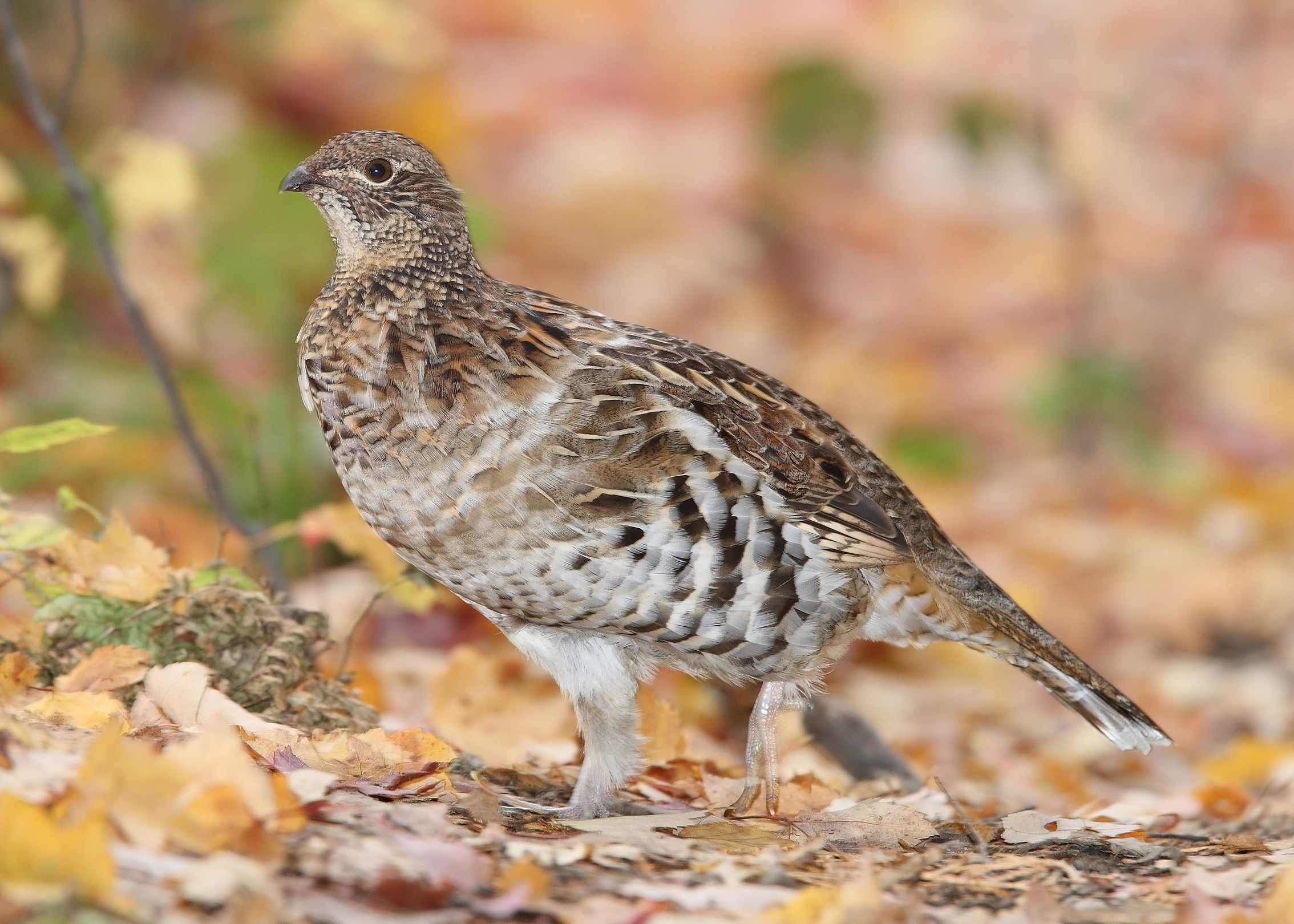
Ruffed Grouse. Source: http://bit.ly/Jlovfy
But none of these deaths and extinctions were taken in solitude. Each time Leopold provided a great deal of exposition illustrating just how intimately woven together were the single animal or species, and everything else in the ecosystem. Reading these leaves one with the distinct sense that we are only now realizing the extent to which extinction permanently affects a place, and that our new-found awareness is no consolation to the systems that have suffered such a devastating blow.
In one essay, Leopold speaks of particular animals holding the numenon of a place. The numenon, in this case, is the linchpin of a place’s identity–while the loss of any species changes a place, the numenon is one that especially carries the immeasurable, yet still perceptible, spirit of that place. In one case:
Everyone knows, for example, that the autumn landscape in the north woods [of Wisconsin] is the land, plus a red maple, plus a ruffed grouse. In terms of conventional physics, the grouse represents only a millionth of either the mass or the energy of an acre. Yet subtract the grouse and the whole thing is dead. An enormous amount of some motive power has been lost. (*p. 146)
And in the case of an individual animal, the grizzly bear nicknamed Bigfoot:
No one ever saw the old bear [on the mountain Escudilla], but in the muddy springs about the base of the cliffs you saw his incredible tracks. Seeing them made the most hard-bitten cowboys aware of bear. Wherever they rode they saw the mountain, and when they saw the mountain they thought of bear. Campfire conversation ran to beef, bailes, and bear. Bigfoot claimed for his own only a cow a year, and a few square miles of useless rocks, but his personality pervaded the country…[after his death] Escudilla still hangs on the horizon, but when you see it you no longer think of bear. It’s only a mountain now. (*p. 143-5)
Arguably the more charismatic animals, plants, and places are often seen as the most irreplaceable, when in fact all are important and often it’s the tiny ones on whose backs and stems the rest of the ecosystem rests. But if we look instead at the greater concept of the numenon as Leopold uses it, rather than just the individual species chosen for it, it’s a great deal like the Genius Loci, the spirit of a place. And all of the above are representatives of what gives a place its unique qualities, the je ne sais quoi, even if we can’t put a label to those qualities themselves. These are not quantifiable in the way that bird counts and the momentum of a waterfall are. They’re exceptionally subjective; it’s arguable that those of us who value a place for what it is create its spirit, while we cannot make a land developer or oil baron see beyond the cash value of the physical natural resources. It’s an aesthetic judgement, but no less crucial for that.
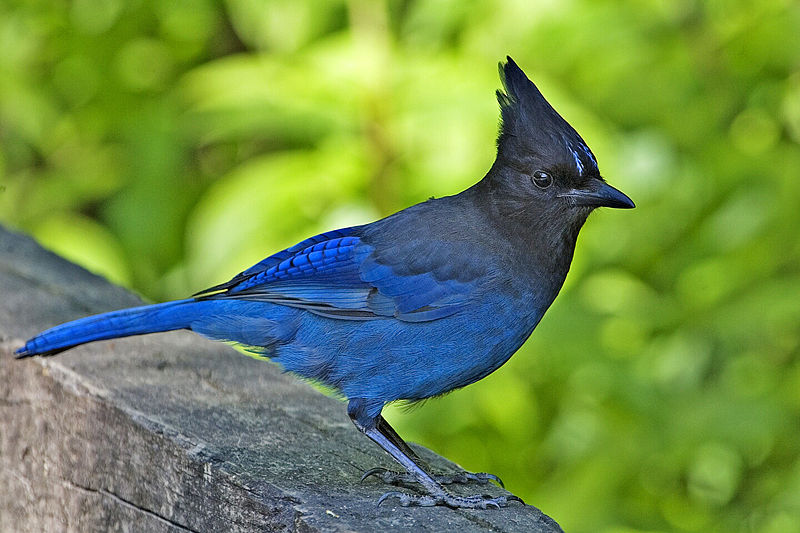
Steller's Jay. Source: http://bit.ly/KhD5oi
Hence, representatives. Or, perhaps, mascots if you will. They are as close as we may get to identifying the spirit of a place, and what we choose (consciously or not) to represent a place-spirit (literal or metaphorical) says a great deal about our relationship to that place. I find it unsurprising that the very first bioregional animal totem to contact me once I moved to Portland was Scrub Jay, as there were several of them living in the trees right outside my first apartment here. It’s not that there weren’t other animals, but the nocturnal raccoons, and the subterranean earthworms, just weren’t as noticeable. And over time, Scrub Jay’s boldness (and sometimes downright obnoxiousness) came to embody the things I love (and sometimes despise) about this city as I’ve gotten to know it better. In the same way, the more secluded but still charismatic Steller’s Jay was the perfect analogue out in the wilderness areas of the Columbia River Gorge. For me, Portland without scrub jays, and the western portion of the Gorge without Steller’s jays, would no longer be the places I have come to love, more than any other of the irreplaceable species here.
So here’s an exercise for you this weekend: think about, or even visit, one of your favorite places, wilderness or otherwise. Consider what the numenon, the place-spirit, the je ne sais quoi, of the place is for you personally, and what being(s) you would most sorely miss if they were gone from there forever. Whose absence would have the most impact? And why are these important to you? How does your connection to that being (or small handful of beings) affect your relationships with the rest of the system? Consider these, and move forward with them.
* Block quotes from A Sand County Almanac: With Essays on Conservation from Round River by Aldo Leopold, published 1986 by Ballantine Books, New York.
Previous Post

May 3, 2012
Grieving For Our Losses
Next Post
June 2, 2012 Bathing in the Colorado, Swimming in the Pacific
Browse Our Archives
Select a Category Crafts Creating Connections Cultural Quandaries Earth Matters Earthly Rites Ecopsychology Fur and Feather Guest Posts Look & Find Natural Reflections Nature in the News Nature-based Holidays Nearby Nature Permaculture Quiz & Questionnaire Rituals & Ceremonies Science & Spirit The Sacred in Suburbia Uncategorized Wordless Wednesday
Select a Month January 2017 December 2016 November 2016 October 2016 September 2016 August 2016 June 2016 April 2016 March 2016 February 2016 January 2016 December 2015 November 2015 October 2015 September 2015 August 2015 July 2015 June 2015 May 2015 April 2015 March 2015 February 2015 January 2015 December 2014 November 2014 October 2014 September 2014 August 2014 July 2014 June 2014 May 2014 April 2014 March 2014 February 2014 January 2014 December 2013 November 2013 October 2013 September 2013 August 2013 July 2013 June 2013 May 2013 April 2013 March 2013 February 2013 January 2013 December 2012 November 2012 October 2012 September 2012 August 2012 July 2012 June 2012 May 2012 April 2012 March 2012 February 2012 January 2012 December 2011 November 2011
Follow Us!
TAKE THE
Religious Wisdom Quiz
I prayed while serving wine to the king, and my sad face led to permission for my mission. Who am I?
Select your answer to see how you score.
Daniel Nehemiah Ezra Mordecai
Related posts from Paths Through The Forests

The Paradox of Tolerance Led To Fascism In...

Coalition Urges Facebook To Be Transparent About Censorship,...


Connecting to Nature in Human-Centered Places
TRENDING AT PATHEOS Pagan

I was recently chatting with someone on Instagram. She asked me what...

While there are many people who share their results, the end of...

On July 23, I saw Christopher Nolan's The Odyssey which is Homer’s...

As I write this two big events have just finished up. One...

Restoring the Watershed of Divine Love
Perhaps cooperation is not something we manufacture through legislation, ideology, or moral...

Many UUs don’t pray because of bad experiences in a previous religion,...
view all Pagan blogs
Ad-Free & Subscriber Log-In Subscription Support
- About Us
- 2026 Calendar
- Videos
- Podcasts
- Library of World Religions
- Faith In Media Tracker
- Advertise With Us
- Write for Us
- Privacy Policy
- Terms of Service
- Do Not Sell My Data
- Contact Us
- Radiant Digital
- Manage Newsletter Subscriptions
- Unsubscribe From Notifications
- Sitemap
Copyright 2008-2026, Patheos. All rights reserved.
Subscription Support Ad-Free & Subscriber Log-In
Follow Patheos