
BuddhistCatholicContemplativeEvangelicalGeneral ChristianHinduJewishLatter-day SaintMuslimNew VisionsProgressive Christian
Beliefs
- Buddhist
- Catholic
- Contemplative
- Evangelical
- General Christian
- Hindu
- Jewish
- Latter-day Saint
- More Voices
- Muslim
- New Visions
- Pagan
- Progressive Christian
Topics
- Religion News
- Food and Religion
- Sports and Religion
- Religious Art
- Religious Music and Entertainment
- Religious Events
- History and Religion
- Style and Religion
- Politics and Religion
- Women in Religion
- Recreation Outdoors and Religion
- Business Finance and Religion
- Careers Workplace and Religion
- Education and Religion
- Family Parenting and Religion
- Health Fitness and Religion
- Home and Religion
- Relationships and Religion
- Technology and Religion
- Travel and Religion
Columnists
- Buddhist Columnists
- Business Finance and Religion Columnists
- Careers Workplace and Religion Columnists
- Catholic Columnists
- Contemplative Columnists
- Education and Religion Columnists
- Evangelists Columnists
- Family Parenting and Religion Columnists
- General Christian Columnists
- Health Fitness and Religion Columnists
- Hindu Columnists
- History and Religion Columnists
- Home and Religion Columnists
- Jewish Columnists
- More Voices Columnists
- Latter Day Columnists
- Muslim Columnists
- New Visions Columnists
- Nonreligious Columnists
- Pagan Columnists
- Politics and Religion Columnists
- Progressive Columnists
- Recreation Outdoors and Religion Columnists
- Relationships and Religion Columnists
- Religion News Columnists
- Religious Art Columnists
- Religious Events Columnists
- Religious Music and Entertainment Columnists
- Sports and Religion Columnists
- Style and Religion Columnists
- Technology and Religion Columnists
- Travel and Religion Columnists
- Women in Religion Columnists
Resource Library
- 2026 Calendar
- Library of World Religions
- The 100 Most Holy Places on Earth
- Patheos Answers
- Podcasts
- Videos
- Faith Leaders Database
- Anglican Episcopalian
- Bahai
- Baptist
- Buddhism
- Christianity
- Confucianism
- Eastern Orthodoxy
- Hinduism
- Holiness and Pentecostal
- ISKCON
- Islam
- Judaism
- Lutheran
- Methodist
- The Church of Jesus Christ of Latter-day Saints
- New Age
- Paganism
- Presbytarian and Reformed
- Protestantism
- Religion Behind the Scenes
- Roman Catholic
- Scientology
- Shia Islam
- Sikhism
- Sufism
- Sunni Islam
- Taoism
- Zen
- See all religions
Research Tools
 Ad-Free & Subscriber Log-In Subscription Support
Ad-Free & Subscriber Log-In Subscription Support
Follow Patheos 

- Trending:
- Forgiveness
- |
- Marriage
- |
- Consciousness
- |
- Death Penalty
- |
- Election
- |
- Halloween
 Paths Through The Forests
- Home
- About
- Comment Guidelines
- Look & Find
- Holidays, Rituals & History
- Creating Connections
- Cultural Quandaries
- Crafts
- Quiz & Questionnaire
- Guest Posts
- Publications
- Archive Index
- Home
- Pagan
- Grieving For Our Losses
Grieving For Our Losses
Last updated on: May 3, 2012 at 7:59 am by Lupa Greenwolf
Grieving For Our Losses 2012-05-03T07:59:31-04:00 Lupa Greenwolf
Patheos Explore the world's faith through different perspectives on religion and spirituality! Patheos has the views of the prevalent religions and spiritualities of the world.
Back in March, I went to visit my parents in Missouri. While I was there, I was horrified to find that the first little patch of scrub woods that I considered “my territory”, as it were, had been completely bulldozed and turned into a pharmacy. There wasn’t a single bit left. What made it worse was that I had intended during this visit to pick up a few more physical traces of the place to go with the pine cone from there on my place altar, because I knew that at some point there’d be no more chances. I guess I was just a little too late.
At the time, I did some immediate processing to try to work through my shock and pain. I wanted to reach out and know that I wasn’t alone in that feeling of deep loss for this place. Since then, I’ve slowly and carefully been uncovering those feelings. I haven’t done a full funerary rite just yet, but the potential is growing.
I keep finding myself going back to my ecopsychology shelves for supporting material in this process. I feel like so much of neo paganismis about hearkening back to places across the ocean, or abstracting places and things into spirits and deities. While the totems and gods have places in my path, this raw, visceral pain calls for a more immediate, physical connection. That place that died is not the place of Artemis, or of totems, but of a child’s wonder at an emerging butterfly and pieces of sandstone that sheltered garter snakes, of poplar trees reaching past the power lines overhead.
So I find inspiration in things that have spirit, but are not necessarily dealing with literal spirits, like the Altars of Extinction project spearheaded by Mary Gomes, a well-known figure in the field of ecopsychology (but also published in Reclaiming Quarterly). In this ritual project it is species, not spirits, that are remembered and called upon. Altars are built to creatures driven to the edge and over, whom we will never see again on this earth because of our excesses. These are centers of grieving for these losses, for the physical animals and plants gone forever.
And I look to the writings of Joanna Macy, whose engagement with collective and personal grief began with protesting against nuclear facilities, but expanded into a greater understanding of how we as individuals and communities feel the loss of the world around us. While all of her writings that I’ve read have been inspirational, I continue to be awestruck by the Council of All Beings ritual that she co-wrote. Again, it is the physical beings that are mourned. And our feelings of being overwhelmed and powerless in the face of so many traumas on a global scale as well as personal are also approached with care and compassion.
I do not say this to speak as though compassion and grieving, and connection to physical beings, have never had a place in neopaganism. But it seems sometimes that many of us spend so much time with our heads focused on what’s going on in the spirit world, waiting for a sign or symbol from another plane, that we get a bit detached from this one. And in the same way, the dominant American culture, that informs so much of American neopaganism, does not offer a place to grieve for the loss of places, of species, of entire systems. I see a lot of “celebrate nature and its cycles” rituals, and I occasionally see places for pagan funerary rites and the like. And I know other individual pagans have suffered similar losses, from the overwhelming sympathy I received when I wrote about my own grief.
But there’s a decided gap in overarching American neopagan spirituality when it comes to grieving greater systems and patterns, and it parallels a similar gap in the dominant culture. We don’t talk about grieving for the environment, perhaps because we’re conditioned to approach the problems from an analytical, let’s-find-a-solution perspective. We’re expected to remain constructive about it all. We don’t have a setting where it’s okay to cry ourselves to pieces over the imminent extinction of many of the wold’s big cats–or some of the most vulnerable little plants. If we treat the loss of a place as being on par with the loss of a person, we’re often seen as having unusual priorities, or being “too sensitive”, or even not caring about people enough.
Perhaps I’m suffering from tunnel vision, though. Maybe I just haven’t been seeing the discussion and the practice of grieving for places and species and ecosystems in neopaganism the way I’ve seen it in ecopsych. Am I missing something? Do you, dear readers, have resources and angles I haven’t found? You gave me a pleasant surprise when so many of you resonated with my loss of my sacred childhood place–perhaps you’ll show me that there’s more going on in intesive grief-work in neopagan spirituality than I had thought.
In the meantime, I continue to meditate on my loss, and to contemplate how I want to move forward from it. There will be a place and a time set aside, when the right place and time come together.
Postscript: The photo below is of the creek near the place where I moved to next, across town. This place still exists, albeit in a much more heavily developed form than when I met it two decades ago. I have no pictures of the place I lost, and there are no photos that I know of that show it as I knew it, as by that point it was an isolated open lot next to a dilapidated apartment complex, and no one else seemed to particularly care about it. But I wanted to leave at least a little beauty at the end of this, as it was difficult to write.
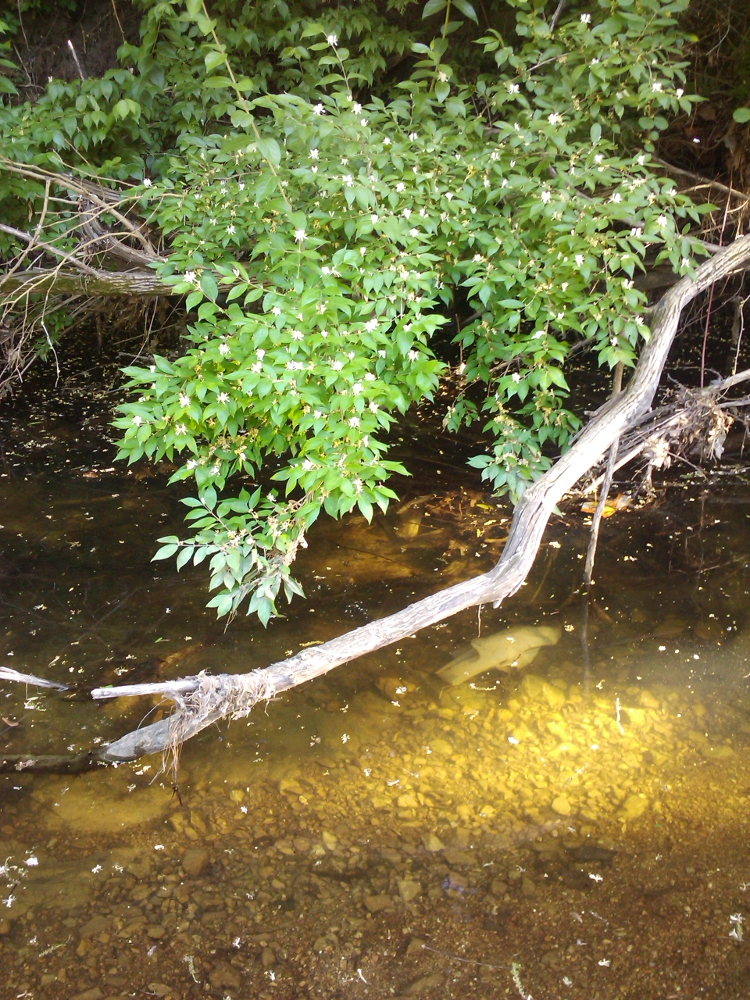
Lupa, 2010.
Previous Post

April 16, 2012
A Few Thoughts on Plant Totems
Next Post
May 17, 2012 Je Ne Sais Quoi
Browse Our Archives
Select a Category Crafts Creating Connections Cultural Quandaries Earth Matters Earthly Rites Ecopsychology Fur and Feather Guest Posts Look & Find Natural Reflections Nature in the News Nature-based Holidays Nearby Nature Permaculture Quiz & Questionnaire Rituals & Ceremonies Science & Spirit The Sacred in Suburbia Uncategorized Wordless Wednesday
Select a Month January 2017 December 2016 November 2016 October 2016 September 2016 August 2016 June 2016 April 2016 March 2016 February 2016 January 2016 December 2015 November 2015 October 2015 September 2015 August 2015 July 2015 June 2015 May 2015 April 2015 March 2015 February 2015 January 2015 December 2014 November 2014 October 2014 September 2014 August 2014 July 2014 June 2014 May 2014 April 2014 March 2014 February 2014 January 2014 December 2013 November 2013 October 2013 September 2013 August 2013 July 2013 June 2013 May 2013 April 2013 March 2013 February 2013 January 2013 December 2012 November 2012 October 2012 September 2012 August 2012 July 2012 June 2012 May 2012 April 2012 March 2012 February 2012 January 2012 December 2011 November 2011
Follow Us!
TAKE THE
Religious Wisdom Quiz
Who was the mother of John the Baptist?
Select your answer to see how you score.
Hannah Deborah Mary Elizabeth
Related posts from Paths Through The Forests

The Paradox of Tolerance Led To Fascism In...

Coalition Urges Facebook To Be Transparent About Censorship,...


Connecting to Nature in Human-Centered Places
TRENDING AT PATHEOS Pagan

I was recently chatting with someone on Instagram. She asked me what...

While there are many people who share their results, the end of...

On July 23, I saw Christopher Nolan's The Odyssey which is Homer’s...

As I write this two big events have just finished up. One...

Restoring the Watershed of Divine Love
Perhaps cooperation is not something we manufacture through legislation, ideology, or moral...

Many UUs don’t pray because of bad experiences in a previous religion,...
view all Pagan blogs
Ad-Free & Subscriber Log-In Subscription Support
- About Us
- 2026 Calendar
- Videos
- Podcasts
- Library of World Religions
- Faith In Media Tracker
- Advertise With Us
- Write for Us
- Privacy Policy
- Terms of Service
- Do Not Sell My Data
- Contact Us
- Radiant Digital
- Manage Newsletter Subscriptions
- Unsubscribe From Notifications
- Sitemap
Copyright 2008-2026, Patheos. All rights reserved.
Subscription Support Ad-Free & Subscriber Log-In
Follow Patheos