
BuddhistCatholicContemplativeEvangelicalGeneral ChristianHinduJewishLatter-day SaintMuslimNew VisionsProgressive Christian
Beliefs
- Buddhist
- Catholic
- Contemplative
- Evangelical
- General Christian
- Hindu
- Jewish
- Latter-day Saint
- More Voices
- Muslim
- New Visions
- Pagan
- Progressive Christian
Topics
- Religion News
- Food and Religion
- Sports and Religion
- Religious Art
- Religious Music and Entertainment
- Religious Events
- History and Religion
- Style and Religion
- Politics and Religion
- Women in Religion
- Recreation Outdoors and Religion
- Business Finance and Religion
- Careers Workplace and Religion
- Education and Religion
- Family Parenting and Religion
- Health Fitness and Religion
- Home and Religion
- Relationships and Religion
- Technology and Religion
- Travel and Religion
Columnists
- Buddhist Columnists
- Business Finance and Religion Columnists
- Careers Workplace and Religion Columnists
- Catholic Columnists
- Contemplative Columnists
- Education and Religion Columnists
- Evangelists Columnists
- Family Parenting and Religion Columnists
- General Christian Columnists
- Health Fitness and Religion Columnists
- Hindu Columnists
- History and Religion Columnists
- Home and Religion Columnists
- Jewish Columnists
- More Voices Columnists
- Latter Day Columnists
- Muslim Columnists
- New Visions Columnists
- Nonreligious Columnists
- Pagan Columnists
- Politics and Religion Columnists
- Progressive Columnists
- Recreation Outdoors and Religion Columnists
- Relationships and Religion Columnists
- Religion News Columnists
- Religious Art Columnists
- Religious Events Columnists
- Religious Music and Entertainment Columnists
- Sports and Religion Columnists
- Style and Religion Columnists
- Technology and Religion Columnists
- Travel and Religion Columnists
- Women in Religion Columnists
Resource Library
- 2026 Calendar
- Library of World Religions
- The 100 Most Holy Places on Earth
- Patheos Answers
- Podcasts
- Videos
- Faith Leaders Database
- Anglican Episcopalian
- Bahai
- Baptist
- Buddhism
- Christianity
- Confucianism
- Eastern Orthodoxy
- Hinduism
- Holiness and Pentecostal
- ISKCON
- Islam
- Judaism
- Lutheran
- Methodist
- The Church of Jesus Christ of Latter-day Saints
- New Age
- Paganism
- Presbytarian and Reformed
- Protestantism
- Religion Behind the Scenes
- Roman Catholic
- Scientology
- Shia Islam
- Sikhism
- Sufism
- Sunni Islam
- Taoism
- Zen
- See all religions
Research Tools
 Ad-Free & Subscriber Log-In Subscription Support
Ad-Free & Subscriber Log-In Subscription Support
Follow Patheos 

- Trending:
- Forgiveness
- |
- Marriage
- |
- Consciousness
- |
- Death Penalty
- |
- Election
- |
- Halloween
 Paths Through The Forests
- Home
- About
- Comment Guidelines
- Look & Find
- Holidays, Rituals & History
- Creating Connections
- Cultural Quandaries
- Crafts
- Quiz & Questionnaire
- Guest Posts
- Publications
- Archive Index
- Home
- Pagan
- We Do Not Return to Nature. We Are Already There.
We Do Not Return to Nature. We Are Already There.
Last updated on: January 27, 2012 at 10:11 pm by Lupa Greenwolf
We Do Not Return to Nature. We Are Already There. 2012-01-27T22:11:51-04:00 Lupa Greenwolf
Patheos Explore the world's faith through different perspectives on religion and spirituality! Patheos has the views of the prevalent religions and spiritualities of the world.
You notice how the URL for this section of the Pagan Newswire Collective has the word “nature” in it? Of course. It’s specifically for nature-based pagan religious and spiritual discussions and ideas. I would bet that the majority of people who think of “nature” are thinking of open areas that have a minimum of human impact, where the signs of humanity are reduced or even almost entirely eradicated. And I feel that’s a grave shortcoming in our perceptions.
I want to share with you one of my very favorite quotes. It’s a statement by Richard Nelson, quoted in The Sacred Earth: Writers on Nature and Spirit, edited by Jason Gardner (emphasis mine):
It’s dangerous to think of ourselves as loathsome creatures or as perversions in the natural world. We need to see ourselves as having a rightful place. We take pictures of all kinds of natural scenes and often we try to avoid having a human being in them…In our society, we force ourselves into a greater and greater distance from the natural world by creating parks and wilderness areas where our only role is to go in and look. And we call this loving it. We lavish tremendous concern and care on scenery but we ignore the ravaging of environments from which our lives are drawn.
This is a perfect image of how we have separated ourselves from the rest of nature. Not separating ourselves from nature, but separating ourselves from the rest of nature. That’s been the entire problem all along. Numerous factors ranging from religion to the Industrial Revolution have systematically convinced many portions of humanity that we are “above nature”, that “nature is to be used”, and otherwise referring to “nature” in the third person—nature the It as opposed to nature the Us.
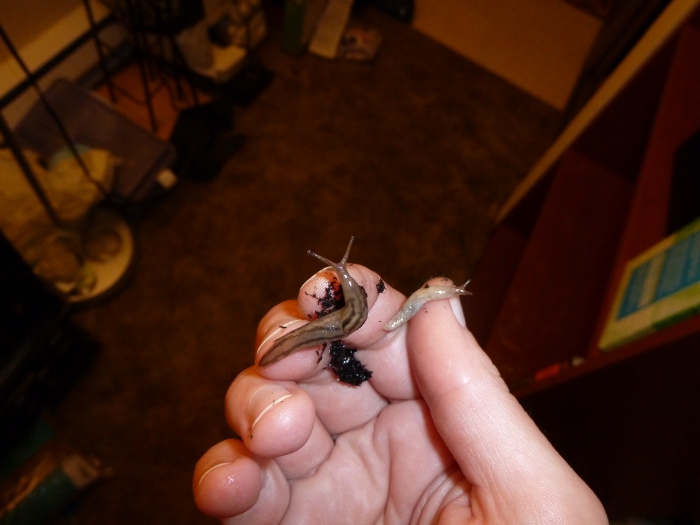
Baby slugs from my apartment balcony garden - photo by Lupa, 2011
This whole idea that we have to go out to the woods or the desert or the coast in order to “be with nature” just continues that disconnection, whether it’s disconnection through devaluing nature as “beneath us”, or disconnection by hyper-romanticizing nature and only looking for its supposedly “pure” manifestations—those that are relatively untouched by humans.
Nature? Nature is everywhere. Nature is the flora in our gut and in the sewers. Nature is the moss growing on old house shingles. Nature is the wind blowing through skyscrapers, in cities whose presence changes the microclimate. Nature is the sun that shines and the rain that falls on every place above ground. And humans? Humans are nature, too. Our big brains and bipedal stance are the adaptations we evolved in order to survive the challenges of being ground-dwelling, omnivorous, hunter-gatherer-scavenger apes. Our cities and buildings are exaggerated manifestations of our nest-building instincts, tempered with aesthetic self-awareness.
And remembering that we are nature reconnects us to everything else. If we remember we are nature, that we cannot separate ourselves from nature, then we come to realize that our cities and other habitations are part of ecosystems—dramatically changed ecosystems, but there nonetheless. We may find that suddenly the issues that affect the environment are immediate—not out in the woods somewhere where we can ignore them, but right here, in our bodies and homes and streets. We can still value the wilderness, but we no longer ghettoize nature as being “out there somewhere that we escape to”.
That’s a very valuable point: the idea that we “escape to nature”. Isn’t it sad that we in the cities feel we are escaping from something that isn’t nature, when in reality nature is all around us? I instead propose that when we are speaking of relatively human-free places, open, quiet areas, we speak of “wilderness” instead of “nature” as a defining term. Wilderness contains an element of primal quality, but without the overarching completion of “nature”. It gives us some way to delineate between the Hoh rain forest on the Olympic Peninsula, and paved-over downtown Seattle, without denying that these places are still family to each other, the blood connecting them embodied in the intertwining waters of Puget Sound and surrounding ways.
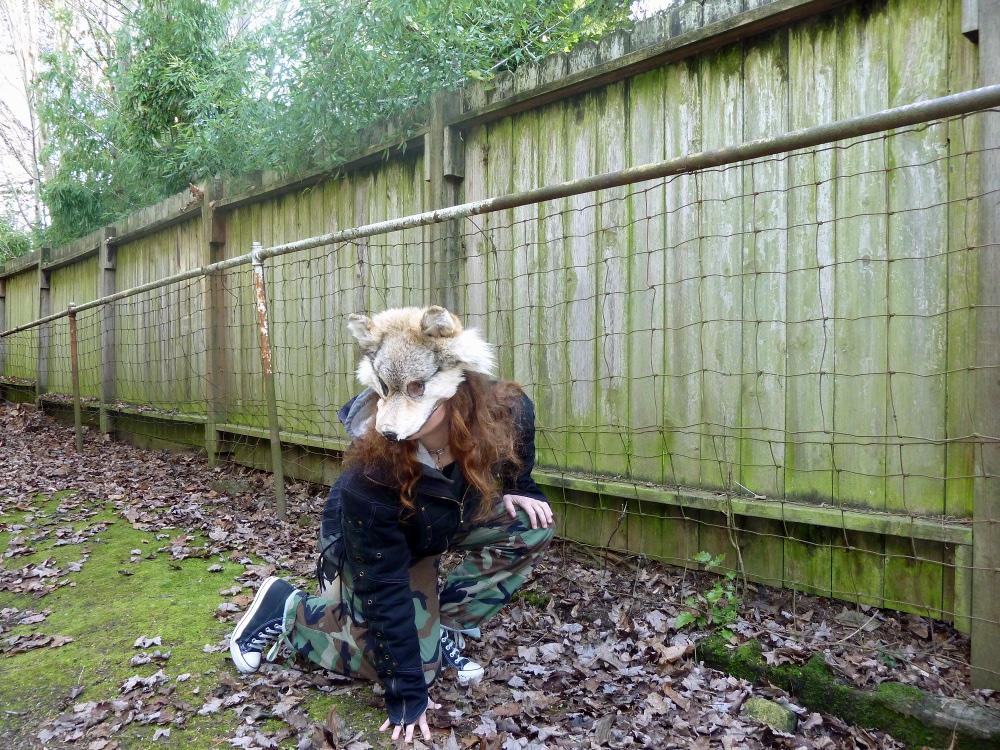 I question the reliance on wilderness as the primary representative to humans of nature. If we are convinced that we can only connect to nature in places away from other humans, then not only are we betraying our poor, disconnected species, especially those who have no choice but to live in cities, but we are also betraying the urban ecosystems as valid representatives of nature. We have abandoned any attempts of making cities healthier places to live for everyone, not just the people rich enough to be able to afford to “escape” on the weekends. We privilege rural animals and plants while taking the urban ones for granted—“dirty pigeons”, “disease-carrying rats”, and “weeds”.
My Therioshamanism blog has had the John Muir quote “In the silence of the wild, we find the home we lost in the city” at the top of it ever since I started it in 2007. I don’t agree with it any more, though I’ve not yet found a good substitute for it just yet. I don’t feel I have lost anything in the city, at least not anything that I can’t find here as well. While I love my trips to the Columbia River Gorge and other wilderness areas, I don’t value them above my talking with the maple tree across the street from my apartment or the scrub jays that vweeeeet though the neighborhood. And it is here in the city, not in the wilderness, that I have found, discovered, returned to the knowledge that I am nature. I joyously embrace the fact that this place is nature as much as Mt. Hood, as much as the Columbia River Gorge, as much as any of the wilderness places I have fallen in love with over time.
For like me, the maple and the scrub jays and all our neighbors are continuing the cycles of nature in this human-strong place, with all its benefits and challenges. I can’t get that experience when I am sitting next to Wahkeena Spring, or at the top of Devil’s Rest. The trees and the jays and I must learn the lessons of nature in this unique place, remember that there are lessons of nature to be learned, and share that remembering with others. If we can accomplish that remembering together then we have more hope, not of destroying cities and losing what is valuable in them, but of bringing our urban nature places back into greater harmony with the rest.
Previous Post

January 17, 2012
Deep Ancestral Totemism, Part Three
Next Post
February 7, 2012 Further Thoughts on Nature, Wilderness, and Urban Sustainability
Browse Our Archives
Select a Category Crafts Creating Connections Cultural Quandaries Earth Matters Earthly Rites Ecopsychology Fur and Feather Guest Posts Look & Find Natural Reflections Nature in the News Nature-based Holidays Nearby Nature Permaculture Quiz & Questionnaire Rituals & Ceremonies Science & Spirit The Sacred in Suburbia Uncategorized Wordless Wednesday
Select a Month January 2017 December 2016 November 2016 October 2016 September 2016 August 2016 June 2016 April 2016 March 2016 February 2016 January 2016 December 2015 November 2015 October 2015 September 2015 August 2015 July 2015 June 2015 May 2015 April 2015 March 2015 February 2015 January 2015 December 2014 November 2014 October 2014 September 2014 August 2014 July 2014 June 2014 May 2014 April 2014 March 2014 February 2014 January 2014 December 2013 November 2013 October 2013 September 2013 August 2013 July 2013 June 2013 May 2013 April 2013 March 2013 February 2013 January 2013 December 2012 November 2012 October 2012 September 2012 August 2012 July 2012 June 2012 May 2012 April 2012 March 2012 February 2012 January 2012 December 2011 November 2011
Follow Us!
TAKE THE
Religious Wisdom Quiz
What was the main language of Jesus’ daily speech?
Select your answer to see how you score.
Latin Greek Hebrew Aramaic
Related posts from Paths Through The Forests

The Paradox of Tolerance Led To Fascism In...

Coalition Urges Facebook To Be Transparent About Censorship,...


Connecting to Nature in Human-Centered Places
TRENDING AT PATHEOS Pagan

I was recently chatting with someone on Instagram. She asked me what...

While there are many people who share their results, the end of...

On July 23, I saw Christopher Nolan's The Odyssey which is Homer’s...

As I write this two big events have just finished up. One...

Restoring the Watershed of Divine Love
Perhaps cooperation is not something we manufacture through legislation, ideology, or moral...

Many UUs don’t pray because of bad experiences in a previous religion,...
view all Pagan blogs
Ad-Free & Subscriber Log-In Subscription Support
- About Us
- 2026 Calendar
- Videos
- Podcasts
- Library of World Religions
- Faith In Media Tracker
- Advertise With Us
- Write for Us
- Privacy Policy
- Terms of Service
- Do Not Sell My Data
- Contact Us
- Radiant Digital
- Manage Newsletter Subscriptions
- Unsubscribe From Notifications
- Sitemap
Copyright 2008-2026, Patheos. All rights reserved.
Subscription Support Ad-Free & Subscriber Log-In
Follow Patheos