
BuddhistCatholicContemplativeEvangelicalGeneral ChristianHinduJewishLatter-day SaintMuslimNew VisionsProgressive Christian
Beliefs
- Buddhist
- Catholic
- Contemplative
- Evangelical
- General Christian
- Hindu
- Jewish
- Latter-day Saint
- More Voices
- Muslim
- New Visions
- Pagan
- Progressive Christian
Topics
- Religion News
- Food and Religion
- Sports and Religion
- Religious Art
- Religious Music and Entertainment
- Religious Events
- History and Religion
- Style and Religion
- Politics and Religion
- Women in Religion
- Recreation Outdoors and Religion
- Business Finance and Religion
- Careers Workplace and Religion
- Education and Religion
- Family Parenting and Religion
- Health Fitness and Religion
- Home and Religion
- Relationships and Religion
- Technology and Religion
- Travel and Religion
Columnists
- Buddhist Columnists
- Business Finance and Religion Columnists
- Careers Workplace and Religion Columnists
- Catholic Columnists
- Contemplative Columnists
- Education and Religion Columnists
- Evangelists Columnists
- Family Parenting and Religion Columnists
- General Christian Columnists
- Health Fitness and Religion Columnists
- Hindu Columnists
- History and Religion Columnists
- Home and Religion Columnists
- Jewish Columnists
- More Voices Columnists
- Latter Day Columnists
- Muslim Columnists
- New Visions Columnists
- Nonreligious Columnists
- Pagan Columnists
- Politics and Religion Columnists
- Progressive Columnists
- Recreation Outdoors and Religion Columnists
- Relationships and Religion Columnists
- Religion News Columnists
- Religious Art Columnists
- Religious Events Columnists
- Religious Music and Entertainment Columnists
- Sports and Religion Columnists
- Style and Religion Columnists
- Technology and Religion Columnists
- Travel and Religion Columnists
- Women in Religion Columnists
Resource Library
- 2026 Calendar
- Library of World Religions
- The 100 Most Holy Places on Earth
- Patheos Answers
- Podcasts
- Videos
- Faith Leaders Database
- Anglican Episcopalian
- Bahai
- Baptist
- Buddhism
- Christianity
- Confucianism
- Eastern Orthodoxy
- Hinduism
- Holiness and Pentecostal
- ISKCON
- Islam
- Judaism
- Lutheran
- Methodist
- The Church of Jesus Christ of Latter-day Saints
- New Age
- Paganism
- Presbytarian and Reformed
- Protestantism
- Religion Behind the Scenes
- Roman Catholic
- Scientology
- Shia Islam
- Sikhism
- Sufism
- Sunni Islam
- Taoism
- Zen
- See all religions
Research Tools
 Ad-Free & Subscriber Log-In Subscription Support
Ad-Free & Subscriber Log-In Subscription Support
Follow Patheos 

- Trending:
- Forgiveness
- |
- Marriage
- |
- Consciousness
- |
- Death Penalty
- |
- Election
- |
- Halloween
 Paths Through The Forests
- Home
- About
- Comment Guidelines
- Look & Find
- Holidays, Rituals & History
- Creating Connections
- Cultural Quandaries
- Crafts
- Quiz & Questionnaire
- Guest Posts
- Publications
- Archive Index
- Home
- Pagan
- Carl Sagan’s “Cosmos”: A Pagan Perspective
Carl Sagan’s “Cosmos”: A Pagan Perspective
Last updated on: December 26, 2011 at 2:44 am by Lupa Greenwolf
Carl Sagan’s “Cosmos”: A Pagan Perspective 2011-12-26T02:44:41-04:00 Lupa Greenwolf
Patheos Explore the world's faith through different perspectives on religion and spirituality! Patheos has the views of the prevalent religions and spiritualities of the world.
When I’m making artwork, I often enjoy having some music or video going on that I can listen to and watch while I work. The other day I finished up watching Carl Sagan’s Cosmos: A Personal Voyage, which I’ve been watching segments of over the past couple of weeks. For those who haven’t seen it, it is an epic, thirteen-hour-long exploration of the Universe we live in, from the atomic level to the entirety of everything, ranging from the Big Bang itself all the way up to the present day. In each of the hour-long segments, Sagan touches on many diverse sciences, as well as history, sociology, psychology, and other disciplines. He puts into layperson’s terms the processes of evolution, the geologic history of the Earth, and the origin of life on this planet and even of the Universe itself.
What I found most invaluable, though, was how the series gives us perspective of where we fit into the grand scheme of things. Until not too long ago, most cultures had a very human-centric view of reality, where we were at the core, and everything revolved around us in importance. Cosmos is both beautiful and controversial because it shows us how very small we are, but also what amazingly intricate and long-lived processes we are an integrated part of. There were many times throughout the series where I was reminded of just how impossibly vast the Universe is, how very tiny the Earth is, and yet also how we ourselves, and everything else, are made of stars–and just how unlikely was the chance that we and everything else on Earth are here today. As humbling as it is to realize just how tiny our “pale blue dot” is, Cosmos also dedicates time to showing what does make us, as a species, so significant in our knowledge of the Universe. As Sagan said in the introduction to the series, “We are a way for the Cosmos to know itself”.
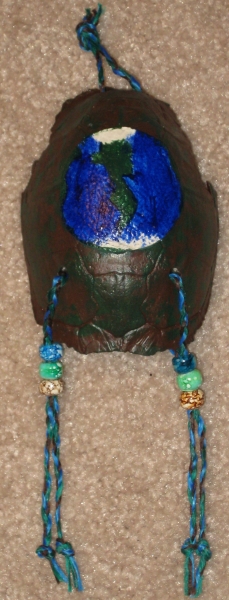
This is simultaneously humbling and inspirational. Much of human religion and spirituality is so heavily anthropocentric our spiritual cosmologies are largely concerned with the interest the Universe and its denizens have in us, and most of our deities are created in our very human image. Many of us never get further than “Earth” and “Sky” as the primordial, “biggest” concept-deities, because that’s how our ancestors understood it to be.* The celestial bodies we most acknowledge are the Sun and the Moon and our closest planetary cousins, but even astrology primarily concerns itself with how the positions of the stars and planets are important to us humans. And yet the Earth, and the visible parts of the Sky, are minute compared to the immensity they, and we, are a part of. It’s humbling because we find more and more that humans are far from the most important collections of stardust, and also inspiring because with every new discovery in biology, in astrophysics, and in so many other disciplines, there’s so much more we can know and explore about Life, the Universe, and Everything, even as laypeople.
I have, over the years, heard pagans and other such folk complain that there’s no real magic in this world, simply because we can’t do things like shoot fireballs from our fingertips or physically shapeshift or heal life-threatening illnesses with a touch. And yet Cosmos is a perfect illustration of the magic that is inherent to this physical reality. Look at evolution, for example. It is not just the “survival of the fittest”, as many oversimplify it. Rather, it is a many-generations-long progression of tiny shifts and alterations, and somehow one ancestral being has offspring which, over millenia, branch off into many diverse creatures. The phylogenetic Tree of Life is full to overflowing with living and extinct beings that are fascinating, beautiful, and inspirational simply by being themselves, without layering on subjective meaning like totemic lore or other symbolism. Or, on a smaller scale, I like to think about photosynthesis. The chloroplasts in plant cells, which are likely derived from cyanobacteria that formed symbiotic relationships with primitive plant cells, take sunlight and turn it into food. All the food we eat is created from sunlight changed into sugars by photosynthesis–we are eating transformed light waves**. How are these things not magical and miraculous, especially the more we know about them?
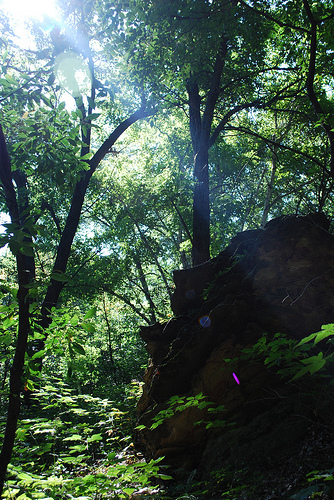
Shrine Walk Trail at Circle Sanctuary by Robert Paxton, 2011. Source: http://bit.ly/vk08sX
Cosmos is a massive journey through many of these manners in which star-stuff has formed over billions of years, and I can’t but think of it as revealing why the physical reality I live in is sacred. “Sacred” means “to inspire awe or reverence”, and with each new piece of knowledge about the Universe I acquire, the more deeply I feel that sacredness. Mythos and folklore and divine inspiration are great and beautiful things in the sphere of human experience, but if we are to understand the roots of those experiences, we need to dig into the (sometimes literal) dirt where those roots are grounded.
I think, perhaps, Cosmos could be in and of itself a ritual tool. Thirteen hours is a long time, and while most pagan rituals last an hour at best, there’s also something to be said for an immersive experience. So here’s a suggestion, whether you’ve seen this series in its entirety already or not: Set aside an entire day where you can be undisturbed, either alone, or with other interested, curious and respectful parties. Get comfortable. And then watch Cosmos from beginning to end. (Take breaks for the bathroom and food as needed, of course, but keep them short.) It will be a lot of information, and you may wish to go back at a later time and watch it over again in smaller segments. But this time, simply open yourself to the flow of information, and see how it affects you and your understanding of the Universe.
It may seem odd, on this nature-spirituality-themed blog, to suggest such long immersion in media. Yet not all media is created equal, and this series is much more information about the Universe than what we can immediately observe on our own, condensed into a few hours. Sitting in front of a television won’t show you the spirit of the land where you live, but it can offer you so much more backstory on its geology and biology and ultimate origin than you could get by watching the denizens of the land interact. It’s a complement to direct experiences with nature, not a replacement, and I see it as inspiration to make more forays out of our homes and into the world around us–and, perhaps, to support more exploration beyond where we can currently go. To know about evolution is one thing, but even scientists best appreciate it when they are able to actually see the plants and animals that resulted. (In fact, some of the most glorious marvels written about nature have been penned by scientists, not about things going on in laboratory settings, but our fellow beings in their own habitats–or the habitats themselves.)
Whether you choose to immerse yourself in a thirteen-hour marathon, or take Cosmos in multiple smaller doses, I encourage you to take what you learn and apply it to your experiences in the world around you. I know for myself that having more of the story has enriched my hikes and rituals outdoors, and I hope this can be a valuable resource for you as well.
* Ancient mythos from various cultures worked with what the people of those cultures knew at the time, with great wisdom but without the benefit of high=powered telescopes and other very helpful technology. However, mythology is constantly changing with the times, and a really good example of a modern mythos in the grand tradition that makes use of 21st-century knowledge, I recommend NUP’s own Restorying the Sacred column, with some lovely modern nature myths written by Eli Effinger-Weintraub.
** We are still unable to shoot fireballs from our fingertips. But isn’t it cool that in a way, through photosynthesis, we can eat fire?
Previous Post

December 15, 2011
Shapeshifting Into Kin: Part Two
Next Post
January 3, 2012 Deep Ancestral Totemism, Part One
Browse Our Archives
Select a Category Crafts Creating Connections Cultural Quandaries Earth Matters Earthly Rites Ecopsychology Fur and Feather Guest Posts Look & Find Natural Reflections Nature in the News Nature-based Holidays Nearby Nature Permaculture Quiz & Questionnaire Rituals & Ceremonies Science & Spirit The Sacred in Suburbia Uncategorized Wordless Wednesday
Select a Month January 2017 December 2016 November 2016 October 2016 September 2016 August 2016 June 2016 April 2016 March 2016 February 2016 January 2016 December 2015 November 2015 October 2015 September 2015 August 2015 July 2015 June 2015 May 2015 April 2015 March 2015 February 2015 January 2015 December 2014 November 2014 October 2014 September 2014 August 2014 July 2014 June 2014 May 2014 April 2014 March 2014 February 2014 January 2014 December 2013 November 2013 October 2013 September 2013 August 2013 July 2013 June 2013 May 2013 April 2013 March 2013 February 2013 January 2013 December 2012 November 2012 October 2012 September 2012 August 2012 July 2012 June 2012 May 2012 April 2012 March 2012 February 2012 January 2012 December 2011 November 2011
Follow Us!
TAKE THE
Religious Wisdom Quiz
How many days was Jesus dead before the resurrection?
Select your answer to see how you score.
Ten Seven Three One
Related posts from Paths Through The Forests

The Paradox of Tolerance Led To Fascism In...

Coalition Urges Facebook To Be Transparent About Censorship,...


Connecting to Nature in Human-Centered Places
TRENDING AT PATHEOS Pagan

I was recently chatting with someone on Instagram. She asked me what...

While there are many people who share their results, the end of...

On July 23, I saw Christopher Nolan's The Odyssey which is Homer’s...

As I write this two big events have just finished up. One...

Restoring the Watershed of Divine Love
Perhaps cooperation is not something we manufacture through legislation, ideology, or moral...

Many UUs don’t pray because of bad experiences in a previous religion,...
view all Pagan blogs
Ad-Free & Subscriber Log-In Subscription Support
- About Us
- 2026 Calendar
- Videos
- Podcasts
- Library of World Religions
- Faith In Media Tracker
- Advertise With Us
- Write for Us
- Privacy Policy
- Terms of Service
- Do Not Sell My Data
- Contact Us
- Radiant Digital
- Manage Newsletter Subscriptions
- Unsubscribe From Notifications
- Sitemap
Copyright 2008-2026, Patheos. All rights reserved.
Subscription Support Ad-Free & Subscriber Log-In
Follow Patheos