
BuddhistCatholicContemplativeEvangelicalGeneral ChristianHinduJewishLatter-day SaintMuslimNew VisionsProgressive Christian
Beliefs
- Buddhist
- Catholic
- Contemplative
- Evangelical
- General Christian
- Hindu
- Jewish
- Latter-day Saint
- More Voices
- Muslim
- New Visions
- Pagan
- Progressive Christian
Topics
- Religion News
- Food and Religion
- Sports and Religion
- Religious Art
- Religious Music and Entertainment
- Religious Events
- History and Religion
- Style and Religion
- Politics and Religion
- Women in Religion
- Recreation Outdoors and Religion
- Business Finance and Religion
- Careers Workplace and Religion
- Education and Religion
- Family Parenting and Religion
- Health Fitness and Religion
- Home and Religion
- Relationships and Religion
- Technology and Religion
- Travel and Religion
Columnists
- Buddhist Columnists
- Business Finance and Religion Columnists
- Careers Workplace and Religion Columnists
- Catholic Columnists
- Contemplative Columnists
- Education and Religion Columnists
- Evangelists Columnists
- Family Parenting and Religion Columnists
- General Christian Columnists
- Health Fitness and Religion Columnists
- Hindu Columnists
- History and Religion Columnists
- Home and Religion Columnists
- Jewish Columnists
- More Voices Columnists
- Latter Day Columnists
- Muslim Columnists
- New Visions Columnists
- Nonreligious Columnists
- Pagan Columnists
- Politics and Religion Columnists
- Progressive Columnists
- Recreation Outdoors and Religion Columnists
- Relationships and Religion Columnists
- Religion News Columnists
- Religious Art Columnists
- Religious Events Columnists
- Religious Music and Entertainment Columnists
- Sports and Religion Columnists
- Style and Religion Columnists
- Technology and Religion Columnists
- Travel and Religion Columnists
- Women in Religion Columnists
Resource Library
- 2026 Calendar
- Library of World Religions
- The 100 Most Holy Places on Earth
- Patheos Answers
- Podcasts
- Videos
- Faith Leaders Database
- Anglican Episcopalian
- Bahai
- Baptist
- Buddhism
- Christianity
- Confucianism
- Eastern Orthodoxy
- Hinduism
- Holiness and Pentecostal
- ISKCON
- Islam
- Judaism
- Lutheran
- Methodist
- The Church of Jesus Christ of Latter-day Saints
- New Age
- Paganism
- Presbytarian and Reformed
- Protestantism
- Religion Behind the Scenes
- Roman Catholic
- Scientology
- Shia Islam
- Sikhism
- Sufism
- Sunni Islam
- Taoism
- Zen
- See all religions
Research Tools
 Ad-Free & Subscriber Log-In Subscription Support
Ad-Free & Subscriber Log-In Subscription Support
Follow Patheos 

- Trending:
- Forgiveness
- |
- Marriage
- |
- Consciousness
- |
- Death Penalty
- |
- Election
- |
- Halloween
 Paths Through The Forests
- Home
- About
- Comment Guidelines
- Look & Find
- Holidays, Rituals & History
- Creating Connections
- Cultural Quandaries
- Crafts
- Quiz & Questionnaire
- Guest Posts
- Publications
- Archive Index
- Home
- Pagan
- Home Base: Place Altars As Connections to Wilderness
Home Base: Place Altars As Connections to Wilderness
Last updated on: November 28, 2011 at 2:59 am by Lupa Greenwolf
Home Base: Place Altars As Connections to Wilderness 2011-11-28T02:59:30-04:00 Lupa Greenwolf
Patheos Explore the world's faith through different perspectives on religion and spirituality! Patheos has the views of the prevalent religions and spiritualities of the world.
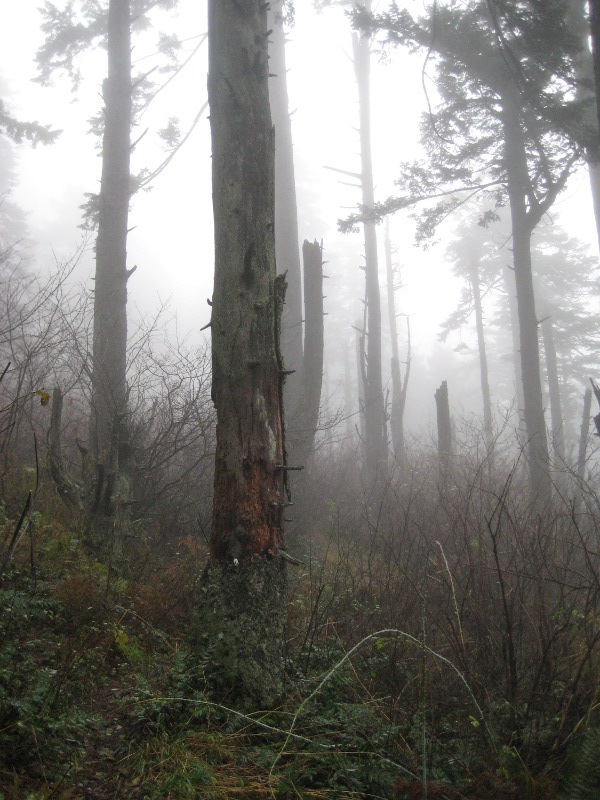
Dog Mountain, WA., November, 2010, by Lupa
I am not a huge fan of “nature” as being separate from humanity. The perceived divide of “natural” and “artificial” may seem like a way to emphasize the non-human nature that we often seem to ignore, but it still reinforces the idea that we are somehow divorced from natural processes and cycles, especially in cities. I do, however, favor the concept of “wilderness”. It evokes a place where humans have not had nearly as much of a dominant place in the ecosystem, and we can see more of what the rest of nature is like when we are just another critter in the woods (or fields, or desert, etc.).
Like many other Portland residents, while I live in the city proper, I do get out quite a bit to the wilderness areas that surround the metro region. Usually I’m off to hide somewhere in the Columbia River Gorge or spending a couple of days at the coast, but I’ve ranged further at times, depending on the situation.
This is a lifelong habit, this seeking less human-populated places for recharging and respite. When I enter the wilderness, I feel as though I am immersing myself in a rich, lush energy, though the nature of that energy changes

Pilot Butte, Bend, OR, July 2010, by Lupa
from place to place. The treasures of the deserts of Eastern Oregon are of a distinct quality compared to the conifer forests of the Gorge. And the genii loci of these places are their own beings as well, though like the boundaries of the places, large and small, they shift and blend and overlap, less distinct than our linear minds might prefer.
As much as I might like to stay immersed in wilderness forever, I also recognize that I am an urban creature. I have wants and needs and obligations that require more connectivity of a human sort. And, admittedly, I like comfort. Snow hiking is much more fun when I know I have a warm home to go back to.
But I don’t want to forget these places I’ve been, nor the often deep spiritual experiences I have while in their embrace, whether tender or terrifying. And so I collect small, single souvenirs for each place—a small stone, a Douglas fir cone, a piece of driftwood, a pheasant feather. I even got an antique glass jar lid from a local wetland that had been cleaned up after years of garbage being dumped there. And for every thing I take with me, I leave a bit of myself: hair, energy, water for a plant if I’ve enough to share. They come home with me, and I mark them with the date and the place as their number has increased with each place I become acquainted with.
They used to have their own shelf, but eventually they migrated over to one of my two primary altars. You can see them scattered around the top of it here, amid the small stone animals I’ve used to signify directional totems for many years.
The relocation of those stones and sticks and such is significant. For years I had a fairly typical generic Wicca-flavored neopagan altar, with the directional markers (animals, of course) plus the tools I used back then (athame, wand, etc.) and my image of Artemis, all from various places around the world and having more abstract than immediate symbolism. Once I began to embrace shamanism–and bioregionalism–more deeply, the tools I no longer used so often ended up on a second altar specifically for ritual implements old and new, and that’s when the gifts from the land spirits made their move.
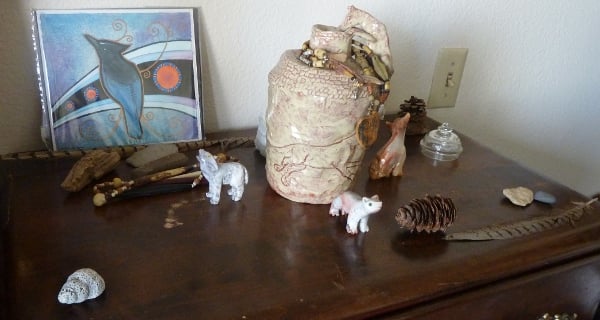
Place Altar by Lupa, 2011
It’s a beautiful weaving, actually. The centerpiece of the altar is a ceramic wolf-themed jug I made back in high school when I was first getting involved in paganism, and it represents me; it’s decorated with a pair of scrimshaw fossilized ivory necklaces that were instrumental in the processes that brought me to the Pacific Northwest. Immediately surrounding it are the four animal statues—Grey Wolf/North, Brown Bear/West, Red Fox/South, and Red-tailed Hawk/East—that survived the shift from my early neoshamanism and neopaganism, through my chaos magic explorations, and on into my more formal shamanic path. They represent the roots of my practice, like a volcanic core of basalt that has survived the erosion of softer stone surrounding it over time.
Radiating out from them, oriented toward the places they came from, are the reminders of the places I’ve been. They ground my practice more deeply in the place I am at. Not only have the spirits of place taken me in, but their other denizens have as well, and increasingly my altars are covered in gifts from other locals—the mule deer leg bone that is the handle of the beater for my drum, or the portrait that Steller’s Jay requested I get from the artist Ravenari in lieu of illegally possessing molted jay feathers.
Looking over these gifts, I can remember for a few moments—or longer, if I wish—what it was like to climb Dog Mountain in a November storm and nearly be blown off the summit; or the first time I met the Pacific Ocean; or the time I retreated to Bend, Oregon and found solace in the deserts there. I can remember the wildlife, and the plants, and the stones, and all the beings that come together in these places, just with these few small reminders.
And they’re all invitations to come back, to reconnect, whether physically or through journeying spiritually. Even the places that scared me weren’t out to get me; I simply wasn’t observing enough respect for them. Every visit is a chance to try again, to go in deeper, to give more of myself to the land spirits and see what happens next.
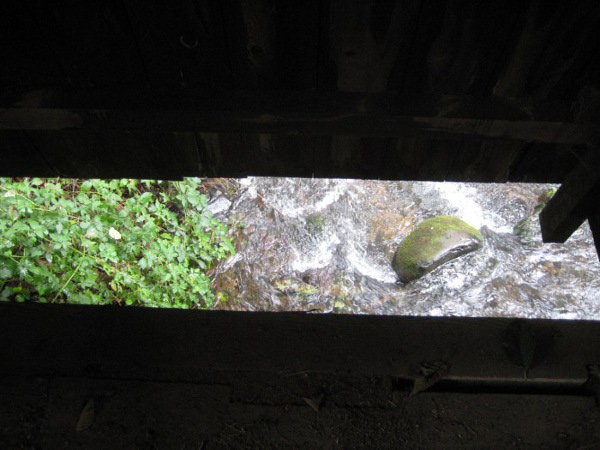
Bridge over Drift Creek near Lincoln City, OR, November 2010, by Lupa
Previous Post

November 22, 2011
Green Tomatoes Are the Reason For the Season
Next Post
December 6, 2011 Shapeshifting into Kin: Part One
Browse Our Archives
Select a Category Crafts Creating Connections Cultural Quandaries Earth Matters Earthly Rites Ecopsychology Fur and Feather Guest Posts Look & Find Natural Reflections Nature in the News Nature-based Holidays Nearby Nature Permaculture Quiz & Questionnaire Rituals & Ceremonies Science & Spirit The Sacred in Suburbia Uncategorized Wordless Wednesday
Select a Month January 2017 December 2016 November 2016 October 2016 September 2016 August 2016 June 2016 April 2016 March 2016 February 2016 January 2016 December 2015 November 2015 October 2015 September 2015 August 2015 July 2015 June 2015 May 2015 April 2015 March 2015 February 2015 January 2015 December 2014 November 2014 October 2014 September 2014 August 2014 July 2014 June 2014 May 2014 April 2014 March 2014 February 2014 January 2014 December 2013 November 2013 October 2013 September 2013 August 2013 July 2013 June 2013 May 2013 April 2013 March 2013 February 2013 January 2013 December 2012 November 2012 October 2012 September 2012 August 2012 July 2012 June 2012 May 2012 April 2012 March 2012 February 2012 January 2012 December 2011 November 2011
Follow Us!
TAKE THE
Religious Wisdom Quiz
What does "Tetragrammaton" refer to in biblical studies?
Select your answer to see how you score.
The first four commandments The first four books of the Bible The four-letter name of God The four Gospels
Related posts from Paths Through The Forests
Holiday Problems In the Classroom

Pagan, But Not What You're Assuming
Want To Notice Nature More? Here's How!
TRENDING AT PATHEOS Pagan

I was recently chatting with someone on Instagram. She asked me what...

While there are many people who share their results, the end of...

On July 23, I saw Christopher Nolan's The Odyssey which is Homer’s...

As I write this two big events have just finished up. One...

Restoring the Watershed of Divine Love
Perhaps cooperation is not something we manufacture through legislation, ideology, or moral...

Many UUs don’t pray because of bad experiences in a previous religion,...
view all Pagan blogs
Ad-Free & Subscriber Log-In Subscription Support
- About Us
- 2026 Calendar
- Videos
- Podcasts
- Library of World Religions
- Faith In Media Tracker
- Advertise With Us
- Write for Us
- Privacy Policy
- Terms of Service
- Do Not Sell My Data
- Contact Us
- Radiant Digital
- Manage Newsletter Subscriptions
- Unsubscribe From Notifications
- Sitemap
Copyright 2008-2026, Patheos. All rights reserved.
Subscription Support Ad-Free & Subscriber Log-In
Follow Patheos