
BuddhistCatholicContemplativeEvangelicalGeneral ChristianHinduJewishLatter-day SaintMuslimNew VisionsProgressive Christian
Beliefs
- Buddhist
- Catholic
- Contemplative
- Evangelical
- General Christian
- Hindu
- Jewish
- Latter-day Saint
- More Voices
- Muslim
- New Visions
- Pagan
- Progressive Christian
Topics
- Religion News
- Food and Religion
- Sports and Religion
- Religious Art
- Religious Music and Entertainment
- Religious Events
- History and Religion
- Style and Religion
- Politics and Religion
- Women in Religion
- Recreation Outdoors and Religion
- Business Finance and Religion
- Careers Workplace and Religion
- Education and Religion
- Family Parenting and Religion
- Health Fitness and Religion
- Home and Religion
- Relationships and Religion
- Technology and Religion
- Travel and Religion
Columnists
- Buddhist Columnists
- Business Finance and Religion Columnists
- Careers Workplace and Religion Columnists
- Catholic Columnists
- Contemplative Columnists
- Education and Religion Columnists
- Evangelists Columnists
- Family Parenting and Religion Columnists
- General Christian Columnists
- Health Fitness and Religion Columnists
- Hindu Columnists
- History and Religion Columnists
- Home and Religion Columnists
- Jewish Columnists
- More Voices Columnists
- Latter Day Columnists
- Muslim Columnists
- New Visions Columnists
- Nonreligious Columnists
- Pagan Columnists
- Politics and Religion Columnists
- Progressive Columnists
- Recreation Outdoors and Religion Columnists
- Relationships and Religion Columnists
- Religion News Columnists
- Religious Art Columnists
- Religious Events Columnists
- Religious Music and Entertainment Columnists
- Sports and Religion Columnists
- Style and Religion Columnists
- Technology and Religion Columnists
- Travel and Religion Columnists
- Women in Religion Columnists
Resource Library
- 2026 Calendar
- Library of World Religions
- The 100 Most Holy Places on Earth
- Patheos Answers
- Podcasts
- Videos
- Faith Leaders Database
- Anglican Episcopalian
- Bahai
- Baptist
- Buddhism
- Christianity
- Confucianism
- Eastern Orthodoxy
- Hinduism
- Holiness and Pentecostal
- ISKCON
- Islam
- Judaism
- Lutheran
- Methodist
- The Church of Jesus Christ of Latter-day Saints
- New Age
- Paganism
- Presbytarian and Reformed
- Protestantism
- Religion Behind the Scenes
- Roman Catholic
- Scientology
- Shia Islam
- Sikhism
- Sufism
- Sunni Islam
- Taoism
- Zen
- See all religions
Research Tools
 Ad-Free & Subscriber Log-In Subscription Support
Ad-Free & Subscriber Log-In Subscription Support
Follow Patheos 

- Trending:
- Forgiveness
- |
- Marriage
- |
- Consciousness
- |
- Death Penalty
- |
- Election
- |
- Halloween
 Paths Through The Forests
- Home
- About
- Comment Guidelines
- Look & Find
- Holidays, Rituals & History
- Creating Connections
- Cultural Quandaries
- Crafts
- Quiz & Questionnaire
- Guest Posts
- Publications
- Archive Index
- Home
- Pagan
- Bella Morte
Bella Morte
Last updated on: November 14, 2011 at 5:55 am by Lupa Greenwolf
Bella Morte 2011-11-14T05:55:00-04:00 Lupa Greenwolf
Patheos Explore the world's faith through different perspectives on religion and spirituality! Patheos has the views of the prevalent religions and spiritualities of the world.
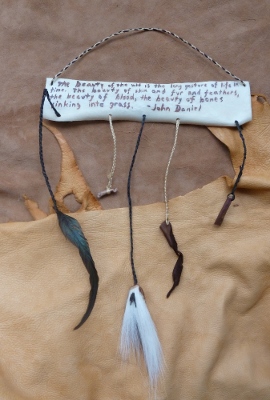
Rawhide wall hanging by Lupa, 2011
The beauty of the wild is the long gesture of life in time. The beauty of skin and fur and feathers, the beauty of blood, the beauty of bones sinking into grass.
–John Daniel, from The Soul Unearthed
That is the quote I painted on a recent creation of mine, shown in the picture above. My canvas was a piece of rawhide left over from a drum kit. The visual punctuation of the entire piece included an eclectic mix: a rooster feather; a coyote toe bone; a sea urchin spine; and two pieces of deer hide, fur and leather.
I chose the quote deliberately for that piece. There is a certain ambiguity to the words, flowing from one end of the life-death cycle to the other. “Life in time” breathes and pounds its heart, while the “bones sinking into grass” create a vivid image of the core structure of the animal, all the rest borne away, disintegrating into nourishment for the flora. In between, the hides and the blood are left open; they may be alive and running yet, but the blood may also be sluiced upon the ground, and the skin stripped from muscle and tendon and prepared for preservation.
In much of the United States, people have a poor relationship with death, to include that of nonhuman animals. The idea of the “poor, dead animals” (particularly those that aren’t carved up on a dinner plate) is often enough of a shock that no one wants to think, let alone talk, about it. We eat beef and pork, not cow and pig, and very few of us ever eat anything that’s looking back at us; even the shrimp are conveniently decapitated for our culinary comfort. The most common discourse about dead animals seems to come from some animal rights activists who quite often use guilt, shame, and shock to try to convince unsuspecting leather-clad omnivores into changing their ways. When the choices are either silence or stigma, there doesn’t seem to be much room in between for more moderate discussions.

I choose what I perceive as one potential moderate path, tempered with much awareness. For over a decade I have been an artist of animal remains, part aesthetics and part spiritual work. On the one hand, I very much appreciate the lovely curve of bone and the lush texture of deerskin, the intricately veined colors of feathers, and the varied structures of the hairs of all sorts of furs. Beyond animal parts as an artistic medium, though, the core of my work is funereal. From the beginning my art has been about reclaiming these remains from being trophies or status symbols, and a significant portion of my “supplies” is made of old fur and leather coats, reclaimed taxidermy, and the like.(1) I guide these remains to a better “afterlife” with others, as has always been my role with them, and everything I make with animal parts gets a full ritual purification as part of my shamanic practice.
Over the years I’ve gotten a wide variety of reactions to my work, from awe to indifference to outright hostility. Thankfully the responses have canted toward the more receptive, whether in person or online. I get the distinct feeling, though, that most people, regardless of their views, are highlighting certain individual facets of the work that, together, I tend to take as a whole.
Most of the people who favor my work seem to primarily connect with it on an aesthetic level. They like having something pretty, whether as something to wear, or as a “powerful” ritual tool. They appreciate it as art, which is perfectly fine. At the other end of the spectrum are the occasional activists who come in swinging; they see the death and the remains, to the exclusion of anything else.
On some occasions, though, I will meet people who bring my art home both as art, and as sacred remains. They haven’t glossed over the fact that what they hold was once living, often combining the parts of animals that never would have met in life (such as the cow and the sea urchin in my wall hanging above). But they still see the beauty in those remains, and in the fact of their death. They can appreciate the loveliness of a long-dead deer’s ribcage seated in a field, and the arrangement of those same ribs into a totemic shrine. They know they carry lives in their hands.
I have not lost sight of the living end of the cycle, either. I have always donated a portion of the funds I make from selling my art to nonprofit groups that work to preserve both animals and their habitat, as well as informal donations to friends and acquaintances in need of help with emergency vet bills and the like. I think my partner, S., put it best when he told me that my most powerful alchemy was taking the remains of animals that had often died cruel and inhumane deaths, and turning them into funds to help those creatures still living and the environs that support them.
And I do my best to educate people about the sources of the remains; I maintain a database of international, federal and state laws on possessing and selling animals parts in the US to help them make educated decisions. Nor do I lie about those of my “materials” that are byproducts of the fur industry; I do not claim they’re roadkilled or “natural deaths”, or wild instead of farmed, to try to assuage people’s guilt or to make me look more ethical in their eyes. To do so would be an insult both to the people I speak with, and the animals themselves, never mind my artistic and spiritual work.
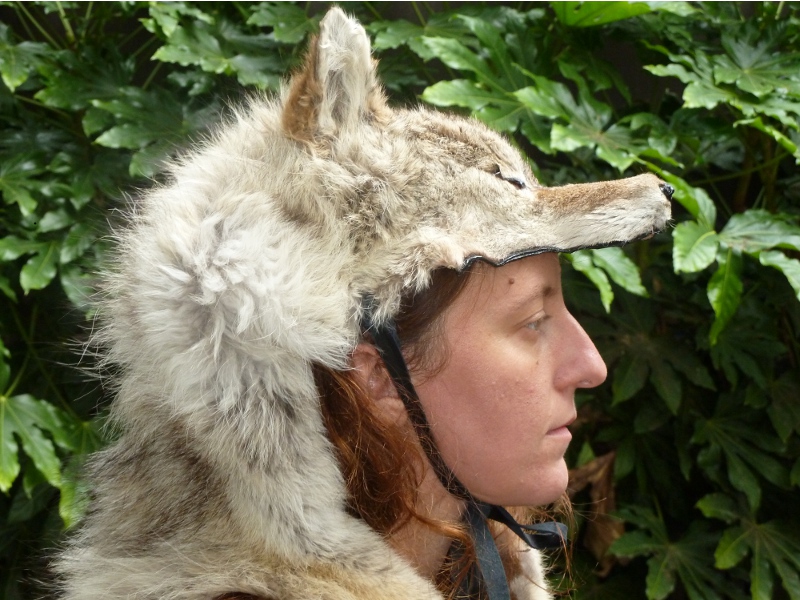
Coyote totem headdress by Lupa, 2011
This work with the remains is another foundational part of my nature-based path, and as I write in this place over time, you may see me refer to the “skin spirits” as a collective term for the spirits of all the animals whose remains I work with, skin, bone and otherwise. My nature-based paganism is rooted in all of the life-death cycle, and this is how I seek the beauty in that which is all too often ignored, or so symbolized as to be almost entirely removed from the gritty reality.
(1) I have become so known for collecting dead critters in certain circles, in fact, that I have been over time gifted with a number of antiques that were inherited by people who had no idea what to do with them, and so decided I was a good next stop for Grandma’s fur coat, or Uncle Doug’s deer heads.
Previous Post

November 7, 2011
Ecopsychology and Neopagan Relevance
Next Post
November 22, 2011 Green Tomatoes Are the Reason For the Season
Browse Our Archives
Select a Category Crafts Creating Connections Cultural Quandaries Earth Matters Earthly Rites Ecopsychology Fur and Feather Guest Posts Look & Find Natural Reflections Nature in the News Nature-based Holidays Nearby Nature Permaculture Quiz & Questionnaire Rituals & Ceremonies Science & Spirit The Sacred in Suburbia Uncategorized Wordless Wednesday
Select a Month January 2017 December 2016 November 2016 October 2016 September 2016 August 2016 June 2016 April 2016 March 2016 February 2016 January 2016 December 2015 November 2015 October 2015 September 2015 August 2015 July 2015 June 2015 May 2015 April 2015 March 2015 February 2015 January 2015 December 2014 November 2014 October 2014 September 2014 August 2014 July 2014 June 2014 May 2014 April 2014 March 2014 February 2014 January 2014 December 2013 November 2013 October 2013 September 2013 August 2013 July 2013 June 2013 May 2013 April 2013 March 2013 February 2013 January 2013 December 2012 November 2012 October 2012 September 2012 August 2012 July 2012 June 2012 May 2012 April 2012 March 2012 February 2012 January 2012 December 2011 November 2011
Follow Us!
TAKE THE
Religious Wisdom Quiz
How many books is the Book of Psalms divided into?
Select your answer to see how you score.
Seven Five Ten Three
Related posts from Paths Through The Forests

Connecting to Nature in Human-Centered Places

Pagan, But Not What You're Assuming
Offerings For a Nature-Based Path
TRENDING AT PATHEOS Pagan

I was recently chatting with someone on Instagram. She asked me what...

While there are many people who share their results, the end of...

On July 23, I saw Christopher Nolan's The Odyssey which is Homer’s...

As I write this two big events have just finished up. One...

Restoring the Watershed of Divine Love
Perhaps cooperation is not something we manufacture through legislation, ideology, or moral...

Many UUs don’t pray because of bad experiences in a previous religion,...
view all Pagan blogs
Ad-Free & Subscriber Log-In Subscription Support
- About Us
- 2026 Calendar
- Videos
- Podcasts
- Library of World Religions
- Faith In Media Tracker
- Advertise With Us
- Write for Us
- Privacy Policy
- Terms of Service
- Do Not Sell My Data
- Contact Us
- Radiant Digital
- Manage Newsletter Subscriptions
- Unsubscribe From Notifications
- Sitemap
Copyright 2008-2026, Patheos. All rights reserved.
Subscription Support Ad-Free & Subscriber Log-In
Follow Patheos