
BuddhistCatholicContemplativeEvangelicalGeneral ChristianHinduJewishLatter-day SaintMuslimNew VisionsProgressive Christian
Beliefs
- Buddhist
- Catholic
- Contemplative
- Evangelical
- General Christian
- Hindu
- Jewish
- Latter-day Saint
- More Voices
- Muslim
- New Visions
- Pagan
- Progressive Christian
Topics
- Religion News
- Food and Religion
- Sports and Religion
- Religious Art
- Religious Music and Entertainment
- Religious Events
- History and Religion
- Style and Religion
- Politics and Religion
- Women in Religion
- Recreation Outdoors and Religion
- Business Finance and Religion
- Careers Workplace and Religion
- Education and Religion
- Family Parenting and Religion
- Health Fitness and Religion
- Home and Religion
- Relationships and Religion
- Technology and Religion
- Travel and Religion
Columnists
- Buddhist Columnists
- Business Finance and Religion Columnists
- Careers Workplace and Religion Columnists
- Catholic Columnists
- Contemplative Columnists
- Education and Religion Columnists
- Evangelists Columnists
- Family Parenting and Religion Columnists
- General Christian Columnists
- Health Fitness and Religion Columnists
- Hindu Columnists
- History and Religion Columnists
- Home and Religion Columnists
- Jewish Columnists
- More Voices Columnists
- Latter Day Columnists
- Muslim Columnists
- New Visions Columnists
- Nonreligious Columnists
- Pagan Columnists
- Politics and Religion Columnists
- Progressive Columnists
- Recreation Outdoors and Religion Columnists
- Relationships and Religion Columnists
- Religion News Columnists
- Religious Art Columnists
- Religious Events Columnists
- Religious Music and Entertainment Columnists
- Sports and Religion Columnists
- Style and Religion Columnists
- Technology and Religion Columnists
- Travel and Religion Columnists
- Women in Religion Columnists
Resource Library
- 2026 Calendar
- Library of World Religions
- The 100 Most Holy Places on Earth
- Patheos Answers
- Podcasts
- Videos
- Faith Leaders Database
- Anglican Episcopalian
- Bahai
- Baptist
- Buddhism
- Christianity
- Confucianism
- Eastern Orthodoxy
- Hinduism
- Holiness and Pentecostal
- ISKCON
- Islam
- Judaism
- Lutheran
- Methodist
- The Church of Jesus Christ of Latter-day Saints
- New Age
- Paganism
- Presbytarian and Reformed
- Protestantism
- Religion Behind the Scenes
- Roman Catholic
- Scientology
- Shia Islam
- Sikhism
- Sufism
- Sunni Islam
- Taoism
- Zen
- See all religions
Research Tools
 Ad-Free & Subscriber Log-In Subscription Support
Ad-Free & Subscriber Log-In Subscription Support
Follow Patheos 

- Trending:
- Forgiveness
- |
- Marriage
- |
- Consciousness
- |
- Death Penalty
- |
- Election
- |
- Halloween

- Home
- Progressive Christian
- Politics and Religion
- Who was St. George, Patron Saint of Palestinian Christians?
Who was St. George, Patron Saint of Palestinian Christians?
Last updated on: December 15, 2025 at 11:00 pm by Daniel Jean Perrier
Who was St. George, Patron Saint of Palestinian Christians? 2025-12-15T23:00:36-05:00 Daniel Jean Perrier
Patheos Explore the world's faith through different perspectives on religion and spirituality! Patheos has the views of the prevalent religions and spiritualities of the world.
In this time of an intensified campaign against Palestinians since October 7th, 2023, the figure of St. George can provide a valuable symbol of the spiritual resilience and interfaith connection of Palestinians. For those of us who venerate saints, he holds a special importance at this moment. In his role as patron saint of Palestinian Christians, we can pray for the whole of Palestine, alongside the work we do materially.
George of Lydda is venerated as an early megalomartyr across Christianity. He is a powerful symbol of connection between the faiths practiced in the region. He is the patron saint of Palestinian, Lebanese, and Syrian Christians. Records of the veneration of the saint can be found as early as the 5th century CE. He is now one of the most venerated saints in Christianity. He is also respected by some Druze and Muslims as a defender of monotheistic faith.
Legends of St. George in Lydda
According to holy tradition, St. George was a man of Cappadocian Greek origin who was a soldier in the Roman army and the Praetorian Guard for the Roman emperor Diocletian. He was executed by decapitation at or near Lydda in Syria Palaestina, and that his body is buried there.
It cannot go unstated that stories of St. George spread through the Crusades, one of the most violent chapters in history. His early veneration begins in Lydda, also known as Diospolis. His story, however, predates these events. The earliest cult of St. George was localized in the traditional site of his execution in 303 CE, Diospolis (Lydda), currently occupied by the State of Israel. A titular church was built during the reign of Constantine the Great, consecrated to “a man of highest distinction.” The church standing in Lydda today was erected in 1872 and rebuilt multiple times. This church houses a sarcophagus traditionally believed to contain his relics.
Over the course of time, stories of his martyrdom have expanded; he is said to have suffered more than twenty separate tortures over seven years. Stories say he converted the Empress Alexandra of Rome, who would also be martyred for refusing to recant her faith. Another well-known legend of St. George includes his slaying of a dragon. This legend is not present in the early hagiographies of the saint, suggesting it may have been a later addition. It was first attributed to him in the 13th century.
Saint George: A Shared Figure
St. George is associated with the Muslim figure al-Khadr, “the green one,” among the Muslim population of the area. Through this association, his veneration in folk piety has been shared with Muslims and Druze in the region alongside Christians. He is included in some Muslim texts as “Jirjis” or “Girgus”.
These texts suggest he lived among a group of believers who were in contact with the last apostles of Jesus. In Muslim legends, he was martyred three times and resurrected each time. In the account of one of his deaths from Ibn al-Athir, his death mirrors that of Jesus. In this account, after St. George’s death, the world is covered in darkness lifted on when he is resurrected.
The Palestinian town of al-Khadr is named after St. George. The Saint’s shared devotion is evident in the shared celebration of the saint among the multiple religious groups of the area. The Monastery and Church of St. George in al-Khadr is considered his most important sanctuary in Palestine.
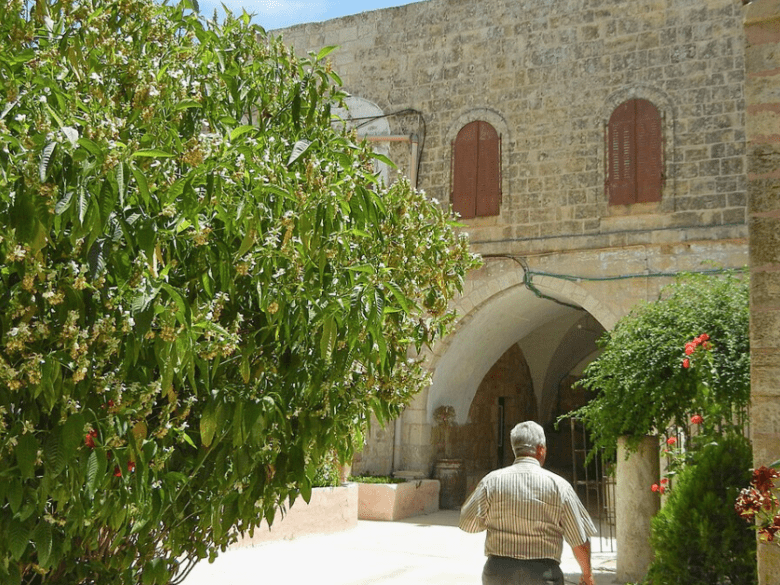
View of the Monastery and Church. シャター / wikipedia.org
The monastery has historically attracted both Palestinian Christians and Muslims. Worshippers across Palestine would visit, trade loaves of bread, and make sacrifices. This tradition continued into the 20th century. Muslims have traditionally guarded the entrance of the church and welcomed pilgrims. Members of both communities have shared rituals such as lighting candles and offering oil at the tomb. Some Muslim families have kept the tradition of taking their sons to Saint George’s church in al-Khadr for the priest to bathe them in the water of the font for strength.
Muslims and Christians often prayed together at the Church of St. George in Lydda. The Church shares a wall with the neighboring mosque, cementing the union of these two communities. This exchange of spiritual practice provides a powerful testament to the religious unity in the area, and reminds us that Christians and Muslims there and elsewhere have shared a history and traditions in peace. Sadly, many of these traditions have not been able to continue due to the occupation of Lydda and al-Khadr previously, as well as the destruction caused in the ongoing period of intensified violence.
A Symbol of Resilience and Unity
In 1948, the Palestinian population of Lydda was almost completely expelled by the forces of the State of Israel occupying the area. The Lydda Death March involved the expulsion of 50,000 Palestinians from Lydda and Ramle by the IDF.
One inhabitant who avoided the expulsion, Spiro Munayyer, described the population of Muslims and Christians being rounded up into the Church of St. George and the connected Mosque of al-Khadr before the expulsion.
As we consider shared traditions, we are confronted with the violence and destruction Palestinians have faced since the establishment of the state of Israel. Pilgrims to the Monastery of St. George once gathered under olive trees. This beautiful tradition emphasizes the level of destruction caused by the campaign against Palestinians on multiple fronts; here, the ecocide of Palestine is called to mind.
The military saint extends beyond the simple soldier figure. He is a symbol of resistance and steadfastness, traits we must carry forward while facing the colonial entities of the world that would see Palestine destroyed. The campaign against Palestine is not new.
Remarkably, traditions of the Feast of St. George survived these expulsions, with Palestinians continuing to travel from throughout the country to visit the saint’s tomb. Festivities conclude with a parade of scouts, Christian and Muslim, playing drums and blowing horns down the main street of Lydda. This shared feast has been celebrated for over 1500 years.
The saint sets a powerful example of standing up for one’s beliefs, even under the threat of death. The enduring tradition stands in strong opposition to the narratives of Palestinian violence perpetuated as propaganda to support the occupation of the area and genocide of its people. It instead highlights shared cultural and spiritual heritage, coexistence and co-worship, and mutual respect.
Progressive Christian
Catholic
History and Religion
Previous Post

March 28, 2025
Debt Forgiveness is Biblical
Next Post

December 15, 2025 Chronic Pain and Sainthood
Recent Comments
"TL;DROur money and banking system is both fake and evil."
"insightful and well-researched, as always. thank you for taking the time to put this together."
Israel’s Ecocide Against Palestine
"The KJV has never been popular with Catholics. It is a Protestant Bible with Protestant ..."
The King James Bible and the ..."
"Jesus spoke of them as TWO commandments with the second subject to the first in ..."
Loving Your Neighbor, Compassion and Community
Browse Our Archives
Select a Category Astrology Holidays LGBTQIA+ Saints Uncategorized
Select a Month May 2026 January 2026 December 2025 June 2025 March 2025 December 2024 August 2024 July 2024 June 2024 January 2024 December 2023 November 2023
Follow Us!
TAKE THE
Religious Wisdom Quiz
In Revelation, what do the four living creatures say day and night without ceasing?
Select your answer to see how you score.
Blessing and honor and glory Holy, holy, holy is the Lord God Almighty Worthy is the Lamb Come, Lord Jesus
Related posts from Patchwork Practice

News & Politics
News & Politics
Israel's Ecocide Against Palestine
News & Politics
News & Politics
The Light of the World in the Shadow...
TRENDING AT PATHEOS Politics and Religion
Our Lady of Częstochowa, Part 1 - What...
Poland's most visited shrine houses the Black Madonna of Poland part of...

Time Unbounded and the Lie of Temporality
To understand the present as present and history as history remains not...
view all Politics and Religion blogs
What Are Your Thoughts?leave a comment
Ad-Free & Subscriber Log-In Subscription Support
- About Us
- 2026 Calendar
- Videos
- Podcasts
- Library of World Religions
- Faith In Media Tracker
- Advertise With Us
- Write for Us
- Privacy Policy
- Terms of Service
- Do Not Sell My Data
- Contact Us
- Radiant Digital
- Manage Newsletter Subscriptions
- Unsubscribe From Notifications
- Sitemap
Copyright 2008-2026, Patheos. All rights reserved.
Subscription Support Ad-Free & Subscriber Log-In
Follow Patheos