
BuddhistCatholicContemplativeEvangelicalGeneral ChristianHinduJewishLatter-day SaintMuslimNew VisionsProgressive Christian
Beliefs
- Buddhist
- Catholic
- Contemplative
- Evangelical
- General Christian
- Hindu
- Jewish
- Latter-day Saint
- More Voices
- Muslim
- New Visions
- Pagan
- Progressive Christian
Topics
- Religion News
- Food and Religion
- Sports and Religion
- Religious Art
- Religious Music and Entertainment
- Religious Events
- History and Religion
- Style and Religion
- Politics and Religion
- Women in Religion
- Recreation Outdoors and Religion
- Business Finance and Religion
- Careers Workplace and Religion
- Education and Religion
- Family Parenting and Religion
- Health Fitness and Religion
- Home and Religion
- Relationships and Religion
- Technology and Religion
- Travel and Religion
Columnists
- Buddhist Columnists
- Business Finance and Religion Columnists
- Careers Workplace and Religion Columnists
- Catholic Columnists
- Contemplative Columnists
- Education and Religion Columnists
- Evangelists Columnists
- Family Parenting and Religion Columnists
- General Christian Columnists
- Health Fitness and Religion Columnists
- Hindu Columnists
- History and Religion Columnists
- Home and Religion Columnists
- Jewish Columnists
- More Voices Columnists
- Latter Day Columnists
- Muslim Columnists
- New Visions Columnists
- Nonreligious Columnists
- Pagan Columnists
- Politics and Religion Columnists
- Progressive Columnists
- Recreation Outdoors and Religion Columnists
- Relationships and Religion Columnists
- Religion News Columnists
- Religious Art Columnists
- Religious Events Columnists
- Religious Music and Entertainment Columnists
- Sports and Religion Columnists
- Style and Religion Columnists
- Technology and Religion Columnists
- Travel and Religion Columnists
- Women in Religion Columnists
Resource Library
- 2026 Calendar
- Library of World Religions
- The 100 Most Holy Places on Earth
- Patheos Answers
- Podcasts
- Videos
- Faith Leaders Database
- Anglican Episcopalian
- Bahai
- Baptist
- Buddhism
- Christianity
- Confucianism
- Eastern Orthodoxy
- Hinduism
- Holiness and Pentecostal
- ISKCON
- Islam
- Judaism
- Lutheran
- Methodist
- The Church of Jesus Christ of Latter-day Saints
- New Age
- Paganism
- Presbytarian and Reformed
- Protestantism
- Religion Behind the Scenes
- Roman Catholic
- Scientology
- Shia Islam
- Sikhism
- Sufism
- Sunni Islam
- Taoism
- Zen
- See all religions
Research Tools
 Ad-Free & Subscriber Log-In Subscription Support
Ad-Free & Subscriber Log-In Subscription Support
Follow Patheos 

- Trending:
- Forgiveness
- |
- Marriage
- |
- Consciousness
- |
- Death Penalty
- |
- Election
- |
- Halloween

- Home
- Progressive Christian
- Politics and Religion
- Giving Tuesday: An Opportunity to Reflect
Giving Tuesday: An Opportunity to Reflect
Last updated on: December 2, 2024 at 11:54 am by Daniel Jean Perrier
Giving Tuesday: An Opportunity to Reflect 2024-12-02T11:54:17-05:00 Daniel Jean Perrier
Patheos Explore the world's faith through different perspectives on religion and spirituality! Patheos has the views of the prevalent religions and spiritualities of the world.
It is post-election, November 2024, as I write this with a gray sky outside that is mildly depressing except that we are in a drought right now so the rain is a relief. I feel both less bad and as bad as expected in the aftermath of the election. What I believe is that Harris would have continued to enact horrific policies, and many people will be immediately worse off because of Trump.
So I’m not happy about it. But my focus had already shifted enough before election day that I couldn’t care much more or less about the outcome. It’s the first year I’ve approached enough apathy about the election that abandoning it was tempting. I’m disillusioned with electoral politics, but I trudge along in the sewage anyway.
My relative safety, despite serious concerns arising from financial strain and the long-term impacts of my disabilities, is surely inoculating me. My thoughts on the next four years remain the same in the aftermath: Don’t let anyone skip straight toward discourse on the next election. Do not stay in the vortex of the election cycle.
The way more of us survive the big stuff is by focusing on the everyday aid. It’s known that people worse off give more to charity than those who are more well-off but not so rich that money means nothing. Because we know we have to. Only you know what you can truly give, what you are willing to give, and only you can hold yourself accountable for your choices. The rest of us can’t know, looking in.
I do know that we humans love signals, and the upcoming holidays provide an opportunity to give and reflect on how we give throughout the year.
Hope in Giving
Giving time, resources, or support to others has undeniable benefits for all of us, including those who are doing the giving. Studies show that generosity boosts well-being and self-esteem, and also strengthens community ties–the very community ties we need to rely on when the government continues to fail us. Even acts of service for your most immediate community, friends, family, and neighbors, foster a supportive connection between giver and recipient.
One might say, well, that just sounds like a relationship: yes. Reciprocal relationships are a natural part of humanity for both our emotional and physical health. In the most evolutionary sense, they are an adaptation that keeps us collectively more well off than we are on our own. When we act in thoughtful generosity and expand where we offer it, we also expand our community, growing our circles of connection.
You may be disillusioned with financial giving and individual volunteering. Many have heard, rightfully, the insufficiency inherent to this type of formal charity. The work, ultimately, is misdirected; it does not change the systemic roots of the problems any given charity or organization seeks to eliminate.
Personal actions, too, are inefficient. Accepting personal responsibility for a problem as big as climate change when, as we all know, it is a few companies creating an incredible percentage of the impact, misdirects our attention and makes us feel more effective than we are while companies and shareholders get away with their cash.
Enduring change will involve thoughtful, deliberate action against institutions and structures that are built to enrich a slim few at the expense of all other life, human and otherwise. But daily change, closer communities, and the alleviation of the suffering going on right now within those systems are also needed. We need to watch ourselves take action and build the sense of possibility necessary to bother to act in the first place. Without it we cannot sustain ourselves and each other in the long march ahead.
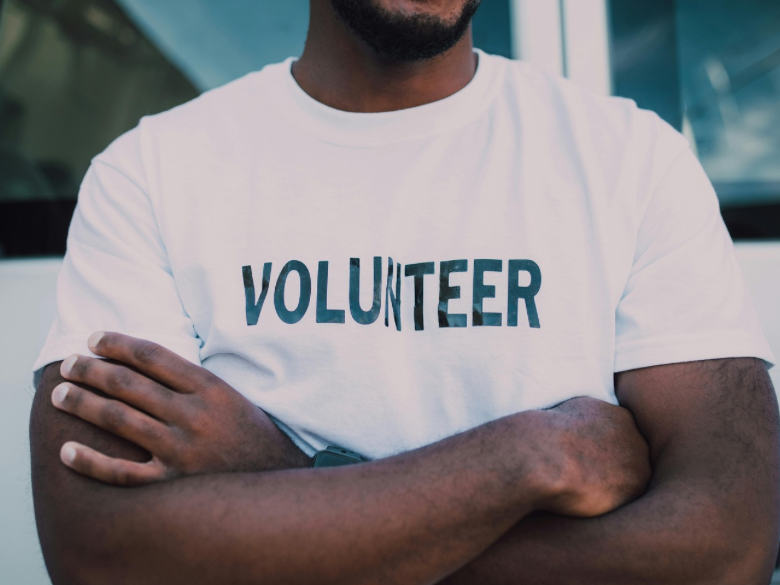
Volunteer. RDNE Stock project/Pexels.com
Formal giving and community volunteering can build the relationships and community resiliency that is integral to collective resistance. This is experientially true, and empirically. Systemic support in a community lays the ground for systemic advocacy for that community, for yourself and your neighbors.
History of Giving Tuesday
The history of Giving Tuesday begins with the history of Thanksgiving, which means a history of colonization and genocide of Indigenous peoples. It is a commemoration of a false, sanitizing, revisionist narrative. Around it has spawned a capitalist hell weekend from Black Friday through Cyber Monday and “deals” bombarding your inbox and screens as soon as November hits.
Giving Tuesday refers both to the Tuesday after Thanksgiving and a specific 501(c)(3) nonprofit promoting the concept. The project began in 2012. Among other things, their funds are used to support local nonprofits, as well as campaigns promoting investing time, money, or care for your neighbors and community, specifically on that day and beyond.
Whether involved with the official organization or not, the unofficial “holiday” serves as a day to turn gratitude into local giving. The feeling of gratitude is known to increase charitable giving. Strengthening community ties brings us one step toward the type of world that can erode a colonial mindset. It can be a reminder of what we unrightfully have via colonial history. We can resist the Thanksgiving narrative in placing gratitude for what we have by both good fortune and hard work that has fruited in the context of the stolen soil it has grown in.
If you are not Indigenous to the place you currently live, consider taking the time to provide practical support to the communities displaced from the land you occupy, in the way the tribe prefers, if this is practical. Otherwise, consider financially giving or volunteering with a charity that provides support to the broader Indigenous community.
Where to Give this Giving Tuesday
Find out whose land you are on with Native Land Digital. The website will provide links to organizations associated with the tribe(s), so you can find out more, including their preferred methods of giving.
An organization to consider supporting is the Native American Rights Fund. NARF has provided legal assistance and promoted Native American rights in areas such as tribal sovereignty, treaty protections, and voting rights since the 1970s.
Do not allow yourself to believe this serves some penance or acts as an indulgence. Don’t make the mistake of unloading your spiritual or social baggage–history does not disappear in giving what is materially owed. But this is an opportunity to reflect on the material reality of the past and the present that it created, one constantly perpetuated, cycling forth. It’s an opportunity to connect what you know to what you do.
My faith leads me to believe that the most perfect world is one that can only be built on community, reflection, and self-correction. Gratitude knows what you have and appreciates whatever it is, giving is what builds our community, and reconciliation with God means stepping toward restoration without the illusion that the past is anything but a cycle to break; it is not a stain that can be cleansed. Any reclamation of my ancestral pagan practices must confront the reality that my family left the land that built those practices as it was stolen, for personal safety in land that itself was stolen.
Progressive Christian
Catholic
Business, Finance and Religion
Previous Post

August 27, 2024
Kamala the Prosecutor vs. Trump the Felon
Next Post

March 28, 2025 Debt Forgiveness is Biblical
Browse Our Archives
Select a Category Astrology Holidays LGBTQIA+ Saints Uncategorized
Select a Month May 2026 January 2026 December 2025 June 2025 March 2025 December 2024 August 2024 July 2024 June 2024 January 2024 December 2023 November 2023
Follow Us!
TAKE THE
Religious Wisdom Quiz
Which Christian tradition is known for ornate mosaics and icons in their churches?
Select your answer to see how you score.
Baptist Orthodox Presbyterian Adventist
Related posts from Patchwork Practice

News & Politics
Time Unbounded and the Lie of Temporality
News & Politics
Value-Based Goals and Avoiding the Cult of Productivity

News & Politics
Advent Wreaths, Thematic Practice and Colorful Outfits

News & Politics
Loving Your Neighbor, Compassion and Community
TRENDING AT PATHEOS Politics and Religion

Our Lady of Częstochowa, Part 1 - What...
Poland's most visited shrine houses the Black Madonna of Poland part of...

Time Unbounded and the Lie of Temporality
To understand the present as present and history as history remains not...
view all Politics and Religion blogs
Ad-Free & Subscriber Log-In Subscription Support
- About Us
- 2026 Calendar
- Videos
- Podcasts
- Library of World Religions
- Faith In Media Tracker
- Advertise With Us
- Write for Us
- Privacy Policy
- Terms of Service
- Do Not Sell My Data
- Contact Us
- Radiant Digital
- Manage Newsletter Subscriptions
- Unsubscribe From Notifications
- Sitemap
Copyright 2008-2026, Patheos. All rights reserved.
Subscription Support Ad-Free & Subscriber Log-In
Follow Patheos