
BuddhistCatholicContemplativeEvangelicalGeneral ChristianHinduJewishLatter-day SaintMuslimNew VisionsProgressive Christian
Beliefs
- Buddhist
- Catholic
- Contemplative
- Evangelical
- General Christian
- Hindu
- Jewish
- Latter-day Saint
- More Voices
- Muslim
- New Visions
- Pagan
- Progressive Christian
Topics
- Religion News
- Food and Religion
- Sports and Religion
- Religious Art
- Religious Music and Entertainment
- Religious Events
- History and Religion
- Style and Religion
- Politics and Religion
- Women in Religion
- Recreation Outdoors and Religion
- Business Finance and Religion
- Careers Workplace and Religion
- Education and Religion
- Family Parenting and Religion
- Health Fitness and Religion
- Home and Religion
- Relationships and Religion
- Technology and Religion
- Travel and Religion
Columnists
- Buddhist Columnists
- Business Finance and Religion Columnists
- Careers Workplace and Religion Columnists
- Catholic Columnists
- Contemplative Columnists
- Education and Religion Columnists
- Evangelists Columnists
- Family Parenting and Religion Columnists
- General Christian Columnists
- Health Fitness and Religion Columnists
- Hindu Columnists
- History and Religion Columnists
- Home and Religion Columnists
- Jewish Columnists
- More Voices Columnists
- Latter Day Columnists
- Muslim Columnists
- New Visions Columnists
- Nonreligious Columnists
- Pagan Columnists
- Politics and Religion Columnists
- Progressive Columnists
- Recreation Outdoors and Religion Columnists
- Relationships and Religion Columnists
- Religion News Columnists
- Religious Art Columnists
- Religious Events Columnists
- Religious Music and Entertainment Columnists
- Sports and Religion Columnists
- Style and Religion Columnists
- Technology and Religion Columnists
- Travel and Religion Columnists
- Women in Religion Columnists
Resource Library
- 2026 Calendar
- Library of World Religions
- The 100 Most Holy Places on Earth
- Patheos Answers
- Podcasts
- Videos
- Faith Leaders Database
- Anglican Episcopalian
- Bahai
- Baptist
- Buddhism
- Christianity
- Confucianism
- Eastern Orthodoxy
- Hinduism
- Holiness and Pentecostal
- ISKCON
- Islam
- Judaism
- Lutheran
- Methodist
- The Church of Jesus Christ of Latter-day Saints
- New Age
- Paganism
- Presbytarian and Reformed
- Protestantism
- Religion Behind the Scenes
- Roman Catholic
- Scientology
- Shia Islam
- Sikhism
- Sufism
- Sunni Islam
- Taoism
- Zen
- See all religions
Research Tools
 Ad-Free & Subscriber Log-In Subscription Support
Ad-Free & Subscriber Log-In Subscription Support
Follow Patheos 

- Trending:
- Forgiveness
- |
- Marriage
- |
- Consciousness
- |
- Death Penalty
- |
- Election
- |
- Halloween

- Home
- Progressive Christian
- Religion News
- Would You Rather Live a Successful Life, or a Beautiful One?
Would You Rather Live a Successful Life, or a Beautiful One?
Last updated on: October 13, 2015 at 3:55 pm by Tim Suttle
Would You Rather Live a Successful Life, or a Beautiful One? 2015-10-13T15:55:43-06:00 Tim Suttle
Patheos Explore the world's faith through different perspectives on religion and spirituality! Patheos has the views of the prevalent religions and spiritualities of the world.
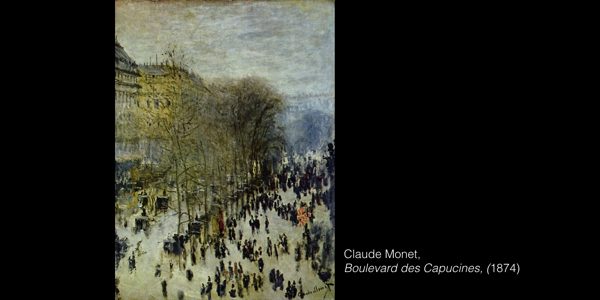
I took this in 2015 at the Nelson-Atkins in KC
In 1874 this painting, Boulevard des Capucines, by Claude Monet was exhibited at a show in Paris. It actually lives here at the Nelson in Kansas City. I spend a lot of time sitting in front of this painting. I love it, but the initial response to it was not good. One critic called it “Hostile to good artistic manners,” and said it should be a crime to put it on display. When people first saw it, they couldn’t discern its beauty…
In 1860-70s in Paris, painting was a serious matter—a recognized profession like the law or Medicine.
There were standards for how painters would be trained, just as there were standards for how doctors & lawyers would be trained. It was all regulated by a government agency. Promising painters began at the Académie des Beaux-Arts, and were slowly weeded out.
At the pinnacle of the art world stood the Salon de Paris, which was the most important exhibition in all of Europe for ages. Every other year, artists from all around the world submitted their work to the Jury at the Salon. For French artists, their careers were on the line. If they liked your work, you would sell paintings. If not, you were finished. The jury would actually stamp a big Red R, for rejected, on your canvas.
The Salon hated works like the one above by Monet, because it didn’t conform to their conventions. The Salon jurors were traditionalists. They wanted classic paintings, heroes on horses, biblical scenes, Greek mythology… and they wanted meticulously accurate work.
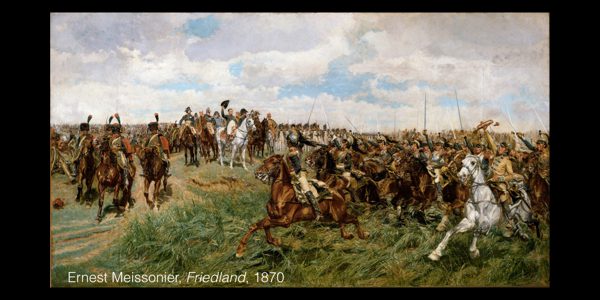
Ernest Meissonier, 1870 Public Domain, Wikimedia commons
This canvas is by Ernest Meissonier, king of the Salon in those days, who was said to have taken courses in horse anatomy at veterinary school in order to paint them more accurately. This was the kind of rigor the Salon wanted…
But a new generation of restless young artists was pushing in a new direction… rejecting conventions.
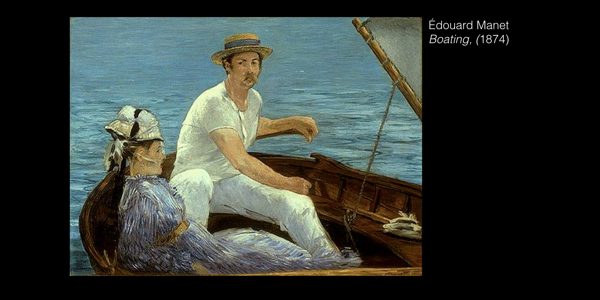
Edouard Manet, 1874 – Public Domain, WikiArt
They didn’t want to paint grand heroic scenes. They wanted to paint everyday life.
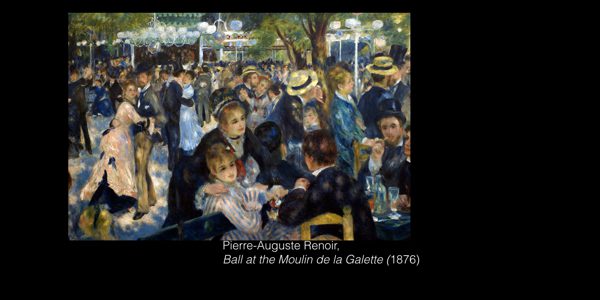
Pierre-Auguste Renoir, 1876 – Public Domain, WikiArt
They didn’t want to impress you w/their technical ability. They wanted to stir your emotions.
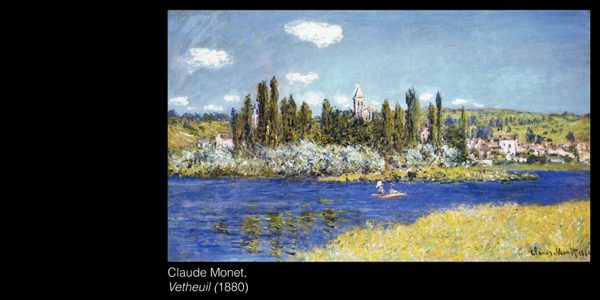
Claude Monet, 1880. Public Domain – WikiArt
They didn’t want a perfectly finished canvas. They wanted you to see their brush work, sense movement, tension, loneliness, & passions.
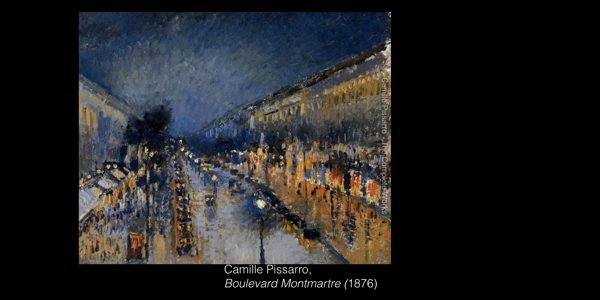
Camille Pissarro, 1876 – Public Domain, WikiArt
They didn’t want precision… they wanted soul! They didn’t want to paint the ideal… wanted to paint the real, and uncover the beauty in it.
The Salon rejected Monet & publicly belittled his work. The few of his friends who showed at the Salon were seen as scandalous. Women fainted when they saw their work. Children ran screaming. People fell to the floor in front of canvases, laughing. Nobody could see the beauty in their new style.
These new artists formed strong friendships in order to support one another in the midst of the rejection. You’d know their names: Manet, Degas, Cezanne, Monet, Renoir, Pissarro… all of them dead broke, fiercely loyal to one another, committed to this new approach, and they would discuss for hours on end what they should do. Conform to the conventions of the Salon? Continue to paint, and try to gain acceptance? Or strike out on their own? They chose the latter.
In 1874, held 1st public exhibition in Paris on Blvd des Capucines. Monet’s canvas by the same name was part of the exhibit.
Reviews were typically harsh. One stuffy reviewer, Louis LeRoy wrote a satirical review titled: The Exhibition of the Impressionists, unintentionally giving these new painters their name. He meant it as a slam, but they liked it. LeRoy was scandalized by Monet’s Boulevard des Capucines. He wrote:
“Be so good as to tell me what those innumerable black tongue-lickings in the lower part of the picture represent?… those are people walking along… do I look like that when I’m walking along the boulevard des Capucines?… It’s unheard of, appalling! I’ll get a stroke from it, for sure.”
Slowly, the impressionists slowly began to win people over—not the experts at first, but the collectors & art lovers. Ultimately the whole world came to see the beauty of the impressionists. When it was all said and done these ragtag young painters turned the art world on its head… & it all happened for one reason: Their work was beautiful…
these ragtag young painters turned the art world on its head… & it all happened for one reason: Their work was beautiful…
Monet’s great canvas portrays the view from a window of the very same room in which they held the first every exhibition of impressionist work. That means you could look at his painting, then out the window at same street, only the painting showed the scene in winter, while the exhibition happened in the summer.
Monet’s work is stunning: a light snow just beginning to fall; a hint of condensation on the window; smoke hanging in the air. A dramatic diagonal line of carriages splits the canvas in two parts, the bustling pedestrians in the foreground caught in mid-stride, the Parisian buildings in the background fade into the canvas.
For those with eyes to see, Monet had captured the spirit of winter in Paris—not the ideal of Paris, the real Paris—and you could feel it when you viewed the painting… you still can. It’s beautiful. In the end it won everyone over because of its beauty.
About the same that time the impressionists were winning their fight, the Christians, in a sense, were losing theirs. The Impressionists won, in part, because their work was beautiful. The Christians lost, in part, because their work was not beautiful. Let me explain what I mean…
The stability of the Middle Ages was interrupted by the burst of art and exploration we call the Renaissance and the Scientific Revolution that followed. The tipping point was around the year 1700, when there began a massive shift in the culture of Europe. It’s often called the Enlightenment or “The Age of Reason” because during this period, human reason became the central value in Western Culture. From that point on, whatever was wrong w/human societies, whatever problems they encountered, human reason was thought to be the answer. If you wanted to influence the world, you could no longer appeal to things like God, or hereditary title, or religion, or divine right.
One of the most famous figures of the Enlightenment is Immanuel Kant. He said that anytime there is being, three things are involved: The True, The Good, and the Beautiful. They are sometimes called the three Transcendentals—transcending all being. Kant wrote famous treatises on all three: Critique of pure reason on the true. Critique of practical reason on the good. Critique of judgment on the beautiful. Kant helped popularized the idea that of the three, Reason was far & away the most important. All of Western Culture went along with him.
This signalled a massive shift in the foundation of society, because up to that time beauty had been the central transcendent ideal in Western culture. Before 1700 beauty was the queen of the transcendentals. After that time, the “true” stole the show.
Christianity went along with this idea & as it did, it began to take on a much more rational quality.
Christianity became all about ideas, truth claims, and doctrinal statements. As the Christian faith became adapted to the Age of Reason, the beautiful—mired in subjectivity & hopelessly fickle—became an afterthought.
As the Christian faith became adapted to the Age of Reason, the beautiful… became an afterthought.
In essence, Christianity aligned itself w/Salon in Paris, celebrating precision & accuracy, & the ideal. Christians lost their sense of beauty & mystery.
In the wake of the brutality of WWII, however, a warm wind began to blow through the church. Christians began to look around at the world of bombs and bullets and ask, what is truth w/out beauty? What’s goodness w/out beauty? What is life w/out beauty? Do we want that?
They began to re-engage the arts w/new energy & purpose.
Christians should not talk about the beautiful in order to become more cultured or refined. When we talk about the beautiful, we are attempting to recover something vital that has been lost.
The scriptures begin, “in the beginning when god created…” The word created, here, is bara… which means “created out of nothing.” It implies a fundamental newness. The theological term is “ex nihilo,” or “out of nothing.” In the Old Testament, only God is ever made the subject of this verb. Only God can create out of nothing.
What God created out of nothing was the, “heavens and the earth.” The first creative movement brought into being all matter in existence everything you can see, and everything you can’t see. But, it was without shape, “a formless void.” This is that famous Hebrew phrase: tohu wa bohu—a swirling, amorphous, and chaotic something-or-other. The ruach elohiym—breath of God—blew over the void.
Then, God spoke into the chaos & ordered it. The Word of God addressed creation & reveals a divine vulnerability. “Let there be” has a hint of cooperation; nature must respond. “Let us make humankind” implies consultation. “Let them have dominion” entails the sharing of power. God’s act of creation is a speaking, and in this speaking God reveals God’s own willingness to be vulnerable.
The first thing God speaks into creation is light. Light is a major them in Genesis one. The word comes up thirteen times. God’s first ordering of creation is the means by which we can behold anything that is.
God finishes the 1st day of creation, and calls it “good.” The Hebrew word is towb (tove). Which, by the way, can also be translated as “beautiful.”
God created, out of nothing, everything you can see and everything you can’t see. At first it was chaotic, but God was present in the chaos, breathing over it. Then God brought order to the chaos through speech, and the words revealed a vulnerability toward creation. The first word was “light,” the very means by which we can see and behold creation. And then, God pronounced all of it “tove” …good …beautiful.
Day 1 sets a pattern for the other 6 days of creation. Day 2 the waters & the sky. Day 3 dry land & vegetation. Day 4 more lights: sun, moon, & stars—and not for nothing, but we should probably notice that God devotes fully 1/3 of the creative time to light (2 out of 6 days) to help us see, and to navigate time and space—Day 5 fish & birds. Day 6 animals & people. Day 7 rest… Sabbath.
Now, the Hebrew people, wrote this creation narrative down, protected it, and proceeded to argue over its meaning & they have really never stopped. In fact they don’t want to stop, because the meaning of creation is endless.
God is a mystery: not in the sense that God is unknowable, but in the sense that God is endlessly knowable… and there is a movement from mystery toward us in creation.
God, as it turns out, is a great mystery. This couldn’t be more important for us on this side of the age of reason. We can never reduce God to an equation, or a truth statement, or a moral code… For all we think we know about God, the truth is that we know very little. From day one, God has been, & remains, a great mystery.
This may be the truest thing we can ever say about God: God is a mystery that can never be fully explained or known. And yet, God wants to be known. No one knows God in a vacuum but only here in this world that he created for that very purpose.
God is a mystery: not in the sense that God is unknowable, but in the sense that God is endlessly knowable. Creation is a powerful movement from mystery toward us. God doesn’t create for entertainment. This wasn’t cosmic arts & crafts time. God is trying to tell us something, to communicate with us. Creation is Revelation… God’s first text.
Creation is the first thing God has to say to us, & what God says is beautiful… and apparently, God wants us to answer back.
God is a mystery, and there is a movement from mystery toward us in creation. God speaks to us. And, this places us under the obligation to answer back. God’s movement toward us calls forth a response.
The question is what kind of response?
For the past four hundred years the answer has been: doctrinal statements and moral codes.
But God’s first word to us was beautiful. What if our first word back to God should be the beautiful as well?
God’s first word to us was beautiful. What if our first word back to God should be the beautiful as well?
What if our most faithful response to God’s creative act is first, to see the beauty; to behold it; to let it sink in; and second, to initiate a creative response of our own
Instead we take one look at the beauty & think: too loosy-goosy. We need to distill this into a list of do’s and don’ts, and make sure everybody is believing & doing the right stuff.
God comes to us as a great mystery, and we try to solve it. “Actually God, let me fix that for you. Have you ever heard of the four spiritual laws?”
God comes to us as a mystery, and we turn him into a document. Then word became flesh, and we have never ceased turning that flesh back into words: If you’re Presbyterian it’s the Westminster Confession. If you’re Lutheran it’s the Augsburg Confession. If you’re Anglican it’s the 39 articles.
If you’re Baptist, it’s the Baptist faith & message. You got a mystery problem? We have a solution for that!
As great as all of those theological works are, they are, in essenence… not the point. The point of revelation is not to help us to get our doctrinal ducks in a row, but to see the beauty of the Lord, and to respond with our lives.
Comedian Brian Regan talks about going to the doctor saying, “I’m having pretty bad heartburn, doc.” The doctor responds by handing him a list of foods that cause heartburn. Regan’s response was, “I already know this… I know how to get it!” I wonder if that’s how God responds when we offer our big doctrinal treatises to him? “I already know this… I’m already God! Couldn’t you just write me a poem or something? Don’t you know any songs or something?”
I wonder if God is thinking: I know I’m a mystery! I’m doing it on purpose. I am beyond words. You need to mystery. You need the beauty if you are ever going to relate to me.
Creation is Revelation. What if the proper response to God’s creativity is just to see it? The world the bible often uses is to behold. It’s from the Old English, where “be” meant “thoroughly.” To Behold is to hold thoroughly; to sit with something long enough to really see it. Our first response to God’s creativity is to behold it. Then, to live our lives creatively back to God, as an act of worship.
We’re told to try and be successful in our lives. What if God would rather have us live a beautiful life?
We’re told to try and be successful in our lives. What if God would rather have us live a beautiful life?
I know this much for sure: in terms of our ability to image God to the world around us, beauty is much more powerful.
If you think what our life says to the people around us.
If we begin with the true, telling people how to think, this will only create resistance. Christians have no privileged position with regard to truth in our culture. In fact, Christians are more often seen as living in denial in terms of certain truths.
If we begin with the good, telling people how to live, they will most likely get a little twitchy and rebellious. Plus, let’s be honest, Christians long ago lost any kind of moral or ethical high ground in our culture.
If we start with the beautiful, however… a song, a poem, a movie, a garden, a well organized garage (to me that’s a beautiful thing), we will find that beauty possesses an undeniably winsome quality. Human beings don’t resist the beautiful.
The beautiful overwhelms, it hijacks incredulity to seize us. This is sometimes called Aesthetic Arrest.
Beauty takes us into its custody and holds us captive. Just as the Impressionists painters who won over their critics won their struggle through the beautiful, Christians, if we are to win our struggle to bear witness to the Lordship of JS, will do so because our work is beautiful… our lives are beautiful.
Not that we should ignore the true and the good. Doctrines and dogmas have their place. Yet, God’s first move toward us was an act of beauty. God’s desire for humankind apparently extends far beyond righting thinking and right acting. God seems to want us to all in love. God seems to want to inspire us to respond to with our own creative faculties.
The problem is we really don’t know how to do this. If I handed you a paragraph of written text & said, “read this, explain it to me & tell me what you think of it.” You could do that. If I handed you a painting, however, and said, “read this, explain it to me & tell me what you think of it.” Your response might not come so readily. We are not experts. We have no training.
Most any uneducated, illiterate person prior to the year 1700 could do a better job of this than we could. They could easily talk about the symbolism in works of art, the beauty of it.
If there is such a thing as a place to start, in terms of our response to the beauty of the earth, it cannot be to turn the mystery into five simple to know God. Our response must be lived.
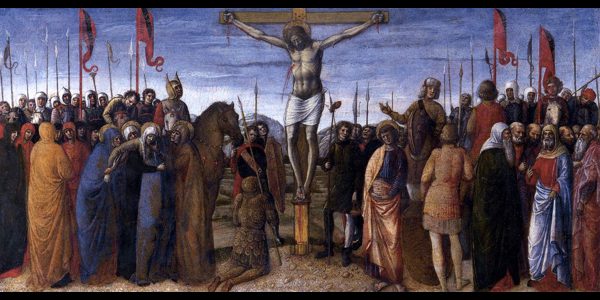
Jacopo Bellini – Crucifixion. Public Domain – WikiArt.
What does a beautiful life look like? It looks like this…
This a beautiful life. This is as scandalous to our world as the impressionist painters were to the world in which they lived. The cross is a scandal. The innocent one is in the middle, by the way, dying… and we call this beauty. An innocent man’s life poured out for the life of the world… a a bloodied and broken body. All of God in Christ, grabbing all of humanity, and pulling them together, uniting them once again in his own body.
This a great mystery, too. Nobody can explain the depths of all that happened in the scene portrayed in this painting: how God entered into human life, restored us to relationship with the creator. But the beautiful remains a scandal to some. They cannot see the beauty.
That is, until they come in contact with you. When your life conforms to this picture of what it means to be a human being, when your life conforms to the cross, then it becomes beautiful… and you don’t have to argue better than everyone else. You don’t have to create a moral code and live up to it. You just get to live, and life itself becomes beautiful. A life such as this has the power to overwhelm others with its beauty. Beauty arrests us.
Between the true, the good, and the beautiful, I’ll take the beautiful. I admit that I don’t know how to do it very well. Yet, as I look at this picture and think about how much time energy and heart I have invested in trying to let that picture define who I am, trying to let the shape of the cross become the shape of my life; as I look at this picture and think of what God has done for me… it makes me want to lean into this cruciformity—the beautiful hands and feet and side—and to let this life… make my life… beautiful.
Previous Post

October 8, 2015
Is Creativity a Habit?: 8 Habits of Highly Creative People
Next Post

October 16, 2015 The Priest, the Banker & the Lawyer: A Little Friday Funny
Browse Our Archives
Select a Category abortion corruption Donald Trump elections Empire Entertainment Ezra Klein ideology Justice Lacan politics race Sports Ta-Nehisi Coates Uncategorized
Select a Month September 2026 March 2026 September 2025 March 2025 June 2024 January 2024 December 2023 May 2023 February 2023 October 2022 April 2022 March 2022 December 2021 November 2021 October 2021 September 2021 August 2021 September 2020 July 2020 June 2020 March 2020 September 2019 July 2019 March 2019 February 2019 January 2019 November 2018 October 2018 September 2018 August 2018 July 2018 June 2018 May 2018 April 2018 March 2018 February 2018 December 2017 November 2017 October 2017 September 2017 August 2017 May 2017 April 2017 March 2017 February 2017 January 2017 December 2016 November 2016 October 2016 September 2016 July 2016 June 2016 May 2016 April 2016 March 2016 February 2016 January 2016 December 2015 November 2015 October 2015 September 2015 August 2015 July 2015 June 2015 May 2015 April 2015 March 2015 February 2015 January 2015 December 2014 November 2014 October 2014 September 2014 August 2014 July 2014 June 2014 May 2014 April 2014 March 2014 February 2014 January 2014 December 2013 November 2013 October 2013 September 2013 August 2013 July 2013 June 2013 May 2013 April 2013 March 2013 February 2013 January 2013 December 2012 November 2012 October 2012 September 2012 August 2012 July 2012 June 2012 May 2012 April 2012 March 2012 February 2012 January 2012 December 2011 November 2011 October 2011 September 2011 August 2011 July 2011 June 2011 May 2011 April 2011 March 2011 February 2011 January 2011 August 2010 July 2010 May 2010 April 2010 March 2010 February 2010 January 2010 December 2009 September 2009 August 2009 July 2009 June 2009 May 2009 April 2009 February 2009 January 2009 December 2008 October 2008 September 2008 August 2008 July 2008 June 2008 May 2008 April 2008 March 2008 February 2008 January 2008 November 2007 October 2007 September 2007 August 2007 July 2007 June 2007 May 2007 April 2007 March 2007 February 2007 January 2007 December 2006 October 2006 September 2006 August 2006 July 2006 June 2006 May 2006 April 2006 December 2004 November 2004 October 2004 September 2004 August 2004
Follow Us!
TAKE THE
Religious Wisdom Quiz
What is the highest holiday in the Orthodox Christian year?
Select your answer to see how you score.
Epiphany Pentecost Pascha (Easter) Nativity
Related posts from Paperback Theology
Artists Are the Antidote to Authoritarianism

Is Creativity a Habit?: 8 Habits of Highly...

Kanye's VMA Speech Is Getting Lots of Love...
TRENDING AT PATHEOS Progressive Christian

What Being a Modern-Day Apostle Means to Me
In my last column, I discussed the ins and outs of modern-day...

Did Ancient China Once Worship the God of...
Across human history, a common thread weaves through the origins of the...

Love Your Neighbor – Including Earth-Kin: Lev. 19,...
God’s command to love your neighbor means acting in an ethical and...

Lead a Church Study of “Jesus and Lao...
Guest writer Jack Thomas (The Irreverent Reverend) reflects on leading his church...

Pastoral Wisdom for Responding to Sermon Pushback
Getting sermon pushback on your social justice sermon? Learn practical, Proverbs-based strategies...

Principles for Understanding the Apostolic Ministry Today
Whenever people discover that my formal ministry title is "apostle," as in...
view all Progressive Christian blogs
Ad-Free & Subscriber Log-In Subscription Support
- About Us
- 2026 Calendar
- Videos
- Podcasts
- Library of World Religions
- Faith In Media Tracker
- Advertise With Us
- Write for Us
- Privacy Policy
- Terms of Service
- Do Not Sell My Data
- Contact Us
- Radiant Digital
- Manage Newsletter Subscriptions
- Unsubscribe From Notifications
- Sitemap
Copyright 2008-2026, Patheos. All rights reserved.
Subscription Support Ad-Free & Subscriber Log-In
Follow Patheos