
BuddhistCatholicContemplativeEvangelicalGeneral ChristianHinduJewishLatter-day SaintMuslimNew VisionsProgressive Christian
Beliefs
- Buddhist
- Catholic
- Contemplative
- Evangelical
- General Christian
- Hindu
- Jewish
- Latter-day Saint
- More Voices
- Muslim
- New Visions
- Pagan
- Progressive Christian
Topics
- Religion News
- Food and Religion
- Sports and Religion
- Religious Art
- Religious Music and Entertainment
- Religious Events
- History and Religion
- Style and Religion
- Politics and Religion
- Women in Religion
- Recreation Outdoors and Religion
- Business Finance and Religion
- Careers Workplace and Religion
- Education and Religion
- Family Parenting and Religion
- Health Fitness and Religion
- Home and Religion
- Relationships and Religion
- Technology and Religion
- Travel and Religion
Columnists
- Buddhist Columnists
- Business Finance and Religion Columnists
- Careers Workplace and Religion Columnists
- Catholic Columnists
- Contemplative Columnists
- Education and Religion Columnists
- Evangelists Columnists
- Family Parenting and Religion Columnists
- General Christian Columnists
- Health Fitness and Religion Columnists
- Hindu Columnists
- History and Religion Columnists
- Home and Religion Columnists
- Jewish Columnists
- More Voices Columnists
- Latter Day Columnists
- Muslim Columnists
- New Visions Columnists
- Nonreligious Columnists
- Pagan Columnists
- Politics and Religion Columnists
- Progressive Columnists
- Recreation Outdoors and Religion Columnists
- Relationships and Religion Columnists
- Religion News Columnists
- Religious Art Columnists
- Religious Events Columnists
- Religious Music and Entertainment Columnists
- Sports and Religion Columnists
- Style and Religion Columnists
- Technology and Religion Columnists
- Travel and Religion Columnists
- Women in Religion Columnists
Resource Library
- 2026 Calendar
- Library of World Religions
- The 100 Most Holy Places on Earth
- Patheos Answers
- Podcasts
- Videos
- Faith Leaders Database
- Anglican Episcopalian
- Bahai
- Baptist
- Buddhism
- Christianity
- Confucianism
- Eastern Orthodoxy
- Hinduism
- Holiness and Pentecostal
- ISKCON
- Islam
- Judaism
- Lutheran
- Methodist
- The Church of Jesus Christ of Latter-day Saints
- New Age
- Paganism
- Presbytarian and Reformed
- Protestantism
- Religion Behind the Scenes
- Roman Catholic
- Scientology
- Shia Islam
- Sikhism
- Sufism
- Sunni Islam
- Taoism
- Zen
- See all religions
Research Tools
 Ad-Free & Subscriber Log-In Subscription Support
Ad-Free & Subscriber Log-In Subscription Support
Follow Patheos 

- Trending:
- Forgiveness
- |
- Marriage
- |
- Consciousness
- |
- Death Penalty
- |
- Election
- |
- Halloween

- Home
- Progressive Christian
- Religion News
- What is the Path to Human Freedom? (It’s Not What You Think It Is)
What is the Path to Human Freedom? (It’s Not What You Think It Is)
Last updated on: August 20, 2015 at 10:19 am by Tim Suttle
What is the Path to Human Freedom? (It’s Not What You Think It Is) 2015-08-20T10:19:31-06:00 Tim Suttle
Patheos Explore the world's faith through different perspectives on religion and spirituality! Patheos has the views of the prevalent religions and spiritualities of the world.
 Freedom is a big deal in our culture—the founding virtue of American society—despite the fact that most of us have a naïve understanding of what we mean when we claim to be free. Freedom is typically defined as self-determination; no limits. We are free to do whatever we want to do, so long as we don’t impede other people’s ability to do whatever they want. The fewer the limits, the greater the freedom, right?
Wrong.
The problem with “freedom as no limits” is that it leads us to what some have called: the undisciplined pursuit of more*[1]***:
- more sex
- more possessions
- more food
- more power
- more friends
- more “likes”
- more money—especially more money.
In our culture we have incredible disdain for the virtue of limits. There seems to be no limit to:
- The amount of debt we will assume.
- The amount of violence we resort to.
- The amount of poverty we are okay with.
- The kinds of injustice & racism we put up with.
- The things we’ll put into, or demand of our bodies.
The problem with all of this is that there is no recognition of the power and virtue of limits. Healthy limits are absolutely essential to the health of the person. The simple fact is: God does not want us to be free to be anything we want to be, because we’ll just try to be gods.
What we need is not the undisciplined pursuit of more, but the disciplined pursuit of less.[2] Limits are not always something to be thrown off and left behind. For the most part, limits are the only things that keep us healthy.
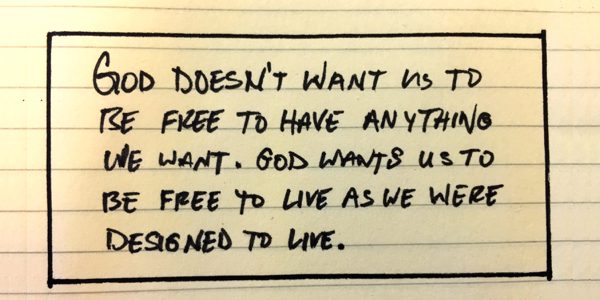
The Christian might say it like this: God does not want you to be free to do and be anything you want. God wants you to be free to be human as human was meant to be. Some limits can be pushed or broken (e.g., disease, hunger, racism, poverty, racism, and so on). Some limits are there to keep us healthy.
Healthy limits have always been part of the Christian story. You can eat from all the trees of the garden, except this one tree. You can work as hard as you like for six days a week, but one day a week you have to rest. You can earn a ton of money, but you can’t spend all of it: 10% goes back to God. And you can’t spend the rest of it only on yourself: keep a margin from which to save, and to be generous. The very concept of fidelity (or covenant), depends upon the willingness to self-limit. (e.g., marriage is the self-limitation to one partner; covenant with God is the self-limitation to one God.)
When we choose a life without limits, we are choosing a kind of slavery in which we will live in bondage to our appetites, desires, and whims. We make ourselves monumentally susceptible to advertising and marketing, and we are more likely to take more than we give back in our relationships: to God, to each other, to ourselves, and to the earth.
One of my favorite novels is Jayber Crow, by Wendell Berry. (It’s the primary metaphor in the introduction of my book, Shrink). One of the subplots involves the contrasting philosophy of life & farming represented by the old-timer, Athey Keith, and the ambitious and young Troy Chatham. Troy wants to go forth and conquer, breaking through limits and imposing his own will upon nature. He thinks the removal if limits comprises the path to freedom. But as the story unfolds, his life takes on the form and shape of a slave. Six days of work isn’t enough, so he works all seven. He becomes separated from his wife and kids. The bank starts to dictate the terms of his livelihood… by the end of the story he is a slave.
Human freedom comes not from the removal of limits, but from respecting healthy limits. In particular freedom comes as we respect the rhythms and structures of nature, and the seasons and traditions of the church.
God doesn’t want us to be free to have anything we want, God wants us to be free to live as we were designed to live. That doesn’t come from the undisciplined pursuit of more, that comes from the disciplined pursuit of less.
One of the most important aspects of our lives as Christians is to learn to respect the rhythms & structures & healthy limits that are woven into the fabric of our world.
*If you want to learn more about these ideas, please consider picking up the book, Shrink: Faithful Ministry in a Church Growth Culture, and consider what this might mean to embrace healthy limits, structures and rhythms as you lead your family, business, or church.
[1] I got this idea from my friend Tim Keel who pointed me to Michael Hyatt, who pointed me to Craig McKeown, who was riffing on Jim Collins… thanks, fellas.
[2] Again, tip of the hat to the above sources.

Next Post
August 21, 2015 How Limits Lead to Freedom, a Practical Exercise: The Purge
Browse Our Archives
Select a Category abortion corruption Donald Trump elections Empire Entertainment Ezra Klein ideology Justice Lacan politics race Sports Ta-Nehisi Coates Uncategorized
Select a Month September 2026 March 2026 September 2025 March 2025 June 2024 January 2024 December 2023 May 2023 February 2023 October 2022 April 2022 March 2022 December 2021 November 2021 October 2021 September 2021 August 2021 September 2020 July 2020 June 2020 March 2020 September 2019 July 2019 March 2019 February 2019 January 2019 November 2018 October 2018 September 2018 August 2018 July 2018 June 2018 May 2018 April 2018 March 2018 February 2018 December 2017 November 2017 October 2017 September 2017 August 2017 May 2017 April 2017 March 2017 February 2017 January 2017 December 2016 November 2016 October 2016 September 2016 July 2016 June 2016 May 2016 April 2016 March 2016 February 2016 January 2016 December 2015 November 2015 October 2015 September 2015 August 2015 July 2015 June 2015 May 2015 April 2015 March 2015 February 2015 January 2015 December 2014 November 2014 October 2014 September 2014 August 2014 July 2014 June 2014 May 2014 April 2014 March 2014 February 2014 January 2014 December 2013 November 2013 October 2013 September 2013 August 2013 July 2013 June 2013 May 2013 April 2013 March 2013 February 2013 January 2013 December 2012 November 2012 October 2012 September 2012 August 2012 July 2012 June 2012 May 2012 April 2012 March 2012 February 2012 January 2012 December 2011 November 2011 October 2011 September 2011 August 2011 July 2011 June 2011 May 2011 April 2011 March 2011 February 2011 January 2011 August 2010 July 2010 May 2010 April 2010 March 2010 February 2010 January 2010 December 2009 September 2009 August 2009 July 2009 June 2009 May 2009 April 2009 February 2009 January 2009 December 2008 October 2008 September 2008 August 2008 July 2008 June 2008 May 2008 April 2008 March 2008 February 2008 January 2008 November 2007 October 2007 September 2007 August 2007 July 2007 June 2007 May 2007 April 2007 March 2007 February 2007 January 2007 December 2006 October 2006 September 2006 August 2006 July 2006 June 2006 May 2006 April 2006 December 2004 November 2004 October 2004 September 2004 August 2004
Follow Us!
TAKE THE
Religious Wisdom Quiz
According to 1 John, what three things testify on earth?
Select your answer to see how you score.
Faith, hope, and love The Spirit, the water, and the blood The Father, the Son, and the Holy Spirit Prayer, fasting, and almsgiving
Related posts from Paperback Theology

Wendell Berry's Greatest Advice
What if Churches Shouldn't Have Goals?

Immigration Confrontation: When Jesus Doesn’t Have Your Back

What God is Not: An Apophatic Account of...
TRENDING AT PATHEOS Progressive Christian

What Being a Modern-Day Apostle Means to Me
In my last column, I discussed the ins and outs of modern-day...

Did Ancient China Once Worship the God of...
Across human history, a common thread weaves through the origins of the...

Love Your Neighbor – Including Earth-Kin: Lev. 19,...
God’s command to love your neighbor means acting in an ethical and...

Lead a Church Study of “Jesus and Lao...
Guest writer Jack Thomas (The Irreverent Reverend) reflects on leading his church...

Pastoral Wisdom for Responding to Sermon Pushback
Getting sermon pushback on your social justice sermon? Learn practical, Proverbs-based strategies...

Principles for Understanding the Apostolic Ministry Today
Whenever people discover that my formal ministry title is "apostle," as in...
view all Progressive Christian blogs
Ad-Free & Subscriber Log-In Subscription Support
- About Us
- 2026 Calendar
- Videos
- Podcasts
- Library of World Religions
- Faith In Media Tracker
- Advertise With Us
- Write for Us
- Privacy Policy
- Terms of Service
- Do Not Sell My Data
- Contact Us
- Radiant Digital
- Manage Newsletter Subscriptions
- Unsubscribe From Notifications
- Sitemap
Copyright 2008-2026, Patheos. All rights reserved.
Subscription Support Ad-Free & Subscriber Log-In
Follow Patheos