
BuddhistCatholicContemplativeEvangelicalGeneral ChristianHinduJewishLatter-day SaintMuslimNew VisionsProgressive Christian
Beliefs
- Buddhist
- Catholic
- Contemplative
- Evangelical
- General Christian
- Hindu
- Jewish
- Latter-day Saint
- More Voices
- Muslim
- New Visions
- Pagan
- Progressive Christian
Topics
- Religion News
- Food and Religion
- Sports and Religion
- Religious Art
- Religious Music and Entertainment
- Religious Events
- History and Religion
- Style and Religion
- Politics and Religion
- Women in Religion
- Recreation Outdoors and Religion
- Business Finance and Religion
- Careers Workplace and Religion
- Education and Religion
- Family Parenting and Religion
- Health Fitness and Religion
- Home and Religion
- Relationships and Religion
- Technology and Religion
- Travel and Religion
Columnists
- Buddhist Columnists
- Business Finance and Religion Columnists
- Careers Workplace and Religion Columnists
- Catholic Columnists
- Contemplative Columnists
- Education and Religion Columnists
- Evangelists Columnists
- Family Parenting and Religion Columnists
- General Christian Columnists
- Health Fitness and Religion Columnists
- Hindu Columnists
- History and Religion Columnists
- Home and Religion Columnists
- Jewish Columnists
- More Voices Columnists
- Latter Day Columnists
- Muslim Columnists
- New Visions Columnists
- Nonreligious Columnists
- Pagan Columnists
- Politics and Religion Columnists
- Progressive Columnists
- Recreation Outdoors and Religion Columnists
- Relationships and Religion Columnists
- Religion News Columnists
- Religious Art Columnists
- Religious Events Columnists
- Religious Music and Entertainment Columnists
- Sports and Religion Columnists
- Style and Religion Columnists
- Technology and Religion Columnists
- Travel and Religion Columnists
- Women in Religion Columnists
Resource Library
- 2026 Calendar
- Library of World Religions
- The 100 Most Holy Places on Earth
- Patheos Answers
- Podcasts
- Videos
- Faith Leaders Database
- Anglican Episcopalian
- Bahai
- Baptist
- Buddhism
- Christianity
- Confucianism
- Eastern Orthodoxy
- Hinduism
- Holiness and Pentecostal
- ISKCON
- Islam
- Judaism
- Lutheran
- Methodist
- The Church of Jesus Christ of Latter-day Saints
- New Age
- Paganism
- Presbytarian and Reformed
- Protestantism
- Religion Behind the Scenes
- Roman Catholic
- Scientology
- Shia Islam
- Sikhism
- Sufism
- Sunni Islam
- Taoism
- Zen
- See all religions
Research Tools
 Ad-Free & Subscriber Log-In Subscription Support
Ad-Free & Subscriber Log-In Subscription Support
Follow Patheos 

- Trending:
- Forgiveness
- |
- Marriage
- |
- Consciousness
- |
- Death Penalty
- |
- Election
- |
- Halloween

- Home
- Progressive Christian
- Religion News
- Advent: The Great Decrescendo (Advent 1B – Isaiah 64:1-9)
Advent: The Great Decrescendo (Advent 1B – Isaiah 64:1-9)
Last updated on: December 3, 2014 at 6:11 am by Tim Suttle
Advent: The Great Decrescendo (Advent 1B – Isaiah 64:1-9) 2014-12-03T06:11:16-07:00 Tim Suttle
Patheos Explore the world's faith through different perspectives on religion and spirituality! Patheos has the views of the prevalent religions and spiritualities of the world.
 This was the message on the first Sunday of Advent, 2014 for Redemption Church. If you are a pastor feel free to copy & steal (w/attribution please!). You can listen to the message here.
Advent 1B – Isaiah 64:1-9 / Waiting
“O, that you would tear open the heavens and come down.”
Today marks the beginning of the season of Advent, which is the 1st day in the new church year. So, by the Christian Calendar, today is New Year’s Day… Happy New Year. There are no bowl games or anything. We just mark the leaving of Ordinary Time as we begin to move thru this progression of Advent, Christmas, Epiphany, Lent, Holy week, Pentecost.
I want to try something to give us a picture of what Advent is about.
(Exercise: First, sing a chord in three part harmony. Then sing same chord as an Amen. Sing the Amen loudly, then softly. Finally, sing the Amen moving from loud to soft). You can listen to the decrescendo here.
That is what is called a decrescendo. Advent is meant to be a long decrescendo. For the next four weeks until Christmas Eve our lives are meant to be a decrescendo. While the rest of the world ramps up to Christmas, we ramp down to Christmas. And there is a reason for this, and singing a decrescendo can help us to see it.
Let’s sing again, start off singing loudly slowly get softer, and this time pay close attention to the intensity that builds as we are getting more and more quiet. (sing)
Did you feel it? The emotional peak isn’t at the beginning, but at the end! That quiet moment when everyone’s singing as softly as they can without dropping out? That’s the advent moment. That’s the moment we are shooting for. And then the few seconds of silence right after we stop, that’s the Christ moment in the celebration of Advent, quiet reverence, anticipation, waiting, awe, wonder, & then release.
The intensity of a decrescendo is why we ramp down to Christmas. And if we do this well, we will reach Christmas Eve prepared to encounter the wonder of incarnation. And, if we’re going to do this well, it will take some intentional planning. We’ll have to front-load as many of our Christmas activities as we can. Do all the decorating, cooking, cleaning, and shopping early on in the month.
Then, as the month goes on, start to shut things down. Don’t go out at night as much. Watch less TV. Find some down time to rest up, and get good sleep. You might even want to take a day off work or a half-day. Find a way to get off by yourself. Go to a museum or a park and just be still and quiet.
I promise if you do this, it will radically change your experience of Christmas. If you make Advent a long slow decrescendo, then you’ll experience growing intensity in your waiting, a reverence that gives way Christmas Eve, to the wonder, awe, and joy of God becoming flesh.
All month we are preparing our souls for that quiet moment just before we light the Christ candle Christmas Eve. Our hope is to become still & receptive & open, in this posture of waiting & anticipating & receiving.
Which is actually the posture of the Hebrew people awaiting Messiah, & this idea of waiting. The passage for today actually begins a chapter earlier, with a long remembrance of the Exodus.
Isaiah 63:18-19 “Your holy people possessed your sanctuary [temple] for a little while; Our adversaries have trodden it down. We have become like those over whom You have never ruled; like those who were not called by Your name.”
Isaiah’s talking about Israel’s descent into Exile, the loss of the Promised Land, and the Temple. Technically this is a Lament Song like you’d find in Psalms. Isaiah’s saying, “You parted the sea, brought us out of Egypt, thru wilderness, into the Promised Land, & now look at us! We’ve been carried off to Babylon… What happened?” It’s this emotional Lament, Israel is destitute, dispossessed…
If you need a contemporary example, imagine how Native Americans must feel today in America. That’s a kind of an exile experience. It was a time of great confusion & uncertainty.
So Isaiah writes this expressive, poetic song that begins:
Is 64:1-2 “Oh, that You would tear open the heavens and come down; that the mountains might quake at Your presence, as fire kindles the brushwood, as fire causes water to boil, to make Your name known to your adversaries; that the nations may tremble at your presence!”
This opening verse provides the refrain for the people of God in Exile, “It feels like you have disappeared all the sudden. Oh, that you would tear open the heavens & come down! Because we need you here!”
Is 64:3-4 “When you did awesome deeds that we did not expect, you came down, the mountains quaked at your presence. From ages past no one has heard, no ear has perceived, no eye has seen any God besides you, who works for those who wait for him. You meet those who gladly do right, those who remember you in your ways.”
This is the quintessential Advent statement. There is no God besides the one who “works for those who wait for him. Advent is about waiting. Then comes one of the most fascinating verses in this section. Isaiah, in the midst of his confession, also makes an accusation:
Is 64:5 “But you were angry, and we sinned; because you hid yourself we transgressed.”
Isaiah blames God for the problems. He says, “I know we transgressed, but you hid yourself. What did you think was gonna happen?” Where did you go? Isaiah asks.
Is 64:6 “We have all become like one who is unclean, and all our righteous deeds are like a filthy cloth. We all fade like a leaf, and our iniquities, like the wind, take us away.”
Isaiah is trying to say that the people are no longer observant Jews. They’ve been forced to eat unclean foods and do unclean things. “We’re fading or disintegrating like leaves in the wind.” And then there’s another accusation:
Is 64:7 “There is no one who calls on your name, or attempts to take hold of you; for you have hidden your face from us, and have delivered us into the hand of our iniquity.”
This is the prophetic move. Isaiah says, “It’s true, nobody calls out to you or reaches for you God, but it’s not all our fault… because you’ve hidden yourself from us.”
In our time, because we’ve sterilized our view of God, we can miss the power of this statement. Isaiah accuses God, and God does not correct him. God seems to sanction this view that there is a kind of hiddenness to the character of God. The theological term for this is deus absconditus, which is Latin for ‘hidden God’. It refers to the reality that since the fall, God has not been fully present to his people. God has often seemed hidden or absent. The presence of God has been somewhat elusive and mysterious.
The prophet says this hiddenness is partly to blame for the struggles of God’s people, and it causes great tension that the text refuses to solve. The people have transgressed, yes, but God has pulled back. And nobody tries to solve the tension, not God, the prophet, or scriptures
Have you ever felt this tension? When you pray, do you ever feel like no one’s there? Ever feel like God is absent? Ever crave a sense of connection to God & it doesn’t come? That’s the hiddenness of God. It can be confusing & painful, and it has always bothered the people of God. So, God’s people have always asked, “Why don’t you tear open the heavens & come down?”
We could do two months on this one question; so today we’re going to limit ourselves to one aspect of it. In this text, God’s hiddenness seems to come (at least in part), as a response that is meant for the good of God’s people. They had been so unfaithful for so long, that God sort of went dark. And this creates an existential crisis for Israel. Which seems to be what God was aiming for.
It’s like this thing that happens with me & my kids sometimes. I’ll be trying to read to them before bedtime, and they will be chattering, laughing. My mom used to call it the “tired sillies.” Does this happen at your house? It can be a pretty maniacal mood before bedtime at our house. And in that moment I can: 1) power up and scream & holler & punish. Or, 2) I can go dark, sit their quietly and don’t say a word.
If I come at my kids with shock & awe, I can reduce them to tears in about 10 seconds… watch. Just kidding. I can do that, but not without putting scars on their hearts, right? (& mine, too). As a father I have this power over my kids, and if I use it in a certain way I can hurt them, even destroy them.
But if I’ll go dark, if I sit quietly & don’t say a word, then it’ll take a while, but eventually they’ll notice I’m not reading. And they come to this awareness on their own. If I yell and scream it’ll stop, but not without collateral damage. But, if I just pull back & sit still, then at some point they’ll become acutely aware of my presence in the room. And, if they come to this awareness on their own, it has staying power. When they settle down not by my choice, but by their own choice. That’s real obedience. That’s a bending of the will.
The hiddenness of God is a move like that. Exile is a move like that, too. Israel is not listening to God, they are fooling around with other gods, hurting themselves, hurting each other, so something needs to be done. God can come at them with shock and awe, and crush them. (By the way, this is the action of the flood… which had dire consequences & God promised not to do it again) Or, God can go dark, just be silent… still present but presence shrinks down. And this offers his children a chance to come to their senses & come back to him.
Now in something like reading books at bedtime, it’s a small thing. But on a cosmic scale, or in regard to a big life event, or especially on the day to day level, the hiddenness of God can be quite difficult for us.
Let’s just tell the truth. It stinks to pray & feel like no one’s there—to reach out to God & crave a sense of connection to God & it doesn’t come… that’s tough.
And this is one of the difficult things about being a Christian; there is a sense in which God is hidden in this life that is for our own good. And what the bible bears witness to time & time again is that this is as painful for the Father as it is for us. That God continually chooses to embrace vulnerability & weakness in order to win our hearts is incredibly costly to God…
Dietrich Bonhoeffer wrote about it this way: “God lets himself be pushed out of the world on to the cross. He is weak and powerless in the world, and that is precisely the way, the only way, in which he is with us and helps us.”
God has chosen to make God’s-self known in weakness. And the reason has something to do with the reason I can’t shock & awe my children into submission. If God came at us with full disclosure, it would destroy us, there’d be no faith, we’d be robots. So God becomes powerless like a human infant.
This is why we have to become still during Advent… why we decrescendo. Because God’s coming in power was a coming in weakness. Unless we get still & quiet & in a sense weak, then we’ll miss it. We spend so much of our life at a manic pace, like children at bedtime going crazy. And, God can crush us, or God can become still & patient, hoping that at some point we will become acutely aware of God’s presence in the room, aware of God’s presence in the world. And we can soften to God’s touch & God can work with us.
Which is the image Isaiah immediately turns to in verse 8.
Is 64:8 “Yet, O Lord, you are our Father; we are the clay, and you are our potter; we are all the work of your hand. Do not be exceedingly angry, O Lord, and do not remember iniquity forever. Now consider, we are all your people.”
Isaiah could see it, when others couldn’t. He says, “You are our Father. We are your children & you love us. And I can see what’s happening to us here in exile. We are like clay & you are the potter. It’s just that you’re not finished working with us yet.”
I’ve asked Kristen Deladurantaye come help us visualize this, she’s going to throw some pottery here on the wheel, and I’m hoping this will help us to enter into the text more fully.

In the ancient world there was a potter in every town. Every child had walked into a potter’s shop & seen the potter working at the wheel. It was like going to a dry cleaner or a hardware store. But this isn’t something we see very often in our daily lives. And, I’m hoping that if we consider this image, it’ll be good for us.
The potter working with clay became a powerful way for the people of God to make sense of the hiddenness of God & the pain of their lives. It fed their imagination, helping them connect the dots between their present struggle & where God was trying to take them. The potter & clay gave them a hopeful way to interpret the fact that they called out to God & sometimes he felt absent. And the power of the image was its ordinariness.
Eugene Peterson says it this way: “Faith is not a leap out of the everyday but a plunge into its depths.” Faith is not a way to escape ordinary life. Faith is a way to experience meaning as we see God at work in everyday things. I mean, if God often seems hidden, especially at crucial times when we need him, and if God isn’t just messing with us, or being cruel, but this for our own good, then we need to get really good at spotting the hand of God in small everyday things. In the midst of ordinary moments… that’s where faith comes to life for us.
And the potter was a rich image & they all knew the ins and outs of it. It’s an earthy task. This is very tactile imagery the prophet uses. You have to get both hands dirty when you throw pottery. It requires full attention; you can’t multitask while you do this.
Sometimes it requires great strength & forcefulness, especially in the beginning when the clay’s cold & hard. You cut a piece off the block of clay, slice it in half, slap it together and begin to knead it. At first it doesn’t want to give way… (we’re like that, too, btw). So you have to patiently knead it, both to make it pliable and also to get the air bubbles out of it.
If you fire a clay pot that has air bubbles in it, it’ll explode. It can literally destroy everything in the kiln. So you have to work the clay until all the air bubbles are gone. And the only way to do it is to push, and pull, and knead the clay. Toward the beginning it takes some strength and force. There’s no pottery without pressure.
It starts out as a cold, unrefined lump, and it takes a lot of work to get it to the point where it can even go on the wheel. When it goes on the wheel, there’s more pressure. Some of it sort of powerful and dramatic, but much of it is subtle & slow & careful. It’s not just squeezing & squishing & squashing now. There is an intention… a purpose. There’s a tenderness to it… still strength & power, but controlled.
People who throw pottery talk about a sensitivity to the clay itself. My sister in law Amy is a sculptor. I was asking her about the potter/clay image. Amy said that you have to listen to the clay; it’s speaking to you. The clay is communicating to the potter something about itself. The potter must sense what they can do with it, and what they can’t. Sometimes the potter can tell the clay what to do and it will just comply. Sometimes the clay speaks back. “I don’t want to be that thing, I want to be this thing.” And if the artist is sensitive and attentive, they can discover it and say, “Oh, that’s what you wanted to be.” And they can move in that direction.
It’s not just the potter imposing his or her will on the clay, there is a kind of give and take. That’s part of this image.
Amy also told me that it is possible to overwork the clay. You can ruin it. Clay breaks down if you push it too far. That’s why master potters are so patient. When they get a hold of some clay that is unwieldy at first, almost like it’s fighting them or working against them, they know that if they’ll be patient and work slowly, most of the time they can hit a rhythm, the clay will come up, and start to come to life. Sometimes those unwieldy pieces turn out to be amazing.
I made Amy sit and talk to me about clay and the art form, and especially about this text, & this is what she told me she sees in this passage:
“When I read this, the first thing I think of is that He’s a master. God is a master on the wheel. This is not his first time. God knows what to do with whatever clay is before him. Sometimes he’ll push on us pretty hard. Sometimes he knows if he keeps pushing it could destroy us. So he has to step back and let us respond. But you can trust him because he’s a master.”
Amy told me that when an artist is working on the wheel and something goes wrong the temperament and mood of the artist comes into play. Some artists will get angry and smash it. Some artists will put it aside for a while and wait. They may come back a few days later and know just what to do with it. They may also realize they like it more than they thought at the time.
God has infinite patience, and imagination. For most of us, we experience the patience of God as pain, right? We want God to do our bidding in the moment. Advent teaches us the importance of waiting. God has time to see what everyone else has missed… even to see what we have missed about ourselves & our own lives.
Eugene Peterson, again, says: “The life of faith is very physical. Being a Christian is very much a matter of flesh—of space and time and things. It means being thrown on the potter’s wheel and shaped, our entire selves, into something useful and beautiful. And when we are not useful or beautiful we are reshaped. Painful, but worth it.”
As we move into Advent, I think this is a helpful image. “Our lives are thrown on a potter’s wheel & shaped into something useful & beautiful.”
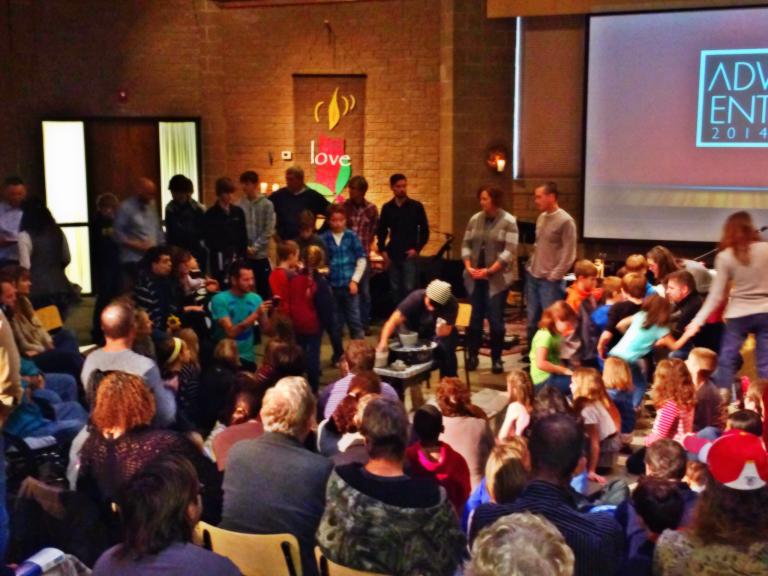
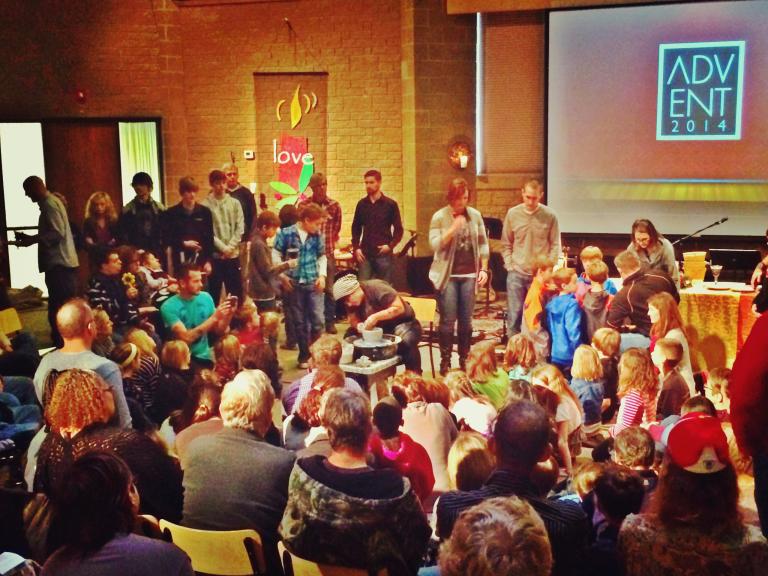 We’re going to do something a little different. I want us all to gather around Kristen and just watch her work for a while. I’ll ask the kids to come up first and sit right in close so you can see what she’s doing. Adults come in around them so we can all just watch. We’re going to just play a song that we can all listen to and watch what’s happening. Then after a few minutes we’ll begin to pass communion around to one another. We’ll just pass the plates and the cup together and you can serve each other.
Just to start our time of observation I want to read this to you: Hiding in the cold, hard clay of our lives is a beautiful work of art; the image of God just waiting to be reflected out into the world in a way that only your body, and soul can do. This sculpting is the work of a lifetime, and it is not so much a doing as it is an undoing; not so much a doing as it is a being done unto.
Most people lack the courage, or confidence, or love, or sheer desperation required in order to let God mold us & shape us. Most of us want a God who will do what we want. We want to tell God what shape our lives should take, like clay on the wheel barking out directions to the potter.
But the potter can make us beautiful beyond our wildest dreams. Life, for the believer, is not found in choosing our own shape, but in allowing God to shape us, making of us what we could have never dreamed for ourselves; helping us to become who we were always meant to be.
Hiding in the clay of your life is a beautiful work of art.
Advent season is about learning to wait, to be patient, and to trust God. And our God is a master. This isn’t his first time. He knows what he’s doing. We can trust him. And if we’ll submit to him & work with him, we’ll find a rhythm. And God will make us into something useful to the kingdom, but even more than that. God will make us into something beautiful.
Previous Post

December 1, 2014
Monday Morning Confessional
Next Post
December 4, 2014 Top Ten Gift Ideas For Book Lovers - 2014.
Browse Our Archives
Select a Category abortion corruption Donald Trump elections Empire Entertainment Ezra Klein ideology Justice Lacan politics race Sports Ta-Nehisi Coates Uncategorized
Select a Month September 2026 March 2026 September 2025 March 2025 June 2024 January 2024 December 2023 May 2023 February 2023 October 2022 April 2022 March 2022 December 2021 November 2021 October 2021 September 2021 August 2021 September 2020 July 2020 June 2020 March 2020 September 2019 July 2019 March 2019 February 2019 January 2019 November 2018 October 2018 September 2018 August 2018 July 2018 June 2018 May 2018 April 2018 March 2018 February 2018 December 2017 November 2017 October 2017 September 2017 August 2017 May 2017 April 2017 March 2017 February 2017 January 2017 December 2016 November 2016 October 2016 September 2016 July 2016 June 2016 May 2016 April 2016 March 2016 February 2016 January 2016 December 2015 November 2015 October 2015 September 2015 August 2015 July 2015 June 2015 May 2015 April 2015 March 2015 February 2015 January 2015 December 2014 November 2014 October 2014 September 2014 August 2014 July 2014 June 2014 May 2014 April 2014 March 2014 February 2014 January 2014 December 2013 November 2013 October 2013 September 2013 August 2013 July 2013 June 2013 May 2013 April 2013 March 2013 February 2013 January 2013 December 2012 November 2012 October 2012 September 2012 August 2012 July 2012 June 2012 May 2012 April 2012 March 2012 February 2012 January 2012 December 2011 November 2011 October 2011 September 2011 August 2011 July 2011 June 2011 May 2011 April 2011 March 2011 February 2011 January 2011 August 2010 July 2010 May 2010 April 2010 March 2010 February 2010 January 2010 December 2009 September 2009 August 2009 July 2009 June 2009 May 2009 April 2009 February 2009 January 2009 December 2008 October 2008 September 2008 August 2008 July 2008 June 2008 May 2008 April 2008 March 2008 February 2008 January 2008 November 2007 October 2007 September 2007 August 2007 July 2007 June 2007 May 2007 April 2007 March 2007 February 2007 January 2007 December 2006 October 2006 September 2006 August 2006 July 2006 June 2006 May 2006 April 2006 December 2004 November 2004 October 2004 September 2004 August 2004
Follow Us!
TAKE THE
Religious Wisdom Quiz
Who said, "If anyone is in Christ, he is a new creation"?
Select your answer to see how you score.
James John Peter Paul
Related posts from Paperback Theology

Immigration Confrontation: When Jesus Doesn’t Have Your Back

What God is Not: An Apophatic Account of...
New Podcast: Becoming Brueggemann — Thoughts on Sabbath...

You'll Spend a Third of your Life Working:...
TRENDING AT PATHEOS Progressive Christian

What Being a Modern-Day Apostle Means to Me
In my last column, I discussed the ins and outs of modern-day...

Did Ancient China Once Worship the God of...
Across human history, a common thread weaves through the origins of the...

Love Your Neighbor – Including Earth-Kin: Lev. 19,...
God’s command to love your neighbor means acting in an ethical and...

Lead a Church Study of “Jesus and Lao...
Guest writer Jack Thomas (The Irreverent Reverend) reflects on leading his church...

Pastoral Wisdom for Responding to Sermon Pushback
Getting sermon pushback on your social justice sermon? Learn practical, Proverbs-based strategies...

Principles for Understanding the Apostolic Ministry Today
Whenever people discover that my formal ministry title is "apostle," as in...
view all Progressive Christian blogs
Ad-Free & Subscriber Log-In Subscription Support
- About Us
- 2026 Calendar
- Videos
- Podcasts
- Library of World Religions
- Faith In Media Tracker
- Advertise With Us
- Write for Us
- Privacy Policy
- Terms of Service
- Do Not Sell My Data
- Contact Us
- Radiant Digital
- Manage Newsletter Subscriptions
- Unsubscribe From Notifications
- Sitemap
Copyright 2008-2026, Patheos. All rights reserved.
Subscription Support Ad-Free & Subscriber Log-In
Follow Patheos