
BuddhistCatholicContemplativeEvangelicalGeneral ChristianHinduJewishLatter-day SaintMuslimNew VisionsProgressive Christian
Beliefs
- Buddhist
- Catholic
- Contemplative
- Evangelical
- General Christian
- Hindu
- Jewish
- Latter-day Saint
- More Voices
- Muslim
- New Visions
- Pagan
- Progressive Christian
Topics
- Religion News
- Food and Religion
- Sports and Religion
- Religious Art
- Religious Music and Entertainment
- Religious Events
- History and Religion
- Style and Religion
- Politics and Religion
- Women in Religion
- Recreation Outdoors and Religion
- Business Finance and Religion
- Careers Workplace and Religion
- Education and Religion
- Family Parenting and Religion
- Health Fitness and Religion
- Home and Religion
- Relationships and Religion
- Technology and Religion
- Travel and Religion
Columnists
- Buddhist Columnists
- Business Finance and Religion Columnists
- Careers Workplace and Religion Columnists
- Catholic Columnists
- Contemplative Columnists
- Education and Religion Columnists
- Evangelists Columnists
- Family Parenting and Religion Columnists
- General Christian Columnists
- Health Fitness and Religion Columnists
- Hindu Columnists
- History and Religion Columnists
- Home and Religion Columnists
- Jewish Columnists
- More Voices Columnists
- Latter Day Columnists
- Muslim Columnists
- New Visions Columnists
- Nonreligious Columnists
- Pagan Columnists
- Politics and Religion Columnists
- Progressive Columnists
- Recreation Outdoors and Religion Columnists
- Relationships and Religion Columnists
- Religion News Columnists
- Religious Art Columnists
- Religious Events Columnists
- Religious Music and Entertainment Columnists
- Sports and Religion Columnists
- Style and Religion Columnists
- Technology and Religion Columnists
- Travel and Religion Columnists
- Women in Religion Columnists
Resource Library
- 2026 Calendar
- Library of World Religions
- The 100 Most Holy Places on Earth
- Patheos Answers
- Podcasts
- Videos
- Faith Leaders Database
- Anglican Episcopalian
- Bahai
- Baptist
- Buddhism
- Christianity
- Confucianism
- Eastern Orthodoxy
- Hinduism
- Holiness and Pentecostal
- ISKCON
- Islam
- Judaism
- Lutheran
- Methodist
- The Church of Jesus Christ of Latter-day Saints
- New Age
- Paganism
- Presbytarian and Reformed
- Protestantism
- Religion Behind the Scenes
- Roman Catholic
- Scientology
- Shia Islam
- Sikhism
- Sufism
- Sunni Islam
- Taoism
- Zen
- See all religions
Research Tools
 Ad-Free & Subscriber Log-In Subscription Support
Ad-Free & Subscriber Log-In Subscription Support
Follow Patheos 

- Trending:
- Forgiveness
- |
- Marriage
- |
- Consciousness
- |
- Death Penalty
- |
- Election
- |
- Halloween

- Home
- Progressive Christian
- Religion News
- Easter 7A – The Ascension of Christ: Acts 1:6-14
Easter 7A – The Ascension of Christ: Acts 1:6-14
Last updated on: June 4, 2014 at 8:03 am by Tim Suttle
Easter 7A – The Ascension of Christ: Acts 1:6-14 2014-06-04T08:03:13-06:00 Tim Suttle
Patheos Explore the world's faith through different perspectives on religion and spirituality! Patheos has the views of the prevalent religions and spiritualities of the world.
This is the sermon I preached last week at Redemption Church. I borrowed heavily from a great sermon Barbara Brown Taylor wrote and published in her book Home By Another Way – which is essential for any pastor who preaches through the lectionary. If you are a pastor, feel free to copy and steal everything.
2014.06.01 – Easter 07
Ascension – Acts 1:6-14
We are entering into the final days of a journey that started clear back in the beginning of Advent. The Church Calendar tells story. It walks us through the gospel story every year.
- Advent: waiting on Christ to appear.
- Christmas: celebrating the incarnation.
- Epiphany: telling stories of revelation & response.
- Lent: Our wilderness experience, learning to trust God for everything
- Easter: Celebrating resurrection.
- Ascension: a critical moment we’ll talk more about.
- Pentecost: the birth of the church.
So our focus today is on the ascension of Christ. Personally I’m excited because it is such a rich theme, but I think most of us have not thought thru its significance. I mean, how many of us can name why is ascension is that significant to us personally, or theologically? So it’s good to get to study this together.
Acts 1:6-11
6 So when they had come together, they asked him, “Lord, is this the time when you will restore the kingdom to Israel?” 7 He replied, “It is not for you to know the times or periods that the Father has set by his own authority. 8 But you will receive power when the Holy Spirit has come upon you; and you will be my witnesses in Jerusalem, in all Judea and Samaria, and to the ends of the earth.” 9 When he had said this, as they were watching, he was lifted up, and a cloud took him out of their sight. 10 While he was going and they were gazing up toward heaven, suddenly two men in white robes stood by them. 11 They said, “Men of Galilee, why do you stand looking up toward heaven? This Jesus, who has been taken up from you into heaven, will come in the same way as you saw him go into heaven.”
Long ago there was a great kingdom known as Georgia (not the Georgia of the deep South, but of the exotic East). Georgia was part of a land mass known in scripture as Asia Minor. The Greeks called it Anatolia—place of the rising sun—because it was to the East. You probably know it as Turkey & the home of the famous city of Istanbul (or is it Constantinople? I can never remember).
 This is where we find the city of Tarsus, where apostle Paul was born. The Kingdom of Troy was here. Two of the seven wonders of ancient world were here, and so was (or is), the Hagia Sophia. (picture) You’re looking at the oldest Christian church on the planet (537AD).
Georgia was tucked into the Kachkar Mountains just off the eastern corner of the Black Sea between Modern-day Turkey & Russia & it was a pretty amazing place—sort of an alpine country with lush forests, streams & waterfalls, good soil, quite defensible, with good ports. Georgia was rich in every way, including the Christian faith. The kings & queens spent fortunes mining rock & hiring architects & artisans to build some of the most beautiful churches the world has ever known.
These are known as Byzantine Cathedrals & they were filled with exquisite arches, frescoes, & stone work, & many are still standing… although empty. If they have any life left in them they are museums or mosques. The rest have been abandoned & lay in ruins:
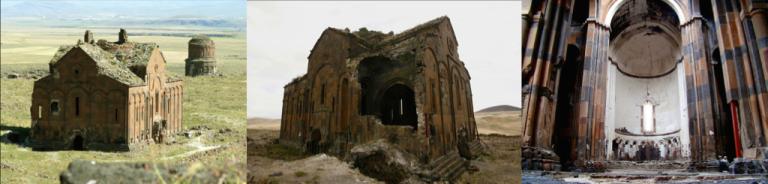
Ani Cathedral
Ani Cathedral (1000), still stands in the ruins of the old Armenian capital of Ani.
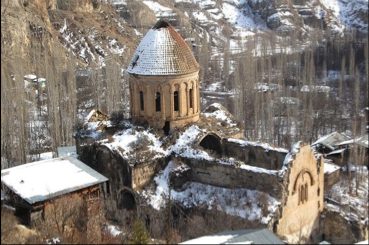
Oshki Monastery & Church
Oshki Monastery & Church (973), in the Erzurum Province of Turkey, was a major literary hub during the Middle Ages.
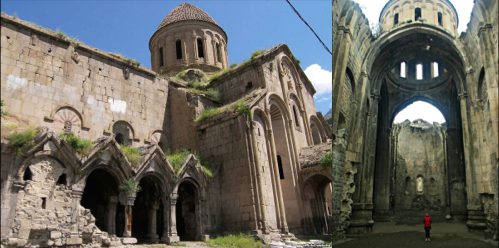
Oskvank Cathedral
Oskvank Cathedral (960), is in Camliyamac and was built by two sons of Georgian king named David.
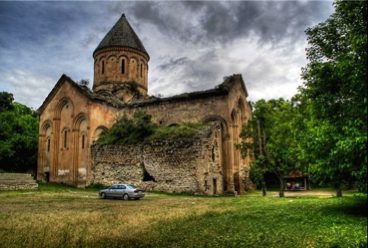
Ishkhani Cathedral
Ishkhani Cathedral (641), another of the oldest cathedrals on the planet, is tucked away in the Artvan Provence of Turkey.
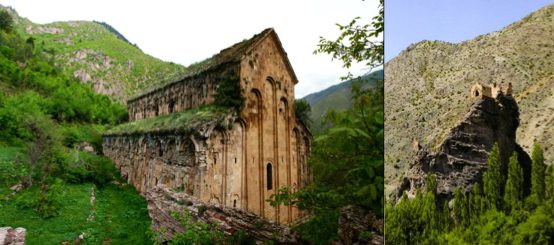
Otkhta Cathedral
Otkhta Cathedral (961), this one is my favorite, it’s built partially into the side of this rock hill. They also built on the same site a stunning fortress. These are both in Usefili, Turkey.
These examples are just a drop in the bucket. Scores of phenomenal examples of classic Byzantine architecture litter the hills of Georgia. But if you go there today all you’ll find is the wreckage of these once great churches, as Barbara Brown Taylor says, “poking up thru the canopy of trees like masts of stranded ships.” …their art & sculpture & carvings & grandeur carried off to museums or plundered. The shells of these once grand churches now serve as soccer fields, sheep pens & garbage dumps.
All that is left are the walls… these once graceful lines of cloisters & arched walkways littered with fading frescoes & carvings of Jesus. You can still visit most of them & catch a glimpse of a half visible a face of Christ with one wild eye that follows you wherever you go, one arm raised in the iconic Greek hand position (you know the one, from all of the old Greek looking icons), Christ imparting a stilted blessing to a church in ruins.
They lay in ruins not because they were abandoned for more modern versions, but because the age of Christianity has pretty much come and gone for Turkey. The Mongols captured Georgia in the 13th Century. Islam took root & spread. Within centuries the Christians were gone. Today Turkey is 99% Muslim.
When WWII ravaged the monasteries & cathedrals of Europe, the Christians promptly rebuilt them, but in Turkey it was different. No one was left to care for them, so the Cathedrals fell apart. They were destroyed by a powerful force: absence. Have you ever thought of that? Absence is powerful… In the absence of their animating force, their walls crumbled, their art was plundered & their stones were scavenged for new houses.
Maybe this was the concern nagging at the hearts of the disciples as Jesus ascended to heaven. Maybe this was Jesus’s concern as he addressed his followers for the final time before fading into a cloud. What would happen to them? What would happen to the gospel community once he was no longer the animating force for their movement? Would they crumble and fall to pieces. How would the kingdom he inaugurated continue in his absence?
Barbara Brown Taylor says the picture Jesus had given them of a loving God & a world bathed in God’s presence was something like a 4-tiered fountain, if you can imagine this: God’s glory spills over into Christ. Christ’s glory spills out into the church. The church’s glory drenches the world… this is how it worked. But how could it still work when Jesus was gone? When he was suddenly absent, would the flow of God’s glory dry up & leave everything downstream to shrivel and die?
The text tells us the disciples were still attempting to put it all together. “Lord, is this the time when you will restore the kingdom to Israel?” they asked. They were still hoping that he was going to somehow establish Israel as a sovereign people over the Holy Land. They are still confused; they think KOG is something that’ll show on a territorial map under the name Israel. They were all raised under the hopes & dreams of the Prophets; guys like Ezekiel, Daniel, and Joel who all promised the same thing: when the kingdom comes, God will finally reign & rule. And then one other thing would happen…
Joel 2: “In the last days I will pour out my spirit upon all flesh; your sons & daughters will prophesy, your old men shall dream dreams, and your young men shall see visions… even on the male & female slaves, in those days, I will pour out my spirit.”
They were expecting not only a new political reality, but a new spiritual reality as YHWH would pour out his spirit upon all flesh.
Of course we know they thought of KOG in nationalistic terms; which is why they ask, “Is this the time you will restore Israel?” Jesus says, it’s not so much a question of when but of how. “It is not for you to know the times or periods that the Father has set by his own authority.” Don’t worry about the when, he said, when is the Father’s territory. The real question was how… and this had to surprise them. Jesus says, “You will receive power when the Holy Spirit has come upon you; and you will be my witnesses in Jerusalem, in all Judea and Samaria, and to the ends of the earth.”
This kingdom advances as the spirit of God comes to live within the hearts of the people & in the life of the community itself. It spreads by witnesses, no by soldiers or wars. It is international—starting in Jerusalem, then Judea, Samaria, and the ends of the world. Which is, by the way, pretty much the way acts progresses. That’s the playbook for how the gospel will travel.
Then w/out much warning Jesus is gone. He does his best imitation of the rapper who says his last line, drops the mike and struts off stage: “When he had said this, as they were watching, he was lifted up, and a cloud took him out of their sight.” Can you imagine? They’re all standing there going, “What just happened?” Gazing up at the sky, craning necks, squinting eyes…
They apparently looked so long that 2 men in white robes (we are meant to understand them as angels) told them to knock it off… he’ll be back.
But Jesus’s sudden absence created an acute theological crisis. Absence is actually kind of a fascinating thing. One can only feel an absence after feeling some kind of presence that has been interrupted. Our kids spent last week with their grandma & grandpa, and I have to tell you it was… awesome. Seriously it was awesome. I haven’t had that kind of free time in years. But seriously, I felt their absence all week. I’m used to their presence, I love being around them. Without that presence, there’s no sense of absence, and the stronger that presence, more powerful the absence.
This is why it’s so hard when children go off to college, or you lose a job, or a loved one.
Absence is generally only hard when a presence has been meaningful in some way. Jesus’s presence meant everything to his disciples, & now all of the sudden he was gone again… his absence caused a powerful crisis.
And if you think about it, Jesus’s absence in our world explains a lot of the tensions & troubles & crises we all experience in this life. Christ’s absence can be devastating, because Christ’ presence is so powerful & good.
Earlier this Spring I went to hear a guy named Andrew Zirschky speak – getting PHD from Princeton in Youth Ministry. He’s researching the impact of social media on Youth Ministry, asking how technology is affecting our children. He said the average teen spends 10.75 hrs a day in some kind of mediated social interaction. And the popular myth explaining “why” is that kids are addicted to the devices. They love the shiny phones & ipads & laptops. He’s named this the “moth myth” …as though they were drawn like moths to a flame. Zirschky says that if you hand a kid a brand new iPhone & turn off call service, & take away the contacts, all you have is an extremely expensive (& somewhat unimpressive) game platform they’ll soon ignore.
Kids aren’t about the shiny new object, they seeking presence that can now be mediated through technology. What they’re after, Zirschky said, is: Presence in Absence. Presence in Absence, just means that kids want to be together when they’re apart. What drives them is a desire for presence. And they’re smarter than we might give them credit for.
Zirschsky asked teens to agree or disagree with this statement: “my online relationships can be just as fulfilling as face to face, real world relationships.” 84% of kids disagreed. Are kids are pretty sharp. They are looking for real face to face relationships. He also said the average teenager now sends 100 text messages per day. What’s interesting is that, for most of them, these are limited to a small group of 3-5 other kids. Social Media is really about having an ongoing dialogue with your real-world friends. It’s about fostering presence in absence.
This, Zirschsky says, is nothing new, because “Teens will take anything social.” The automobile was once new technology that meant transportation to the parents. But when teens got ahold of them, they took them social & gave us drive in restaurants, drive in theaters, and make-out point. They took the car social. He actually chased down newspaper accounts of teens staging coordinated break-ins to telegraph offices w/teens farther up the line in order to establish a connection.
The smart phone has incredible power not because it’s shiny & fun, but because it offers presence in bsence and this is a powerful thing.
(btw… Zirschky says a powerful driving force behind social media today is that our kids lives are so overscheduled. They just want to be together, but they’re too busy & spread out. So they are constantly absent from their close 3-5 friends, and they will use anything to mediate that presence.)
This drive for presence in absence is the powerful question facing the disciples: how will they carry on in Jesus’s absence? His presence meant everything to them. It changed everything in their lives. They were not particularly useful w/out him. All of the sudden he’s absent, and his absence threatened everything they’d come to care about. How would the gospel continue to move forward?
Jesus’s answer was—and this has to shock us as it did them—you! “You will receive power when the Holy Spirit has come upon you; and you will be my witnesses in Jerusalem, in all Judea and Samaria, and to the ends of the earth.”
I‘ve always thought the pivotal word in that verse was either power, or witnesses, and I still think they are very important words here. But now I think the whole verse turns on the word you. How will God’s presence continue on in the world? How will the kingdom advance in Jesus’s absence? … You. You will receive power. You will be my witnesses. Somehow the power of God, the Spirit of God that was always present in the life of Jesus, it was going to come upon them in a new way, and his absence wouldn’t be as much of a problem.
This kingdom advances as the spirit of God comes to live within the hearts of the people & the community itself as they begin to bear witness through their lives that Jesus is Israel’s Messiah & the world’s true Lord. In small and incomplete ways God is doing in and through you, what God did in and through Jesus. Just as God’s Spirit was present in JS, now God’s Spirit is present in you & me. Just as Jesus bore witness to the good news of God’s redemption, now you & I will be the witness. And part of this transition involves Jesus’s ascension… he has to go. This is a key point: for Christ to accomplish his plan for the kingdom, he has to leave.
“When he had said this, as they were watching, he was lifted up, and a cloud took him out of their sight.” This is the actual moment of ascension, so it’s big. Now, we’ve talked at length about the Hebrew worldview. And we often tend to think we’re much smarter than those primitive Hebrew people who thought heaven was up there somewhere, just past sky (since they didn’t know about space). That’s really not what they thought—that’s more of a Greek/platonic worldview.
Up (here) is a metaphor – like moving “up” from 4th to 5th grade. We’re able to say that without thinking you graduate to a classroom that is slightly higher in elevation. Up has more of the connotation of “beyond.” Jesus isn’t flying out through the atmosphere, and solar system, and into the Milky Way somewhere. The Jewish people didn’t think this either. We shouldn’t think they’re too primitive to use metaphors to try and describe a mystery… they were pretty sharp.
Remember the Hebrew view of the universe was that earth and heaven are not totally separate. They are two conjoined dimensions. Earth is the realm in which we live. Heaven is where God lives. N.T. Wright says it’s kind of like the control room for earth. These two dimensions overlap, but are separated by a veil. The New Testament teaches that after the Resurrection, Jesus was able to navigate both dimensions. He seemed to be at home in realm of earth and the realm of heaven. Still, by the way, fully human. Jesus wasn’t a ghost, he was a fully embodied human being who could be at home in both dimensions—the realm of heaven, and the realm of earth.
In verse 9 we have this detail, “a cloud took him out of their sight.” Immediately our minds should go to events from the scriptures: The transfiguration, in which Jesus is glorified in a cloud; the wilderness & the cloud that led them through the desert; the Holy of holies where a cloud covered the ark. This cloud shows up in scriptures to signify the division between heaven & earth—a division that is shrouded in mystery—it’s cloudy, unclear.
So what we have in the ascension is Jesus moving from one dimension to the other through this same cloud of unknowing we’ve seen all throughout the scriptures. Where he goes is not so much up as it is beyond, and this makes things difficult for us, because we have very limited understanding of “beyond.” The bible doesn’t give us a lot of detail about it. I’m actually quite skeptical of people who say they have all the details about “beyond.” Those details are above our pay grade.
What we learn from the ascension, however, is that Jesus lives on, still fully incarnated, still in bodily form, reigning as a part of the community of triune God in that place that lies beyond. And this means something very important for us as persons. It means that we have a fully sympathetic representative in that place (in the control room). Someone who is fully human like us is now there on the other side, at the right hand of the Father, interceding on our behalf.
And his promise as he left was that in his absence, he would send the gift of the Holy Spirit to continue his work on the earth. He calls it power. “You will receive power.” The Holy Spirit is nothing short of the power & presence of God that has been unleashed into the world & it comes upon you and me. The power of God, spirit of Christ lives on in the world through you and me, as we are drawn into this new community like living stones filled with the presence of God.
So the 4-tiered fountain still flows. God’s glory spills over into Christ. Christ’s glory spills over into the church through the power of the Holy Spirit. The church’s glory drenches the world with the worship of the one true God, the Father of Jesus, through the power of the Spirit.
And after all of these centuries, Christians still have the audacity to believe the church can be the one place on the planet where God is still present and active, even though Jesus is no longer present here in the flesh, walking around physically talking to us & healing people.
Barbara Brown Taylor says it this way: “The roof may be gone, and there may be sheep grazing in the nave, but Christ is still there—half a face, with one wide eye looking right at us, one hand raised in endless benediction—still giving his blessing to a ruined church. He cannot, or will not, be separated from his body. What God has joined together, let no one put asunder.” P. 139 That’s one of those lines that, as a writer, you read it and start to think, yeah, I don’t like you very much anymore… that’s just good, yeah? Barbara Brown Taylor… I can’t stand here anymore.
This is what we celebrate in the ascension—there are kind of 2 sides to it.
On one hand, we experience a sense of absence. Jesus is no longer bodily with us and this causes tension. We can’t see him as a distinct person walking around in the flesh. So the story of the ascension is a story of loss, a story of absence.
On the other hand, we experience a new presence. Jesus is with us through the power of the Holy Spirit. Only now—and this is huge, this is why the ascension matters so much—his presence has no limits. Before the ascension, the presence of Christ was limited to a specific time & place. You had to get into his circle, or at least close enough to touch the hem of his robe. Now his spirit has been unleashed into the world & it’s on the move, extending through Jerusalem, Judea, to Samaria, and to the ends of the world.
When we tell the story of the Ascension, we have to acknowledge these twin realities: On one hand we feel this absence. Jesus has gone to be with the Father, leaving us w/a sense of longing. I think this longing is a common part of the Christian experience. Especially when we face the brokenness of our world. Jesus is not bodily with us as we face the brokenness & chaos. So we are left with a lingering sense of tension, pain, longing, & sorrow that our savior is not physically here walking around putting to rights every broken situation.
And yet we also have this sense of God’s presence with us through the Spirit… which gives us a sense of hope. We live w/a sense of undaunted expectation. We know that Christ is there in the control room with God, pouring out his Spirit into the world. So even when it seems like we are alone, his spirit is with us.
These are the twin realities of the ascension:
The absence of Jesus creates a sense of sorrow. The world is not as it should be & he’s not here healing every sick person he meets, and every leper, & raising the dead. So when we face pain, fear, violence, sadness, fear, shame, we do so with a sense of longing. When Jesus was with the disciples, he could quell those forces… immediately—he just healed whatever broken thing he ran up against. Part of our reality is a kind of sorrow that he’s not here doing that same kind of thing in our midst.
But the twin reality is that the presence of God through the Holy Spirit gives us a sense of hope.
And so we live with this kind of optimistic expectation that the brokenness will not have the final word. We are filled with hope, and this hope is extremely powerful.
The absence will produce in us a kind of sorrow & longing, but the presence of the Spirit gives us hope, and a powerful connection to God… ongoing presence that although it is not always obvious, it is nevertheless very real. And when we live in light of this presence, it produces in us this overflowing hope that God is still working on our behalf; that God is still coming for us; that it won’t be too long until we are in God’s presence once again, because the KOG is breaking into the world.
We see glimpses of this every time his people come together to worship. The Spirit of God is with us. We experience God’s presence, and know that God is healing our broken hearts, and helping to put our lives back together.
As I was thinking about this scripture this week, pondering these twin realities—the longing that comes with Christ’s Absence, and the hope the accompanies his presence with us—I was thinking about the fact that Jesus called it power. You will receive power, he said. Sometimes this has been interpreted as power to do miracles, to heal, to cast out demons. Sometimes this is interpreted power to run the world, political power, even military power. I think it is the sheer power of expectation & hope. Hope has incredible power.
As I was thinking of these twin realities this song popped into my head. It’s a song that Isaac Anderson wrote (he’s not only a really good writer and speaker, he’s a really good musician and songwriter). It’s really short, only has a few lines… I’m going to just grab my mandolin & sing the main part of the song for you. It goes:
It won’t be too long now.
There’s a weight that’s pressing down.
There’s a swelling in the belly of the world.
It won’t be too long now.
There’s a Son who’s pressing down.
There’s a swelling in the belly of the world.
And now I can’t stand Isaac Anderson, either… that’s just great isn’t it? I mean that’s a killer line: there’s a swelling in the belly of the world. That’s hope, right? The image is of an expectant mother. The world is giving birth to something… it’s the kingdom of God. And for some reason God has chosen to work through us. The power of the HS has been unleashed in the world, and although we have a sense of sorrow; although we have a sense of longing; although we can sense the absence of our Lord—even so, we have this power that has come upon us… this presence… and it creates in us this insurmountable sense of hope. So when everyone else is screaming “Doom! The sky is falling.”
We say, “It won’t be too long now…” That’s our song. I know this is kind of a weird way to end a sermon, but if you would just sing it with me (again).
And here’s a kind of bridge section:
Welcome to the end of your sorrow.
Welcome to the end of yourself.
Welcome to tomorrow—where hope lives.
(chorus again)
Previous Post

June 3, 2014
On the Hubris of Prayer Experts: Pilgrim at Tinker Creek, Part I
Next Post
June 5, 2014 Pilgrim at Tinker Creek, Part II
Browse Our Archives
Select a Category abortion corruption Donald Trump elections Empire Entertainment Ezra Klein ideology Justice Lacan politics race Sports Ta-Nehisi Coates Uncategorized
Select a Month September 2026 March 2026 September 2025 March 2025 June 2024 January 2024 December 2023 May 2023 February 2023 October 2022 April 2022 March 2022 December 2021 November 2021 October 2021 September 2021 August 2021 September 2020 July 2020 June 2020 March 2020 September 2019 July 2019 March 2019 February 2019 January 2019 November 2018 October 2018 September 2018 August 2018 July 2018 June 2018 May 2018 April 2018 March 2018 February 2018 December 2017 November 2017 October 2017 September 2017 August 2017 May 2017 April 2017 March 2017 February 2017 January 2017 December 2016 November 2016 October 2016 September 2016 July 2016 June 2016 May 2016 April 2016 March 2016 February 2016 January 2016 December 2015 November 2015 October 2015 September 2015 August 2015 July 2015 June 2015 May 2015 April 2015 March 2015 February 2015 January 2015 December 2014 November 2014 October 2014 September 2014 August 2014 July 2014 June 2014 May 2014 April 2014 March 2014 February 2014 January 2014 December 2013 November 2013 October 2013 September 2013 August 2013 July 2013 June 2013 May 2013 April 2013 March 2013 February 2013 January 2013 December 2012 November 2012 October 2012 September 2012 August 2012 July 2012 June 2012 May 2012 April 2012 March 2012 February 2012 January 2012 December 2011 November 2011 October 2011 September 2011 August 2011 July 2011 June 2011 May 2011 April 2011 March 2011 February 2011 January 2011 August 2010 July 2010 May 2010 April 2010 March 2010 February 2010 January 2010 December 2009 September 2009 August 2009 July 2009 June 2009 May 2009 April 2009 February 2009 January 2009 December 2008 October 2008 September 2008 August 2008 July 2008 June 2008 May 2008 April 2008 March 2008 February 2008 January 2008 November 2007 October 2007 September 2007 August 2007 July 2007 June 2007 May 2007 April 2007 March 2007 February 2007 January 2007 December 2006 October 2006 September 2006 August 2006 July 2006 June 2006 May 2006 April 2006 December 2004 November 2004 October 2004 September 2004 August 2004
Follow Us!
TAKE THE
Religious Wisdom Quiz
A woman who had suffered bleeding for twelve years was healed by touching Jesus' what?
Select your answer to see how you score.
The hairs of his head His hand His cloak His feet
Related posts from Paperback Theology

Why Christian Faith Must Evolve—or Risk Dying


A Less Lonely Way to Lose Your Faith:...
Sermonsmith Episode 60: Tim Suttle - Conversations About...
TRENDING AT PATHEOS Progressive Christian

What Being a Modern-Day Apostle Means to Me
In my last column, I discussed the ins and outs of modern-day...

Did Ancient China Once Worship the God of...
Across human history, a common thread weaves through the origins of the...

Love Your Neighbor – Including Earth-Kin: Lev. 19,...
God’s command to love your neighbor means acting in an ethical and...

Lead a Church Study of “Jesus and Lao...
Guest writer Jack Thomas (The Irreverent Reverend) reflects on leading his church...

Pastoral Wisdom for Responding to Sermon Pushback
Getting sermon pushback on your social justice sermon? Learn practical, Proverbs-based strategies...

Principles for Understanding the Apostolic Ministry Today
Whenever people discover that my formal ministry title is "apostle," as in...
view all Progressive Christian blogs
Ad-Free & Subscriber Log-In Subscription Support
- About Us
- 2026 Calendar
- Videos
- Podcasts
- Library of World Religions
- Faith In Media Tracker
- Advertise With Us
- Write for Us
- Privacy Policy
- Terms of Service
- Do Not Sell My Data
- Contact Us
- Radiant Digital
- Manage Newsletter Subscriptions
- Unsubscribe From Notifications
- Sitemap
Copyright 2008-2026, Patheos. All rights reserved.
Subscription Support Ad-Free & Subscriber Log-In
Follow Patheos