
BuddhistCatholicContemplativeEvangelicalGeneral ChristianHinduJewishLatter-day SaintMuslimNew VisionsProgressive Christian
Beliefs
- Buddhist
- Catholic
- Contemplative
- Evangelical
- General Christian
- Hindu
- Jewish
- Latter-day Saint
- More Voices
- Muslim
- New Visions
- Pagan
- Progressive Christian
Topics
- Religion News
- Food and Religion
- Sports and Religion
- Religious Art
- Religious Music and Entertainment
- Religious Events
- History and Religion
- Style and Religion
- Politics and Religion
- Women in Religion
- Recreation Outdoors and Religion
- Business Finance and Religion
- Careers Workplace and Religion
- Education and Religion
- Family Parenting and Religion
- Health Fitness and Religion
- Home and Religion
- Relationships and Religion
- Technology and Religion
- Travel and Religion
Columnists
- Buddhist Columnists
- Business Finance and Religion Columnists
- Careers Workplace and Religion Columnists
- Catholic Columnists
- Contemplative Columnists
- Education and Religion Columnists
- Evangelists Columnists
- Family Parenting and Religion Columnists
- General Christian Columnists
- Health Fitness and Religion Columnists
- Hindu Columnists
- History and Religion Columnists
- Home and Religion Columnists
- Jewish Columnists
- More Voices Columnists
- Latter Day Columnists
- Muslim Columnists
- New Visions Columnists
- Nonreligious Columnists
- Pagan Columnists
- Politics and Religion Columnists
- Progressive Columnists
- Recreation Outdoors and Religion Columnists
- Relationships and Religion Columnists
- Religion News Columnists
- Religious Art Columnists
- Religious Events Columnists
- Religious Music and Entertainment Columnists
- Sports and Religion Columnists
- Style and Religion Columnists
- Technology and Religion Columnists
- Travel and Religion Columnists
- Women in Religion Columnists
Resource Library
- 2026 Calendar
- Library of World Religions
- The 100 Most Holy Places on Earth
- Patheos Answers
- Podcasts
- Videos
- Faith Leaders Database
- Anglican Episcopalian
- Bahai
- Baptist
- Buddhism
- Christianity
- Confucianism
- Eastern Orthodoxy
- Hinduism
- Holiness and Pentecostal
- ISKCON
- Islam
- Judaism
- Lutheran
- Methodist
- The Church of Jesus Christ of Latter-day Saints
- New Age
- Paganism
- Presbytarian and Reformed
- Protestantism
- Religion Behind the Scenes
- Roman Catholic
- Scientology
- Shia Islam
- Sikhism
- Sufism
- Sunni Islam
- Taoism
- Zen
- See all religions
Research Tools
 Ad-Free & Subscriber Log-In Subscription Support
Ad-Free & Subscriber Log-In Subscription Support
Follow Patheos 

- Trending:
- Forgiveness
- |
- Marriage
- |
- Consciousness
- |
- Death Penalty
- |
- Election
- |
- Halloween

- Home
- Progressive Christian
- Religion News
- Ten Facts About Da Vinci’s Last Supper: A Reflection for Maundy Thursday
Ten Facts About Da Vinci’s Last Supper: A Reflection for Maundy Thursday
Last updated on: April 17, 2014 at 5:35 am by Tim Suttle
Ten Facts About Da Vinci’s Last Supper: A Reflection for Maundy Thursday 2014-04-17T05:35:39-06:00 Tim Suttle
Patheos Explore the world's faith through different perspectives on religion and spirituality! Patheos has the views of the prevalent religions and spiritualities of the world.
 Every year on Maundy Thursday I wake up thinking about this painting. I’ve never seen it in person (bucket list), but I’ve known about it nearly my entire life. A copy of it was framed and hung in the second and third-grade Sunday School room in the tiny little Southern Baptist Church my family attended. When I was too bored or distracted to pay attention to the lesson I’d stare at this picture. It fascinates me to this day.
Maundy Thursday is rooted in Jesus’s teaching from John 13, “A new command I give you: Love one another. As I have loved you, so you must love one another. By this everyone will know that you are my disciples, if you love one another.”
In Jerome’s Latin Vulgate bible, the word for this new command is mandato… same word from which we get mandate. It’s also thought to be the origins of the name Maundy. There is a new mandate signified two ways in the four gospels: the redefinition of the Passover meal as Eucharist, and the washing of feet as a symbol of how the new community works.
I’ll think about this picture all day long, and stare at it from time to time. That we have this work at all is amazing. It’s the Thor of murals… you can’t kill it.
Da Vinci was an eccentric, notoriously slow and distracted. Legend has it that when his patron and the monastery pressured him to finish the mural, he threatened to use the abbot’s face as a model for the face of Judas. (You can’t rush fine art).
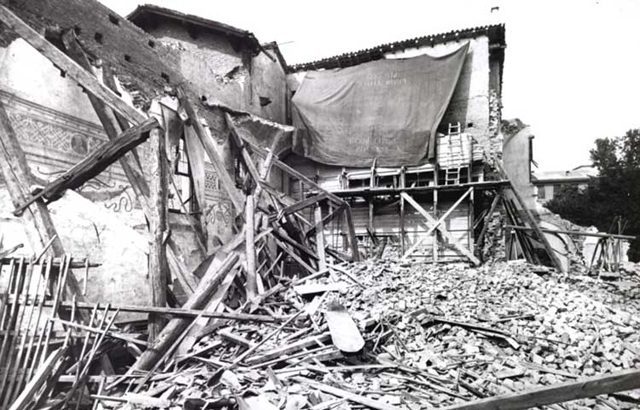 Begun in 1495, the methodology Da Vinci for the painting was an experiment that didn’t work and the painting deteriorated quickly. 150 years later, it was considered to be beyond saving. In 1776 this part of the abbey was used as a stable for French soldiers’ horses. Twenty four years later it was damaged in a flood that covered the entire wall. During WWII (1943) the monastery was destroyed. But the painting had been protected by a series of scaffolds and sandbags, and it emerged without a scratch. The Monastery was rebuilt around the painting, which is still in a dining hall. There are no other works of art in the room, and no written literature about it.
Here are just a few bits of trivia in the form of a quiz & answers… see how many out of the ten you get right.
10 Facts about DaVinci’s Last Supper:
- Why did DaVinci choose this subject matter for his painting?
- How big is it?
- Where is the painting located?
- How long did it take and when was it finished?
- Who is Jesus sharing a meal with in this picture?
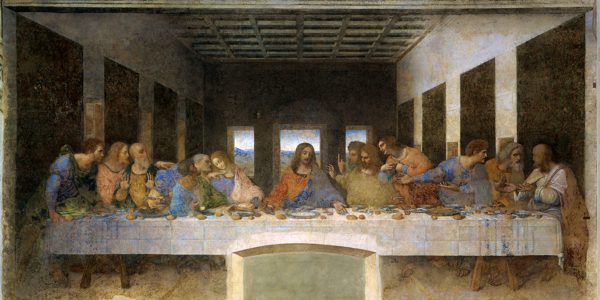
- Can you name those seated at the table from left to right?
- Why is the painting in such poor condition?
- Why can we not see Jesus’s feet?
- What year was the painting’s major restoration completed?
- What is DaVinci’s most famous painting?
Answers:
- The work was commissioned by the Duke of Milan (Lodovico Sforza), and the subject matter was chosen for DaVinci.
- 15 feet tall by 29 feet wide.
- The original mural is on a wall of the refectory (dining hall) in the Convent of Santa Maria delle Grazie in Milan, Italy.
- It took DaVinci (a noted procrastinator with a history of leaving works unfinished), about three years to complete the mural from 1495 to 1498.
- They are the 12 disciples.
- Bartholomew, James, Andrew, Judas, Peter, John, Jesus, Thomas, James (brother of John), Phillip, Matthew, Thaddeus, and Simon.
- The painting is in such poor condition because instead of painting in wet plaster, DaVinci chose to paint this on dry plaster. The immediate result was a much more stunning piece. The long term disaster was that it was not at all durable. It was not unlike painting on a cement wall with Tempura paint.
- Jesus did originally have feet, but in 1650 another door was added to the refectory and so the portion of the painting beneath Jesus (nobody knew how famous it would eventually be), was literally demolished. What you see there is an old doorway.
- 1999.
- Mona Lisa.
Previous Post

April 16, 2014
Lent 6A, Palm Sunday: John 19:12-19 - Powerful / Not-Powerful
Next Post
April 18, 2014 Good and Bad News for Christmas & Easter Christians: A Little Friday Funny
Browse Our Archives
Select a Category abortion corruption Donald Trump elections Empire Entertainment Ezra Klein ideology Justice Lacan politics race Sports Ta-Nehisi Coates Uncategorized
Select a Month September 2026 March 2026 September 2025 March 2025 June 2024 January 2024 December 2023 May 2023 February 2023 October 2022 April 2022 March 2022 December 2021 November 2021 October 2021 September 2021 August 2021 September 2020 July 2020 June 2020 March 2020 September 2019 July 2019 March 2019 February 2019 January 2019 November 2018 October 2018 September 2018 August 2018 July 2018 June 2018 May 2018 April 2018 March 2018 February 2018 December 2017 November 2017 October 2017 September 2017 August 2017 May 2017 April 2017 March 2017 February 2017 January 2017 December 2016 November 2016 October 2016 September 2016 July 2016 June 2016 May 2016 April 2016 March 2016 February 2016 January 2016 December 2015 November 2015 October 2015 September 2015 August 2015 July 2015 June 2015 May 2015 April 2015 March 2015 February 2015 January 2015 December 2014 November 2014 October 2014 September 2014 August 2014 July 2014 June 2014 May 2014 April 2014 March 2014 February 2014 January 2014 December 2013 November 2013 October 2013 September 2013 August 2013 July 2013 June 2013 May 2013 April 2013 March 2013 February 2013 January 2013 December 2012 November 2012 October 2012 September 2012 August 2012 July 2012 June 2012 May 2012 April 2012 March 2012 February 2012 January 2012 December 2011 November 2011 October 2011 September 2011 August 2011 July 2011 June 2011 May 2011 April 2011 March 2011 February 2011 January 2011 August 2010 July 2010 May 2010 April 2010 March 2010 February 2010 January 2010 December 2009 September 2009 August 2009 July 2009 June 2009 May 2009 April 2009 February 2009 January 2009 December 2008 October 2008 September 2008 August 2008 July 2008 June 2008 May 2008 April 2008 March 2008 February 2008 January 2008 November 2007 October 2007 September 2007 August 2007 July 2007 June 2007 May 2007 April 2007 March 2007 February 2007 January 2007 December 2006 October 2006 September 2006 August 2006 July 2006 June 2006 May 2006 April 2006 December 2004 November 2004 October 2004 September 2004 August 2004
Follow Us!
TAKE THE
Religious Wisdom Quiz
Who prophesied against Tyre, predicting it would become a bare rock?
Select your answer to see how you score.
Amos Daniel Joel Ezekiel
Related posts from Paperback Theology
10 Stunning Facts About Davinci's Last Supper for...

I Am Surrounded by Neighbors, and I Am...
Why Christians Need to Observe Lent
TRENDING AT PATHEOS Progressive Christian

What Being a Modern-Day Apostle Means to Me
In my last column, I discussed the ins and outs of modern-day...

Did Ancient China Once Worship the God of...
Across human history, a common thread weaves through the origins of the...

Love Your Neighbor – Including Earth-Kin: Lev. 19,...
God’s command to love your neighbor means acting in an ethical and...

Lead a Church Study of “Jesus and Lao...
Guest writer Jack Thomas (The Irreverent Reverend) reflects on leading his church...

Pastoral Wisdom for Responding to Sermon Pushback
Getting sermon pushback on your social justice sermon? Learn practical, Proverbs-based strategies...

Principles for Understanding the Apostolic Ministry Today
Whenever people discover that my formal ministry title is "apostle," as in...
view all Progressive Christian blogs
Ad-Free & Subscriber Log-In Subscription Support
- About Us
- 2026 Calendar
- Videos
- Podcasts
- Library of World Religions
- Faith In Media Tracker
- Advertise With Us
- Write for Us
- Privacy Policy
- Terms of Service
- Do Not Sell My Data
- Contact Us
- Radiant Digital
- Manage Newsletter Subscriptions
- Unsubscribe From Notifications
- Sitemap
Copyright 2008-2026, Patheos. All rights reserved.
Subscription Support Ad-Free & Subscriber Log-In
Follow Patheos