
BuddhistCatholicContemplativeEvangelicalGeneral ChristianHinduJewishLatter-day SaintMuslimNew VisionsProgressive Christian
Beliefs
- Buddhist
- Catholic
- Contemplative
- Evangelical
- General Christian
- Hindu
- Jewish
- Latter-day Saint
- More Voices
- Muslim
- New Visions
- Pagan
- Progressive Christian
Topics
- Religion News
- Food and Religion
- Sports and Religion
- Religious Art
- Religious Music and Entertainment
- Religious Events
- History and Religion
- Style and Religion
- Politics and Religion
- Women in Religion
- Recreation Outdoors and Religion
- Business Finance and Religion
- Careers Workplace and Religion
- Education and Religion
- Family Parenting and Religion
- Health Fitness and Religion
- Home and Religion
- Relationships and Religion
- Technology and Religion
- Travel and Religion
Columnists
- Buddhist Columnists
- Business Finance and Religion Columnists
- Careers Workplace and Religion Columnists
- Catholic Columnists
- Contemplative Columnists
- Education and Religion Columnists
- Evangelists Columnists
- Family Parenting and Religion Columnists
- General Christian Columnists
- Health Fitness and Religion Columnists
- Hindu Columnists
- History and Religion Columnists
- Home and Religion Columnists
- Jewish Columnists
- More Voices Columnists
- Latter Day Columnists
- Muslim Columnists
- New Visions Columnists
- Nonreligious Columnists
- Pagan Columnists
- Politics and Religion Columnists
- Progressive Columnists
- Recreation Outdoors and Religion Columnists
- Relationships and Religion Columnists
- Religion News Columnists
- Religious Art Columnists
- Religious Events Columnists
- Religious Music and Entertainment Columnists
- Sports and Religion Columnists
- Style and Religion Columnists
- Technology and Religion Columnists
- Travel and Religion Columnists
- Women in Religion Columnists
Resource Library
- 2026 Calendar
- Library of World Religions
- The 100 Most Holy Places on Earth
- Patheos Answers
- Podcasts
- Videos
- Faith Leaders Database
- Anglican Episcopalian
- Bahai
- Baptist
- Buddhism
- Christianity
- Confucianism
- Eastern Orthodoxy
- Hinduism
- Holiness and Pentecostal
- ISKCON
- Islam
- Judaism
- Lutheran
- Methodist
- The Church of Jesus Christ of Latter-day Saints
- New Age
- Paganism
- Presbytarian and Reformed
- Protestantism
- Religion Behind the Scenes
- Roman Catholic
- Scientology
- Shia Islam
- Sikhism
- Sufism
- Sunni Islam
- Taoism
- Zen
- See all religions
Research Tools
 Ad-Free & Subscriber Log-In Subscription Support
Ad-Free & Subscriber Log-In Subscription Support
Follow Patheos 

- Trending:
- Forgiveness
- |
- Marriage
- |
- Consciousness
- |
- Death Penalty
- |
- Election
- |
- Halloween

- Home
- Progressive Christian
- Religion News
- Jehoshua: Signs and Wonders
Jehoshua: Signs and Wonders
Last updated on: April 30, 2014 at 11:00 am by Tim Suttle
Jehoshua: Signs and Wonders 2014-04-30T11:00:38-06:00 Tim Suttle
Patheos Explore the world's faith through different perspectives on religion and spirituality! Patheos has the views of the prevalent religions and spiritualities of the world.
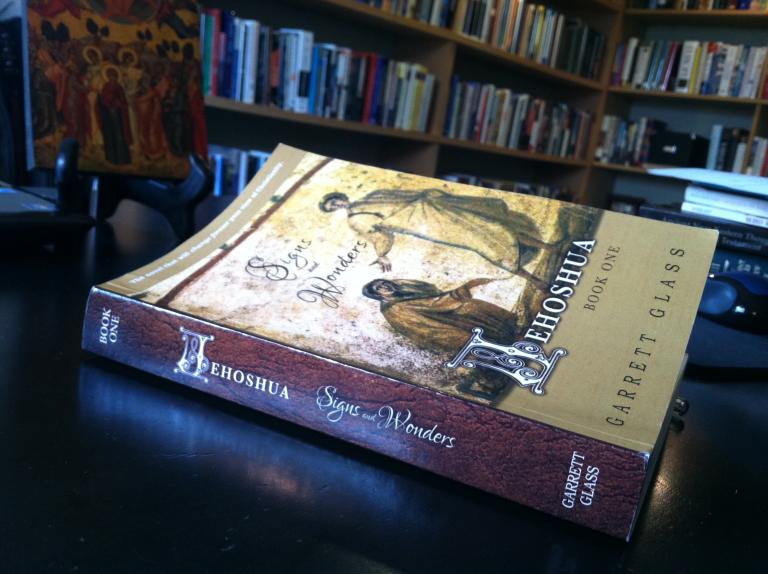 “People have been looking for Jesus for a long time, but never quite like this.” – N.T. Wright, “Five Gospels but No Gospel”
I’ve heard many descriptions of the historical Jesus over the years. Garrett Glass’ Jesus seems as unfamiliar to me as any. Billed as a work of historical fiction, the self-published Jehoshua: Signs and Wonders is heavy on the fiction… not so much on the history, though.
I’ve been reading this book for a few weeks now, off and on. I’m having roughly the same reaction to it that I had to Reza Aslan’s Zealot. In order to hit with the pros when it comes to the historical Jesus, you have to be a pro yourself. This has to be your discipline. To write well in this sub-genre (Historical Fiction/New Testament Era), requires not only expertise in literature/creative writing, but also a massive amount of reading and study in ancient near eastern culture, languages, archaeological research, text critical studies, as well as discussion with experts in the field. You have to read and assimilate at least the major works that comprise the full spectrum of modern historical Jesus scholarship. That, plus you have to be a brilliant writer who, having done all the research, knows how far to push without overreaching. It’s an incredibly demanding discipline. Which is probably why it’s not often attempted, and rarely done well. I know I could never do it.
Jehoshua is meant to be a fictional telling of the first 25 years of the Christian movement. Predictably, Glass’ Jesus is not divine, doesn’t do miracles, and did not rise from the dead–although he is so overweight they need extra rope to keep him on the cross. He also introduces the possibility that his real father is a Roman soldier named Pantera (insert Life of Brian jokes here… “Your father is a Roman, Brian!”). Moving against the four biblical Gospels’ interpretation of Jesus’s life, Glass envisions a movement that came about as a result of Jewish and Roman cultural-political machinations, committed or deluded followers, as well as a cloying portion of happenstance.
The project is ambitious, and his stories are interesting at times. The back matter includes appendices with some rudimentary historical facts, and a bibliography, which in and of itself is odd. I don’t remember seeing a bibliography in a work of non-scholarly historical fiction before. However, the list provides some insight into Glass’ influences. It reads like a who’s who of the Jesus Seminar: John Dominic Crossan, Marcus Borg, Robert Funk, Burton Mack, Karen King, John S. Kloppenborg, James Robinson—all Charter Fellows of the Jesus Seminar, plus other controversial scholars like Bart Ehrman and John Shelby Spong.
To be sure, any survey of historical Jesus scholarship work has to include Crossan, Borg, Mack, et al. But too many names are missing. Notably absent are people like N.T. Wright (who has to be at the top of any list of living historical Jesus scholars), Ben Meyers, Anthony Harvey, E.P. Sanders, or even a more popular name like A.N. Wilson. (If you ever want to trace the history of historical Jesus scholarship, Wright has written a concise survey called Who Was Jesus). The result is that Glass seems to have based his view of Jesus and the early church on the historical findings of only a few closely aligned scholars occupying ground far outside the mainstream—ground that has not yet been won in terms of the wider scholarly debate. Glass takes a bag full of these strands of (dubious) historical detail and attempts to weave every single one of them into the narrative. The result is that the story often feels contrived. For instance:
- Glass creates the character Lamech, who bought Jesus’ cloak from the Roman Soldier who won it gambling. Lamech cuts the cloak and sells it as a nostrum to people who believed Jesus had healing powers. When Lemech discovers that he physically resembles Jesus (in a day before photographs it was easier to pull this off), he pretends to be the risen Lord in order to make money, fooling even Jesus’ closest friends. Hence the plausible explanation for any and all risen Jesus encounters.
- Mary Magdalene’s reputation for harlotry stems not from her experiences as a prostitute, but her experiences with Jesus. Glass’ explanation in Appendix A says, “This is not a novel idea; others have explored the possibility that Jehoshua, as a human, might have had a sexual nature and sexual experiences with women, or even men (what was he doing alone with that young man in the garden of Gesthemane?” [sic – typos abound in the book]. Jesus is portrayed as soaking up the adoration of the crowds and channeling it into his own sexual experiences with Mary and others. It’s cliché. Just once I want a liberal historical Jesus writer to say Mary Magdalene was a typical divorced woman forced into occasional prostitution in order to eat because the culture was horrible to women.
- Jesus is never resurrected, and is never even buried. Instead he is thrown off the side of the hill where he was killed, torn to pieces, and eaten by a pack of wild dogs.
- The more outlandish historical possibilities (Jesus was overweight, bi-sexual, and the bastard son of a Roman soldier, or the constant plausible explanations for anything that smacks of metaphysics) are introduced as subtle suggestions–inner dialogue from the supporting cast, a fleeting thought, or unresolved possible explanation by a character.
The downside of a story like this is that it blurs the lines between fact and fiction excusing anything they author presents that might in fact be misleading or outright wrong as just part of a made up story. It’s like when my kids say something cruel, followed by “I’m just kidding.” Over the course of the novel, it starts to feel disingenuous, if not fantastic.
The upside of Glass’ attempt to retell the story of early Christianity is that he roots the story of the early church firmly in the narrative of Israel and 2nd Temple Judaism. Whatever historical details might be off, Glass sidesteps the fatal mistake of most liberal tellings of the early Jesus story by acknowledging the early Christian movement as a fundamentally Jewish reality (whether he gets that Jewish reality right or not is another story).
In his introduction, Glass states that Jehoshua is not “intended to be a challenge to anyone’s beliefs as a Christian. I am not trying to convert people away from Christianity.” The front cover, however, reads “The novel that will change forever your view of Christianity.” Given the material in the front and back matter, it seems clear that Glass has a more polemical agenda in mind. Glass says he writes for an audience of Christians who are open to “alternate endings of the Passion story,” Christians who are distanced from the faith, completely secular, or those who have opted out of Christianity altogether. I think all of those audiences would benefit from a more thoroughly researched novel.
If you are so inclined you might try: Anne Rice’s Christ the Lord: Out of Egypt, Christ the Lord: The Road to Cana; Nikos Kazantzakis’ The Last Temptation of Christ; Anita Diamant’s The Red Tent; or one of my personal favorites The Lost Letters of Pergamum by Bruce Longenecker.
Previous Post

April 30, 2014
Botched Oklahoma Execution: Killing in the Name of the State
Next Post
May 1, 2014 Hauerwas and... Mohler? Notes From An Unlikely Conversation
Browse Our Archives
Select a Category abortion corruption Donald Trump elections Empire Entertainment Ezra Klein ideology Justice Lacan politics race Sports Ta-Nehisi Coates Uncategorized
Select a Month September 2026 March 2026 September 2025 March 2025 June 2024 January 2024 December 2023 May 2023 February 2023 October 2022 April 2022 March 2022 December 2021 November 2021 October 2021 September 2021 August 2021 September 2020 July 2020 June 2020 March 2020 September 2019 July 2019 March 2019 February 2019 January 2019 November 2018 October 2018 September 2018 August 2018 July 2018 June 2018 May 2018 April 2018 March 2018 February 2018 December 2017 November 2017 October 2017 September 2017 August 2017 May 2017 April 2017 March 2017 February 2017 January 2017 December 2016 November 2016 October 2016 September 2016 July 2016 June 2016 May 2016 April 2016 March 2016 February 2016 January 2016 December 2015 November 2015 October 2015 September 2015 August 2015 July 2015 June 2015 May 2015 April 2015 March 2015 February 2015 January 2015 December 2014 November 2014 October 2014 September 2014 August 2014 July 2014 June 2014 May 2014 April 2014 March 2014 February 2014 January 2014 December 2013 November 2013 October 2013 September 2013 August 2013 July 2013 June 2013 May 2013 April 2013 March 2013 February 2013 January 2013 December 2012 November 2012 October 2012 September 2012 August 2012 July 2012 June 2012 May 2012 April 2012 March 2012 February 2012 January 2012 December 2011 November 2011 October 2011 September 2011 August 2011 July 2011 June 2011 May 2011 April 2011 March 2011 February 2011 January 2011 August 2010 July 2010 May 2010 April 2010 March 2010 February 2010 January 2010 December 2009 September 2009 August 2009 July 2009 June 2009 May 2009 April 2009 February 2009 January 2009 December 2008 October 2008 September 2008 August 2008 July 2008 June 2008 May 2008 April 2008 March 2008 February 2008 January 2008 November 2007 October 2007 September 2007 August 2007 July 2007 June 2007 May 2007 April 2007 March 2007 February 2007 January 2007 December 2006 October 2006 September 2006 August 2006 July 2006 June 2006 May 2006 April 2006 December 2004 November 2004 October 2004 September 2004 August 2004
Follow Us!
TAKE THE
Religious Wisdom Quiz
What does "Tabitha" mean in Aramaic?
Select your answer to see how you score.
Blessed one Servant Daughter of God Gazelle
Related posts from Paperback Theology

10 Great Quotes on Thanksgiving and Gratitude

Shawn Merithew's 9Marks Review of Shrink: A Non-Engaged...

All Modern Bible Translations are Good, But Are...

Easter 7A - The Ascension of Christ: Acts...
TRENDING AT PATHEOS Progressive Christian

Why Christians Have a Sacred Duty to Vote:...
The Bible offers strong support for the sacred duty to vote. Here...

What Being a Modern-Day Apostle Means to Me
In my last column, I discussed the ins and outs of modern-day...

Did Ancient China Once Worship the God of...
Across human history, a common thread weaves through the origins of the...

Love Your Neighbor – Including Earth-Kin: Lev. 19,...
God’s command to love your neighbor means acting in an ethical and...

Lead a Church Study of “Jesus and Lao...
Guest writer Jack Thomas (The Irreverent Reverend) reflects on leading his church...

Principles for Understanding the Apostolic Ministry Today
Whenever people discover that my formal ministry title is "apostle," as in...
view all Progressive Christian blogs
Ad-Free & Subscriber Log-In Subscription Support
- About Us
- 2026 Calendar
- Videos
- Podcasts
- Library of World Religions
- Faith In Media Tracker
- Advertise With Us
- Write for Us
- Privacy Policy
- Terms of Service
- Do Not Sell My Data
- Contact Us
- Radiant Digital
- Manage Newsletter Subscriptions
- Unsubscribe From Notifications
- Sitemap
Copyright 2008-2026, Patheos. All rights reserved.
Subscription Support Ad-Free & Subscriber Log-In
Follow Patheos