
BuddhistCatholicContemplativeEvangelicalGeneral ChristianHinduJewishLatter-day SaintMuslimNew VisionsProgressive Christian
Beliefs
- Buddhist
- Catholic
- Contemplative
- Evangelical
- General Christian
- Hindu
- Jewish
- Latter-day Saint
- More Voices
- Muslim
- New Visions
- Pagan
- Progressive Christian
Topics
- Religion News
- Food and Religion
- Sports and Religion
- Religious Art
- Religious Music and Entertainment
- Religious Events
- History and Religion
- Style and Religion
- Politics and Religion
- Women in Religion
- Recreation Outdoors and Religion
- Business Finance and Religion
- Careers Workplace and Religion
- Education and Religion
- Family Parenting and Religion
- Health Fitness and Religion
- Home and Religion
- Relationships and Religion
- Technology and Religion
- Travel and Religion
Columnists
- Buddhist Columnists
- Business Finance and Religion Columnists
- Careers Workplace and Religion Columnists
- Catholic Columnists
- Contemplative Columnists
- Education and Religion Columnists
- Evangelists Columnists
- Family Parenting and Religion Columnists
- General Christian Columnists
- Health Fitness and Religion Columnists
- Hindu Columnists
- History and Religion Columnists
- Home and Religion Columnists
- Jewish Columnists
- More Voices Columnists
- Latter Day Columnists
- Muslim Columnists
- New Visions Columnists
- Nonreligious Columnists
- Pagan Columnists
- Politics and Religion Columnists
- Progressive Columnists
- Recreation Outdoors and Religion Columnists
- Relationships and Religion Columnists
- Religion News Columnists
- Religious Art Columnists
- Religious Events Columnists
- Religious Music and Entertainment Columnists
- Sports and Religion Columnists
- Style and Religion Columnists
- Technology and Religion Columnists
- Travel and Religion Columnists
- Women in Religion Columnists
Resource Library
- 2026 Calendar
- Library of World Religions
- The 100 Most Holy Places on Earth
- Patheos Answers
- Podcasts
- Videos
- Faith Leaders Database
- Anglican Episcopalian
- Bahai
- Baptist
- Buddhism
- Christianity
- Confucianism
- Eastern Orthodoxy
- Hinduism
- Holiness and Pentecostal
- ISKCON
- Islam
- Judaism
- Lutheran
- Methodist
- The Church of Jesus Christ of Latter-day Saints
- New Age
- Paganism
- Presbytarian and Reformed
- Protestantism
- Religion Behind the Scenes
- Roman Catholic
- Scientology
- Shia Islam
- Sikhism
- Sufism
- Sunni Islam
- Taoism
- Zen
- See all religions
Research Tools
 Ad-Free & Subscriber Log-In Subscription Support
Ad-Free & Subscriber Log-In Subscription Support
Follow Patheos 

- Trending:
- Forgiveness
- |
- Marriage
- |
- Consciousness
- |
- Death Penalty
- |
- Election
- |
- Halloween

- Home
- Progressive Christian
- Religion News
- Easter 1A, John 20:1-18 – Disney’s Frozen & the Resurrection
Easter 1A, John 20:1-18 – Disney’s Frozen & the Resurrection
Last updated on: April 24, 2014 at 6:41 am by Tim Suttle
Easter 1A, John 20:1-18 – Disney’s Frozen & the Resurrection 2014-04-24T06:41:15-06:00 Tim Suttle
Patheos Explore the world's faith through different perspectives on religion and spirituality! Patheos has the views of the prevalent religions and spiritualities of the world.
https://www.youtube.com/watch?v=sbVz8IKhc9U
On Easter Sunday we showed this clip just before the sermon. When the song started, you could hear little voices all over the room start to sing along. The sound took my breath away. It was our kids. On Christmas & Easter we have all of our children, even the babies, join us in worship; that way no one misses out. They knew the song & couldn’t help themselves. After a couple lines the singing died away (I think the parents started shushing them). If I had it to do all over again, I’d invite them to sing along.
This sermon was delivered on Easter Sunday, 2014 at Redemption Church in Olathe, KS. I have to acknowledge Rob Bell’s “Begin at the Beginning,” talk, from which I took the central thesis & some of his good language. I stole the “Up there down here” language from John Ortberg. If you are a pastor, feel free to copy and steal anything here.
_________________________________________________________________
2014.04.20 – Easter 01
John 20 – Frozen and the Resurrection
How many of you have seen this movie, Frozen? How many of you LOVE, this movie Frozen. Did you hear all the little voices singing when the song started? That was amazing. I think the movie is interesting in part because all of the tension in the story revolves around the relationship between these 2 sisters.
Elsa (older sister) has this power: she can create ice and snow; which is amazing, but it can be a bit dangerous sometimes. Once when she was a little girl she seriously injured her little sister Anna while they were playing together. But, it’s Disney right? So magic trolls fix the little sister right up, and the parents decide to isolate Elsa from her little sister until she can learn how to control her gift. And to make it easier, the trolls remove part of Anna’s memories. After than, Anna remembers how much fun they had together & how close they were. But she doesn’t remember anything about her sister’s magical ability. Elsa, remembers everything. She knows that she has this amazing little sister that she loves, how much fun they used to have. But she’s terribly afraid she’ll hurt her little sister. So she cuts herself off completely.
Anna (the younger sister), starts the story a few chapters in. She remembers playing w/her big sister, but has no memory of the reason there’s a problem. She’s hurt by this sister she loves, and doesn’t understand why Elsa won’t play with her, or talk to her, and never comes out of her room.
Elsa tells the story from the beginning, w/this gift that seems wonderful, but it’s dangerous & she can’t control it. Anna begins the story in the middle, w/a sister who used to be fun, but now she’s completely withdrawn. Since they begin in such different places, they both tell very different stories about their lives… so they end up on opposite sides of a door, both wishing they could be together: the older thinking it’s an act of love, the younger one thinking it’s an act of rejection. The only difference where they begin to tell the story…
I once heard a pastor say, “Where and how you begin the story, and where and how you end the story, shapes and determines what story you’re telling…” Parents know this routine: one child runs upstairs crying, “Brother slapped me in the arm.” You yell for brother, who appears in tears carrying the Lego ship he spent 4 hrs building, now in 100 pieces. Anyone familiar with this? Where you begin the story determines what kind of story you’re telling.
So when it comes to the big, big story; the cosmic story of the world & where it came from and our lives, and what they mean… Where and how you begin, and where and how you end that story will determine what kind of story your life is telling.
In the movie Frozen, the Anna tells a story about an older sister who’s cold–an ice queen–it felt like her sister didn’t love her anymore. But she wasn’t beginning from the beginning of the story. The older sister tells a very different story. She thinks she is acting out of love. What’s strange is that it’s the same reality. They are living the same reality. But they begin the story in very different places. And where and how you begin the story will determine what kind of story you’re telling.
Now, Endings have a similar impact on the story as well. In the Frozen story (btw, let me just give a spoiler alert: If you’ve never seen Frozen before, I’m totally going to ruin this movie for you. But it’s already grossed over $650 million – so if you never see it, I think Disney will still be okay), as the story builds… you begin to see that the older sister has become consumed w/the fear that she’ll end up hurting the people close to her. So she isolates herself; she runs off & builds this superman-style fortress of solitude… it’s this ice castle for a snow queen. She’s so afraid her life will end badly, that she cuts herself off. This has an impact not only on her younger sister, but the whole land, which is now in this perpetual winter.
Anna has a very different ending in mind, especially after their parents die. She believes that the story can have a happy ending (together). So she refuses to give up on it; she trudges off through the snow to find her sister. They both have these different ideas of how the story will end. Elsa thinks it’s a tragic story of isolation & loneliness & fear. Anna thinks it is a love story. And how you END the story will determine what kind of story you are telling…
You guys remember the movie Charlie Wilson’s War? In it, Phillip Seymour Hoffman’s character tells this story:
“There’s a little boy and on his 14th birthday he gets a horse, and everybody in the village says, “How wonderful. The boy got a horse.” And the Zen master says, “We’ll see.” Two years later, the boy falls off the horse, breaks his leg, and everyone in the village says, “How terrible.” And the Zen master says, “We’ll see.” Then, a war breaks out and all the young men have to go off and fight… except the boy can’t cause his legs all messed up. And everybody in the village says, “How wonderful.” And the Zen master says…
What does he say? We’ll see… The point is that where and how you end that story will determine what kind of story it is you are actually telling.
I’m sure you’ve made the connection already, but it bears making it explicit: this is how the Christian story works as well. Where and how you begin the story of God, and where and how you end the story of God, will shape and determine what kind of story you’re telling. Today we tell the story of how the end of the story takes am unexpected twist in the life of Jesus Christ.
In the scripture we just read, Mary looks straight at Jesus and doesn’t recognize him. She is convinced she already knows the end of that story. Mary has no imagination for how there could be a different ending of the story. Dead people don’t get up and walk around. And Messiah’s don’t die. One theologian has said that saying “crucified Messiah” was like saying “boiled ice.” That’s what Easter is all about: giving us a new imagination for how the story can end, in the hopes that this can change everything about the story we tell with our own lives right here and now.
This story BEGINS clear back in Gen. 1, with a God who is distinct from creation, which was a strange thing to believe in a culture where pretty much everyone worshipped the creation or some part of it. But the Hebrew God is distinct from creation. And this God creates things, that can create more things: trees that can make more trees; animals that can make more animals. And one creature God has a special relationship with (humans). God gives them responsibility over the creation. Their job is to take care of it, and steward it. “Be fruitful & multiply; fill the earth & subdue it, have dominion over it. Till the earth & keep it. Make it grow & flourish.”
Everywhere God looks; God wants to see things flourishing. And this diverse creation exists in a kind of order. God is distinct from creation, but intimately involved. Creation is dynamic, it’s growing & constantly developing. Humans are meant to order creation in certain ways: Sabbath rest, honoring fathers and mothers, not killing, lying… The order is meant to allow everything to flourish. Creation is “teeming” with life because it is rightly ordered.
But if the people try to be God, it won’t work. And if the people start to worship creation it won’t work. There’s an order – a harmony to it all.
The Jewish people had a word for this order/harmony: shalom (peace) – which is not like inner peace, or world peace. It means everything in its proper place functioning as it should, that’s shalom. And God blesses all of this and calls it good. This is how the story of God & us begins in Genesis 1 and 2.
Then comes Chapter 3 of Genesis, where shalom is disrupted, and harmony is replaced with an ugly dissonance. And all of the human’s relationships go sideways, and the people begin to: hide from God; they feel shame about their nakedness; they blame each other; and when they work the earth works against them, and the work becomes toil. The order that everything needs in order to flourish is disrupted. For us, this disrupts the way we relate to God, ourselves, other people, and the created order.
The order, and harmony, and shalom is disrupted. The Hebrew people have a name for this as well, they call this disruption sin. To the Hebrew mind, sin isn’t just cheating on your taxes, or lying to your parents. Sin is just anything that disrupts shalom & ruins the harmony of creation. That’s what happens in Gen. 3.
Now some people have a tendency to start the story of God from Gen. 3 (with sin), instead of Gen. 1-2 (with creation, order, flourishing, & shalom). And, if you begin the story in Gen. 3, then the story you tell when you talk about God becomes about the removal of sin. But, if you begin the story in Gen. 1, then the story you tell is about the restoration of shalom… which includes dealing with sin, it’s just so much bigger than that.
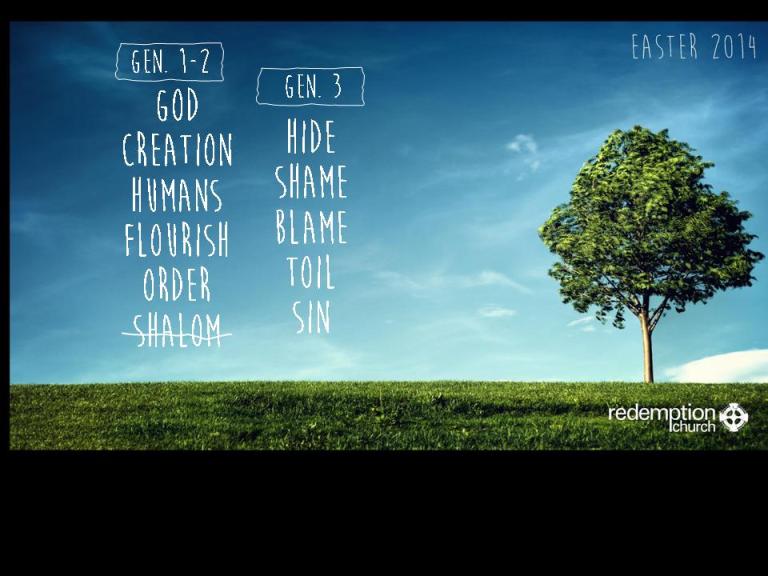
If you begin in Gen. 3, you end up telling a story that’s based in what’s wrong with everything (hiding, shame, blame, toil, sin). If you begin in Gen. 1, you end up telling a story that’s based in what we are meant to be: (God, creation, humans, flourishing, order, shalom)… and those are very different stories. Just like the two sisters in Frozen: one story produces fear, the other produces hope. One is about managing sin. The other is about God’s determination to redeem & restore everything: creation, humans – all flourishing in order & shalom.
So where and how you BEGIN the story of God, will shape and determine what kind of story you’re telling; who you think GOD is & who YOU are & what your life means… How you begin impacts all of it.
Now, where & how you END the story has a big impact too. This part’s tricky. I mean how do you know the end of the story before it happens? You can guess, but you’ll probably guess wrong. Often those who start in Ch. 3, they end up saying the story is about God punishing all the sinners. Sometimes they say God is about beaming up the good people & frying the bad ones who are left behind.
But Jesus chose to talk about the big story in a different way; in fact, over & over in all the gospels he used the same metaphor of kingdom. For us this is odd, because don’t have kings in our society. We’ve got, like… Burger King. It’s not really the same is it? We have some kings. Who’s the king of Rock & Roll? (Elvis). The king of pop? (Michael Jackson). This is for the children of the 80s: Who’s the sausage king of Chicago? (Abe Frohman – Ferris Buehler)
We have some kings, but it’s not the same thing. So we don’t always get this concept of kingdom. A kingdom is a place where whatever the king wants to happen, happens… where the king gets to say. So, a king’s kingdom is the range of the king’s effective will. (Dallas Willard). Where the king’s will is done, that’s his kingdom. Where the king’s will isn’t done, is not his kingdom.
So, when Jesus talked about the big story, the cosmic story, he said that God’s kingdom was breaking into earth. So this is his prayer: “Thy kingdom come, thy will be done on earth as it is in heaven.” This is his most common sermon: “The KOG is at hand/near” JS believed that the place where God gets to reign & rule (his kingdom) it has appeared, and was unleashed & taking over.
God’s will is for things on earth to be ordered just like the beginning of the story: with order, harmony, flourishing, shalom. And when God is the king, that’s how the world will be; that’s God’s will. So, Jesus wasn’t trying to get everyone down here to go up there. He was trying to get up there to come down here. (Thank you John Ortberg). He wanted God to reign on earth; for God’s kingdom to come. He wanted the range of God’s effective will to extend to all of us.
That’s why everywhere Jesus went he was healing people. Anytime Jesus saw a disruption of shalom he moved against it, to restore right order, to restore peace & harmony & flourishing. Jesus’s mission was to usher in a new kingdom, with God reigning & ruling once again & all things rightly ordered. The way he went about it was that he tried to get his followers to see the beginning & end of the story in a new way… hoping that with a new beginning & ending, they could start to live a different story with their lives right now.
______________________________________________________________
Jesus’s mission was to usher in a new kingdom, with God reigning & ruling once again & all things rightly ordered. The way he went about it was that he tried to get his followers to see the beginning & end of the story in a new way… hoping that with a new beginning & ending, they could start to live a different story with their lives right now.
______________________________________________________________
If he could change the way they see the BEGINNING: they’d see God isn’t about crushing the broken; but forgiving the broken & restoring shalom.
If he could change the way they see the END: they’d see death might be the enemy, but that God’s love can actually overcome death…
The way he changed the beginning was through his life & ministry. Thru his teaching, healing, actions, everything JS does show that God is a God of love & forgiveness, healing, restoration.
The way he changed the end is, he was faithful all the way to death: Believing that God wouldn’t abandon him… God would raise him up.
Jesus taught that if we can see the new Beginning/Ending: how we enter into that new story, is to live our lives the way that Jesus lived his life. To tell the same story with our lives that he told with his; to pour out our lives for the people around us; to die to ourselves in a thousand tiny ways every day; believing that after every death died for the sake of God’s peace (and God’s shalom, God’s kingdom on earth), comes a resurrection.

The movie Frozen is actually a resurrection story. You remember what happens at the end of the movie? Anna, she dies for her big sister… the ice Queen. There’s an assassin who’s about to kill her and Anna steps in front of him & gives her own life to save her sister… It’s the gospel… it’s Jesus saying, “Greater love has no one than this: to lay down one’s life for one’s friends.” (John 15:13-14).
The self-sacrificial love unleashes new life and that changes the two sisters’ story forever. If you think about it this is a radical departure for a Disney Movie. The whole Disney narrative is built on the power of true love’s kiss, right? (that’s Beauty & the Beast, Snow White, Sleeping Beauty). But in Frozen, they subvert their own narrative. It’s not romantic love, but self-sacrificial love that changes their story.
When Anna lays down her life for her sister, Elsa is broken-hearted. Then comes the resurrection scene & Elsa finally sees that love is stronger than fear (or sin, shame, blame, hatred, & anything on the list from Genesis 3). And their whole story changes. Self-sacrificial love become her entrance into a whole new story. And all of the sudden order is restored, ice melts, and the queen is able to steward her gifts in a good way.
That’s resurrection. When Jesus is resurrected, we see how the story is going to end; we know that what God did for Jesus, God will do for all of us one day. We learn that the end of the story is really a new beginning.
If that’s the end of the story, then we can live without fear. If that’s the end, then it changes everything that comes before it… because it means that life will overcome death in the end. And if that’s true, all the sudden we can pour out our lives for each other. We don’t have to worry that life might run out. There will always be more life for those who live like Jesus lived. So we are able to live differently, unselfishly – actually we live a life that is rightly ordered, like God designed from start (shalom).
______________________________________________________________
This is the great hope of resurrection: Those who are alive in Christ become so fully alive, that when they die, life overcomes death. This changes everything about the story you tell w/your own life.
______________________________________________________________
So the question I invite you all to ask on this Resurrection Sunday, is the question that Resurrection demands we ask: Is this the life I want to live? I got one shot at this; is my life rightly ordered? Is this peace/shalom or is this fear, greed, shame, loneliness… Resurrection gives us permission to change & just go for it. Is this the life you want to live?
The story of God says that you can be born into a whole new story anytime you’re ready. And your entrance into that new story is about catching a glimpse of this amazing beginning, and new ending; and knowing that if that’s the way the story ends, I can live w/out fear. If that’s the way the story ends, I can pour my life out for others, for the life of the world without worrying that my life will give out. If that’s the way the story ends, I can steward my gifts for kingdom.
How you begin and end the story will determine what kind of story you tell – with your life. Our story begins with a God who loves us and gives us a calling to order the world & cause it to flourish. Our story ends with a new beginning. So every time we die to ourselves and others, God uses that as the vehicle for new life. Believe in that, and it will change everything about the story you tell with your life right now.
Previous Post

April 22, 2014
Happy Earth Day! (Or as we evangelicals like to call it, Tuesday).
Browse Our Archives
Select a Category abortion corruption Donald Trump elections Empire Entertainment Ezra Klein ideology Justice Lacan politics race Sports Ta-Nehisi Coates Uncategorized
Select a Month September 2026 March 2026 September 2025 March 2025 June 2024 January 2024 December 2023 May 2023 February 2023 October 2022 April 2022 March 2022 December 2021 November 2021 October 2021 September 2021 August 2021 September 2020 July 2020 June 2020 March 2020 September 2019 July 2019 March 2019 February 2019 January 2019 November 2018 October 2018 September 2018 August 2018 July 2018 June 2018 May 2018 April 2018 March 2018 February 2018 December 2017 November 2017 October 2017 September 2017 August 2017 May 2017 April 2017 March 2017 February 2017 January 2017 December 2016 November 2016 October 2016 September 2016 July 2016 June 2016 May 2016 April 2016 March 2016 February 2016 January 2016 December 2015 November 2015 October 2015 September 2015 August 2015 July 2015 June 2015 May 2015 April 2015 March 2015 February 2015 January 2015 December 2014 November 2014 October 2014 September 2014 August 2014 July 2014 June 2014 May 2014 April 2014 March 2014 February 2014 January 2014 December 2013 November 2013 October 2013 September 2013 August 2013 July 2013 June 2013 May 2013 April 2013 March 2013 February 2013 January 2013 December 2012 November 2012 October 2012 September 2012 August 2012 July 2012 June 2012 May 2012 April 2012 March 2012 February 2012 January 2012 December 2011 November 2011 October 2011 September 2011 August 2011 July 2011 June 2011 May 2011 April 2011 March 2011 February 2011 January 2011 August 2010 July 2010 May 2010 April 2010 March 2010 February 2010 January 2010 December 2009 September 2009 August 2009 July 2009 June 2009 May 2009 April 2009 February 2009 January 2009 December 2008 October 2008 September 2008 August 2008 July 2008 June 2008 May 2008 April 2008 March 2008 February 2008 January 2008 November 2007 October 2007 September 2007 August 2007 July 2007 June 2007 May 2007 April 2007 March 2007 February 2007 January 2007 December 2006 October 2006 September 2006 August 2006 July 2006 June 2006 May 2006 April 2006 December 2004 November 2004 October 2004 September 2004 August 2004
Follow Us!
TAKE THE
Religious Wisdom Quiz
Jesus replied: "‘Love the Lord your God with all your heart and with all your soul and with all your mind.’ This is the first and greatest commandment. And the second is like it: ‘__________________’"
Select your answer to see how you score.
Love Your Neighbor As Yourself Love Others Do Not Kill Honor Your Father And Mother
Related posts from Paperback Theology

Good News for Christmas and Easter Christians (and...

Wendell Berry on the Practice of Resurrection: The...

How Does "Dying for our Sins" Work?
TRENDING AT PATHEOS Progressive Christian

What Being a Modern-Day Apostle Means to Me
In my last column, I discussed the ins and outs of modern-day...

Did Ancient China Once Worship the God of...
Across human history, a common thread weaves through the origins of the...

Love Your Neighbor – Including Earth-Kin: Lev. 19,...
God’s command to love your neighbor means acting in an ethical and...

Lead a Church Study of “Jesus and Lao...
Guest writer Jack Thomas (The Irreverent Reverend) reflects on leading his church...

Pastoral Wisdom for Responding to Sermon Pushback
Getting sermon pushback on your social justice sermon? Learn practical, Proverbs-based strategies...

Principles for Understanding the Apostolic Ministry Today
Whenever people discover that my formal ministry title is "apostle," as in...
view all Progressive Christian blogs
Ad-Free & Subscriber Log-In Subscription Support
- About Us
- 2026 Calendar
- Videos
- Podcasts
- Library of World Religions
- Faith In Media Tracker
- Advertise With Us
- Write for Us
- Privacy Policy
- Terms of Service
- Do Not Sell My Data
- Contact Us
- Radiant Digital
- Manage Newsletter Subscriptions
- Unsubscribe From Notifications
- Sitemap
Copyright 2008-2026, Patheos. All rights reserved.
Subscription Support Ad-Free & Subscriber Log-In
Follow Patheos