
BuddhistCatholicContemplativeEvangelicalGeneral ChristianHinduJewishLatter-day SaintMuslimNew VisionsProgressive Christian
Beliefs
- Buddhist
- Catholic
- Contemplative
- Evangelical
- General Christian
- Hindu
- Jewish
- Latter-day Saint
- More Voices
- Muslim
- New Visions
- Pagan
- Progressive Christian
Topics
- Religion News
- Food and Religion
- Sports and Religion
- Religious Art
- Religious Music and Entertainment
- Religious Events
- History and Religion
- Style and Religion
- Politics and Religion
- Women in Religion
- Recreation Outdoors and Religion
- Business Finance and Religion
- Careers Workplace and Religion
- Education and Religion
- Family Parenting and Religion
- Health Fitness and Religion
- Home and Religion
- Relationships and Religion
- Technology and Religion
- Travel and Religion
Columnists
- Buddhist Columnists
- Business Finance and Religion Columnists
- Careers Workplace and Religion Columnists
- Catholic Columnists
- Contemplative Columnists
- Education and Religion Columnists
- Evangelists Columnists
- Family Parenting and Religion Columnists
- General Christian Columnists
- Health Fitness and Religion Columnists
- Hindu Columnists
- History and Religion Columnists
- Home and Religion Columnists
- Jewish Columnists
- More Voices Columnists
- Latter Day Columnists
- Muslim Columnists
- New Visions Columnists
- Nonreligious Columnists
- Pagan Columnists
- Politics and Religion Columnists
- Progressive Columnists
- Recreation Outdoors and Religion Columnists
- Relationships and Religion Columnists
- Religion News Columnists
- Religious Art Columnists
- Religious Events Columnists
- Religious Music and Entertainment Columnists
- Sports and Religion Columnists
- Style and Religion Columnists
- Technology and Religion Columnists
- Travel and Religion Columnists
- Women in Religion Columnists
Resource Library
- 2026 Calendar
- Library of World Religions
- The 100 Most Holy Places on Earth
- Patheos Answers
- Podcasts
- Videos
- Faith Leaders Database
- Anglican Episcopalian
- Bahai
- Baptist
- Buddhism
- Christianity
- Confucianism
- Eastern Orthodoxy
- Hinduism
- Holiness and Pentecostal
- ISKCON
- Islam
- Judaism
- Lutheran
- Methodist
- The Church of Jesus Christ of Latter-day Saints
- New Age
- Paganism
- Presbytarian and Reformed
- Protestantism
- Religion Behind the Scenes
- Roman Catholic
- Scientology
- Shia Islam
- Sikhism
- Sufism
- Sunni Islam
- Taoism
- Zen
- See all religions
Research Tools
 Ad-Free & Subscriber Log-In Subscription Support
Ad-Free & Subscriber Log-In Subscription Support
Follow Patheos 

- Trending:
- Forgiveness
- |
- Marriage
- |
- Consciousness
- |
- Death Penalty
- |
- Election
- |
- Halloween
 PANTHEON
- Home
- Pagan
- Guest Post: Steve Provost asks Whose god is it anyway?
Guest Post: Steve Provost asks Whose god is it anyway?
Last updated on: August 4, 2011 at 6:14 am by Guest Contributor
Guest Post: Steve Provost asks Whose god is it anyway? 2011-08-04T06:14:36-04:00 Guest Contributor
Patheos Explore the world's faith through different perspectives on religion and spirituality! Patheos has the views of the prevalent religions and spiritualities of the world.
Need more proof that the traditional media’s claims of “objectivity” are bogus? You need look no further than a single three-letter word: god.

Current style in journalism goes something like this:
Capitalize God or words that mean God in reference to the divine being of all monotheistic religions. Lowercase god, goddess and their plural forms when referring to the deities of polytheistic religions and cultural mythologies; but capitalize their proper names.
See any bias there?
I sure do. For some reason, under these guidelines, polytheistic deities get the short end of the stick. That hardly seems objective to me. Some may contend that using the term “god” by itself in referring to a deity from a given pantheon might cause confusion. There’s no way of knowing which one, they might argue. I’ll return to that a little later, but it’s really beside the point. The problem with using a big “G” in reference to any god is that it’s incredibly presumptuous. And it’s also flat wrong, because the word simply is not a proper name. Using it as such implies that the monotheists are right: There’s only one god.
But which one?
Even if we assume, for the sake of argument, that monotheism is the way to go, it doesn’t come close to resolving the issue. There’s more than one monotheistic faith out there, and many of them have radically different ideas about who this one-and-only god is. The AP Style Guide recently promoted the god of Islam to the status of God with a capital “G” in the following updated entry: “Allah: The Arabic name for God. The word God should be used, unless the Arabic name is used in a quote written or spoken in English.”

Mosque in Kiarong, Brunei
It might make Muslims happy to know that their version of god is finally being awarded status equal to that of the Christian god in this so-called “bible of journalism.” But hold on a minute. It turns out that the term Allah didn’t originate with Muslims at all. In fact, it was already in use on the Arabian Peninsula long before Muhammad came along. And it wasn’t a name at all, but a title – an abbreviated version of the term “al-ilah,” meaning simply “the deity.” Now here’s the kicker: It was applied to the highest-ranking god in a polytheistic system. Evidently, the idea of using a generic term equivalent to “God” in a such a setting wasn’t that confusing to the pre-Islamic Arabs and their Palestinian neighbors. So there’s no reason it should be confusing to us.
That pretty much debunks the idea of treating the gods of polytheism any differently.

Elijah kicks some ass
But wait. The story doesn’t end there. Obviously, the pre-Islamic Arabs and Palestinians weren’t referring to the god of Islam (since Muhammad hadn’t yet founded the Muslim faith). And it so happens they weren’t referring to the Judeo-Christian god, either. Not hardly. Rather, al-ilah was simply another title for the nemesis of the Judeo-Christian god. Baal. You might remember him as the Canaanite deity who got beaten down by the Jewish god YHWH in a lightning-throwing, caged death match refereed by none other than the prophet Elijah.
Things get even more complicated from here. It turns out that Baal wasn’t actually a proper name, either. It was a Ugaritic word meaning “lord” and often was used in conjunction with a suffix that further identified the deity in question. Baal-zebul was used to mean “lord of the high place” (presumably a shrine/temple erected on a mountain). This god’s enemies apparently mocked him by changing the title slightly to read baal-zebub, meaning “lord of the flies,” then further denigrated him by falsely equating him with Satan. But he had other titles, as well:
- Baal-shamem, meaning “lord of the heavens.”
- Baal-zaphon, or “lord of the north.”
- Baal-haddad, meaning “the mighty lord” or “the lord of thunder.”
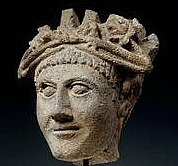 Baal
Baal
I sense a theme here. It seems that the ancients were pretty keen on using divine titles in place of proper names. But why?
The likely answer lies in the ancient belief that someone who knew a deity’s true name could invoke it to harness the power of that deity. This is why the true name of the Jewish god was never written out. It was only abbreviated in as YHWH. (This abbreviation is known as the tetragrammaton, which literally means “four-letter [word].”) Even today, Pagans and Christians aren’t that different. Pagans may invoke the names of Artemis or Thor in their rituals, while Christians seek to perform healings “in Jesus’ name.” From where I sit, it’s hard to see much of a distinction.
Another title often used as a name is “christ.” It’s pretty widely known that this wasn’t Jesus’ “last name.” It was, in fact, the Greek translation of a Hebrew word, messiah (or mashiah), which simply means “anointed one.” Not savior of the world, or incarnate god or anything so grandiose. In the ancient world, it most commonly referred to a king or a high priest, though it could also be used more generically to describe anyone anointed with olive oil to perform a specific task. When people refer to Jesus Christ, it’s actually inaccurate. What they should be saying is Jesus, the christ.
If all these terms are just titles, there’s no reason to capitalize them. AP itself is quite clear in stating that the first letter of a title should be lowercase when it (the title) stands alone. Hence, it’s “the pope” or “the president.” Formal titles, on the other hand, are capitalized before a name, as in President Obama and Pope Benedict. So a case might be made for capitalizing Christ Jesus, although one could also argue that the title “christ” was bestowed upon this particular person by his followers and was never formally recognized by any state in the ancient world. He was, after all, never crowned king.

But let’s get back to the term “god.” If it stands by itself, it’s obviously a title – a shortened form of “the god” – not a name. Using it as a name is, well, just plain silly. Imagine if we started calling the Christian god, “the dude in the sky” or “the guy with the long white beard who nukes people if they don’t follow his commandments.” Would we capitalize those references, too?
The easiest way around this whole issue is to refer to gods by their proper names whenever possible. We’re not superstitious enough to believe that using a divine name will cause all hell to break loose. This is the 21st century, after all. And we use names such as Zeus and Poseidon and Isis in the course of conversation without batting an eye. Call the Judeo-Christian god YHWH (it’s the closest thing we have to his name). Call Jesus … well … Jesus, not “christ.” Call all the gods from polytheistic traditions by their names, too. It’s only fair to them and, more importantly, to their followers. If we don’t know a god’s actual name, identify him with his followers – the god of the Muslims, the god of Israel or the Norse fertility goddess.
That’s the policy here at The Provocation, where we serve our news blunt and candid, and in no way aspire to objectivity. Still, if we happen to adopt a policy that puts us a little closer to that phantom condition than the people who have made it their stock in trade, we won’t complain. It’s just another feather in our cap.
May the gods bless you. All of them.
Reprinted with permission from The Provocation. Check out Steve’s other great posts!
Previous Post

August 3, 2011
Wyrd Designs – Sacred Pagan Sites in Berlin – Hel’s Pond
Next Post
August 4, 2011 Pre-Smurf Humor
Browse Our Archives
Select a Category alexandrian asatru astrology ATW Audio books btw ceremonial magick chaos classics community conversion cosmology dianic discordian druid dvd eclectic equinox ethics family feri festivals film Fully Inclusive Events gardnerian gender issues glbt heathen hellenismos history humor initiation interfaith magick meditation Military movies music mysticism myth networking news Open Thread Pagan Pagan 101 Paganism passings polytheism Polytheistic Religion polytheology praxis Reading List religio romana review ritual sabbats santeria service solstice symbols tools values wicca witchcraft
Select a Month July 2016 May 2016 April 2016 March 2016 February 2016 January 2016 December 2015 September 2012 August 2012 July 2012 June 2012 May 2012 April 2012 March 2012 February 2012 January 2012 December 2011 November 2011 October 2011 September 2011 August 2011 July 2011 June 2011 May 2011 April 2011 March 2011 February 2011 January 2011 December 2010 November 2010 October 2010 September 2010 August 2010 July 2010 June 2010 May 2010 April 2010 March 2010
TAKE THE
Religious Wisdom Quiz
What animal tricked Eve into eating the forbidden fruit?
Select your answer to see how you score.
Serpent Bear Lion Eagle
Related posts from PANTHEON

Miasma Matters: Concerning Purity


A Generation of Converts: Back to a Life...

Wiccanate: Or You Think This Post Is About...
TRENDING AT PATHEOS Pagan

I was recently chatting with someone on Instagram. She asked me what...

While there are many people who share their results, the end of...

On July 23, I saw Christopher Nolan's The Odyssey which is Homer’s...

As I write this two big events have just finished up. One...

Restoring the Watershed of Divine Love
Perhaps cooperation is not something we manufacture through legislation, ideology, or moral...

Many UUs don’t pray because of bad experiences in a previous religion,...
view all Pagan blogs
Ad-Free & Subscriber Log-In Subscription Support
- About Us
- 2026 Calendar
- Videos
- Podcasts
- Library of World Religions
- Faith In Media Tracker
- Advertise With Us
- Write for Us
- Privacy Policy
- Terms of Service
- Do Not Sell My Data
- Contact Us
- Radiant Digital
- Manage Newsletter Subscriptions
- Unsubscribe From Notifications
- Sitemap
Copyright 2008-2026, Patheos. All rights reserved.
Subscription Support Ad-Free & Subscriber Log-In
Follow Patheos