
BuddhistCatholicContemplativeEvangelicalGeneral ChristianHinduJewishLatter-day SaintMuslimNew VisionsProgressive Christian
Beliefs
- Buddhist
- Catholic
- Contemplative
- Evangelical
- General Christian
- Hindu
- Jewish
- Latter-day Saint
- More Voices
- Muslim
- New Visions
- Pagan
- Progressive Christian
Topics
- Religion News
- Food and Religion
- Sports and Religion
- Religious Art
- Religious Music and Entertainment
- Religious Events
- History and Religion
- Style and Religion
- Politics and Religion
- Women in Religion
- Recreation Outdoors and Religion
- Business Finance and Religion
- Careers Workplace and Religion
- Education and Religion
- Family Parenting and Religion
- Health Fitness and Religion
- Home and Religion
- Relationships and Religion
- Technology and Religion
- Travel and Religion
Columnists
- Buddhist Columnists
- Business Finance and Religion Columnists
- Careers Workplace and Religion Columnists
- Catholic Columnists
- Contemplative Columnists
- Education and Religion Columnists
- Evangelists Columnists
- Family Parenting and Religion Columnists
- General Christian Columnists
- Health Fitness and Religion Columnists
- Hindu Columnists
- History and Religion Columnists
- Home and Religion Columnists
- Jewish Columnists
- More Voices Columnists
- Latter Day Columnists
- Muslim Columnists
- New Visions Columnists
- Nonreligious Columnists
- Pagan Columnists
- Politics and Religion Columnists
- Progressive Columnists
- Recreation Outdoors and Religion Columnists
- Relationships and Religion Columnists
- Religion News Columnists
- Religious Art Columnists
- Religious Events Columnists
- Religious Music and Entertainment Columnists
- Sports and Religion Columnists
- Style and Religion Columnists
- Technology and Religion Columnists
- Travel and Religion Columnists
- Women in Religion Columnists
Resource Library
- 2026 Calendar
- Library of World Religions
- The 100 Most Holy Places on Earth
- Patheos Answers
- Podcasts
- Videos
- Faith Leaders Database
- Anglican Episcopalian
- Bahai
- Baptist
- Buddhism
- Christianity
- Confucianism
- Eastern Orthodoxy
- Hinduism
- Holiness and Pentecostal
- ISKCON
- Islam
- Judaism
- Lutheran
- Methodist
- The Church of Jesus Christ of Latter-day Saints
- New Age
- Paganism
- Presbytarian and Reformed
- Protestantism
- Religion Behind the Scenes
- Roman Catholic
- Scientology
- Shia Islam
- Sikhism
- Sufism
- Sunni Islam
- Taoism
- Zen
- See all religions
Research Tools
 Ad-Free & Subscriber Log-In Subscription Support
Ad-Free & Subscriber Log-In Subscription Support
Follow Patheos 

- Trending:
- Forgiveness
- |
- Marriage
- |
- Consciousness
- |
- Death Penalty
- |
- Election
- |
- Halloween
 PANTHEON
- Home
- Pagan
- Guest Post: Drew Jacob on Lúnasa with “The Family”
Guest Post: Drew Jacob on Lúnasa with “The Family”
Last updated on: July 28, 2011 at 7:01 am by Guest Contributor
Guest Post: Drew Jacob on Lúnasa with “The Family” 2011-07-28T07:01:48-04:00 Guest Contributor
Patheos Explore the world's faith through different perspectives on religion and spirituality! Patheos has the views of the prevalent religions and spiritualities of the world.
What are your plans for this Lúnasa? Hold a ritual? Make offerings? I’d like to suggest a different perspective on the holiday, and some ways to celebrate it that many Pagans may not be familiar with.
For four years I’ve been a devotee of Lugh. I had felt a pull toward him for far longer, but also knew he’s a demanding deity with high expectations of his followers. I waited until I was ready.
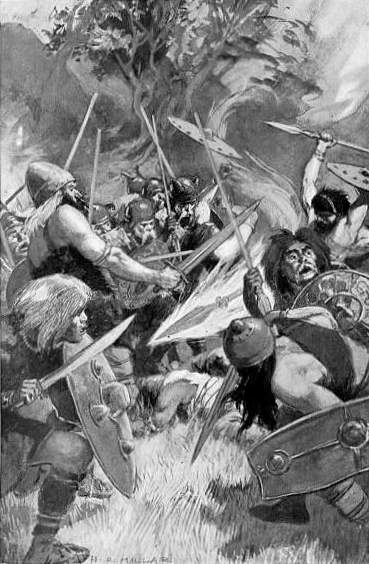
Lugh's magic spear by H.R.Millar
When I first apprenticed myself to Lugh, I made a one-year contract starting May Day, the traditional time to start contracts in Ireland. Based on the results of that year I dedicated myself to him for life, and he became my oide, my spiritual teacher. Makes sense, if you think about it.
During that first year of devotion I became close not only to Lugh, but to his extended family as well. (“Close” may be the wrong word, as they mostly paid me no mind, but I was in their presence during my devotion and got to know them.)
Lugh’s family is a remarkable group. His grandfather is the incontrovertible Dian Cécht, unfailing physician of the gods. Pagans often forget Dian Cécht nowadays and pray to Brighid for healing instead, but that’s a little like thanking the lights and electrical outlets at the hospital. Brighid is the fire of the life force, but Dian Cécht is the guy with the scalpel.
Lugh’s aunt, Airmed, is the lady of healing herbs, and ultimately the patron of pharmacists and herbalists. His father, Cían, is a shapeshifter with quite the epic exploits of his own; his mother, Eithnu, is a Fomhor (giant). Thus, the Heroic Deity is a product of a family of healers and magicians, spanning the two great races of Irish myth: giants and gods. Through his mother, he is descended from Balor of the Evil Eye and Nemhain, the goddess of terror.
Try getting into preschool with a record like that.
Perhaps the most awe-inspiring figures around Lugh however are his wife, Bua, the goddess of victory, who is incredibly kind; and Manannán mac Lir. Mac Lir in particular fascinates me because, as Lugh’s own oide, he is the only one who seems to treat the heroic god as a little boy. People are fond of calling mac Lir a sea god because of a few lines of poetry; but mac Lir is an aged old man and king in his own right, the god of crossing boundaries, a reserved and wizened deity with a wry sense of humor. He reminds me of one of those retired old men who know more than anybody in the room but let the younger guys fight over who’s right.
With a family like this, Lúnasa is a Really Big Deal. But why? What is this holiday about, besides harvest time and party time?
Lúnasa was originally dedicated to the goddess Tailtiu, Lugh’s muime or foster-mother. There’s precious little known about Tailtiu except this:
Tailltiu… queen of the Fir Bolg, came after the slaughter was inflicted upon the Fir Bolg in that first battle of Mag Tuired to Coill Cuan [Forest of the Bend]: and the wood was cut down by her, so it was a plain under clover-flower before the end of a year… So Tailltiu died in Tailltiu, and her name clave thereto and her grave is from the Seat of Tailltiu north-eastward.
That’s worth reading carefully. When you consider that Coill Cuan is the same place called Telltown (aka Tailtiu), and that the goddess Tailtiu is actually the land spirit of that place, this story takes on an added dimension. The area around Telltown was one of many tracts of land that was completely deforested in the Bronze Age to make way for agriculture. See where I’m going?
Tailtiu cut down her forest – her own body – so that other people could eat. And killed herself in the process.
That’s how you get your own holiday, people.
Add to this the fact that her holiday occurs at the beginning of the harvest, and that Lugh is connected to numerous myths involving a fight to save the fertility of the land, and you have a pretty strong case for what Lúnasa is really about: a land goddess gave her life to provide food.
So what’s the best way to celebrate Lúnasa? Well, it’s a funeral and all, so you should do what the Irish always do at a sad occasion: party like crazy.
Most Pagans mark their holidays with rituals, but the majority of traditional Lúnasa festivities are pretty secular. In a way, Lúnasa is the most widely celebrated Gaelic polytheist holiday on earth, since every state and county fair is a reflex of the same fairs held in honor of Lugh and Tailtiu. Anyone who likes races, sports, music, drinking, eating or partying with friends can enjoy Lúnasa.
On a deeper level, it’s like the Olympics: 96% of people are there just for a good time, but for some of the athletes and competitors it’s an experience of spiritual exhilaration. Contests of music and poetry are as common traditionally as contests of strength and speed, and there is something special about participating. Lugh and his family are gods of skill, and the act of participating in one of these contests of skill is itself a votive act. Even people who aren’t normally athletic might join in the noble competition because it is a holiday tradition.
Traditional sports, aside from a lengthy overland race, once included racing horses through water – either along the beach or across a lake. Riders were at a high risk of drowning in these races, but the risk was part of the exhilaration. Shows of fearlessness, as well as strength and skill, were part of the festivities.
There are many other ways to celebrate. At our last Lúnasa celebration we had duels with foam swords and a giant water balloon fight. Other activities have included races and a “three legged chase.” The idea is simple: three-legged race teams with foam swords run after a fomhor, a one-legged giant, hopping on one foot to get away from them. When a team tackles the fomhor to the ground the chase is over, and that team is the winner. I also love to read Cath Maighe Tuiredh around this time, which shows just about every member of the family in action at one point or another.
These are just a few of the memorable moments from my own Lúnasa celebrations, but my hope is that more people will get outside, get active, and get moving this holiday. Any kind of outdoor festivities can be a great way to celebrate Lúnasa, and if you can add some fun games and sports to your holiday plans you’ll be carrying on a fine tradition. This is honoring Lugh and family the way they likes to be honored: with skill and competition.
Previous Post

July 27, 2011
Keep Your Occult Knowledge To Yourself, Please
Next Post
July 29, 2011 13 Songs for Lammas/Lughnasadh!
Browse Our Archives
Select a Category alexandrian asatru astrology ATW Audio books btw ceremonial magick chaos classics community conversion cosmology dianic discordian druid dvd eclectic equinox ethics family feri festivals film Fully Inclusive Events gardnerian gender issues glbt heathen hellenismos history humor initiation interfaith magick meditation Military movies music mysticism myth networking news Open Thread Pagan Pagan 101 Paganism passings polytheism Polytheistic Religion polytheology praxis Reading List religio romana review ritual sabbats santeria service solstice symbols tools values wicca witchcraft
Select a Month July 2016 May 2016 April 2016 March 2016 February 2016 January 2016 December 2015 September 2012 August 2012 July 2012 June 2012 May 2012 April 2012 March 2012 February 2012 January 2012 December 2011 November 2011 October 2011 September 2011 August 2011 July 2011 June 2011 May 2011 April 2011 March 2011 February 2011 January 2011 December 2010 November 2010 October 2010 September 2010 August 2010 July 2010 June 2010 May 2010 April 2010 March 2010
TAKE THE
Religious Wisdom Quiz
What prophet, along with Zechariah, encouraged the rebuilding of the Temple?
Select your answer to see how you score.
Obadiah Elijah Malachi Haggai
Related posts from PANTHEON

Miasma Matters: Concerning Purity


A Generation of Converts: Back to a Life...

Wiccanate: Or You Think This Post Is About...
TRENDING AT PATHEOS Pagan

When we talk about Greek religion, we often begin with the dodekatheion—the...

I was recently chatting with someone on Instagram. She asked me what...

While there are many people who share their results, the end of...

On July 23, I saw Christopher Nolan's The Odyssey which is Homer’s...

As I write this two big events have just finished up. One...

Restoring the Watershed of Divine Love
Perhaps cooperation is not something we manufacture through legislation, ideology, or moral...
view all Pagan blogs
Ad-Free & Subscriber Log-In Subscription Support
- About Us
- 2026 Calendar
- Videos
- Podcasts
- Library of World Religions
- Faith In Media Tracker
- Advertise With Us
- Write for Us
- Privacy Policy
- Terms of Service
- Do Not Sell My Data
- Contact Us
- Radiant Digital
- Manage Newsletter Subscriptions
- Unsubscribe From Notifications
- Sitemap
Copyright 2008-2026, Patheos. All rights reserved.
Subscription Support Ad-Free & Subscriber Log-In
Follow Patheos