
BuddhistCatholicContemplativeEvangelicalGeneral ChristianHinduJewishLatter-day SaintMuslimNew VisionsProgressive Christian
Beliefs
- Buddhist
- Catholic
- Contemplative
- Evangelical
- General Christian
- Hindu
- Jewish
- Latter-day Saint
- More Voices
- Muslim
- New Visions
- Pagan
- Progressive Christian
Topics
- Religion News
- Food and Religion
- Sports and Religion
- Religious Art
- Religious Music and Entertainment
- Religious Events
- History and Religion
- Style and Religion
- Politics and Religion
- Women in Religion
- Recreation Outdoors and Religion
- Business Finance and Religion
- Careers Workplace and Religion
- Education and Religion
- Family Parenting and Religion
- Health Fitness and Religion
- Home and Religion
- Relationships and Religion
- Technology and Religion
- Travel and Religion
Columnists
- Buddhist Columnists
- Business Finance and Religion Columnists
- Careers Workplace and Religion Columnists
- Catholic Columnists
- Contemplative Columnists
- Education and Religion Columnists
- Evangelists Columnists
- Family Parenting and Religion Columnists
- General Christian Columnists
- Health Fitness and Religion Columnists
- Hindu Columnists
- History and Religion Columnists
- Home and Religion Columnists
- Jewish Columnists
- More Voices Columnists
- Latter Day Columnists
- Muslim Columnists
- New Visions Columnists
- Nonreligious Columnists
- Pagan Columnists
- Politics and Religion Columnists
- Progressive Columnists
- Recreation Outdoors and Religion Columnists
- Relationships and Religion Columnists
- Religion News Columnists
- Religious Art Columnists
- Religious Events Columnists
- Religious Music and Entertainment Columnists
- Sports and Religion Columnists
- Style and Religion Columnists
- Technology and Religion Columnists
- Travel and Religion Columnists
- Women in Religion Columnists
Resource Library
- 2026 Calendar
- Library of World Religions
- The 100 Most Holy Places on Earth
- Patheos Answers
- Podcasts
- Videos
- Faith Leaders Database
- Anglican Episcopalian
- Bahai
- Baptist
- Buddhism
- Christianity
- Confucianism
- Eastern Orthodoxy
- Hinduism
- Holiness and Pentecostal
- ISKCON
- Islam
- Judaism
- Lutheran
- Methodist
- The Church of Jesus Christ of Latter-day Saints
- New Age
- Paganism
- Presbytarian and Reformed
- Protestantism
- Religion Behind the Scenes
- Roman Catholic
- Scientology
- Shia Islam
- Sikhism
- Sufism
- Sunni Islam
- Taoism
- Zen
- See all religions
Research Tools
 Ad-Free & Subscriber Log-In Subscription Support
Ad-Free & Subscriber Log-In Subscription Support
Follow Patheos 

- Trending:
- Forgiveness
- |
- Marriage
- |
- Consciousness
- |
- Death Penalty
- |
- Election
- |
- Halloween
 PANTHEON
- Home
- Pagan
- Wyrd Designs – The Walking Undead
Wyrd Designs – The Walking Undead
Last updated on: October 28, 2010 at 7:37 am by wyrddesigns
Wyrd Designs – The Walking Undead 2010-10-28T07:37:52-04:00 wyrddesigns
Patheos Explore the world's faith through different perspectives on religion and spirituality! Patheos has the views of the prevalent religions and spiritualities of the world.
The crisp cool air of autumn is in the air, and with Halloween around the corner the airwaves are full of stories about vampires, werewolves, demons, ghosts and zombies (and oh how I have been waiting for AMC’s Walking Dead series). Of course the cultures that comprise the Northern Tradition were certainly known for their own stories. Even quintessential American literary classics like Washington Irving’s The Legend of Sleepy Hollow have their roots in Germanic folktales and beliefs. There is something about that tale in particular which seems to derive from an aspect of the Wild Hunt afterall, which is said to roam in some areas from the time of Winter Nights (which is upon us) to Yule.
There are numerous accounts in the Eddas and Sagas that talk about the undead, and attacks by them which intensify as the days shorten and the nights lengthen. In fact while there were afterlife beliefs, there was also a belief that the dead corpse was empowered and given a pseudo-life within the grave. These grave mound-dwellers were known as haugbui, their rein of influence was usually limited to their barrow and they’d only attack those who trespassed. The undead you really had to worry about were the undead who could roam far away from their grave-mounds: the draugr or aptrgangr. While they smelled of decay, could spread pestilence, and had the color of death about them, their bodies often times were described as not being corrupted with decay. In death their bodies had swollen (not with gas or bloating, which is a natural process of decay) but rather with new girth and dense mass that they would use to crush their victims to death.They were also characterized as having super-human strength, ferocious teeth and fierce claws. In some accounts they also possess other powers (aka trollskap) such as: the ability to swim through earth and solid stone, precognition, weather-magic, darkness-calling, and shape-shifting (animals, trolls, etc.).
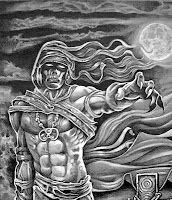
Draugr may roam on the land, or in the sea. Considering the sea-faring nature of the Norse and the staple food that fishing providing for these ancient peoples, there is no wonder that there are also stories about the undead in the water who originated from the mariners who died at sea. Ghost ships fall into this category as well with a particular folk tradition of a draugr in oilskins sailing in a half submerged shipped.
In my personal opinion, stories about vampires and werewolves, shifting from animal to human states has partial roots at least in this ancient culture’s beliefs both with the berserkergang (wolf/bear skin cultuses) as well as with the shapeshifting descriptions of the dead. It would not surprise me that the origin of the vampires keeping native soil in their coffins, derives in part from the traditions of grave-mound dwellers. In modern-day Norway, the term they use for vampire trnalsates to bloodsucking draugr.
We know in Anglo-Saxon England, that when someone inherited land they had to identify the burial mounds and name the inhabitants of them in order to inherit. This no doubt was to help reinforce the need to deal appropriately with the dead, including one’s ancestors, by showing them their due respect. Properly honoring the dead no doubt helped to curtail any unfavorable activity from the undead. If you gave them proper offerings, and were careful not to offend them or violate their graves then you had little to fear. But for those who would grave rob you might meet not only the discontented haugbui but also the dead’s mother, called a ketta which was described as a fierce she-cat. There are a few academic articles, which analyze the Beowulf monster by connecting it to the ketta tradition.
Just as archaeologists have discovered that some persons were buried with bricks in their mouths for fear that they were vampires in other cultures, there are unique burial folk traditions among the Scandinavians that were used to keep the dead from walking. Unfortunately many of these examples come after the conversion to Christianity. So we’re not sure how old some of the customs are, or what their pre-Christian counterpart may have been. Some of these folk traditions included burying an open pair of iron scissors laid across their chest, placing an arrangement of straw or twigs under their shroud, using needles to pin their feet in place, big toes were tied together, and the dead would be carried to their grave in a way to disorient and confuse them, with people walking around the corpse to hide their view.
If you did find yourself with a roaming undead harassing you, you needed to find someone who was courageous to wrestle the undead back to its grave. While iron may slow it down and injure it, it could not ultimately kill it. When simply returning the dead to their grave would not suffice, the warrior would have to decapitate the body, burn it, and then scatter its ashes in the water so it could not re-assemble itself to return.
So what do we take away from this? That the dead should be treated with a wary respect, for they have the ability whether out of being wronged, or through perhaps jealousy to strike out. When they are disrespected and trifled with the consequences can be most serious indeed.
Some of the stories in lore that talk about the undead:
- Laxdaela Saga
- Eyrbyggja Saga
- Grettirs Saga
- Egils Saga
- Saxo Grammaticus
Previous Post

October 27, 2010
The Silly Season: Witches, Politics or Both?
Next Post
October 29, 2010 The Love of Community
Browse Our Archives
Select a Category alexandrian asatru astrology ATW Audio books btw ceremonial magick chaos classics community conversion cosmology dianic discordian druid dvd eclectic equinox ethics family feri festivals film Fully Inclusive Events gardnerian gender issues glbt heathen hellenismos history humor initiation interfaith magick meditation Military movies music mysticism myth networking news Open Thread Pagan Pagan 101 Paganism passings polytheism Polytheistic Religion polytheology praxis Reading List religio romana review ritual sabbats santeria service solstice symbols tools values wicca witchcraft
Select a Month July 2016 May 2016 April 2016 March 2016 February 2016 January 2016 December 2015 September 2012 August 2012 July 2012 June 2012 May 2012 April 2012 March 2012 February 2012 January 2012 December 2011 November 2011 October 2011 September 2011 August 2011 July 2011 June 2011 May 2011 April 2011 March 2011 February 2011 January 2011 December 2010 November 2010 October 2010 September 2010 August 2010 July 2010 June 2010 May 2010 April 2010 March 2010
TAKE THE
Religious Wisdom Quiz
Who first witnessed the empty tomb after Jesus' resurrection?
Select your answer to see how you score.
John Nicodemus Mary Magdalene Andrew
Related posts from PANTHEON

New Ancestors: Saying Goodbye, Saying Hello

Archiving Our History Before We Lose It

Guest Post: Steven Abell's "The Toad Prince &...

Aurora, Grey's Anatomy and Senseless Death
TRENDING AT PATHEOS Pagan

I was recently chatting with someone on Instagram. She asked me what...

While there are many people who share their results, the end of...

On July 23, I saw Christopher Nolan's The Odyssey which is Homer’s...

As I write this two big events have just finished up. One...

Restoring the Watershed of Divine Love
Perhaps cooperation is not something we manufacture through legislation, ideology, or moral...

Many UUs don’t pray because of bad experiences in a previous religion,...
view all Pagan blogs
Ad-Free & Subscriber Log-In Subscription Support
- About Us
- 2026 Calendar
- Videos
- Podcasts
- Library of World Religions
- Faith In Media Tracker
- Advertise With Us
- Write for Us
- Privacy Policy
- Terms of Service
- Do Not Sell My Data
- Contact Us
- Radiant Digital
- Manage Newsletter Subscriptions
- Unsubscribe From Notifications
- Sitemap
Copyright 2008-2026, Patheos. All rights reserved.
Subscription Support Ad-Free & Subscriber Log-In
Follow Patheos