
BuddhistCatholicContemplativeEvangelicalGeneral ChristianHinduJewishLatter-day SaintMuslimNew VisionsProgressive Christian
Beliefs
- Buddhist
- Catholic
- Contemplative
- Evangelical
- General Christian
- Hindu
- Jewish
- Latter-day Saint
- More Voices
- Muslim
- New Visions
- Pagan
- Progressive Christian
Topics
- Religion News
- Food and Religion
- Sports and Religion
- Religious Art
- Religious Music and Entertainment
- Religious Events
- History and Religion
- Style and Religion
- Politics and Religion
- Women in Religion
- Recreation Outdoors and Religion
- Business Finance and Religion
- Careers Workplace and Religion
- Education and Religion
- Family Parenting and Religion
- Health Fitness and Religion
- Home and Religion
- Relationships and Religion
- Technology and Religion
- Travel and Religion
Columnists
- Buddhist Columnists
- Business Finance and Religion Columnists
- Careers Workplace and Religion Columnists
- Catholic Columnists
- Contemplative Columnists
- Education and Religion Columnists
- Evangelists Columnists
- Family Parenting and Religion Columnists
- General Christian Columnists
- Health Fitness and Religion Columnists
- Hindu Columnists
- History and Religion Columnists
- Home and Religion Columnists
- Jewish Columnists
- More Voices Columnists
- Latter Day Columnists
- Muslim Columnists
- New Visions Columnists
- Nonreligious Columnists
- Pagan Columnists
- Politics and Religion Columnists
- Progressive Columnists
- Recreation Outdoors and Religion Columnists
- Relationships and Religion Columnists
- Religion News Columnists
- Religious Art Columnists
- Religious Events Columnists
- Religious Music and Entertainment Columnists
- Sports and Religion Columnists
- Style and Religion Columnists
- Technology and Religion Columnists
- Travel and Religion Columnists
- Women in Religion Columnists
Resource Library
- 2026 Calendar
- Library of World Religions
- The 100 Most Holy Places on Earth
- Patheos Answers
- Podcasts
- Videos
- Faith Leaders Database
- Anglican Episcopalian
- Bahai
- Baptist
- Buddhism
- Christianity
- Confucianism
- Eastern Orthodoxy
- Hinduism
- Holiness and Pentecostal
- ISKCON
- Islam
- Judaism
- Lutheran
- Methodist
- The Church of Jesus Christ of Latter-day Saints
- New Age
- Paganism
- Presbytarian and Reformed
- Protestantism
- Religion Behind the Scenes
- Roman Catholic
- Scientology
- Shia Islam
- Sikhism
- Sufism
- Sunni Islam
- Taoism
- Zen
- See all religions
Research Tools
 Ad-Free & Subscriber Log-In Subscription Support
Ad-Free & Subscriber Log-In Subscription Support
Follow Patheos 

- Trending:
- Forgiveness
- |
- Marriage
- |
- Consciousness
- |
- Death Penalty
- |
- Election
- |
- Halloween

- HOME
- Me and the Blog
- Defining Pagan
- Rituals & Holidays
- All Posts
- Blogroll
- Publications
- FREE NEWSLETTER
- Home
- Pagan
- Celebrating Yule: Light in the Darkness
Celebrating Yule: Light in the Darkness
Last updated on: December 9, 2019 at 1:41 pm by Jason Mankey
Celebrating Yule: Light in the Darkness 2019-12-09T13:41:41-07:00 Jason Mankey
Patheos Explore the world's faith through different perspectives on religion and spirituality! Patheos has the views of the prevalent religions and spiritualities of the world.
The Winter Solstice is the shortest day and longest night of every year. The date of the Winter Solstice is variable and can occur anywhere from December 20 to December 23. After the Winter Solstice the amount of sunlight we receive will gradually lengthen until starting to decline again six months later at the Summer Solstice. The Winter Solstice has been celebrated for thousands of years and many of the traditions associated with it have become part of Christian and secular Christmas and New Year’s (January 1) celebrations.
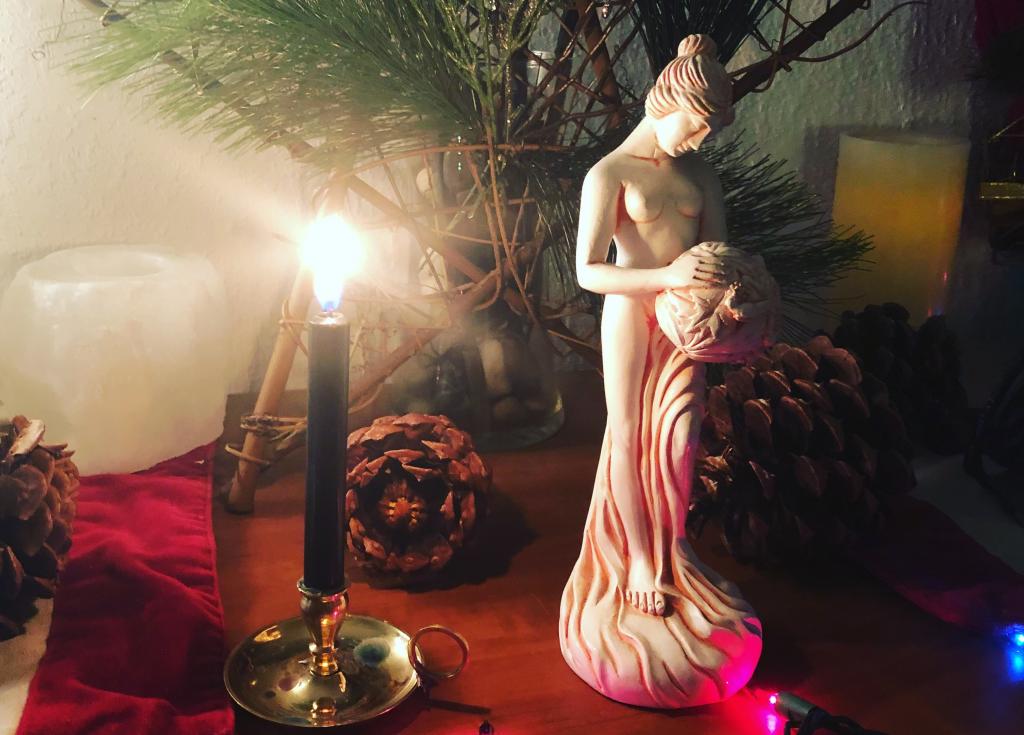
Most Witches refer to the Winter Solstice today as Yule, which is an apt name. Yule was a legitimate Norse holiday commemorating the Winter Solstice and later used as an alternative name for Christmas. The Winter Solstice is also sometimes called Midwinter; if Samhain marks the start of Winter, and Imbolc its end, then the Winter Solstice is the middle point. The majority of us today often use these terms interchangeably. Because many holidays have been celebrated in late December over the millennia, I often refer to this period as “Yuletide.” New Year’s Eve, Christmas, and our own Yule can all be traced back to Pagan antiquity with some certainty.
For Modern Witches, Yule is generally seen as the “rebirth of the sun” and a lot of our rituals are built around this idea. Sometimes “the sun” is personified as a deity that is reborn on the solstice, and others mark the occasion by lighting candles on the longest night of the year. Because of that long night the Winter Solstice can be a rather melancholy sabbat if one chooses to approach it that way (it is generally dark and cold that night), but many Yule celebrations are joyous. This is because many of the ancient festivals celebrated near the Winter Solstice were rather fun and drunken affairs.
The most influential of those ancient holidays was the Roman Saturnalia, celebrated over a period of three to five days beginning on December 17. (1) The Saturnalia was generally a celebration of abundance, and included feasting and often heavy drinking. The Greek writer Lucian wrote of the holiday: “Let every man be treated equal, slave and freeman, poor and rich.” (2)
One of the longest lasting traditions associated with Saturnalia, was that of the Mock King. Mock Kings ruled over individual Saturnalia celebrations, generally encouraging frivolity and issuing absurd proclamations. Though we don’t hear or read about Mock Kings very often today, the practice carried on for centuries. In the Middle Ages Mock Kings became “Lords of Misrule” and presided over winter celebrations in manor houses throughout Europe. (If you think the Holiday Season is long today, the medieval one lasted from about Samhain all the way to Imbolc!) (3)
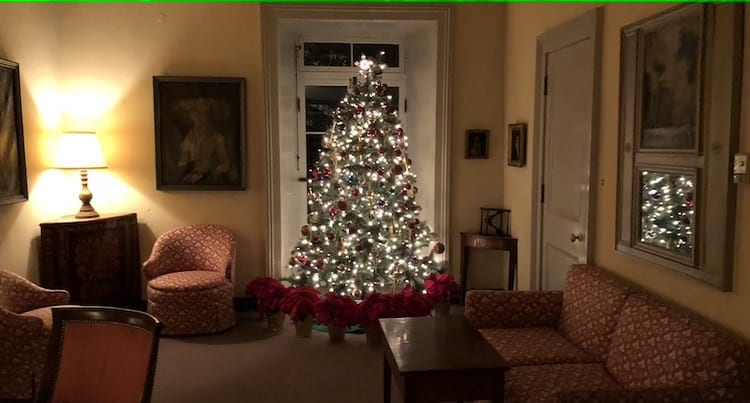
Though Kings of Misrule gradually disappeared from most holiday celebrations, what they represented during Yule persisted. Drinking and upsetting social norms became a part of the wassailing tradition. Though often associated today with something akin to Christmas caroling wassailing was originally a holiday custom focused on food, drink, and sometimes petty vandalism. The poor would visit the homes of the rich and demand food and drink. In exchange for the food and drink they would often sing, perform plays, and toast to the good health of their host. When wassailers were denied food and beverage they often retaliated with pranks and violence. (Wassailing is still with us today too; we call it “trick or treat”.) Some historians have argued that Wassailing served as a kind social safety valve, allowing the less powerful to gain the upper-hand over the nobility and/or their employers, at least for a few days. (4)
In addition to Saturnalia the Norse Yule had a tremendous impact on our modern celebration of the holiday (and on the Christian Christmas). Though we don’t know a whole lot about how the Norse celebrated Yule it too seemed to feature feasting and excessive drinking. Animal sacrifice (and the accompanying meat dinner that resulted from it) was also a part of the holiday, holiday, along with some sort of ancestor veneration. (5) Fires and candles were also a part of the holiday and the custom that would eventually come to be known as the “Yule Log” also came from the Norse Yule. (6)
Ways to Celebrate Yule
Yule might be my favorite sabbat to celebrate because there are so many different ideas and traditions that can be incorporated into its rituals. Nearly anything associated with Christmas is fair game for Yule rituals. Trees, stockings, mistletoe, even snow-people if you live in the right sort of climate for it. When my non-magickal friends visit Ari and I’s house in December most of them comment on just how “Christmasy” it looks. Little do they know that nearly every decoration in our living room has connections to our Witchcraft.
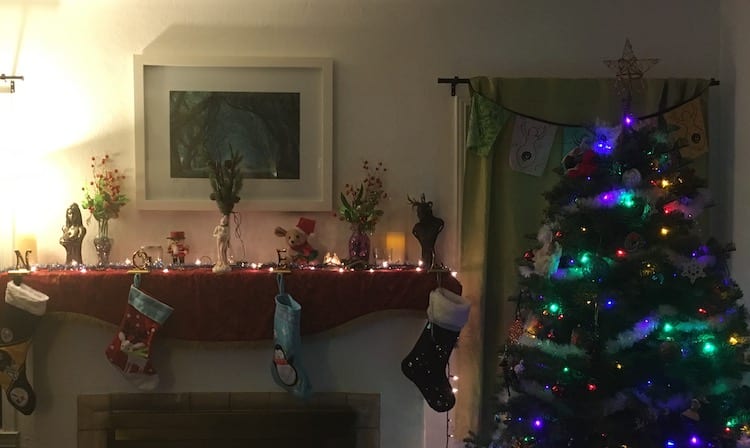
Of course that’s my Steeler stocking hung by the chimney with care.
Though Santa Claus doesn’t visit every coven, he’s long a been a guest deity at my Yuletide rites. Despite being known in some circles as Saint Nicholas, Santa Claus has a mixed background and owes just as much to the Norse god Odin (or Woden) as he does to the Christian Saint with whom he shares a name. In addition to Santa Claus, Yuletide is full of several other figures with likely pre-Christian origins. Some of these include the Tomte, the Yule Goat, the Yule Lads (or Goblins), the Krampus, and of course the elves that work for Santa at the North Pole. My wife isn’t a big fan, but I love working the Krampus into our December rituals! One of my other favorite other gift givers is probably post-Christian, the Italian La Befana, but since she’s an Italian Witch she’s worth mentioning here (she also shows up in one of the Yule rituals in this book).
Giving has been a part of Midwinter celebrations since the Roman Saturnalia and is a welcome ritual activity amongst many Modern Witches. Presents can be distributed by someone playing the role of Woden, or through a “secret Santa” gift exchange. Gathering toys and food for those in need is a magickal activity too! Often this is far more satisfying than giving a friend an unneeded trinket.
As a sabbat celebrating the rebirth of the sun, Yule has long been associated with light. It’s a time for lighting candles to fight the darkness, and for celebrating the rebirth of the sun god. Many Witches celebrate the birth of several different solar deities on or near the solstice, and this is a great idea to build a ritual around. Even the little baby Jesus taps into this theme. Because of the limited light we receive at the start of the Winter, many Witches hold solstice vigils on the night of Yule, and stay up all night to greet the returning sun.
The story of the Oak and Holly Kings is a great way to illustrate the “growing” half of the year that begins at Yule. In many Midwinter interpretations of this myth the Holly King often looks much like Santa Claus or Father Christmas, making him the “older brother” who is slain on the Winter Solstice. The Oak and Holly Kings are not the only royalty to show up at Yule, Queens and Kings of Misrule are generally welcome guests at Midwinter sabbats.
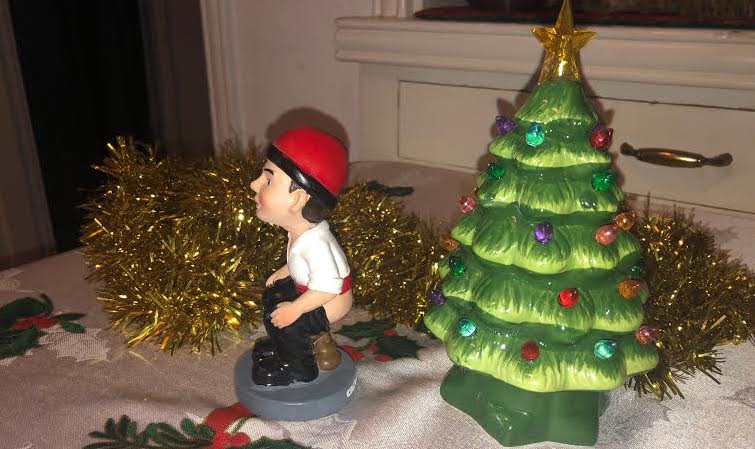
For thousands of years now Midwinter celebrations have been celebratory. We see this to some degree in our modern world with New Year’s Eve and office Christmas Parties, but it was a part of the Norse Yule and Roman Saturnalia too. Toasting to the good health of those around you, playing games, and simply having fun are appropriate ways to celebrate Yule.
For many people Winter is a season that’s approached with dread, but it doesn’t have to be that way. Winter is when the world is renewed through snow and rain, and the cold weather kills all the bugs that drive most of us crazy. Instead of actively fighting against it, Winter is something that should be embraced. Bring some snow inside for your rituals, or simply enjoy a cup of hot chocolate or some mulled wine. We should be thankful of the natural world no matter where we are on the Wheel of the Year.
Lights, snow, gifts, battling brothers, wassail, carols, partying, Lords of Misrule, mystical gift- givers, the longer days, trees, logs, the sun’s rebirth . . .. . Yule probably has the longest and most varied list of things in which to build rituals around. For this reason, it’s become a favorite of many Modern Witches. There’s something especially satisfying about celebrating a holiday that everyone around you seems to be celebrating too (and many of them are, even if they don’t know it!).
For more on the sabbats and lots of rituals pick up THE WITCH’S WHEEL OF THE YEAR: RITUALS FOR CIRCLES, SOLITARIES, & COVENS
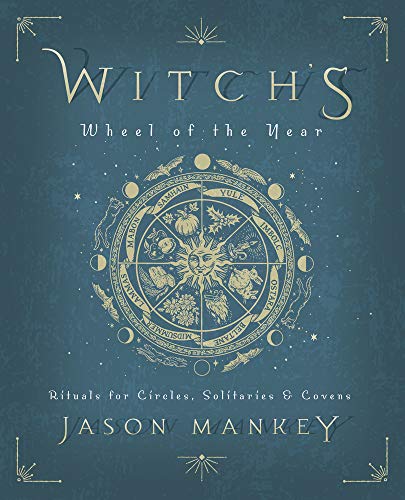
The Witch’s Wheel of the Year: Rituals for Covens, Circles, and Solitaries ©2019 Jason Mankey and published by Llewellyn Worldwide.
NOTES
1. Forbes, Bruce David, Christmas: A Candid History, University of California Press, 2007, page 8.
2. Forbes, also page 8. This is a terrific book.
3. Gerry Bowler, The Encyclopedia of Christmas, McClelland & Stewart Publishers, 2000, page 134.
4. Nissenbaum, Stephen, The Battle for Christmas, Vintage Books (Random House), 1996, page 11.
5. Forbes, Christmas: A Candid History, pages 11-12.
6. Ibid, pages 12-13.
Previous Post
December 6, 2019
Paganism & Witchcraft in the 2010's
Next Post
December 17, 2019 The Magick of the Yule Log
Browse Our Archives
Select a Category Editorializing Gateways to Paganism Guest Posts Holiday Histories Led Zeppelin News and Views Occult Pagan Pagan TV Club Paganism polytheism Ramble On Reviews Ritual Strange Days Uncategorized
Select a Month August 2026 March 2026 February 2026 November 2025 September 2025 August 2025 April 2025 August 2024 April 2024 February 2024 December 2023 October 2023 August 2023 June 2023 May 2023 January 2023 October 2022 August 2022 July 2022 June 2022 May 2022 April 2022 March 2022 February 2022 January 2022 December 2021 November 2021 October 2021 September 2021 August 2021 July 2021 June 2021 April 2021 March 2021 February 2021 January 2021 December 2020 November 2020 October 2020 August 2020 July 2020 June 2020 May 2020 April 2020 March 2020 February 2020 January 2020 December 2019 November 2019 October 2019 September 2019 August 2019 July 2019 June 2019 May 2019 April 2019 March 2019 February 2019 January 2019 December 2018 November 2018 October 2018 September 2018 August 2018 July 2018 June 2018 May 2018 April 2018 March 2018 February 2018 January 2018 December 2017 November 2017 October 2017 September 2017 August 2017 July 2017 June 2017 May 2017 April 2017 March 2017 February 2017 January 2017 December 2016 November 2016 October 2016 September 2016 August 2016 July 2016 June 2016 May 2016 April 2016 March 2016 February 2016 January 2016 December 2015 November 2015 October 2015 September 2015 August 2015 July 2015 June 2015 May 2015 April 2015 March 2015 February 2015 January 2015 December 2014 November 2014 October 2014 September 2014 August 2014 July 2014 June 2014 May 2014 April 2014 March 2014 February 2014 January 2014 December 2013 November 2013 October 2013 September 2013 August 2013 July 2013 June 2013 May 2013 April 2013 March 2013 February 2013 January 2013 December 2012 November 2012 October 2012 September 2012 August 2012 July 2012 June 2012 April 2012 October 2011 September 2011 August 2011
Follow Us!
TAKE THE
Religious Wisdom Quiz
On which day did God create animals?
Select your answer to see how you score.
On the first day On the fourth day On the sixth day On the third day
Related posts from Raise the Horns

What Makes a Good Ritualist? No Idea

Yule is Also a Time for the Dead

Witchcraft Remembrances & Appreciation at Samhaintide
TRENDING AT PATHEOS Pagan

Janie Learns the Way of the Cross: A...
Teaching children about Jesus' Passion can be challenging. Many parents and educators...

Looking For Good Catholic Writing - October 2026
He alone extends the heavens, and he walks upon the waves of...

In "Irreplaceable," our book on vocation and technology, Trevor Sutton and I...

I was strolling through the top floor of the brand new Parthenon...

What Does Gêvâh Mean For Kimberley Guifoyle &...
This week, a lot of the news is focused on Kimberly Guilfoyle....

INNER CIRCLE: Profound Mystery (Of Christ In All...
Ephesians 5:31-32 “For this reason, a man will leave his father and...
view all Pagan blogs
Ad-Free & Subscriber Log-In Subscription Support
- About Us
- 2026 Calendar
- Videos
- Podcasts
- Library of World Religions
- Faith In Media Tracker
- Advertise With Us
- Write for Us
- Privacy Policy
- Terms of Service
- Do Not Sell My Data
- Contact Us
- Radiant Digital
- Manage Newsletter Subscriptions
- Unsubscribe From Notifications
- Sitemap
Copyright 2008-2026, Patheos. All rights reserved.
Subscription Support Ad-Free & Subscriber Log-In
Follow Patheos