
BuddhistCatholicContemplativeEvangelicalGeneral ChristianHinduJewishLatter-day SaintMuslimNew VisionsProgressive Christian
Beliefs
- Buddhist
- Catholic
- Contemplative
- Evangelical
- General Christian
- Hindu
- Jewish
- Latter-day Saint
- More Voices
- Muslim
- New Visions
- Pagan
- Progressive Christian
Topics
- Religion News
- Food and Religion
- Sports and Religion
- Religious Art
- Religious Music and Entertainment
- Religious Events
- History and Religion
- Style and Religion
- Politics and Religion
- Women in Religion
- Recreation Outdoors and Religion
- Business Finance and Religion
- Careers Workplace and Religion
- Education and Religion
- Family Parenting and Religion
- Health Fitness and Religion
- Home and Religion
- Relationships and Religion
- Technology and Religion
- Travel and Religion
Columnists
- Buddhist Columnists
- Business Finance and Religion Columnists
- Careers Workplace and Religion Columnists
- Catholic Columnists
- Contemplative Columnists
- Education and Religion Columnists
- Evangelists Columnists
- Family Parenting and Religion Columnists
- General Christian Columnists
- Health Fitness and Religion Columnists
- Hindu Columnists
- History and Religion Columnists
- Home and Religion Columnists
- Jewish Columnists
- More Voices Columnists
- Latter Day Columnists
- Muslim Columnists
- New Visions Columnists
- Nonreligious Columnists
- Pagan Columnists
- Politics and Religion Columnists
- Progressive Columnists
- Recreation Outdoors and Religion Columnists
- Relationships and Religion Columnists
- Religion News Columnists
- Religious Art Columnists
- Religious Events Columnists
- Religious Music and Entertainment Columnists
- Sports and Religion Columnists
- Style and Religion Columnists
- Technology and Religion Columnists
- Travel and Religion Columnists
- Women in Religion Columnists
Resource Library
- 2026 Calendar
- Library of World Religions
- The 100 Most Holy Places on Earth
- Patheos Answers
- Podcasts
- Videos
- Faith Leaders Database
- Anglican Episcopalian
- Bahai
- Baptist
- Buddhism
- Christianity
- Confucianism
- Eastern Orthodoxy
- Hinduism
- Holiness and Pentecostal
- ISKCON
- Islam
- Judaism
- Lutheran
- Methodist
- The Church of Jesus Christ of Latter-day Saints
- New Age
- Paganism
- Presbytarian and Reformed
- Protestantism
- Religion Behind the Scenes
- Roman Catholic
- Scientology
- Shia Islam
- Sikhism
- Sufism
- Sunni Islam
- Taoism
- Zen
- See all religions
Research Tools
 Ad-Free & Subscriber Log-In Subscription Support
Ad-Free & Subscriber Log-In Subscription Support
Follow Patheos 

- Trending:
- Forgiveness
- |
- Marriage
- |
- Consciousness
- |
- Death Penalty
- |
- Election
- |
- Halloween

- HOME
- Me and the Blog
- Defining Pagan
- Rituals & Holidays
- All Posts
- Blogroll
- Publications
- FREE NEWSLETTER
- Home
- Pagan
- Paganism & Witchcraft Are Not Venn Diagrams
Paganism & Witchcraft Are Not Venn Diagrams
Last updated on: August 14, 2019 at 7:14 pm by Jason Mankey
Paganism & Witchcraft Are Not Venn Diagrams 2019-08-14T19:14:33-06:00 Jason Mankey
Patheos Explore the world's faith through different perspectives on religion and spirituality! Patheos has the views of the prevalent religions and spiritualities of the world.
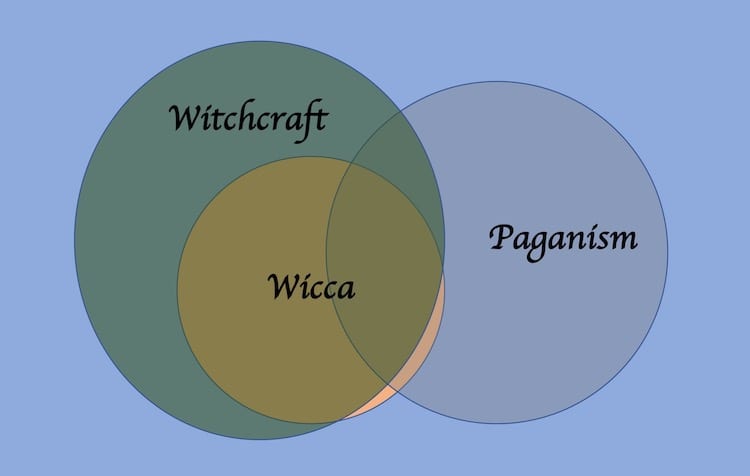
Every once in awhile a Venn Diagram from the excellent Witchy Words blog gets dusted off and passed around the internet. (And Witchy Words will be missed It shut down mostly in April of 2019.) I’m sure the original diagram was created with the best of intentions and those who pass it around do so in good faith, but I’ve always found its explanations far too limiting. I just don’t believe that terms and categories such as Paganism, Wicca, and Witchcraft are capable of being diagramed.
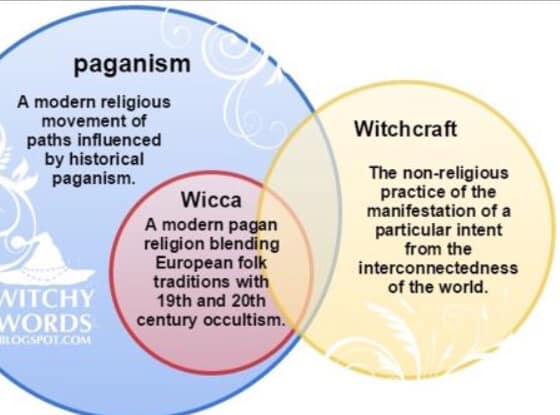
The original diagram I’m writing about.
If you aren’t sure exactly what a Venn Diagram is, Merriam Webster definition defines a Venn Diagram as: “a graph that employs closed curves and especially circles to represent logical relations between and operations on sets and the terms of propositions by the inclusion, exclusion, or intersection of the curves.” The problem with words such as Paganism, Wicca, and Witchcraft is that they aren’t logical. Most often they are emotional terms of self-identity, which is why treating them “logically” can be rather problematic and most often leads to arguments online (and blog posts like this one).
At this point in my life I’ve mostly given up on trying to define Paganism, Witchcraft, and Wicca because I’m not sure it can really be done without pissing someone off. What I tend to dislike most these days are attempts to limit those words, or divorce them from their historical and contemporary contexts. As someone who loves history and loves getting out and visiting the Magickal/Pagan Community, I see these words used in a variety of ways by a variety of different people.
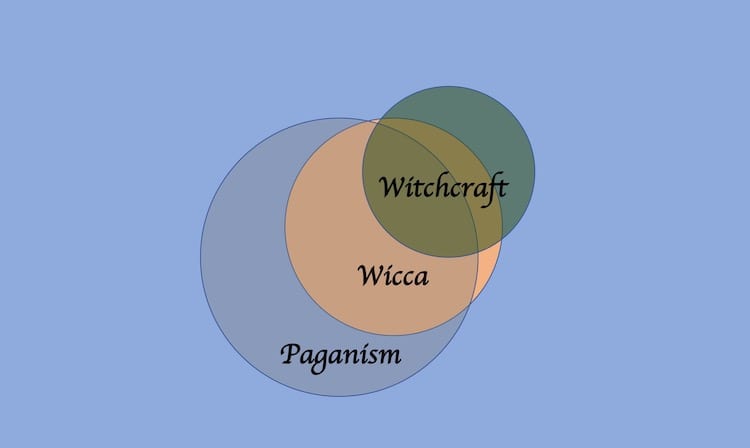
The Venn Diagram I’m writing is problematic right from the start with its definition of “paganism”: “A modern religious movement of paths influenced by historical paganism.” Most certainly everyone today who self-identifies as a Pagan is walking a rather modern path. Even those who do their best to reconstruct ancient pagan practices are still being influenced by our modern ideas, especially ideas about what is acceptable or not acceptable in our society.
But not all Modern Pagan practices are attempts at historical reconstruction. One of the most influential, the Church of All Worlds, was primarily influenced by the science fiction novel Stranger in a Strange Land.
The multifaceted nature of today’s Pagan Community means that people come to Paganism for a variety of reasons. Honestly, I think there are a lot of people who simply love the freedom that Paganism affords. They can worship whatever deity they want (and let’s not forget, there are a lot of deities people honor today that are not ancient), or no deity at all, and they can party and take lovers without any judgement (as long as everyone consents and there are responsible!), There are also a whole lot of self-identifying Pagans who actively bristle at anything to do with “religion,” a reaction that seems rather prevalent in our extended community these days.
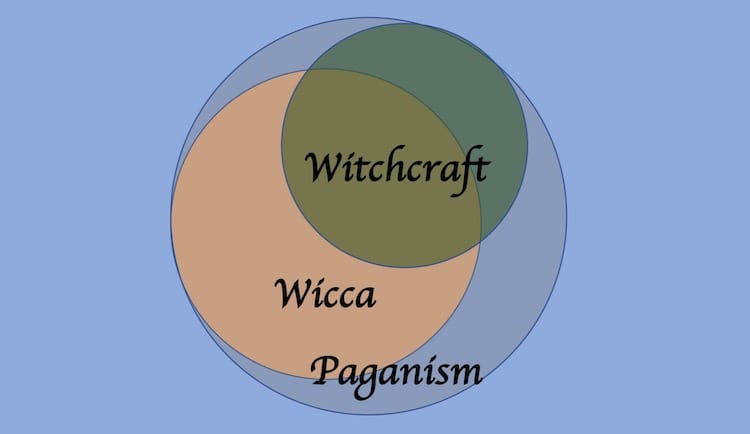
Most Pagans I know love the Earth, which has always felt like a more natural rallying cry to me for me when it comes to what “Paganism” is. Whether its celebrating the sabbats, hugging trees, or at least paying lip-service to the idea of responsible stewardship, this is something I see most Modern Pagans engaging in. Ultimately, I’m of the belief that if you call yourself a Pagan, you probably are a Pagan. That doesn’t apply in the reverse though, others are also what they identify as, and we don’t get to decide they are Pagan simply because it makes us sound more formidable when we add over a billion Hindus.
I know a lot of Wiccans today who actively bristle when nestled under the Pagan Umbrella, and there’s some truth to that. Wiccan-Witchcraft has origins in fraternal orders such as Freemasonry, and contains a very magickal word view. There are people out there who put the “birth of Modern Paganism” in 1967, which even by conservative standards, is at least fifteen years AFTER the first (what we today would call a) Wiccan-Witch went public. Keeping that in mind, it could be argued that Paganism was simply influenced by Wicca in its traditional form, and is seperate from it.
The rest of the definition in the Venn Diagram I’m writing about here is hard to quibble with “A modern pagan religion blending European folk traditions with 19th and 20th century occultism.” I’d go back even further though when it comes to that occultism. Texts from the grimoire tradition (starting in the late Middle Ages/early Modern Period) are foundational when it comes to a lot of Wiccan ritual and structure. Wicca may be modern, but it’s roots are deep.
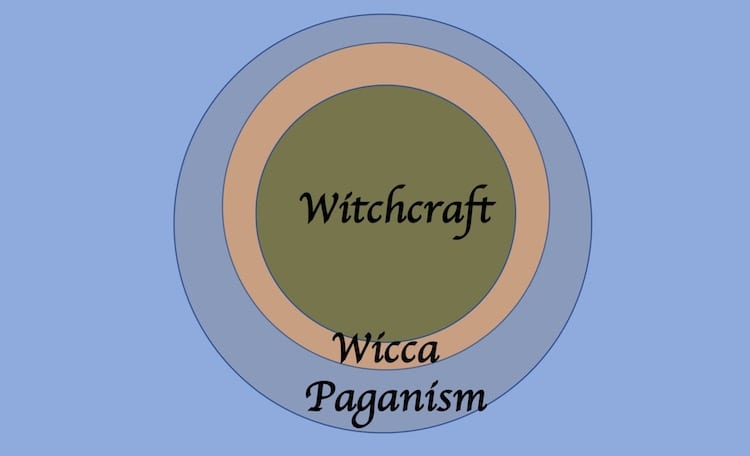
It’s become common to disassociate Witchcraft and Wicca these days, something done in this particular diagram, but it’s something I’ll always take exception to. The very word “Wicca” means Witch, and was originally pronounced with a “tch” sound instead of the hard “c” we use today. Wicca simply meant “male witch” like wicce met “female Witch.” How people who self-identify as Witches and whose practice has been traditionally known as Witchcraft only barely overlap with “Witchcraft” is a mystery to me. Wiccan-Witchcraft is not the only kind of Witchcraft, but it is a type of Witchcraft. (Not every Witch is a Wiccan, but at least according to history and the meaning of words, every Wiccan is a Witch.)
The most problematic definition on this particular diagram involves the word “Witchcraft” and that shouldn’t surprise anyone. Witch is a word with multiple meanings, and has been used in a variety of ways over the last 1200 years. I guess I shouldn’t be surprised that Witchcraft is defined here as: “The non-religious practice of the manifestation of a particular intent from the interconnectedness of the world.” Magick can most certainly be separated from a religious or spiritual viewpoint, and many Witches when practicing magick are trying to manifest their intent through natural energy, spirits of the dead, and various other means, but . . . .
One does not need to practice any sort of religion to practice Witchcraft, or believe in any sort of deities or higher powers. But traditionally most everything we call “Witchcraft” has utilized components that might be considered “religious” or “spiritual.” The innocents who were executed during the witch trials of the early Modern Period (1380-1780) were all believed to be a part of a network of religious witches overseen by the Devil.
It’s become popular to refer to folk magick practices as “witchcraft” these days, and most of those folks also utilized religious or spiritual ideas. Cunning-folks used Bible verses when crafting spells, along with religious symbols like crosses. The goddess Diana has been associated with Witchcraft for millenia, which is again another spiritual or religious belief. I also know lots of people who say that working with the spirits of the dead is a requirement in Witchcraft, and I’m not sure how that quite lines up with “interconnectedness of the world.”
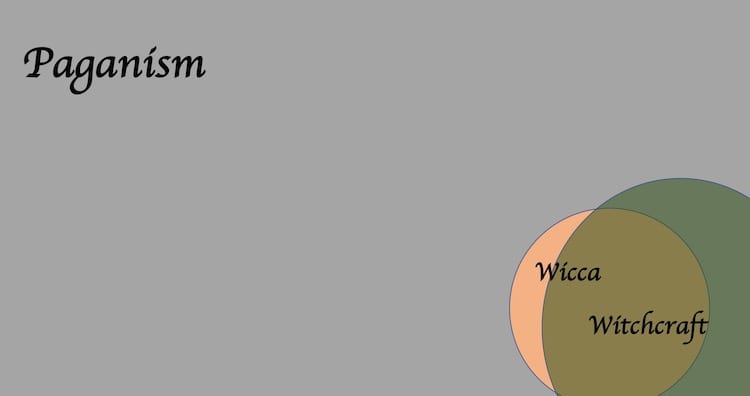
I think we’ve moved further away from most forms of magick (and by extension Witchcraft) needing a religious or spiritual component. And again, I’m not arguing that such things are necessary, but historically they have been a part of Witchcraft. To divorce Witchcraft of anything related to religion seems a bit limiting.
In the end Witchcraft, Wicca, and Paganism overlap (or don’t) where we as individuals need them to. For some of us they might be concentric circles, for others city-states all walled off from each other each other. As for me, I’m not a big believer in walls, and I celebrate my Paganism when I’m in the great outdoors, practice my Witchcraft when I need a little spellwork done, and gather in my Wiccan circle when the coven meets.
Previous Post

August 7, 2019
Generation X Pagan
Next Post
August 20, 2019 Secrets of a Pagan Blogger
Browse Our Archives
Select a Category Editorializing Gateways to Paganism Guest Posts Holiday Histories Led Zeppelin News and Views Occult Pagan Pagan TV Club Paganism polytheism Ramble On Reviews Ritual Strange Days Uncategorized
Select a Month August 2026 March 2026 February 2026 November 2025 September 2025 August 2025 April 2025 August 2024 April 2024 February 2024 December 2023 October 2023 August 2023 June 2023 May 2023 January 2023 October 2022 August 2022 July 2022 June 2022 May 2022 April 2022 March 2022 February 2022 January 2022 December 2021 November 2021 October 2021 September 2021 August 2021 July 2021 June 2021 April 2021 March 2021 February 2021 January 2021 December 2020 November 2020 October 2020 August 2020 July 2020 June 2020 May 2020 April 2020 March 2020 February 2020 January 2020 December 2019 November 2019 October 2019 September 2019 August 2019 July 2019 June 2019 May 2019 April 2019 March 2019 February 2019 January 2019 December 2018 November 2018 October 2018 September 2018 August 2018 July 2018 June 2018 May 2018 April 2018 March 2018 February 2018 January 2018 December 2017 November 2017 October 2017 September 2017 August 2017 July 2017 June 2017 May 2017 April 2017 March 2017 February 2017 January 2017 December 2016 November 2016 October 2016 September 2016 August 2016 July 2016 June 2016 May 2016 April 2016 March 2016 February 2016 January 2016 December 2015 November 2015 October 2015 September 2015 August 2015 July 2015 June 2015 May 2015 April 2015 March 2015 February 2015 January 2015 December 2014 November 2014 October 2014 September 2014 August 2014 July 2014 June 2014 May 2014 April 2014 March 2014 February 2014 January 2014 December 2013 November 2013 October 2013 September 2013 August 2013 July 2013 June 2013 May 2013 April 2013 March 2013 February 2013 January 2013 December 2012 November 2012 October 2012 September 2012 August 2012 July 2012 June 2012 April 2012 October 2011 September 2011 August 2011
Follow Us!
TAKE THE
Religious Wisdom Quiz
What does Paul say in 1 Thessalonians about the day of the Lord?
Select your answer to see how you score.
It will come like a thief in the night It will come when peace is declared It will come with great signs It will come after the tribulation
Related posts from Raise the Horns

What Makes a Good Ritualist? No Idea

Witchcraft Remembrances & Appreciation at Samhaintide

Raymond Buckland & The Big Blue Book

TRENDING AT PATHEOS Pagan

Janie Learns the Way of the Cross: A...
Teaching children about Jesus' Passion can be challenging. Many parents and educators...

Looking For Good Catholic Writing - October 2026
He alone extends the heavens, and he walks upon the waves of...

In "Irreplaceable," our book on vocation and technology, Trevor Sutton and I...

I was strolling through the top floor of the brand new Parthenon...

What Does Gêvâh Mean For Kimberley Guifoyle &...
This week, a lot of the news is focused on Kimberly Guilfoyle....

INNER CIRCLE: Profound Mystery (Of Christ In All...
Ephesians 5:31-32 “For this reason, a man will leave his father and...
view all Pagan blogs
Ad-Free & Subscriber Log-In Subscription Support
- About Us
- 2026 Calendar
- Videos
- Podcasts
- Library of World Religions
- Faith In Media Tracker
- Advertise With Us
- Write for Us
- Privacy Policy
- Terms of Service
- Do Not Sell My Data
- Contact Us
- Radiant Digital
- Manage Newsletter Subscriptions
- Unsubscribe From Notifications
- Sitemap
Copyright 2008-2026, Patheos. All rights reserved.
Subscription Support Ad-Free & Subscriber Log-In
Follow Patheos