
BuddhistCatholicContemplativeEvangelicalGeneral ChristianHinduJewishLatter-day SaintMuslimNew VisionsProgressive Christian
Beliefs
- Buddhist
- Catholic
- Contemplative
- Evangelical
- General Christian
- Hindu
- Jewish
- Latter-day Saint
- More Voices
- Muslim
- New Visions
- Pagan
- Progressive Christian
Topics
- Religion News
- Food and Religion
- Sports and Religion
- Religious Art
- Religious Music and Entertainment
- Religious Events
- History and Religion
- Style and Religion
- Politics and Religion
- Women in Religion
- Recreation Outdoors and Religion
- Business Finance and Religion
- Careers Workplace and Religion
- Education and Religion
- Family Parenting and Religion
- Health Fitness and Religion
- Home and Religion
- Relationships and Religion
- Technology and Religion
- Travel and Religion
Columnists
- Buddhist Columnists
- Business Finance and Religion Columnists
- Careers Workplace and Religion Columnists
- Catholic Columnists
- Contemplative Columnists
- Education and Religion Columnists
- Evangelists Columnists
- Family Parenting and Religion Columnists
- General Christian Columnists
- Health Fitness and Religion Columnists
- Hindu Columnists
- History and Religion Columnists
- Home and Religion Columnists
- Jewish Columnists
- More Voices Columnists
- Latter Day Columnists
- Muslim Columnists
- New Visions Columnists
- Nonreligious Columnists
- Pagan Columnists
- Politics and Religion Columnists
- Progressive Columnists
- Recreation Outdoors and Religion Columnists
- Relationships and Religion Columnists
- Religion News Columnists
- Religious Art Columnists
- Religious Events Columnists
- Religious Music and Entertainment Columnists
- Sports and Religion Columnists
- Style and Religion Columnists
- Technology and Religion Columnists
- Travel and Religion Columnists
- Women in Religion Columnists
Resource Library
- 2026 Calendar
- Library of World Religions
- The 100 Most Holy Places on Earth
- Patheos Answers
- Podcasts
- Videos
- Faith Leaders Database
- Anglican Episcopalian
- Bahai
- Baptist
- Buddhism
- Christianity
- Confucianism
- Eastern Orthodoxy
- Hinduism
- Holiness and Pentecostal
- ISKCON
- Islam
- Judaism
- Lutheran
- Methodist
- The Church of Jesus Christ of Latter-day Saints
- New Age
- Paganism
- Presbytarian and Reformed
- Protestantism
- Religion Behind the Scenes
- Roman Catholic
- Scientology
- Shia Islam
- Sikhism
- Sufism
- Sunni Islam
- Taoism
- Zen
- See all religions
Research Tools
 Ad-Free & Subscriber Log-In Subscription Support
Ad-Free & Subscriber Log-In Subscription Support
Follow Patheos 

- Trending:
- Forgiveness
- |
- Marriage
- |
- Consciousness
- |
- Death Penalty
- |
- Election
- |
- Halloween

- HOME
- Me and the Blog
- Defining Pagan
- Rituals & Holidays
- All Posts
- Blogroll
- Publications
- FREE NEWSLETTER
- Home
- Pagan
- Why Can’t There Be Christian Witches?
Why Can’t There Be Christian Witches?
Last updated on: June 1, 2019 at 11:53 am by Jason Mankey
Why Can’t There Be Christian Witches? 2019-06-01T11:53:20-06:00 Jason Mankey
Patheos Explore the world's faith through different perspectives on religion and spirituality! Patheos has the views of the prevalent religions and spiritualities of the world.
I noticed someone on social media lamenting a Christian Witches convention that took place in Salem Massachusetts this past April. Never mind that the event is already over with, I’m much more bothered by the policing of both the Witch and Christian worlds, and the idea that there’s “no such thing as a Christian witch.”
I’ll admit that that I don’t understand people self-identifying as Christian Witches in the Pagan world, but I don’t have to understand something to be accepting of it. There are also a whole lot of Witchcraft Traditions that have Christianity quietly tucked into their DNA somewhere. Nothing emerges in a vacuum and for the last 1700 years Christianity has been the elephant in the room, it’s only logical that a whole lot of Witch traditions might have been influenced by Christianity.
Modern Witchcraft is not an offshoot of Christianity, but Christianity has impacted at least a bit of what some of us do. Christianity has also influenced Buddhism, Hinduism, and Islam over the last 1500 years, and ancient paganisms influenced Christianity and Judaism two thousand years ago (and in the case of Judaism further out than that). This is how religions and belief systems work, to think that the Witch community somehow stands outside of that paradigm is sheer hubris.
“One document consisted of notes originally taken by a man who was initiated into a magical group of four elderly women the Oxfordshire village in which he lived in the years around 1940. They were a part of the teachings of this group, and consisted of the various magical uses to which twenty-six of the biblical psalms could be put, sometimes consisting of the the whole psalm and sometimes of a single verse. They are obviously classic Christian folk magick, of a sort recorded copiously from the early Middle Ages to the twentieth century, although the special importance of the psalms to Protestants would suggest that this use of them post-dates the Reformation.” -Ronald Hutton writing on a witch book owned by Andrew Chumbley in Triumph of the Moon, in 1999 (pages 306-307).
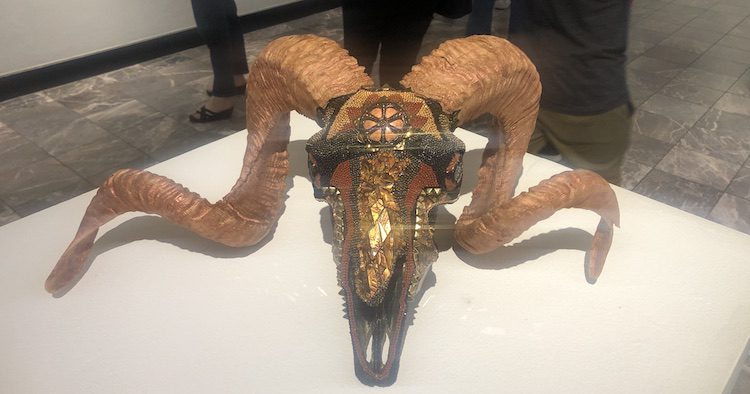
You may not have heard of Andrew Chumbley, but his impact on Modern Witchcraft over the last 20 years has been extraordinary. Much of the current rise in “Traditional Witchcraft” can be traced in no small part to the work of Chumbley, who spent years documenting magickal techniques and practices, most notably his own Sabbatic Tradition. Chumbley wasn’t a Christian, but if he used the text written about above in his magickal work, he was most certainly influenced by Christianity. And in the world of Traditional Witchcraft such influences are common, not outliers. (And Chumbley is also majorly responsible for the boom in high quality Witchcraft books from speciality publishers.)
The first person most of us think of when it comes to Traditional Witchcraft is Robert Cochrane, whose Witch group was (and still is) The Clan of Tubal Cain. Tubal Cain was a famous Hebrew blacksmith, not a figure from Greek mythology. Traditional Witchcraft also often references figures such as Lucifer or the Devil, and we all know where he came from.
I just picked up my copy of The Red Goddess and immediately noticed the quotation from Song of Songs (that’s a book in the Bible) on the back, not to mention all the quotes from the book of Revelation which feature prominently in its text. And if you read a lot of Traditional Witchcraft books you’ve no doubt run into figures such as the Nephilim, Watchers, and Enoch. Where do people think this stuff comes from?

In addition there’s a long history of Christians using magick. If your practice is influenced by charmers or cunning-folk you are utilizing techniques practiced overwhelmingly by self-identifying Christians. Are you into Pennsylvania Dutch Pow-Wow? That’s another thing developed by Christians.
Wiccan-Witchcraft has also been impacted by Christianity. The early modern grimoires which helped to shape a lot of Wiccan ritual practices were mostly written by Christians, and those that weren’t were written by Muslims and Jews. The names of many of those grimoires give away their Biblical roots. The Key of Solomon, The Sixth and Seventh Books of Moses, and The Grimoire of Pope Honorius were all allegedly written by Biblical or Christian figures. And don’t overlook just how impactful some of these books have been on Wicca especially, there’s a lot of stuff in my BoS that reads like it came straight from The Key of Solomon.
Wiccan-Witches have borrowed a whole lot of stuff from Freemasonry over the years, from vocabulary to ritual techniques, and the early Masons were overwhelmingly Christian. Many of Masonries most esoteric architects were Christian too, and I’m sure some of us have taken a little from them over the years too. Groups such as the Theosophical Society honored Jesus, and one of my all-time favorite occultists, Dion Fortune, always found time for her Master Jesus.
So yeah, we probably owe Christians at least a small debt of gratitude for many of our practices. Today we call many of these things “Witchcraft” so it makes sense that Christians looking to engage in these practices might call themselves Christian Witches.
Many Witches who seem aghast at the idea of Christian Witches in their midst often quote the Bible to back up their outrage. (And when you think about it, isn’t that an odd choice? Why do we give a shit about what’s in the Bible?) One of the most quoted passages is from Paul’s Book of Galatians, Chapter 5, verses 19-21:
“The acts of the flesh are obvious: sexual immorality, impurity and debauchery; idolatry and witchcraft; hatred, discord, jealousy, fits of rage, selfish ambition, dissensions, factions and envy; drunkenness, orgies, and the like. I warn you, as I did before, that those who live like this will not inherit the kingdom of God.” -New International Version
But the word “witchcraft” can have a whole host of different meanings, and its use probably comes down to who is doing the translating. Look here, we get “sorcery” instead of “witchcraft.” (And really, most people are guilty of all these things, why single out magickal practice?):

“Now the works of the flesh are evident: sexual immorality, impurity, sensuality, idolatry, sorcery, enmity, strife, jealousy, fits of anger, rivalries, dissensions, divisions, envy, drunkenness, orgies, and things like these. I warn you, as I warned you before, that those who do such things will not inherit the kingdom of God.” -English Standard Version
The Bible says a lot of different shit, most of which is ignored by Christians. Why fixate on just the Witchcraft? That doesn’t make any sense to me.
General religious and spiritual identities are malleable. There are thousands of different types of Christianity, hundreds of different types of Witchcraft. Nobody owns the definition of Christian which is why there are Mormons, Catholics, Baptists, Seventh-Day Adventists, Progressive Christians, and Jehovah’s Witnesses. Many of these groups disagree on all sorts of issues, but you can’t stop any of them from using the word Christian. (Though there are people in each group who do their best to try and own the word, and they all fail outside of their smaller faith communities.)
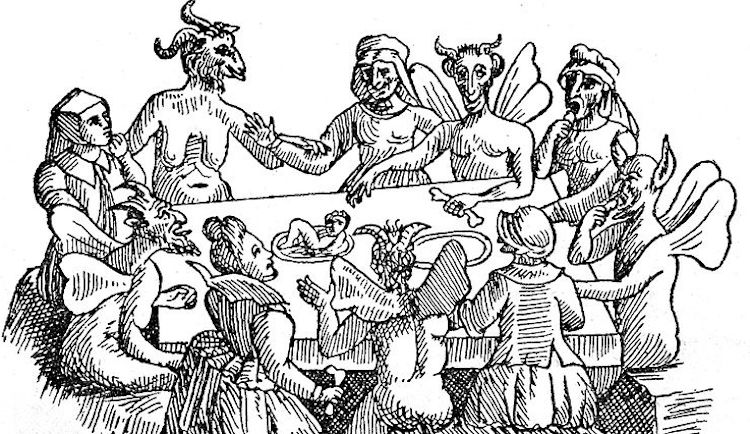
Image from the Welcome Trust, via WikiMedia. CC 4.0 License.

If Witchcraft is simply a magickal practice, void of religion or spirituality (which is how the word is used by many today) how can there not be Christian Witches? That’s like saying that there can’t be Jewish herbalists. Certainly the idea of Witchcraft is not compatible with an overwhelming majority of Christians, but if it works for some people who really cares? It doesn’t hurt you or hurt me unless the Christian-Witches suddenly start speaking for all of us.
Witchcraft is empowering, I’ll all in for anyone with an open mind using it to take charge of their life. I’m all for more Witches in the world, not less.
Note: There are also lots of spiritual and magickal traditions that are sometimes labeled witchcraft without most practitioners identifying that way. Practices such as Voudun, New Orleans Voodoo, Santeria, and Hoodoo have always contained Christian elements. Marie Laveau while being the High Priestess of New Orleans Voodoo, for example, also strongly identified as a Catholic. But the majority of those practitioners do not self-identify as witches, which is why they are not included in this article. And I have a long standing practice of not lumping everyone into the “witchcraft category” unless they deliberately choose to identify that way.
Previous Post

May 27, 2019
Do We Need Pan-Pagan Clergy? (I Don't Think So)
Next Post

June 19, 2019 Summer Solstice Musings
Browse Our Archives
Select a Category Editorializing Gateways to Paganism Guest Posts Holiday Histories Led Zeppelin News and Views Occult Pagan Pagan TV Club Paganism polytheism Ramble On Reviews Ritual Strange Days Uncategorized
Select a Month August 2026 March 2026 February 2026 November 2025 September 2025 August 2025 April 2025 August 2024 April 2024 February 2024 December 2023 October 2023 August 2023 June 2023 May 2023 January 2023 October 2022 August 2022 July 2022 June 2022 May 2022 April 2022 March 2022 February 2022 January 2022 December 2021 November 2021 October 2021 September 2021 August 2021 July 2021 June 2021 April 2021 March 2021 February 2021 January 2021 December 2020 November 2020 October 2020 August 2020 July 2020 June 2020 May 2020 April 2020 March 2020 February 2020 January 2020 December 2019 November 2019 October 2019 September 2019 August 2019 July 2019 June 2019 May 2019 April 2019 March 2019 February 2019 January 2019 December 2018 November 2018 October 2018 September 2018 August 2018 July 2018 June 2018 May 2018 April 2018 March 2018 February 2018 January 2018 December 2017 November 2017 October 2017 September 2017 August 2017 July 2017 June 2017 May 2017 April 2017 March 2017 February 2017 January 2017 December 2016 November 2016 October 2016 September 2016 August 2016 July 2016 June 2016 May 2016 April 2016 March 2016 February 2016 January 2016 December 2015 November 2015 October 2015 September 2015 August 2015 July 2015 June 2015 May 2015 April 2015 March 2015 February 2015 January 2015 December 2014 November 2014 October 2014 September 2014 August 2014 July 2014 June 2014 May 2014 April 2014 March 2014 February 2014 January 2014 December 2013 November 2013 October 2013 September 2013 August 2013 July 2013 June 2013 May 2013 April 2013 March 2013 February 2013 January 2013 December 2012 November 2012 October 2012 September 2012 August 2012 July 2012 June 2012 April 2012 October 2011 September 2011 August 2011
Follow Us!
TAKE THE
Religious Wisdom Quiz
What does "forgive us our trespasses as we forgive"" mean in the Lord's Prayer?
Select your answer to see how you score.
Ask for wealth We should forgive others Hold grudges Pray for revenge
Related posts from Raise the Horns

What Makes a Good Ritualist? No Idea

Witchcraft Remembrances & Appreciation at Samhaintide

Raymond Buckland & The Big Blue Book

TRENDING AT PATHEOS Pagan

Letters on Living the Faith by C.S. Lewis
Most of us met C.S. Lewis as a public intellectual. Mere Christianity....

When Halloween Unmasks Married Hearts
Written by Dr. David K. Ewen from Eternal Truth Bible College Behind...

Aristotle. He’s been called the father of logic, the father of the...

Methodist Central Hall and Westminster Abbey
Situated on the same square is Methodist Central Hall and Westminster Abbey. ...

57th Dove Awards Honor Dolly Parton, Crown New...
On gospel music’s biggest night, the 57th annual GMA Dove Awards honored...

The First Eucharistic Controversy: Christ’s Real Presence
For Catholics, the Eucharist is the source and summit of the Christian...
view all Pagan blogs
Ad-Free & Subscriber Log-In Subscription Support
- About Us
- 2026 Calendar
- Videos
- Podcasts
- Library of World Religions
- Faith In Media Tracker
- Advertise With Us
- Write for Us
- Privacy Policy
- Terms of Service
- Do Not Sell My Data
- Contact Us
- Radiant Digital
- Manage Newsletter Subscriptions
- Unsubscribe From Notifications
- Sitemap
Copyright 2008-2026, Patheos. All rights reserved.
Subscription Support Ad-Free & Subscriber Log-In
Follow Patheos