
BuddhistCatholicContemplativeEvangelicalGeneral ChristianHinduJewishLatter-day SaintMuslimNew VisionsProgressive Christian
Beliefs
- Buddhist
- Catholic
- Contemplative
- Evangelical
- General Christian
- Hindu
- Jewish
- Latter-day Saint
- More Voices
- Muslim
- New Visions
- Pagan
- Progressive Christian
Topics
- Religion News
- Food and Religion
- Sports and Religion
- Religious Art
- Religious Music and Entertainment
- Religious Events
- History and Religion
- Style and Religion
- Politics and Religion
- Women in Religion
- Recreation Outdoors and Religion
- Business Finance and Religion
- Careers Workplace and Religion
- Education and Religion
- Family Parenting and Religion
- Health Fitness and Religion
- Home and Religion
- Relationships and Religion
- Technology and Religion
- Travel and Religion
Columnists
- Buddhist Columnists
- Business Finance and Religion Columnists
- Careers Workplace and Religion Columnists
- Catholic Columnists
- Contemplative Columnists
- Education and Religion Columnists
- Evangelists Columnists
- Family Parenting and Religion Columnists
- General Christian Columnists
- Health Fitness and Religion Columnists
- Hindu Columnists
- History and Religion Columnists
- Home and Religion Columnists
- Jewish Columnists
- More Voices Columnists
- Latter Day Columnists
- Muslim Columnists
- New Visions Columnists
- Nonreligious Columnists
- Pagan Columnists
- Politics and Religion Columnists
- Progressive Columnists
- Recreation Outdoors and Religion Columnists
- Relationships and Religion Columnists
- Religion News Columnists
- Religious Art Columnists
- Religious Events Columnists
- Religious Music and Entertainment Columnists
- Sports and Religion Columnists
- Style and Religion Columnists
- Technology and Religion Columnists
- Travel and Religion Columnists
- Women in Religion Columnists
Resource Library
- 2026 Calendar
- Library of World Religions
- The 100 Most Holy Places on Earth
- Patheos Answers
- Podcasts
- Videos
- Faith Leaders Database
- Anglican Episcopalian
- Bahai
- Baptist
- Buddhism
- Christianity
- Confucianism
- Eastern Orthodoxy
- Hinduism
- Holiness and Pentecostal
- ISKCON
- Islam
- Judaism
- Lutheran
- Methodist
- The Church of Jesus Christ of Latter-day Saints
- New Age
- Paganism
- Presbytarian and Reformed
- Protestantism
- Religion Behind the Scenes
- Roman Catholic
- Scientology
- Shia Islam
- Sikhism
- Sufism
- Sunni Islam
- Taoism
- Zen
- See all religions
Research Tools
 Ad-Free & Subscriber Log-In Subscription Support
Ad-Free & Subscriber Log-In Subscription Support
Follow Patheos 

- Trending:
- Forgiveness
- |
- Marriage
- |
- Consciousness
- |
- Death Penalty
- |
- Election
- |
- Halloween

- HOME
- Me and the Blog
- Defining Pagan
- Rituals & Holidays
- All Posts
- Blogroll
- Publications
- FREE NEWSLETTER
- Home
- Pagan
- Loki & Personal Gnosis
Loki & Personal Gnosis
Last updated on: March 15, 2019 at 12:19 pm by Jason Mankey
Loki & Personal Gnosis 2019-03-15T12:19:15-06:00 Jason Mankey
Patheos Explore the world's faith through different perspectives on religion and spirituality! Patheos has the views of the prevalent religions and spiritualities of the world.
“I am the trickster, scourge of all those methodical and over analyzing. I am the trouble in the best laid plans, the unexpected when all seems well. I am the chaos in a world of balance.”
My first introduction to the character of Loki was in Marvel’s Thor comic as a four or five year old. My first introduction to Loki the god came while writing a Charge of the God back in 1996. Loki is a strange god, more well known than most thanks to his appearances in pop-culture, but also a somewhat taboo subject with many people advising others to stay away from him. He seems more popular today than he did twenty-five years ago, but that’s just a personal observation.
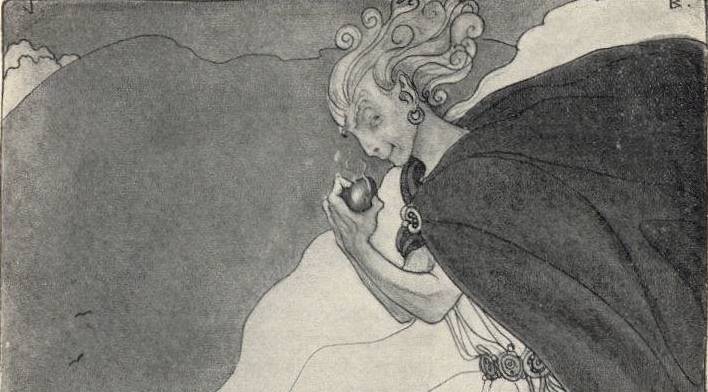
“Loki consumes a roasted heart,” (1911) by John Bauer. From WikiMedia.
Some of Loki’s currently popularity is probably the result of Tom Hiddleston’s portray of the god in all the Marvel Movies. Hiddleston’s Loki oozes charisma, and has evolved into an anti-hero, one of those “bad guys” who sometimes does the right thing and has the sympathy of the audience. Loki’s popularity in the movies has also resulted in devotees of the god being labeled “comic book fans” with a bit of a sneer along with a “they don’t know Loki” dismissal.
Loki is not one of our house deities. There are no paintings of him on the wall, or devotional statues in my office. I’m not sure my wife would be cool with me placing him in a public space in our home, so his energy and his interactions with me are confined to a small spaces and particular rituals.
I did not go seeking Loki, and there are parts of me embarrassed to admit our (limited) relationship, fearful that cries of “comic book fan!” will echo over the internet. But Loki keeps showing up in my life, and inspired by John Beckett’s recent post on personal gnosis I felt it was time to share my experiences with him. I am wary of personal gnosis, but our experiences with deity are our own, and I certainly don’t expect anyone else to share my opinions or understandings, especially when it comes to Loki.
Those who advise staying far away from Loki often do so because of how the god is portrayed in mythology. Myth is a great starting point for our understanding of deity, but myth is written by human beings, and often those human beings have an agenda or bias that is not readily apparent. We like to think that we truly know the myths of Odin, Freya, Thor, and Loki, but what we have our glimpses written down by Christians. Ragnarok vividly, and most likely intentionally, parallels the story of how the world will end in the Revelation of St. John. Well known stories such as Thor fighting Midgard Serpent are equivalent to archangel Michael fighting the dragon. (1)
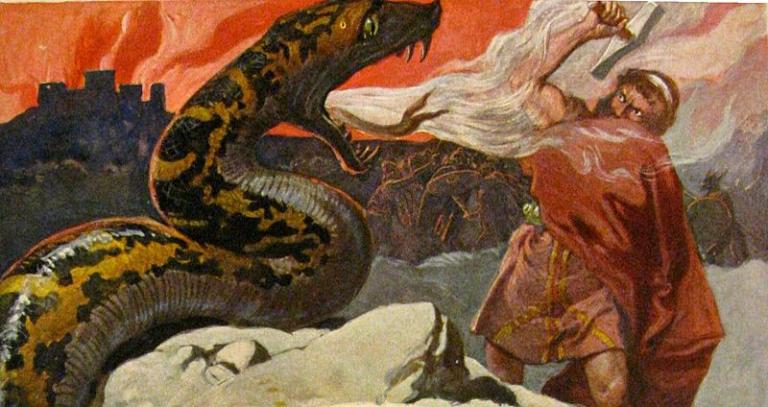
“Thor Fights the Serpent” by Emil Doepler. From WIkiMedia.
Because of this I can’t help but wonder if Loki’s character was intentionally changed when Norse myths were eventually written down. The Eddas for example were only written down in the 13th Century, long after Christianization. By that point it’s likely that readers (and authors) would have been actively expecting an antagonist to stand against the heroes of the story. The end-result being that the least understood deity in the existing stories (Loki) was changed into something else, a villain.
I’m not suggesting that we stop reading mythology or that it’s not useful when it comes to a deity like Loki. I’m sure it retains several truths and insights, but it doesn’t hurt to be at least somewhat wary of the source(s). Most other Indo-European pantheons don’t contain the “bad guy” that Loki seems to be either. His portrayal is certainly an outlier in European myth, unless that myth was being directly influenced by Christianity.
My feelings about how Loki’s myth might have been changed are the result of a couple of intense experiences where I was asked to “play the part” of Loki during ritual. I did not “draw down” Loki in these instances, but I felt like he was there with me. The first time involved a retelling of The Kidnapping of Idun.
In that instance I felt Loki as the trickster, but not a trickster out to intentionally harm people. This was a god who liked to laugh, and play jokes on his friends and acquaintances. The jokes he plays are not necessarily nice, but aren’t intentionally malicious either. Walking with Loki during that play was enjoyable, dare I say it, fun?

“Loki’s flight to Jötunheim” (1908) by W. G. Collingwood. From WikiMedia
A little over a year later I was asked to portray Loki in another ritual, this one encompassing much more of Norse mythology. I was hesitant to sign up for it since it would include a re-enactment of Baldur’s death at the hands of Loki via a dart made of mistletoe. I almost said “no” a dozen times, but a little voice urged me on, that and the ritual was being put on by Ryan Smith, whom I happen to like a great deal.
As we get closer and closer to me (Loki) throwing the dart of mistletoe, except Loki didn’t throw the mistletoe, the god Höd did the throwing, lost in the moment, I don’t remember things as clearly as I’d like to. I began to feel a mischievous glee descend over me. “This will be fun!” it seemed to say, and “we’ll all get a good laugh out of it.” And then the dart is thrown and Baldur falls to the ground dead.
I don’t know exactly what happened after that, but I felt as if I was sitting alone in the center of our ritual space, despair falling down from the sky upon me. “I didn’t mean to kill him” I remember saying as Loki, “I didn’t mean to kill him,” and rocking back and forth anguish upon my features and tears in my eye. Even just writing this I feel that wave of sadness . . . “I didn’t mean to kill him.” In other words, it was a prank gone wrong.
What this all means, I don’t know. This is simply my personal gnosis and personal (better) understanding of the god Loki.
NOTE
Winroth, Anders, The Age of the Vikings, Princeton University Press, 2014, page 190.
Previous Post

March 13, 2019
Five Witchcraft Books That Changed My Life
Next Post

March 27, 2019 Witchcraft & Dion Fortune
Browse Our Archives
Select a Category Editorializing Gateways to Paganism Guest Posts Holiday Histories Led Zeppelin News and Views Occult Pagan Pagan TV Club Paganism polytheism Ramble On Reviews Ritual Strange Days Uncategorized
Select a Month August 2026 March 2026 February 2026 November 2025 September 2025 August 2025 April 2025 August 2024 April 2024 February 2024 December 2023 October 2023 August 2023 June 2023 May 2023 January 2023 October 2022 August 2022 July 2022 June 2022 May 2022 April 2022 March 2022 February 2022 January 2022 December 2021 November 2021 October 2021 September 2021 August 2021 July 2021 June 2021 April 2021 March 2021 February 2021 January 2021 December 2020 November 2020 October 2020 August 2020 July 2020 June 2020 May 2020 April 2020 March 2020 February 2020 January 2020 December 2019 November 2019 October 2019 September 2019 August 2019 July 2019 June 2019 May 2019 April 2019 March 2019 February 2019 January 2019 December 2018 November 2018 October 2018 September 2018 August 2018 July 2018 June 2018 May 2018 April 2018 March 2018 February 2018 January 2018 December 2017 November 2017 October 2017 September 2017 August 2017 July 2017 June 2017 May 2017 April 2017 March 2017 February 2017 January 2017 December 2016 November 2016 October 2016 September 2016 August 2016 July 2016 June 2016 May 2016 April 2016 March 2016 February 2016 January 2016 December 2015 November 2015 October 2015 September 2015 August 2015 July 2015 June 2015 May 2015 April 2015 March 2015 February 2015 January 2015 December 2014 November 2014 October 2014 September 2014 August 2014 July 2014 June 2014 May 2014 April 2014 March 2014 February 2014 January 2014 December 2013 November 2013 October 2013 September 2013 August 2013 July 2013 June 2013 May 2013 April 2013 March 2013 February 2013 January 2013 December 2012 November 2012 October 2012 September 2012 August 2012 July 2012 June 2012 April 2012 October 2011 September 2011 August 2011
Follow Us!
TAKE THE
Religious Wisdom Quiz
Which chapter in Proverbs is known as the "Virtuous Woman" chapter?
Select your answer to see how you score.
Proverbs 10 Proverbs 22 Proverbs 31 Proverbs 3
Related posts from Raise the Horns


The Return of the Pagan Scapegoats


Magickal & Pagan Gathers: Some Thoughts
TRENDING AT PATHEOS Pagan

The Sermon on the Mount, Part I: Matthew...
The Sermon on the Mount, Part I (Matthew 4:12-5:12) St. Matthew moves...

What's up from Crossway: Reviewing some of their latest A few weeks...

Janie Learns the Way of the Cross: A...
Teaching children about Jesus' Passion can be challenging. Many parents and educators...

Looking For Good Catholic Writing - October 2026
He alone extends the heavens, and he walks upon the waves of...

In "Irreplaceable," our book on vocation and technology, Trevor Sutton and I...

I was strolling through the top floor of the brand new Parthenon...
view all Pagan blogs
Ad-Free & Subscriber Log-In Subscription Support
- About Us
- 2026 Calendar
- Videos
- Podcasts
- Library of World Religions
- Faith In Media Tracker
- Advertise With Us
- Write for Us
- Privacy Policy
- Terms of Service
- Do Not Sell My Data
- Contact Us
- Radiant Digital
- Manage Newsletter Subscriptions
- Unsubscribe From Notifications
- Sitemap
Copyright 2008-2026, Patheos. All rights reserved.
Subscription Support Ad-Free & Subscriber Log-In
Follow Patheos