
BuddhistCatholicContemplativeEvangelicalGeneral ChristianHinduJewishLatter-day SaintMuslimNew VisionsProgressive Christian
Beliefs
- Buddhist
- Catholic
- Contemplative
- Evangelical
- General Christian
- Hindu
- Jewish
- Latter-day Saint
- More Voices
- Muslim
- New Visions
- Pagan
- Progressive Christian
Topics
- Religion News
- Food and Religion
- Sports and Religion
- Religious Art
- Religious Music and Entertainment
- Religious Events
- History and Religion
- Style and Religion
- Politics and Religion
- Women in Religion
- Recreation Outdoors and Religion
- Business Finance and Religion
- Careers Workplace and Religion
- Education and Religion
- Family Parenting and Religion
- Health Fitness and Religion
- Home and Religion
- Relationships and Religion
- Technology and Religion
- Travel and Religion
Columnists
- Buddhist Columnists
- Business Finance and Religion Columnists
- Careers Workplace and Religion Columnists
- Catholic Columnists
- Contemplative Columnists
- Education and Religion Columnists
- Evangelists Columnists
- Family Parenting and Religion Columnists
- General Christian Columnists
- Health Fitness and Religion Columnists
- Hindu Columnists
- History and Religion Columnists
- Home and Religion Columnists
- Jewish Columnists
- More Voices Columnists
- Latter Day Columnists
- Muslim Columnists
- New Visions Columnists
- Nonreligious Columnists
- Pagan Columnists
- Politics and Religion Columnists
- Progressive Columnists
- Recreation Outdoors and Religion Columnists
- Relationships and Religion Columnists
- Religion News Columnists
- Religious Art Columnists
- Religious Events Columnists
- Religious Music and Entertainment Columnists
- Sports and Religion Columnists
- Style and Religion Columnists
- Technology and Religion Columnists
- Travel and Religion Columnists
- Women in Religion Columnists
Resource Library
- 2026 Calendar
- Library of World Religions
- The 100 Most Holy Places on Earth
- Patheos Answers
- Podcasts
- Videos
- Faith Leaders Database
- Anglican Episcopalian
- Bahai
- Baptist
- Buddhism
- Christianity
- Confucianism
- Eastern Orthodoxy
- Hinduism
- Holiness and Pentecostal
- ISKCON
- Islam
- Judaism
- Lutheran
- Methodist
- The Church of Jesus Christ of Latter-day Saints
- New Age
- Paganism
- Presbytarian and Reformed
- Protestantism
- Religion Behind the Scenes
- Roman Catholic
- Scientology
- Shia Islam
- Sikhism
- Sufism
- Sunni Islam
- Taoism
- Zen
- See all religions
Research Tools
 Ad-Free & Subscriber Log-In Subscription Support
Follow Patheos 

- Trending:
- Advent
- |
- Forgiveness
- |
- Thanksgiving
- |
- Election
- |
- Seasonal Holidays
- |
- Marriage

- HOME
- Me and the Blog
- Defining Pagan
- Rituals & Holidays
- All Posts
- Blogroll
- Publications
- FREE NEWSLETTER
- Home
- Pagan
- The Eleusian Mysteries: Initiation in the Ancient World
The Eleusian Mysteries: Initiation in the Ancient World
Last updated on: December 26, 2018 at 3:41 pm by Jason Mankey
The Eleusian Mysteries: Initiation in the Ancient World 2018-12-26T15:41:11-07:00 Jason Mankey
Patheos Explore the world's faith through different perspectives on religion and spirituality! Patheos has the views of the prevalent religions and spiritualities of the world.
Initiation rituals are probably one of the oldest forms of religious ritual among humans and could go back tens of thousands of years. In contemporary hunter-gatherer societies, initiations continue to play a large role in community life and often involve painful procedures such as the removal of teeth, circumcision, scarification, and blood letting. (1) Understandably, such forms of initiation are not common today in the Western world and have had little (if any) influence on modern Pagan practices. Much more influential have been the Greek mysteries, especially those that took place at Eleusis, a city just outside of Athens.
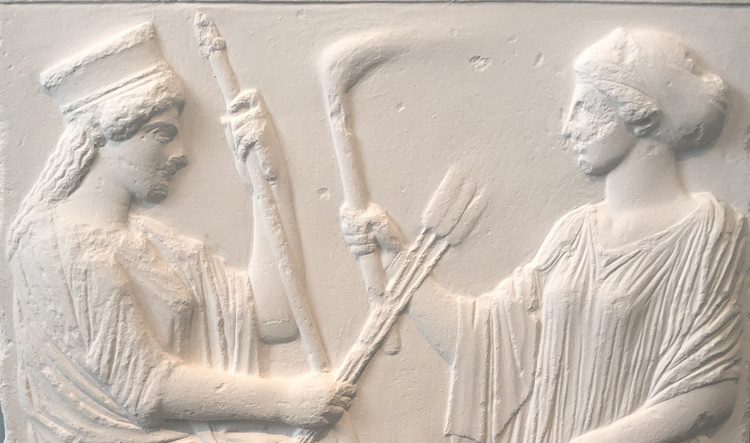
The Eleusinian Mysteries were the most famous set of initiation rites in the ancient world, and though it’s likely that hundreds of thousands of people participated in them over the course of nearly a thousand years, we know very little about them. Initiates were sworn to secrecy, and only rarely were those vows broken—and generally by Christians who turned their backs on their vows. But thanks to those oath breakers, as well as ancient art (especially pottery) that depicted the Mysteries, excavations from Eleusis itself, and a few poems and letters, it’s possible to at least intelligently speculate on what happened at Eleusis all those centuries ago.
Because of their secrecy, the Eleusinian Mysteries haven’t been as influential as some might wish them to be, but every time we celebrate a mystery we are, in a way, celebrating Eleusis. The modern word mystery comes directly from the ancient Greek mysterion, which means “secret rite or doctrine,” and mysterion itself derives from mystes, which means “one who has been initiated.” (2) Just saying the word mystery links us to some of the most celebrated of all ancient Pagan rites!
The mysteries of Greek and Roman antiquity were not limited to those at Eleusis. Deities such as Dionysus, Orpheus, Magna Mater, and Mithras all had their own mysteries, and unlike the Eleusinian Mysteries, those cults were portable. (The Eleusinian Mysteries could be performed only at Eleusis.) However, we know less about those rites, probably because they weren’t centrally located and were more likely to vary from location to location.
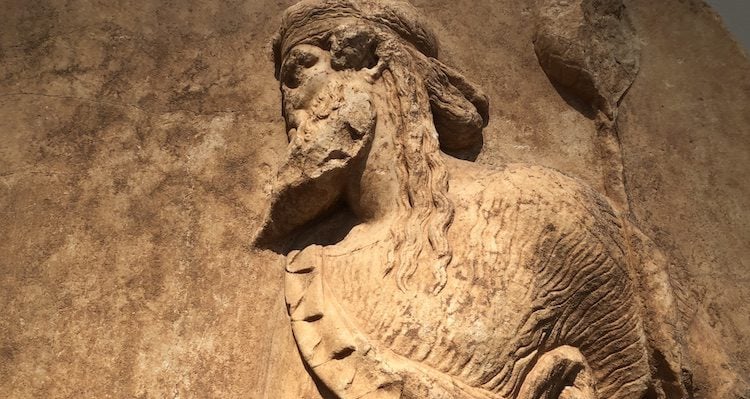
Dionysus.
The Eleusinian Mysteries were dedicated to the grain and harvest goddess Demeter, along with her daughter, Persephone, who was known at Eleusis as Kore, which translates as “the Girl.” (3) Other deities were invoked at the Mysteries (including a form of Dionysus), but the rites revolved around Demeter and her daughter. The most famous tale of Demeter and Persephone involves the abduction of the latter by Hades, the Greek god of the underworld. In that tale, Demeter is distraught over the loss of her daughter, and her depression robs the world of its fertility. Eventually Persephone is returned to her mother, but not before eating four to six pomegranate seeds (depending on which version of the story you read). Because Persephone eats the food of the dead, she is obligated to return to that world for four (or six) months of the year. This story serves as a metaphor for the change of seasons.
It’s unknown just how large a role that story played in the Mysteries at Eleusis, but it must have been at least a small one. While Demeter was distraught over the loss of her daughter, she worked for a time as a wet nurse for the king in Eleusis, promising to establish the Mysteries there after her daughter’s return. Perhaps even more importantly, the Mysteries took place at the end of September/beginning of October.
Those of us living in the United States and Great Britain often interpret that period as a time when Persephone might be traveling to the underworld. However, in ancient Greece near Athens, crops were planted in the late fall because the summer was too hot for agriculture. (4) In other words, Persephone actually returns to her mother in the fall, and the Mysteries most likely celebrated that reunion.
One of the more intriguing bits of information about the Mysteries comes from the Christian Clement of Alexandria (150–215). In his Exhortation to the Greeks, he writes of a synthema, a word or object that brings one closer to deity and may even grant access to their power: “I fasted, I drank from the kykeon, I took out of the kiste [box], worked, placed back in the basket (kalathos) and from the basket into the kiste.” (5) Not surprisingly, Clement doesn’t offer much insight into what this all means, but it’s likely that the “work” alluded to refers to a mortar and pestle.
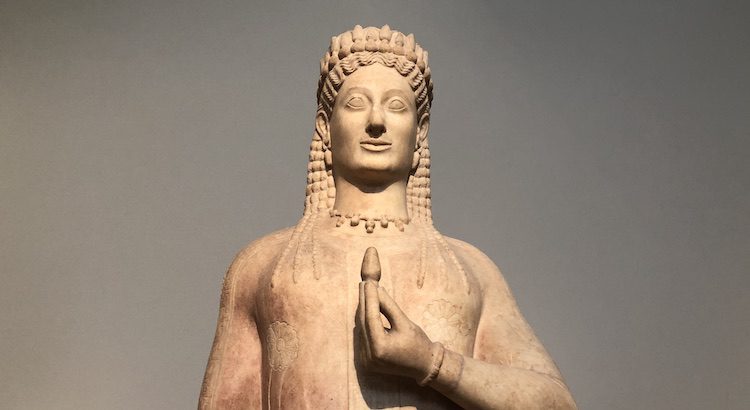
Kore
The mortar and pestle might have also been important in the creation of the kykeon, a barley drink associated with the Mysteries.(6) Over the last hundred years it has become fashionable to try to link kykeon with hallucinogenic substances such as ergot, a fungus that grows on grain. The problem with this is that thousands of people participated in the Mysteries every year for a thousand years, and the amount of ergot needed for such an undertaking would have been quite large. Ergot is also very unpleasant, and it’s likely the physical effects would have been commented on by writers and participants. (7)
The two biggest secrets at Eleusis likely had something to do with death and the afterlife, along with the civilizing power of agriculture. The famous orator Cicero (106–43 BCE) once wrote that the Mysteries teach “how to live in joy, and how to die with better hopes.” (8) Officiants who presided over the Mysteries had epitaphs on their headstones with statements such as “death is not only not an evil, but good.” (9) The rites themselves might have concluded with the showing of an ear of grain, the meaning of which might be related to wealth, the cycle of death and rebirth, a child, or the civilizing nature of agriculture. (This type of speculation comes from pottery, which often shows the ancient king of Eleusis holding an ear of grain while standing between Demeter and Persephone.)
Though we don’t know exactly how the Greeks interpreted the Mysteries of Demeter, it is possible to construct an outline of how they were probably enacted. Unlike most of our more modern initiation ceremonies, initiation into the Mysteries took place over several days and involved a great deal of walking. The Mysteries began in Athens, where prospective initiates had to walk through the city with a baby pig and then take that piglet down to the sea to be washed and sacrificed. This served as a method of purification for initiates and was probably a major Athenian spectacle. Just imagine several thousand people walking around with pigs in their arms! (10)

Eleusis today.
A few days after the piglet sacrifice, two processions departed from Athens to Eleusis, fourteen miles down the road. The initiation process at Eleusis was two-tiered, and the first procession was limited to past initiates seeking a greater understanding of the Mysteries. A day after their departure, the would-be initiates were allowed to walk to Eleusis. After a long walk they danced in honor of the goddesses and were finally admitted into the sanctuary. Upon admission they probably fasted, with their fast lasting until the revelation of the Mysteries the following evening.
Several different activities made up the bulk of the Mysteries, including a probable torchlit search for Persephone and an enactment of her reunion with Demeter. It’s likely that initiates were blindfolded during the search for Persephone and forced to walk what must have felt like dangerous pathways. To aid them in their search for Persephone, those returning to the Mysteries were given torches, which they most likely waved near the heads of the new initiates. While the search was under way, a priest banged a gong in the sanctuary, summoning Kore to return to the world of the living.
Eventually Persephone returned and was reunited with her mother, a spectacle that could only be witnessed by those who had returned to experience the Mysteries a second time. The reunited Persephone and Demeter, along with the second-timers, then entered Eleusis’s main sanctuary. Once in place the new initiates were free to remove their blindfolds and enter the sanctuary, which would have been awash in a sea of light from the thousands of burning torches.
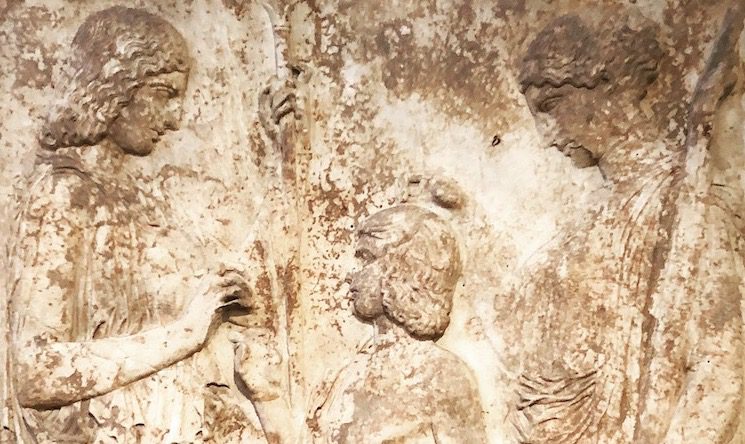
After gazing upon the two goddesses (and likely a few other deities), the new initiates were ushered out of the sanctuary and the returnees were then shown an ear of grain. After the rites had ended there was probably feasting, merry making, and perhaps a few consensual orgies.
Due to the madcap energy present at the Mysteries, it’s likely that every initiation experience differed from person to person. The blindfolds, the exhaustion, the fear from the fires—all of this must have had a transformative effect on the psyches of those involved. I’m sure the priests who led the Mysteries had their own interpretations of the meaning of everything, but the meanings that mattered most were those gleaned by the participants—and that’s a truth that still applies to the mysteries of initiation today.
Adapted from the book Transformative Witchcraft: The Greater Mysteries, Llewellyn Publications, 2019. You can purchase Transformative Witchcraft at most major booksellers and your local Witch-shop. The link above will take you to Llewellyn’s site. If you must buy it on Amazon, that link is here.
I’m really proud of this book, and hope you might consider picking it up. I share more of the book in this article on The Witches’ Pyramid.
All images by me, and were either taken at Eleusis or the National Archaeological Museum in Athens.
NOTES
1. Hayden, Brian Shamans, Sorcerers, and Saints, Smithsonian Books, 2003, pages 103–104.
2. Online Etymology Dictionary, https://www.etymonline.com/word/mystery
3. Burkert, Walter, Greek Religion, Harvard University Press, 1985, page 159. Other books sometimes translate Kore as “the Maiden.”
4. Bowden, Hugh, Mystery Cults of the Ancient World, Princeton University Press, page 28. There are many smart people who disagree with this interpretation.
5. Burkert, Greek Religion, page 286.
6. Ibid., 286.
7. Burkert, Ancient Mystery Cults, Harvard University Press, 1987, page 108
8. 100. Ibid.
9. 101. Ibid.
10. This entire summary of what happened at the Mysteries comes from Hugh Bowden’s Mystery Cults of the Ancient World, pages 32–42. Bowden’s account is extremely readable, a quality that can be challenging to find when mucking around in ancient history.
Previous Post

December 18, 2018
Santa Claus Was NOT a Shaman
Next Post
December 28, 2018 On a Pagan New Year
Browse Our Archives
Select a Category Editorializing Gateways to Paganism Guest Posts Holiday Histories Led Zeppelin News and Views Occult Pagan Pagan TV Club Paganism polytheism Ramble On Reviews Ritual Strange Days Uncategorized
Select a Month August 2026 March 2026 February 2026 November 2025 September 2025 August 2025 April 2025 August 2024 April 2024 February 2024 December 2023 October 2023 August 2023 June 2023 May 2023 January 2023 October 2022 August 2022 July 2022 June 2022 May 2022 April 2022 March 2022 February 2022 January 2022 December 2021 November 2021 October 2021 September 2021 August 2021 July 2021 June 2021 April 2021 March 2021 February 2021 January 2021 December 2020 November 2020 October 2020 August 2020 July 2020 June 2020 May 2020 April 2020 March 2020 February 2020 January 2020 December 2019 November 2019 October 2019 September 2019 August 2019 July 2019 June 2019 May 2019 April 2019 March 2019 February 2019 January 2019 December 2018 November 2018 October 2018 September 2018 August 2018 July 2018 June 2018 May 2018 April 2018 March 2018 February 2018 January 2018 December 2017 November 2017 October 2017 September 2017 August 2017 July 2017 June 2017 May 2017 April 2017 March 2017 February 2017 January 2017 December 2016 November 2016 October 2016 September 2016 August 2016 July 2016 June 2016 May 2016 April 2016 March 2016 February 2016 January 2016 December 2015 November 2015 October 2015 September 2015 August 2015 July 2015 June 2015 May 2015 April 2015 March 2015 February 2015 January 2015 December 2014 November 2014 October 2014 September 2014 August 2014 July 2014 June 2014 May 2014 April 2014 March 2014 February 2014 January 2014 December 2013 November 2013 October 2013 September 2013 August 2013 July 2013 June 2013 May 2013 April 2013 March 2013 February 2013 January 2013 December 2012 November 2012 October 2012 September 2012 August 2012 July 2012 June 2012 April 2012 October 2011 September 2011 August 2011
Follow Us!
TAKE THE
Religious Wisdom Quiz
Who said, "You come against me with sword and spear, but I come against you in the name of the Lord Almighty"?
Select your answer to see how you score.
Saul Jonathan David Eli
Related posts from Raise the Horns

The Return of the Pagan Scapegoats
Magickal & Pagan Gathers: Some Thoughts
TRENDING AT PATHEOS Pagan

Thanksgiving as a Way of Life: A Christian...
Each year, Thanksgiving brings families and friends together to share meals, stories,...

Two Women Doctors Who Went Against the Current
Women physicians who transformed healthcare for "Indians" “I shall have an advantage...
Reading Culture Through Scripture, Not the Other Way...
A Radix Teleology and Faith Before Seeing: Essentialism “For we also have...
Thy Word is Truth: The Bible Vindicated by...
My 59th book, completed on 9 November 2026; 204 pages. *****...

Adventurous Lectionary -1st. Sunday of Advent - November...
The Adventurous Lectionary - The First Sunday of Advent – November 29,...

Will Islam become the world's biggest religion by 2035? Congo will replace...
view all Pagan blogs
Ad-Free & Subscriber Log-In Subscription Support
- About Us
- 2026 Calendar
- Videos
- Podcasts
- Library of World Religions
- Faith In Media Tracker
- Advertise With Us
- Write for Us
- Privacy Policy
- Terms of Service
- Do Not Sell My Data
- Contact Us
- Radiant Digital
- Manage Newsletter Subscriptions
- Unsubscribe From Notifications
- Sitemap
Copyright 2008-2026, Patheos, part of the Radiant Digital network of media brands. All rights reserved.
Subscription Support Ad-Free & Subscriber Log-In
Follow Patheos