
BuddhistCatholicContemplativeEvangelicalGeneral ChristianHinduJewishLatter-day SaintMuslimNew VisionsProgressive Christian
Beliefs
- Buddhist
- Catholic
- Contemplative
- Evangelical
- General Christian
- Hindu
- Jewish
- Latter-day Saint
- More Voices
- Muslim
- New Visions
- Pagan
- Progressive Christian
Topics
- Religion News
- Food and Religion
- Sports and Religion
- Religious Art
- Religious Music and Entertainment
- Religious Events
- History and Religion
- Style and Religion
- Politics and Religion
- Women in Religion
- Recreation Outdoors and Religion
- Business Finance and Religion
- Careers Workplace and Religion
- Education and Religion
- Family Parenting and Religion
- Health Fitness and Religion
- Home and Religion
- Relationships and Religion
- Technology and Religion
- Travel and Religion
Columnists
- Buddhist Columnists
- Business Finance and Religion Columnists
- Careers Workplace and Religion Columnists
- Catholic Columnists
- Contemplative Columnists
- Education and Religion Columnists
- Evangelists Columnists
- Family Parenting and Religion Columnists
- General Christian Columnists
- Health Fitness and Religion Columnists
- Hindu Columnists
- History and Religion Columnists
- Home and Religion Columnists
- Jewish Columnists
- More Voices Columnists
- Latter Day Columnists
- Muslim Columnists
- New Visions Columnists
- Nonreligious Columnists
- Pagan Columnists
- Politics and Religion Columnists
- Progressive Columnists
- Recreation Outdoors and Religion Columnists
- Relationships and Religion Columnists
- Religion News Columnists
- Religious Art Columnists
- Religious Events Columnists
- Religious Music and Entertainment Columnists
- Sports and Religion Columnists
- Style and Religion Columnists
- Technology and Religion Columnists
- Travel and Religion Columnists
- Women in Religion Columnists
Resource Library
- 2026 Calendar
- Library of World Religions
- The 100 Most Holy Places on Earth
- Patheos Answers
- Podcasts
- Videos
- Faith Leaders Database
- Anglican Episcopalian
- Bahai
- Baptist
- Buddhism
- Christianity
- Confucianism
- Eastern Orthodoxy
- Hinduism
- Holiness and Pentecostal
- ISKCON
- Islam
- Judaism
- Lutheran
- Methodist
- The Church of Jesus Christ of Latter-day Saints
- New Age
- Paganism
- Presbytarian and Reformed
- Protestantism
- Religion Behind the Scenes
- Roman Catholic
- Scientology
- Shia Islam
- Sikhism
- Sufism
- Sunni Islam
- Taoism
- Zen
- See all religions
Research Tools
 Ad-Free & Subscriber Log-In Subscription Support
Follow Patheos 

- Trending:
- Advent
- |
- Forgiveness
- |
- Thanksgiving
- |
- Election
- |
- Seasonal Holidays
- |
- Marriage

- HOME
- Me and the Blog
- Defining Pagan
- Rituals & Holidays
- All Posts
- Blogroll
- Publications
- FREE NEWSLETTER
- Home
- Pagan
- Just What Is Today’s Paganism?
Just What Is Today’s Paganism?
Last updated on: July 17, 2018 at 5:01 pm by Jason Mankey
Just What Is Today’s Paganism? 2018-07-17T17:01:50-06:00 Jason Mankey
Patheos Explore the world's faith through different perspectives on religion and spirituality! Patheos has the views of the prevalent religions and spiritualities of the world.
I think our community is a bit obsessed with labels. There are dozens of different Witchcrafts, a whole bunch of Druid orders, varying degrees of polytheist, and lots of names given to those who honor Norse pantheons. It used to be that the word “Pagan” was a unifying force in our communities. To a smaller degree that still applies today (this is blog is a part of the Patheos Pagan channel for instance), but I think less so than just ten or twelve years ago.

Demeter for the win! (And the harvest.)
Twenty or thirty years ago most Pagan traditions shared a few traits:
The Irish-Celtic Wheel of the Year When I was starting out everyone I knew in the Pagan Community at least played lip service to the idea of the “Wheel of the Year” and the solstices, equinoxes, and cross-quarter days that populate it. I’m sure it wasn’t as universal as I thought it was back in the 90’s, but it was more common than not. Most everyone I knew gathered to celebrate “the sabbats” no matter their path, and in those days I was surrounded by a lot more than Witches, I counted Druids, Thelemites and Christo-Pagans as some of my cloest friends.
The Divine Feminine I’ve never been naive enough to think that all Pagans worship “the Goddess” but everyone I knew twenty or thirty years ago at least had a goddess sitting on their altar or among the deities they honored. Goddesses varied of course, there was the Wiccan “Lady,” specific deities such as Rhiannon and Freya, and the Marys (both the Virgin and the Magdalene). That last bit might make some people uncomfortable, but I had friends that absolutely honored those figures as goddesses.
Magick All of my Pagan friends twenty-five years ago believed in magick, I’m not sure it was even open for debate. To be a Witch or a Druid or whatever else generally came with a belief in the practice, and when we were bored we’d throw energy balls at each other and debate the finer points of magickal practice. We saw books on ritual magick as a part of the Pagan experience, to not read such things was to be left behind.
Polytheism I think most of us used to refer to ourselves as polytheists, and most of the people we knew at least used the language of polytheism. The idea that there were “many kinds of polytheism” never really occurred to any of us. What we were doing was obviously different what the monotheists were doing, wasn’t that enough?
Today the Pagan landscape has changed dramatically. There are Re-constructionist groups exploring the holidays of various ancient pagan traditions (Hellenic, Egyptian, Sumerian, and dozens more) and as a result they are less interested in Celtic holidays. There are more and more Pagans who are also trying to connect with the Wheel of the Year where they live instead of trying to graft an Irish and/or British (many of us have been inspired by the goings on in Wales, Scotland, and England) seasonal calendar onto what they do. I know some Witches today who are entirely focused on re-creating the Witchcraft known to us from Margaret Murray’s Witch-Cult in Western Europe (book published in 1921), a cosmology that mostly lacked any sort of goddess figure.
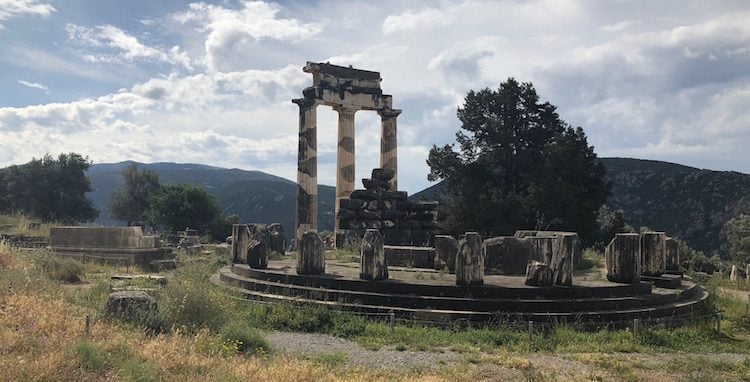
Temple of Athena Pronaia near Apollo’s Temple at Delphi.
Magick and polytheism and their place in Paganism has probably changed the most over the last twenty years. I’m sure there have always been atheist Pagans and Pagans who don’t believe in magick, the difference is that they are much louder now, and actively turn up their nose at such things. I’m not bothered by a lack of belief in deity (or magick) but I find it frustrating and insulting when such beliefs are ridiculed.
Polytheism has become a matter of degrees, and is now often prefaced with qualifiers such as “soft” or “hard.” I get it, Pan is not the same as a “the Horned God,” but the problem comes when people try and interpret or define someone else’s experience with deity. “You can’t be a polytheist because you are a Wiccan” is something I’ve heard many times over the past five years, even though I honor the deities in my house as separate and distinct entities.
With all of these different points of view then, what makes up today’s Paganism? Is the answer simple or complex? Are we still under one umbrella or several? The answer you get will probably depend on who you ask, but I think there are still some qualifiers when considering today’s Paganism.

Brakebills Graduate Thorn Mooney with her new book. It’s a Pagan in a Pagan place with a Pagan thing!
The People Who Congregate in Pagan Spaces are Pagans, Mostly
This is a rather simple answer, but I also think it’s true. The people who read books generally classified as “Pagan,” go to events labeled “Pagan” and congregate in Pagan spaces (both online and off) are probably Pagans, and are most certainly part of the Pagan Community. There are some people who get stuck under this banner who actively bristle at the word Pagan, and that’s fair, but I’m not sure it can be escaped from at present. The only way to completely leave the word Pagan behind is to build institutions free from people who identify as Pagans. (And I’m always happy to call people whatever it is they want to be called, I’m only arguing that certain groups are going to get lumped into “Paganism” when they inhabit the same social circles as self-identifying Pagans.)
This understanding of the word Pagan probably leaves some people out that we would otherwise think of Pagans. With Witchcraft evolving into a sometimes more aesthetic practice, and with those practitioners mostly absent from spaces such as this one, it’s possible to see their Witchcraft as outside of Pagandom. Faiths outside of monotheism aren’t a part of today’s Paganism unless they choose to be. “Hindus” aren’t suddenly Pagans in the sense that you or I might be simply because we wish it were so. There are some practitioners of Voodoo and Vodun who are comfortable identifying as Pagans, and others who are not. Whether or not they are “Pagans” probably depends on if they inhabit general Pagan spaces or not.
Pagans Are Generally a Pretty Tolerant Bunch (But Not as Much as Some of Us Would Like)
The Modern Pagan Community is far from perfect and has a whole lot of issues left to address when it comes to inclusitivioty, but I still think we are a rather tolerant bunch. There are other indicators of today’s Paganism, though these indicators are often more contentious. I’d argue that the Pagan Community as presently constituted is a generally tolerant place. That doesn’t mean everyone within it is socially liberal, but I think there’s an expectation that our public events are open to everyone (this is not always handled to perfection, but it’s the general rule). In addition we don’t let known racists post on our blog spots, nor do they release books through “Pagan” publishers. This is one of the reasons I don’t believe that Racists are Threatening to Take Over Paganism, because we’ve never let those elements truly enter our community.
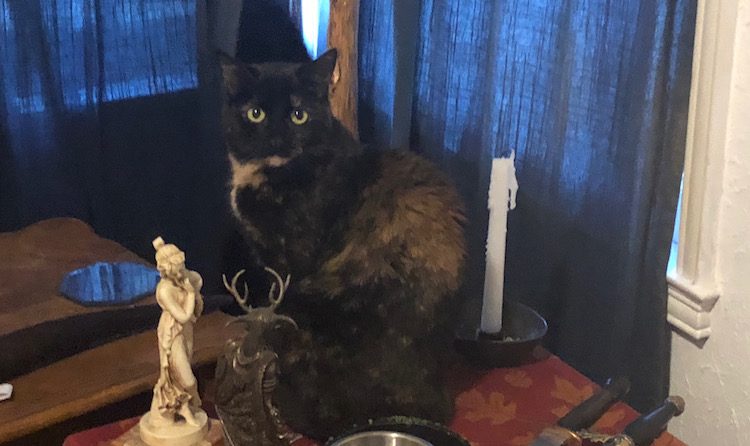
We keep telling Summer that she’s not allowed to learn magick. She keeps trying anyways.
There’s a reason Margot Adler left racist Heathen and Asatru groups out of her book Drawing Down the Moon back in 1979, and that’s because she didn’t see them as part of modern Pagan culture. Most Pagan groups actively embraced the sixties in some way, racist Heathen groups were a reaction to that period of time. In other words, the evolution of those groups was separate from where most of us come from. It’s true that “folkish” Heathens attempt to invade our spaces now and again, but they are generally quickly shut down. Paganism is more liberal today than at any point in its history, I truly don’t see us falling backwards anytime in the near or distant future. Many of the most intolerant voices in Paganism today lie on the outskirts of our community and seem destined to end up in the dust-bin of history.
Common Points of Origin
The earliest Modern Pagan groups arose out of a renewed interest in ceremonial and folk magick, Celtic and British folklore, mythology, and the art and poetry of the Romantic and Victorian periods. Many of the more organized (and I use that term loosely) were influenced by fraternal orders, this especially applies to initiatory Witchcraft traditions and certain Druid orders. Not every Pagan group embraced the 1960’s wholeheartedly, but the ideas of the 60’s counter-culture can be seen in a wide range of Pagan traditions.
It’s these common points of origin within the varied pieces that make up today’s Paganism which makes calling traditions like Vodou, Hinduism(s), and Native American spiritualities “Pagan” problematic. Sure, they might be “pagan” in an anthropological sense, but these groups have been doing their own thing for centuries and millennia before we re-found our cauldrons and put on our ritual robes. In other words, they have their own culture, history, and ways of doing things that are often quite different from what we do.
A Shared Language
Most people who operate in the Modern Pagan sphere share a great deal of language. This doesn’t mean we all speak alike, but we share a lingo (though a lot of it is still rather Wiccan-specific). Words that society at large doesn’t really use in day to day conversation: coven, sabbat (along with certain names for those holidays), grove, circle, magick, athame, stang, the list is pretty long here. Again, I’m not arguing that everyone uses all of those things or celebrates all the same holidays, only that we generally all know what those things mean or are.
We share a ritual language too, even when we aren’t doing the same rituals. I can visit a re-constructionist ritual or a Druid ritual and can reasonably keep up because what they are doing is still familiar to me even if it’s not how I practice ritual. Atheo-Pagans and I don’t share a lot of beliefs, but we do share a ritual language, and their rituals sound a great deal like my own.

How can you NOT love this?
Love the Earth
Most people who identify as Pagans love the Earth, that really hasn’t changed since the 1960’s. That doesn’t mean everyone is a great environmentalist, and how to love the Earth is going to vary from person to person. Some Pagans are hunters, some are vegetarians, and both of those extremes include some of the absolute Pagan folks I know. How one can best love the natural world is going to vary, and that’s OK.
This also doesn’t mean every Pagan out there recycles or actively tries to reduce their carbon footprint (though I wish that it did). What it means is that most Pagans I know when seeing an impressive natural sight let out the same “holy shit!!” that I do.
Maybe Not a Religion Any More?
There’s a growing belief that Paganism is a social grouping and not a religion, and that’s probably the case (especially since many Pagans today actively disassociate what they do from “religion.”) In a world with many goddesses and gods and none at all, not being a religious subculture probably make the most sense.
What most Pagans are is at least spiritual. We use the tools of Paganism to connect with something larger than ourselves. For some (including me) that means deity. For others it’s magick, and for others it’s the natural world. That we are capable of respecting these different ways of connection and still maintain something resembling a positive community speaks well of us.
(And everyone knows Pagans throw the best parties, it’s why a lot of people enjoy hanging out with us.)
Previous Post

July 11, 2018
Witchcraft Has No Gatekeepers
Next Post

July 27, 2018 Witchcraft Is My Magickal Religion
Browse Our Archives
Select a Category Editorializing Gateways to Paganism Guest Posts Holiday Histories Led Zeppelin News and Views Occult Pagan Pagan TV Club Paganism polytheism Ramble On Reviews Ritual Strange Days Uncategorized
Select a Month August 2026 March 2026 February 2026 November 2025 September 2025 August 2025 April 2025 August 2024 April 2024 February 2024 December 2023 October 2023 August 2023 June 2023 May 2023 January 2023 October 2022 August 2022 July 2022 June 2022 May 2022 April 2022 March 2022 February 2022 January 2022 December 2021 November 2021 October 2021 September 2021 August 2021 July 2021 June 2021 April 2021 March 2021 February 2021 January 2021 December 2020 November 2020 October 2020 August 2020 July 2020 June 2020 May 2020 April 2020 March 2020 February 2020 January 2020 December 2019 November 2019 October 2019 September 2019 August 2019 July 2019 June 2019 May 2019 April 2019 March 2019 February 2019 January 2019 December 2018 November 2018 October 2018 September 2018 August 2018 July 2018 June 2018 May 2018 April 2018 March 2018 February 2018 January 2018 December 2017 November 2017 October 2017 September 2017 August 2017 July 2017 June 2017 May 2017 April 2017 March 2017 February 2017 January 2017 December 2016 November 2016 October 2016 September 2016 August 2016 July 2016 June 2016 May 2016 April 2016 March 2016 February 2016 January 2016 December 2015 November 2015 October 2015 September 2015 August 2015 July 2015 June 2015 May 2015 April 2015 March 2015 February 2015 January 2015 December 2014 November 2014 October 2014 September 2014 August 2014 July 2014 June 2014 May 2014 April 2014 March 2014 February 2014 January 2014 December 2013 November 2013 October 2013 September 2013 August 2013 July 2013 June 2013 May 2013 April 2013 March 2013 February 2013 January 2013 December 2012 November 2012 October 2012 September 2012 August 2012 July 2012 June 2012 April 2012 October 2011 September 2011 August 2011
Follow Us!
TAKE THE
Religious Wisdom Quiz
Which king allowed the Jews to return from Babylon and rebuild their Temple?
Select your answer to see how you score.
Nebuchadnezzar Cyrus Xerxes Darius
Related posts from Raise the Horns
What Makes a Good Ritualist? No Idea

Witchcraft Remembrances & Appreciation at Samhaintide
Raymond Buckland & The Big Blue Book

TRENDING AT PATHEOS Pagan

When Worry Gets You Nowhere, How Can Faith...
Sometimes, we think that by worrying, we can somehow predict the future....

The Wasp And I: Meditations on Repentance
How can we enter the power and joy of the repentant self...

Reflections on the Evangelical Theological Society
As I mentioned before, this year, for the first time since 2005,...

Demmed if it do and demmed if it...
"First Presidency Announces Salt Lake Temple Rededication Date" Apropos of that,...

Stop Making Thanksgiving Problematic And Just Give Thanks
“What if, today, we were grateful for everything?” –Charlie Brown I...

Sunday Readings: Stay Awake and Hope
The First Sunday of Advent begins a new liturgical year, and the...
view all Pagan blogs
Ad-Free & Subscriber Log-In Subscription Support
- About Us
- 2026 Calendar
- Videos
- Podcasts
- Library of World Religions
- Faith In Media Tracker
- Advertise With Us
- Write for Us
- Privacy Policy
- Terms of Service
- Do Not Sell My Data
- Contact Us
- Radiant Digital
- Manage Newsletter Subscriptions
- Unsubscribe From Notifications
- Sitemap
Copyright 2008-2026, Patheos, part of the Radiant Digital network of media brands. All rights reserved.
Subscription Support Ad-Free & Subscriber Log-In
Follow Patheos