
BuddhistCatholicContemplativeEvangelicalGeneral ChristianHinduJewishLatter-day SaintMuslimNew VisionsProgressive Christian
Beliefs
- Buddhist
- Catholic
- Contemplative
- Evangelical
- General Christian
- Hindu
- Jewish
- Latter-day Saint
- More Voices
- Muslim
- New Visions
- Pagan
- Progressive Christian
Topics
- Religion News
- Food and Religion
- Sports and Religion
- Religious Art
- Religious Music and Entertainment
- Religious Events
- History and Religion
- Style and Religion
- Politics and Religion
- Women in Religion
- Recreation Outdoors and Religion
- Business Finance and Religion
- Careers Workplace and Religion
- Education and Religion
- Family Parenting and Religion
- Health Fitness and Religion
- Home and Religion
- Relationships and Religion
- Technology and Religion
- Travel and Religion
Columnists
- Buddhist Columnists
- Business Finance and Religion Columnists
- Careers Workplace and Religion Columnists
- Catholic Columnists
- Contemplative Columnists
- Education and Religion Columnists
- Evangelists Columnists
- Family Parenting and Religion Columnists
- General Christian Columnists
- Health Fitness and Religion Columnists
- Hindu Columnists
- History and Religion Columnists
- Home and Religion Columnists
- Jewish Columnists
- More Voices Columnists
- Latter Day Columnists
- Muslim Columnists
- New Visions Columnists
- Nonreligious Columnists
- Pagan Columnists
- Politics and Religion Columnists
- Progressive Columnists
- Recreation Outdoors and Religion Columnists
- Relationships and Religion Columnists
- Religion News Columnists
- Religious Art Columnists
- Religious Events Columnists
- Religious Music and Entertainment Columnists
- Sports and Religion Columnists
- Style and Religion Columnists
- Technology and Religion Columnists
- Travel and Religion Columnists
- Women in Religion Columnists
Resource Library
- 2026 Calendar
- Library of World Religions
- The 100 Most Holy Places on Earth
- Patheos Answers
- Podcasts
- Videos
- Faith Leaders Database
- Anglican Episcopalian
- Bahai
- Baptist
- Buddhism
- Christianity
- Confucianism
- Eastern Orthodoxy
- Hinduism
- Holiness and Pentecostal
- ISKCON
- Islam
- Judaism
- Lutheran
- Methodist
- The Church of Jesus Christ of Latter-day Saints
- New Age
- Paganism
- Presbytarian and Reformed
- Protestantism
- Religion Behind the Scenes
- Roman Catholic
- Scientology
- Shia Islam
- Sikhism
- Sufism
- Sunni Islam
- Taoism
- Zen
- See all religions
Research Tools
 Ad-Free & Subscriber Log-In Subscription Support
Ad-Free & Subscriber Log-In Subscription Support
Follow Patheos 

- Trending:
- Forgiveness
- |
- Marriage
- |
- Consciousness
- |
- Death Penalty
- |
- Election
- |
- Halloween

- HOME
- Me and the Blog
- Defining Pagan
- Rituals & Holidays
- All Posts
- Blogroll
- Publications
- FREE NEWSLETTER
- Home
- Pagan
- Pagan Pilgrimage: The Oracle of Delphi
Pagan Pilgrimage: The Oracle of Delphi
Last updated on: May 11, 2018 at 8:52 am by Jason Mankey
Pagan Pilgrimage: The Oracle of Delphi 2018-05-11T08:52:28-06:00 Jason Mankey
Patheos Explore the world's faith through different perspectives on religion and spirituality! Patheos has the views of the prevalent religions and spiritualities of the world.
I discovered Greek Mythology in the second grade. The name of the book that introduced me to Zeus, Artemis, Hercules and all the rest has long escaped my memory, but the stories have remained with me ever since. My love of the ancient Hellenic world has stayed with me as I’ve grown older, and has included forays into Greek religion and history. When an opportunity arose to visit Greece this year my wife and I leapt at the chance, and on our “must see list” was Delphi and what remains of the Temple of Apollo which housed the Oracle all those centuries ago.
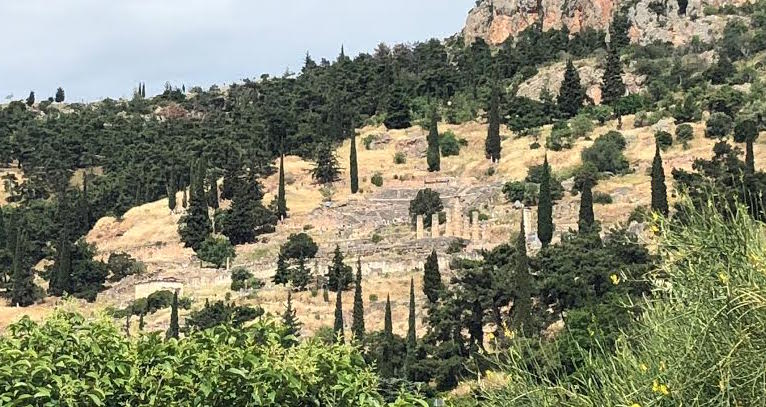
Delphi and Apollo’s Temple from a distance.
This article is not about the history of the Oracle (more accurately the Pythia-the Priestess who gave Apollo’s prophecies), but about my feelings for it, and what was invoked when I was actually among its remains. For me, Apollo’s Temple at Delphi, is unquestionably a place of Pagan Pilgrimage. It’s more than a historical site, it’s a spot where we know actual magick (divination-a form of magick) and worship (sacrifices and reverence for the gods) took place. The Parthenon in Athens is an amazing sight, but it’s never held my imagination in the way Delphi has over the decades.
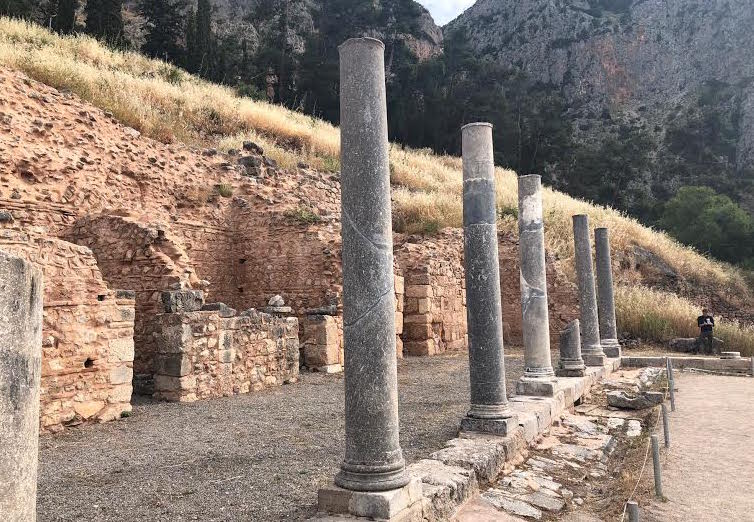
What’s left of a treasury I think.
Jerusalem Fever is the name given to “a well-documented phenomenon where foreign visitors suffer psychotic delusions that they are figures from the Bible or harbingers of the End of Days,” and something similar has been associated with Delphi over the years as well. It was not evident during my 26 hour visit, but I could see why it might happen in Delphi.
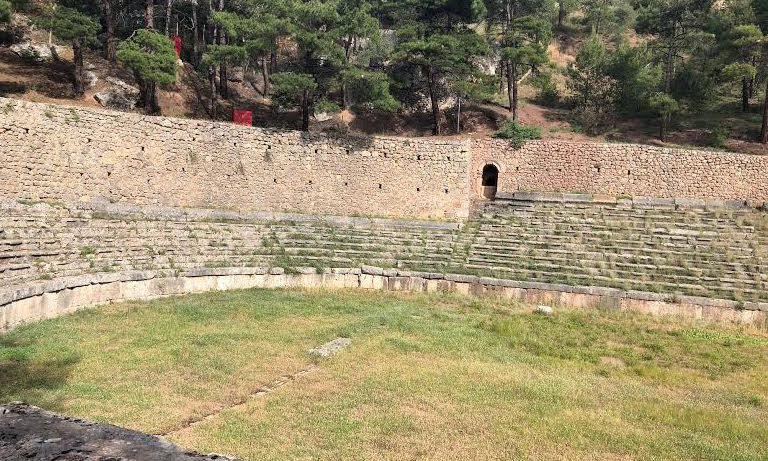
The coliseum, located behind the theatre and Temple of Apollo. Built by the Romans.
The village of Delphi is a three hour bus ride from Athens, but it might as well be a world away. The village hugs Mount Parnassus and consists of only a small handful of extremely narrow streets. Its streets remind me a great deal of Glastonbury, as most of them are filled with tourist brick-a-brack designed to part the worshippers of Zeus with the euros in their wallets. Hotels and taverns are all named after the Greek Gods, we stayed at the Hotel Leto and ate at the Cafe Dionysus. The gods may not be worshipped in Delphi town, but they are certainly honoured there.
A short walk from the town of Delphi is the site most of us call the Oracle of Delphi, or Delphi. “The Oracle” (as the name of a place) was a large temple complex built directly into the mountain its self. In ancient times it consisted of treasury buildings (all the major city-states contributed to the Oracle), a theatre, a coliseum (perhaps the best preserved ruin), and of course the Temple of Apollo where the Pythia gave her prophecies.
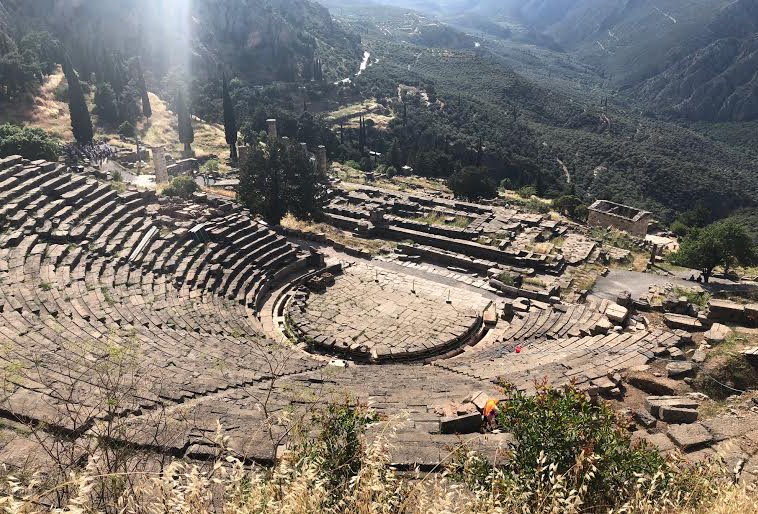
Theatre. I think Dionysus was saying hello.
Though the coliseum and theatre are the best preserved of the buildings at Delphi, it’s the Temple of Apollo which still commands reverence and awe. Apollo’s columns may be worn and mostly fallen, but they still retain much of their grandeur from 2500 years ago. If one walks up above the Temple and looks down upon it, it’s even more impressive. Such a view provides the devotee with a true measure of just how big Apollo’s temple was in its heyday. Such a view also allows the imagination to wander a bit more, to contemplate just where the Pythia might have stood while breathing in the sacred vapours so that she could touch the wisdom of Apollo.
The question I’m most often asked when visiting ancient sacred places is “did you feel anything?” Two days before below Athena’s Parthenon at a long destroyed temple of Dionysus I felt great sadness. Standing in the remnants of Apollo’s most famous shrine I felt hope and gained a small degree of comfort from the gods.
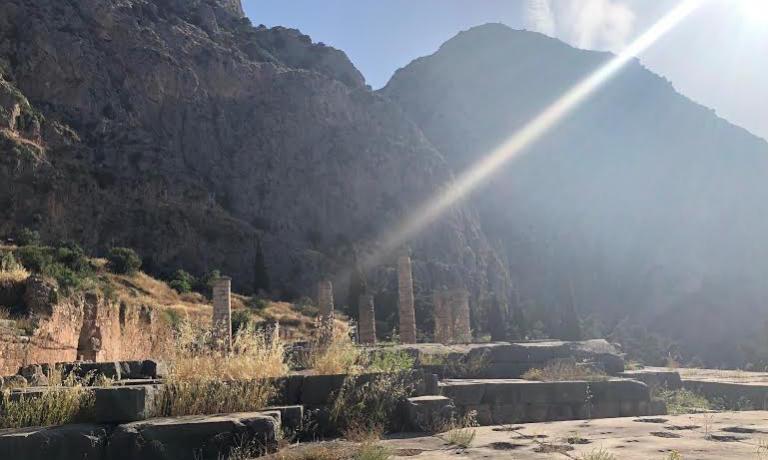
I have no words, The Temple of Apollo
I’m not sure that I felt them in the way I might in the flickering candlelight of a Witch circle, but during my morning at Apollo’s doorstep I felt the ancientness of the gods. It’s a power and a memory that goes back beyond the Greeks to the Indo-Europeans who shared their gods of sea, sky, and sun. Much of what remains at Delphi was built by the Roman Empire, an empire and people who adopted the gods of the Greeks and then took them to the rest of Europe just as the Macedonian Alexander the Great took them as far as India. Gods more selfish than those upon Mount Olympus tried to remove Zeus and his family from history, but they re-emerged during the Renaissance just as powerful as before and brought with them music, poetry, and art.
That’s what I felt as Apollo’s rays bathed Ari and I in golden light and a healthy sheen of sweat. I was not moved to make any sort of prophecy at Delphi, nor did I find myself wanting to worship the gods while there. (In all seriousness, the swarms of tourist groups made any sort of prolonged contemplation nearly impossible, and we beat most of them to the sight-it only got worse as our time at Delphi progressed.) But I felt their power and their enormity and their timelessness, and it’s a feeling I’ll return to again and again in the coming years when my faith wavers or I find myself in doubt.
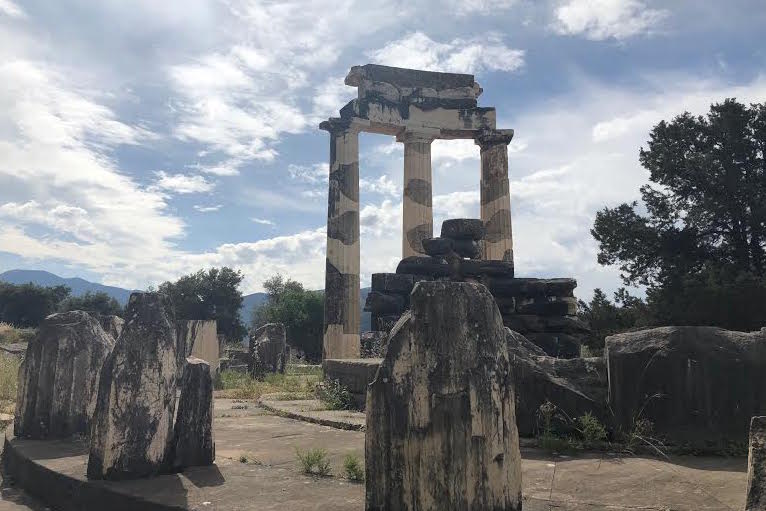
Temple of Athena Pronaia
ODDS AND ENDS FROM OUR TRIP
Less well known than the Temple of Apollo and less than a half of mile away stands what little remains of the Temple of Athena Pronaia. Unlike Apollo’s Temple it lacks ticket takers or a museum and the throngs of tourists that depart from buses to see the Oracle. I found this spot just as powerful as Apollo’s Temple, if not more so.
The “ray of light” I got on my Temple of Apollo pictures did not show up on the ones my wife took. I’m sure it’s just glare, but to me it felt as if Apollo himself was blessing us.
Am I a sucker for stuff with deities on it? Yes, I left Delphi with a Dionysus plate, two t-shirts, and an oak leaf/acorn wall hanging.
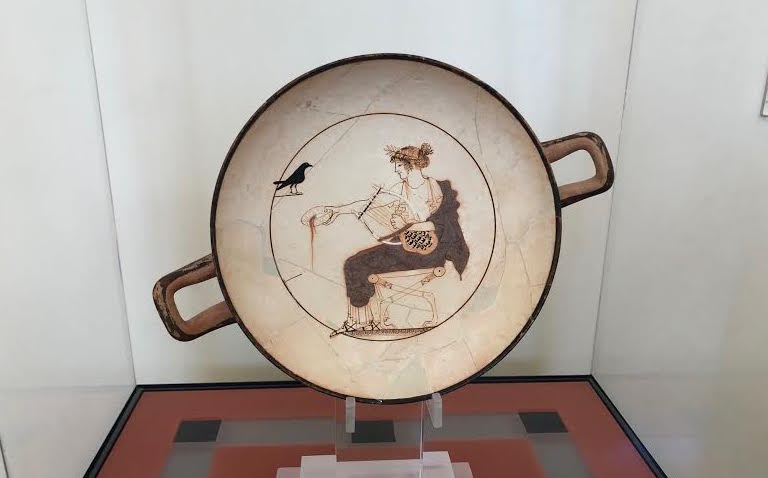
Apollo, of course I now own this on a t-shirt.
The art that’s been found at the temple complex is mostly all in the Delphi Museum. Not much remains, but some of it is absolutely stunning.
I’m writing this in Santorini, perhaps the island that inspired Plato’s stories of Atlantis.
Previous Post

May 7, 2018
Triumph & Tragedy Amongst the Gods in Athens Greece
Next Post
May 14, 2018 Adventures in Atlantis (Santorini)
Browse Our Archives
Select a Category Editorializing Gateways to Paganism Guest Posts Holiday Histories Led Zeppelin News and Views Occult Pagan Pagan TV Club Paganism polytheism Ramble On Reviews Ritual Strange Days Uncategorized
Select a Month August 2026 March 2026 February 2026 November 2025 September 2025 August 2025 April 2025 August 2024 April 2024 February 2024 December 2023 October 2023 August 2023 June 2023 May 2023 January 2023 October 2022 August 2022 July 2022 June 2022 May 2022 April 2022 March 2022 February 2022 January 2022 December 2021 November 2021 October 2021 September 2021 August 2021 July 2021 June 2021 April 2021 March 2021 February 2021 January 2021 December 2020 November 2020 October 2020 August 2020 July 2020 June 2020 May 2020 April 2020 March 2020 February 2020 January 2020 December 2019 November 2019 October 2019 September 2019 August 2019 July 2019 June 2019 May 2019 April 2019 March 2019 February 2019 January 2019 December 2018 November 2018 October 2018 September 2018 August 2018 July 2018 June 2018 May 2018 April 2018 March 2018 February 2018 January 2018 December 2017 November 2017 October 2017 September 2017 August 2017 July 2017 June 2017 May 2017 April 2017 March 2017 February 2017 January 2017 December 2016 November 2016 October 2016 September 2016 August 2016 July 2016 June 2016 May 2016 April 2016 March 2016 February 2016 January 2016 December 2015 November 2015 October 2015 September 2015 August 2015 July 2015 June 2015 May 2015 April 2015 March 2015 February 2015 January 2015 December 2014 November 2014 October 2014 September 2014 August 2014 July 2014 June 2014 May 2014 April 2014 March 2014 February 2014 January 2014 December 2013 November 2013 October 2013 September 2013 August 2013 July 2013 June 2013 May 2013 April 2013 March 2013 February 2013 January 2013 December 2012 November 2012 October 2012 September 2012 August 2012 July 2012 June 2012 April 2012 October 2011 September 2011 August 2011
Follow Us!
TAKE THE
Religious Wisdom Quiz
How many apostles did Jesus have?
Select your answer to see how you score.
12 4 14 11
Related posts from Raise the Horns


Can We Lose Deities? Fuzzy Polytheism, and Wicca...
Worship Is More Than Words & Offerings
TRENDING AT PATHEOS Pagan

Janie Learns the Way of the Cross: A...
Teaching children about Jesus' Passion can be challenging. Many parents and educators...

Looking For Good Catholic Writing - October 2026
He alone extends the heavens, and he walks upon the waves of...

In "Irreplaceable," our book on vocation and technology, Trevor Sutton and I...

I was strolling through the top floor of the brand new Parthenon...

What Does Gêvâh Mean For Kimberley Guifoyle &...
This week, a lot of the news is focused on Kimberly Guilfoyle....

INNER CIRCLE: Profound Mystery (Of Christ In All...
Ephesians 5:31-32 “For this reason, a man will leave his father and...
view all Pagan blogs
Ad-Free & Subscriber Log-In Subscription Support
- About Us
- 2026 Calendar
- Videos
- Podcasts
- Library of World Religions
- Faith In Media Tracker
- Advertise With Us
- Write for Us
- Privacy Policy
- Terms of Service
- Do Not Sell My Data
- Contact Us
- Radiant Digital
- Manage Newsletter Subscriptions
- Unsubscribe From Notifications
- Sitemap
Copyright 2008-2026, Patheos. All rights reserved.
Subscription Support Ad-Free & Subscriber Log-In
Follow Patheos