
BuddhistCatholicContemplativeEvangelicalGeneral ChristianHinduJewishLatter-day SaintMuslimNew VisionsProgressive Christian
Beliefs
- Buddhist
- Catholic
- Contemplative
- Evangelical
- General Christian
- Hindu
- Jewish
- Latter-day Saint
- More Voices
- Muslim
- New Visions
- Pagan
- Progressive Christian
Topics
- Religion News
- Food and Religion
- Sports and Religion
- Religious Art
- Religious Music and Entertainment
- Religious Events
- History and Religion
- Style and Religion
- Politics and Religion
- Women in Religion
- Recreation Outdoors and Religion
- Business Finance and Religion
- Careers Workplace and Religion
- Education and Religion
- Family Parenting and Religion
- Health Fitness and Religion
- Home and Religion
- Relationships and Religion
- Technology and Religion
- Travel and Religion
Columnists
- Buddhist Columnists
- Business Finance and Religion Columnists
- Careers Workplace and Religion Columnists
- Catholic Columnists
- Contemplative Columnists
- Education and Religion Columnists
- Evangelists Columnists
- Family Parenting and Religion Columnists
- General Christian Columnists
- Health Fitness and Religion Columnists
- Hindu Columnists
- History and Religion Columnists
- Home and Religion Columnists
- Jewish Columnists
- More Voices Columnists
- Latter Day Columnists
- Muslim Columnists
- New Visions Columnists
- Nonreligious Columnists
- Pagan Columnists
- Politics and Religion Columnists
- Progressive Columnists
- Recreation Outdoors and Religion Columnists
- Relationships and Religion Columnists
- Religion News Columnists
- Religious Art Columnists
- Religious Events Columnists
- Religious Music and Entertainment Columnists
- Sports and Religion Columnists
- Style and Religion Columnists
- Technology and Religion Columnists
- Travel and Religion Columnists
- Women in Religion Columnists
Resource Library
- 2026 Calendar
- Library of World Religions
- The 100 Most Holy Places on Earth
- Patheos Answers
- Podcasts
- Videos
- Faith Leaders Database
- Anglican Episcopalian
- Bahai
- Baptist
- Buddhism
- Christianity
- Confucianism
- Eastern Orthodoxy
- Hinduism
- Holiness and Pentecostal
- ISKCON
- Islam
- Judaism
- Lutheran
- Methodist
- The Church of Jesus Christ of Latter-day Saints
- New Age
- Paganism
- Presbytarian and Reformed
- Protestantism
- Religion Behind the Scenes
- Roman Catholic
- Scientology
- Shia Islam
- Sikhism
- Sufism
- Sunni Islam
- Taoism
- Zen
- See all religions
Research Tools
 Ad-Free & Subscriber Log-In Subscription Support
Ad-Free & Subscriber Log-In Subscription Support
Follow Patheos 

- Trending:
- Forgiveness
- |
- Marriage
- |
- Consciousness
- |
- Death Penalty
- |
- Election
- |
- Halloween

- HOME
- Me and the Blog
- Defining Pagan
- Rituals & Holidays
- All Posts
- Blogroll
- Publications
- FREE NEWSLETTER
- Home
- Pagan
- Adventures in Minoan Crete
Adventures in Minoan Crete
Last updated on: May 18, 2018 at 9:00 am by Jason Mankey
Adventures in Minoan Crete 2018-05-18T09:00:19-06:00 Jason Mankey
Patheos Explore the world's faith through different perspectives on religion and spirituality! Patheos has the views of the prevalent religions and spiritualities of the world.
Shortly after leaving the Heraklion Archeological Museum this afternoon I turned to my wife and said “If I had to choose between the famous places in Greece or the museums, I’d choose the museums.” The museums are where one can still see the gods (or what’s left of them anyways), the wall paintings, and most of whatever else has survived from Ancient Greece. A place like Delphi is more than a collection of rocks, but without its artefacts and context so much of what made Delphi Delphi is lost.
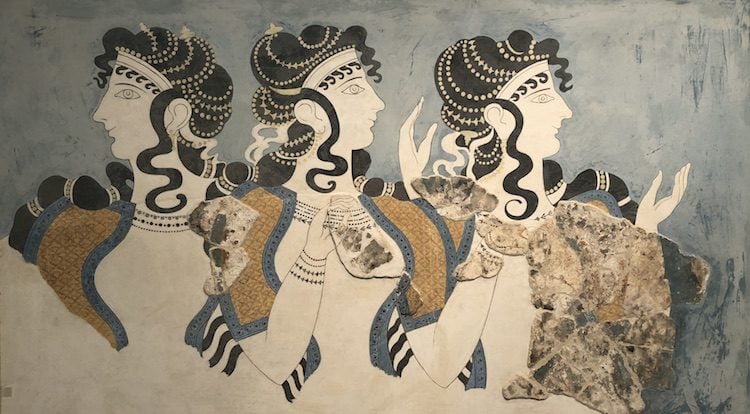
One of the most iconic images from Minoan Crete.
I realize how difficult it is to preserve things from the very distant past, especially things that were actively hated by a new faith absolutely terrified of classical paganism. Some of the best preserved archeological sites of the ancient world are those preserved due to catastrophe and forgetfulness. Pompeii and Akrotiri were encased in pumice and ash, and while tragic for the people who lived there, those events gave us an unparalleled peak into ancient history. The tomb of King Tutankhamun remained mostly undisturbed until the 20th Century because he had been mostly erased from Egyptian history.
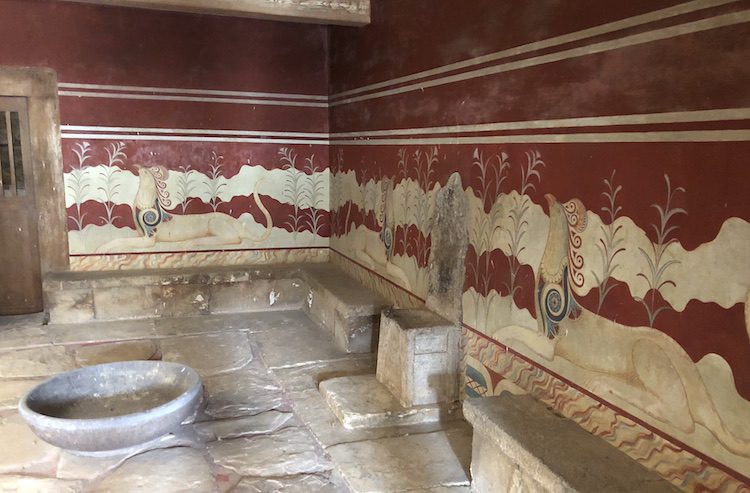
“The Throne Room” at Knossos.
Something similar happened on the Greek island of Crete when the legends of King Minos and his Minoan civilisation went from being a part of history to a part of mythology. The greatest city of the Minoans, Knossos (often dubbed the first city in Europe), spent several centuries buried, and when it was finally unearthed at the start of the 20th Century it came with several treasures. In the annals of history, Knossos is a huge deal, having first been settled in 7000 BCE, eventually ballooning into a city of over 100,000 people in 1700 BCE. (Knossos remained inhabited for centuries after the collapse of the Minoan civilisation in 1100 BCE, but was eventually abandoned in the 9th Century.)
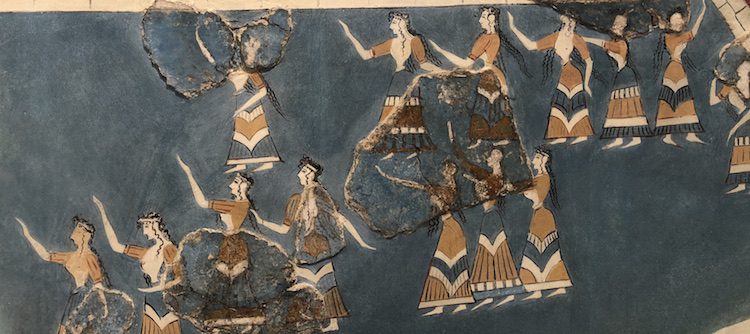
Worshipping the Goddess.
Though Knossos hosted Romans, Macedonians, Mycenaean Greeks, and stone age cultures whose names are lost to history, it’s most famous as the home of the Minoans. When people visit Knossos today they are visiting the remains of a grand palace built between 1700 and 1400 BCE. The most famous parts of it were excavated by the Englishman Arthur Evans. Even today, 75 plus years after his death, his work dominates what’s been unearthed at Knossos, with most signs at the complex reading “according to Arthur Evans.”
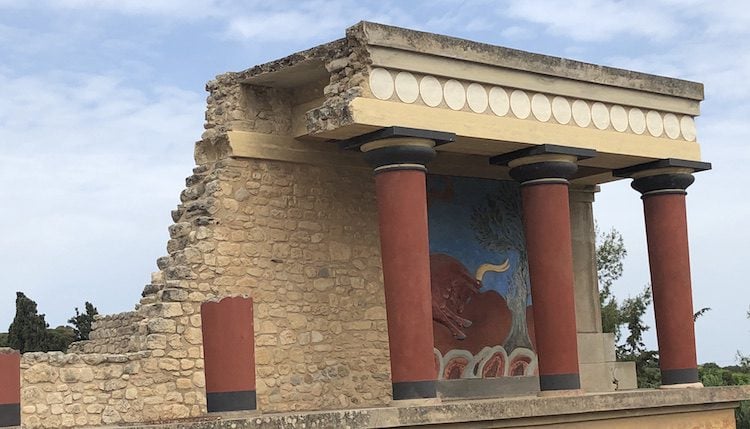
An Evans recreation, either you like it or you don’t.
There are two three things you should know about Evans and his excavations at Knossos. The first is that I believe he tried his very best. He made the best guesses he could and did the best with what he had available to him. The problem with that is (and this is the second thing), he was often wrong. But his work so dominates that Knossos that all of the rooms and structures there continue to use the names he assigned to them a 100 years ago.
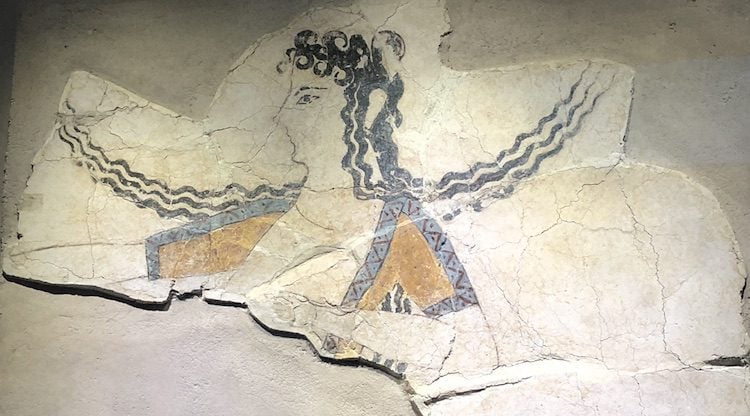
Most likely a (or The) Goddess.
The third thing about Evans is either something one will appreciate or absolutely hate: he tried to reassemble parts of the place at Knossos. Now I’m not talking about stacking pieces of column on top of each other to recreate a column, I’m talking “let’s add some concrete and rebuild this room.” He also painted on the walls in the palace attempting to recreate the wall paintings discovered there. He also had certain pillars repainted to match what they might have looked like in antiquity.
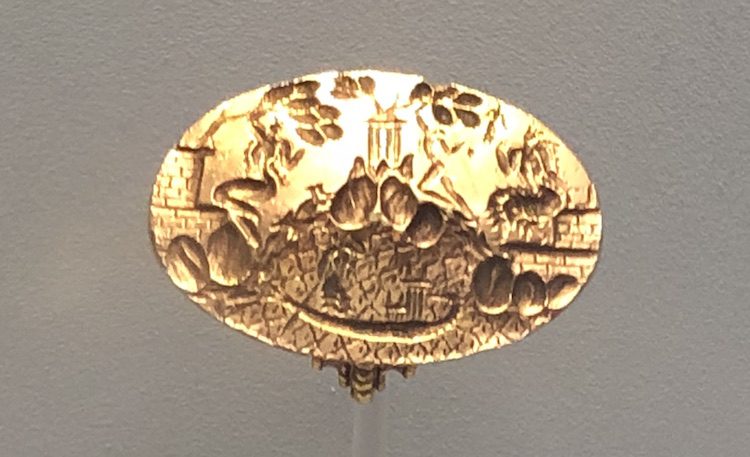
Minoan Bee Pendant.
Evans’ cosmetic surgery at Knossos has led some to dub to the “Disneyland of Archeological Sites” (at least according to Trip Advisor) but I kind of like it. The problem I alluded to at the start of this piece is a huge one for classical Greek sites. Many of them mostly look like piles of rocks with the odd pillar still standing up. I like using my imagination at historical sites, but when it comes to a lot of spots in Greece SO MUCH has been lost and destroyed (and what has survived is sometimes miles away in a museum) that it’s nearly impossible. At least Evans’ Disneyfied throne rooms paint a picture of what it might have been like to be in those rooms when they were in use.
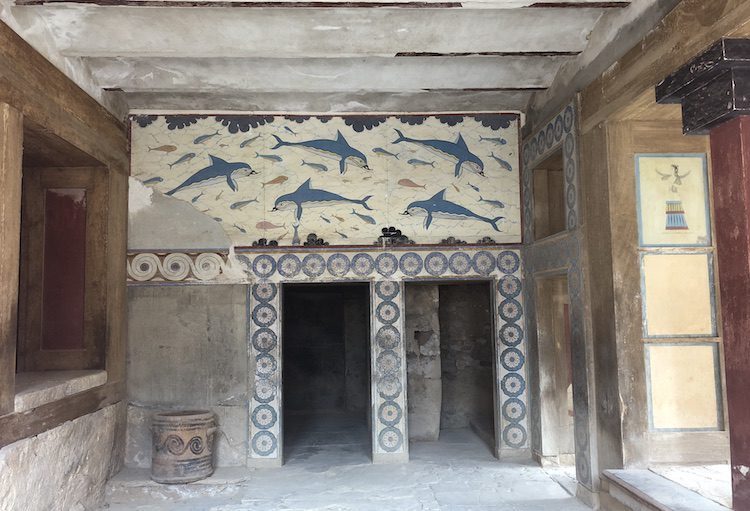
“The Queen’s Room” at Knossos.
One of the best things about Knossos is how much religious stuff has survived. Most famous is the Minoan Snake Goddess (or Goddesses) and she lives up to her reputation. Gazing upon the original her with my own eyes is something I’ll cherish forever. Goddess worship, along with some sort of bull veneration representing the masculine, seems to have made up the religion of the Minoans. The Goddess, with her dancers holding their hands towards the sky, is a beautiful image.
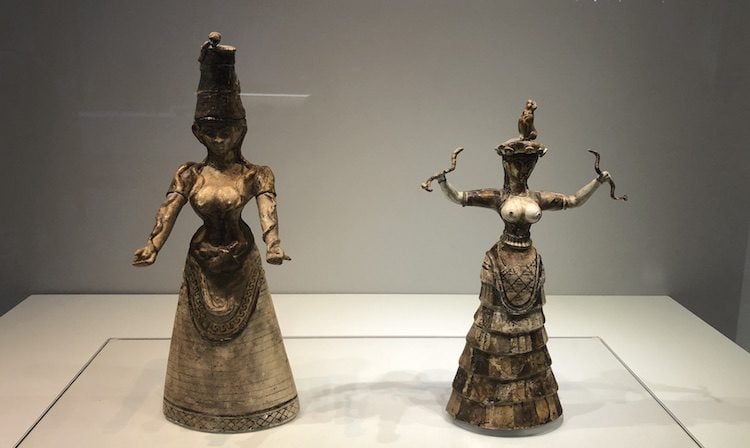
Snake Goddess! (Or Goddesses)
Crete might be most famous for the wall paintings that have survived, and what has survived is impressive, it’s just not as much as you might think. When you really get up close to the paintings (in the museum of course, not the actual site) it’s easy to see how much has been filled in by modern artists and archeologists. I’m sure that what’s been done (most likely) represents what was there, but how will we ever know for sure? It was glorious and heart breaking to see all at the same time.
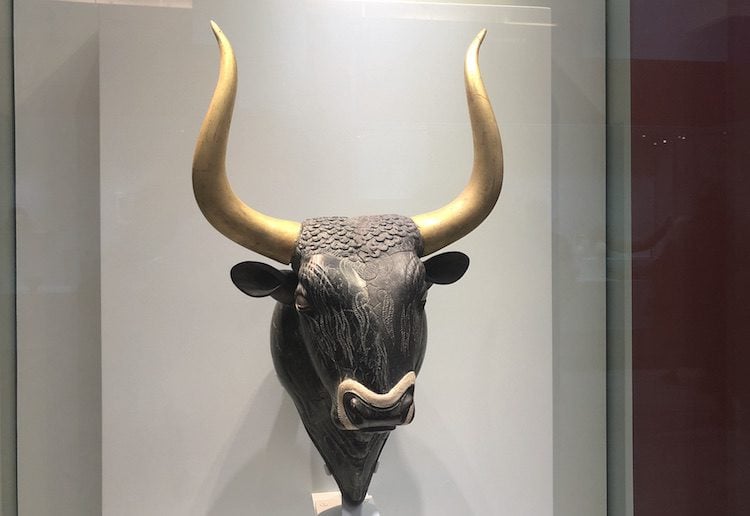
Pour it out of the libation bull.
Some of the most amazing artefacts from Knossos are the bull’s head rhytons (libation vases). I remember the first time I ever saw one in a book and thinking “that’s a beautiful statue!” and was amazed to think it was a working tool. In addition to the libation cups, Ari and I loved Minoan jewellery, all of it would still be impressive today (and not just the stuff made out of gold).
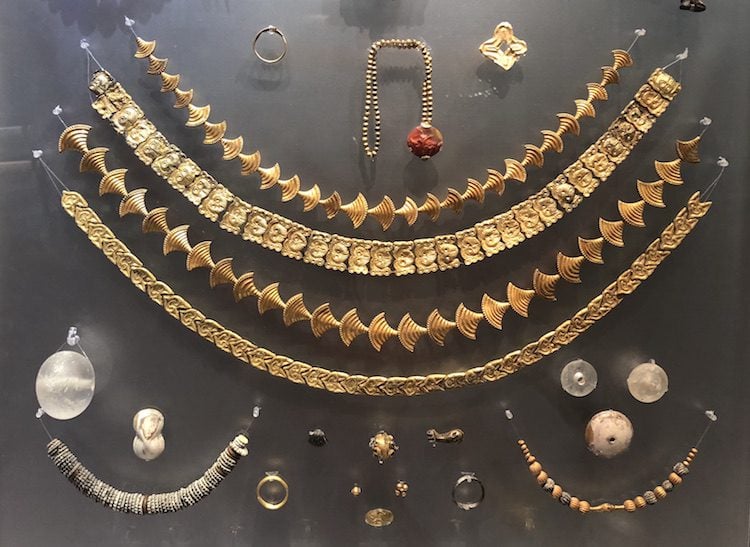
So pretty!
Speaking of religious artefacts, I almost forget to mention the double headed axe symbol that’s all over Knossos. It was most likely used for protection and to keep death away (at least that’s what the signs said). The axes show up on jewellery, pottery, and were simply mounted on walls at Knossos. The ones below were over a foot wide!
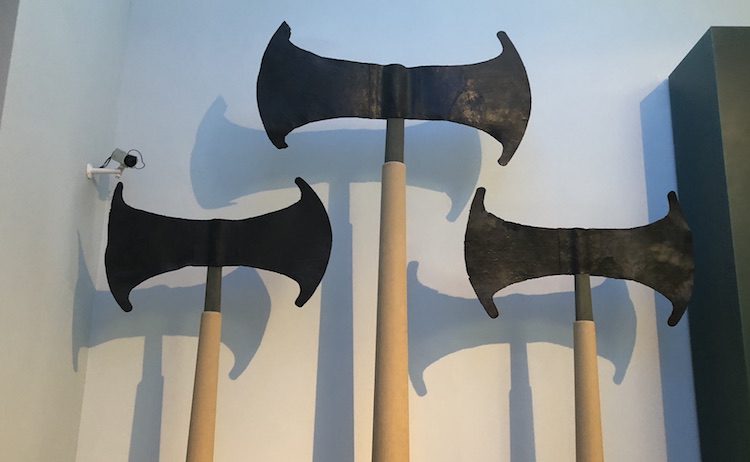
So much more to write about this trip to Greece in the coming months, and certainly much more to process. Greece has been lovely, and as we prepare to leave its golden shores I find myself craving tacos and buffalo sauce. But before those cravings are satisfied, we are spending a few days in Croatia, two nights in the UK, and then we’ll be back home in the Bay Area.
Happy Travels.
Previous Post
May 14, 2018
Adventures in Atlantis (Santorini)
Next Post
May 29, 2018 Where the Gods Live
Browse Our Archives
Select a Category Editorializing Gateways to Paganism Guest Posts Holiday Histories Led Zeppelin News and Views Occult Pagan Pagan TV Club Paganism polytheism Ramble On Reviews Ritual Strange Days Uncategorized
Select a Month August 2026 March 2026 February 2026 November 2025 September 2025 August 2025 April 2025 August 2024 April 2024 February 2024 December 2023 October 2023 August 2023 June 2023 May 2023 January 2023 October 2022 August 2022 July 2022 June 2022 May 2022 April 2022 March 2022 February 2022 January 2022 December 2021 November 2021 October 2021 September 2021 August 2021 July 2021 June 2021 April 2021 March 2021 February 2021 January 2021 December 2020 November 2020 October 2020 August 2020 July 2020 June 2020 May 2020 April 2020 March 2020 February 2020 January 2020 December 2019 November 2019 October 2019 September 2019 August 2019 July 2019 June 2019 May 2019 April 2019 March 2019 February 2019 January 2019 December 2018 November 2018 October 2018 September 2018 August 2018 July 2018 June 2018 May 2018 April 2018 March 2018 February 2018 January 2018 December 2017 November 2017 October 2017 September 2017 August 2017 July 2017 June 2017 May 2017 April 2017 March 2017 February 2017 January 2017 December 2016 November 2016 October 2016 September 2016 August 2016 July 2016 June 2016 May 2016 April 2016 March 2016 February 2016 January 2016 December 2015 November 2015 October 2015 September 2015 August 2015 July 2015 June 2015 May 2015 April 2015 March 2015 February 2015 January 2015 December 2014 November 2014 October 2014 September 2014 August 2014 July 2014 June 2014 May 2014 April 2014 March 2014 February 2014 January 2014 December 2013 November 2013 October 2013 September 2013 August 2013 July 2013 June 2013 May 2013 April 2013 March 2013 February 2013 January 2013 December 2012 November 2012 October 2012 September 2012 August 2012 July 2012 June 2012 April 2012 October 2011 September 2011 August 2011
Follow Us!
TAKE THE
Religious Wisdom Quiz
What does the name "Elijah" mean?
Select your answer to see how you score.
God saves God heals My God is Yahweh God is judge
Related posts from Raise the Horns

Can We Lose Deities? Fuzzy Polytheism, and Wicca...
The Eleusian Mysteries: Initiation in the Ancient World

TRENDING AT PATHEOS Pagan

Pope Leo Celebrates Mass for Nurses & Docs...
I don't have any idea how he did it, but Pope Leo...

The Sermon on the Mount, Part I: Matthew...
The Sermon on the Mount, Part I (Matthew 4:12-5:12) St. Matthew moves...

What's up from Crossway: Reviewing some of their latest A few weeks...

Janie Learns the Way of the Cross: A...
Teaching children about Jesus' Passion can be challenging. Many parents and educators...

Looking For Good Catholic Writing - October 2026
He alone extends the heavens, and he walks upon the waves of...

In "Irreplaceable," our book on vocation and technology, Trevor Sutton and I...
view all Pagan blogs
Ad-Free & Subscriber Log-In Subscription Support
- About Us
- 2026 Calendar
- Videos
- Podcasts
- Library of World Religions
- Faith In Media Tracker
- Advertise With Us
- Write for Us
- Privacy Policy
- Terms of Service
- Do Not Sell My Data
- Contact Us
- Radiant Digital
- Manage Newsletter Subscriptions
- Unsubscribe From Notifications
- Sitemap
Copyright 2008-2026, Patheos. All rights reserved.
Subscription Support Ad-Free & Subscriber Log-In
Follow Patheos