
BuddhistCatholicContemplativeEvangelicalGeneral ChristianHinduJewishLatter-day SaintMuslimNew VisionsProgressive Christian
Beliefs
- Buddhist
- Catholic
- Contemplative
- Evangelical
- General Christian
- Hindu
- Jewish
- Latter-day Saint
- More Voices
- Muslim
- New Visions
- Pagan
- Progressive Christian
Topics
- Religion News
- Food and Religion
- Sports and Religion
- Religious Art
- Religious Music and Entertainment
- Religious Events
- History and Religion
- Style and Religion
- Politics and Religion
- Women in Religion
- Recreation Outdoors and Religion
- Business Finance and Religion
- Careers Workplace and Religion
- Education and Religion
- Family Parenting and Religion
- Health Fitness and Religion
- Home and Religion
- Relationships and Religion
- Technology and Religion
- Travel and Religion
Columnists
- Buddhist Columnists
- Business Finance and Religion Columnists
- Careers Workplace and Religion Columnists
- Catholic Columnists
- Contemplative Columnists
- Education and Religion Columnists
- Evangelists Columnists
- Family Parenting and Religion Columnists
- General Christian Columnists
- Health Fitness and Religion Columnists
- Hindu Columnists
- History and Religion Columnists
- Home and Religion Columnists
- Jewish Columnists
- More Voices Columnists
- Latter Day Columnists
- Muslim Columnists
- New Visions Columnists
- Nonreligious Columnists
- Pagan Columnists
- Politics and Religion Columnists
- Progressive Columnists
- Recreation Outdoors and Religion Columnists
- Relationships and Religion Columnists
- Religion News Columnists
- Religious Art Columnists
- Religious Events Columnists
- Religious Music and Entertainment Columnists
- Sports and Religion Columnists
- Style and Religion Columnists
- Technology and Religion Columnists
- Travel and Religion Columnists
- Women in Religion Columnists
Resource Library
- 2026 Calendar
- Library of World Religions
- The 100 Most Holy Places on Earth
- Patheos Answers
- Podcasts
- Videos
- Faith Leaders Database
- Anglican Episcopalian
- Bahai
- Baptist
- Buddhism
- Christianity
- Confucianism
- Eastern Orthodoxy
- Hinduism
- Holiness and Pentecostal
- ISKCON
- Islam
- Judaism
- Lutheran
- Methodist
- The Church of Jesus Christ of Latter-day Saints
- New Age
- Paganism
- Presbytarian and Reformed
- Protestantism
- Religion Behind the Scenes
- Roman Catholic
- Scientology
- Shia Islam
- Sikhism
- Sufism
- Sunni Islam
- Taoism
- Zen
- See all religions
Research Tools
 Ad-Free & Subscriber Log-In Subscription Support
Follow Patheos 

- Trending:
- Advent
- |
- Forgiveness
- |
- Thanksgiving
- |
- Election
- |
- Seasonal Holidays
- |
- Marriage

- HOME
- Me and the Blog
- Defining Pagan
- Rituals & Holidays
- All Posts
- Blogroll
- Publications
- FREE NEWSLETTER
- Home
- Pagan
- The Witch’s Guide to Ostara
The Witch’s Guide to Ostara
Last updated on: March 13, 2018 at 5:56 pm by Jason Mankey
The Witch’s Guide to Ostara 2018-03-13T17:56:58-06:00 Jason Mankey
Patheos Explore the world's faith through different perspectives on religion and spirituality! Patheos has the views of the prevalent religions and spiritualities of the world.
What Is It? Ostara is a sabbat celebrating the Spring or Vernal Equinox. Modern Witches have been celebrating it since at least the 1950’s, and possibly even earlier. Depending on where you live and how you interpret the Wheel of the year, Ostara is either the first or second sabbat celebrating Spring. Ostara can be celebrated on the equinox proper (usually around the 20 of March) or simply when a Witch has the time for it. Ostara is one of the “lesser sabbats,” a phrase used to describe the sabbats that occur on the equinoxes and solstices.

The Maiden spending some time next to my cherry tree.
Did Ancient Pagans Celebrate Ostara? Surprisingly, they did not. Ostara is a modern holiday, not an ancient one. There are some holidays celebrated on the Spring Equinox, including the Iranian New Year, called Nooroz or Nowruz. In Japan the holiday of Shunbun (春分) is celebrated on the equinox and serves as a time to remember the dead, pray to the spirits of the land, and celebrate the rebirth of the Earth.
Where does the name Ostara come from?: The Spring Equinox was given the name Ostara by American-born Witch and poet Aidan Kelly. While putting together a Witchcraft calendar in 1974 Kelly decided to gift the equinoxes and solstices with more poetic names than “Spring Equinox” and “Summer Solstice.” For the Spring Equinox he chose the word Ostara, which comes to us from the British historian Bede.
According to Bede (673-735 CE) the word “Easter” comes from a goddess named Eostre, whose name was given to an entire month “Eostur-month,” and then eventually to one specific holiday occurring in that month, the one we now call Easter. Eostre is mostly absent from the historical record, but it seems unlikely that Bede would have made up a goddess out of whole cloth. Bede mentions that by the time he was writing about her, her worship had already ceased. More recently linguist Philip Shaw has argued that Eostre was most likely a Germanic Matron Goddess worshipped by Anglo-Saxons in present day county Kent.
A goddess named Ostara also shows up in the writings of folklorist Jacob Grimm. Grimm speculated that there was a goddess named Ostara and that the Christian holiday of Easter was named after her. Grimm also gathered up all the elements he thought were “pagan” and matched them to his goddess. Modern interpretations of the goddess Eostre generally follow the template established by Grimm. Though there’s no concrete proof pointing towards a historical Ostara as articulated by Grimm, it’s not completely out of the question.
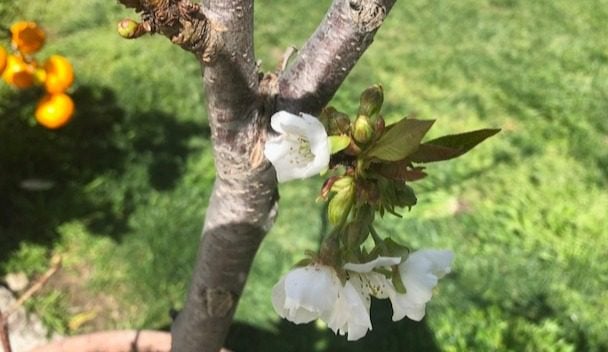
First cherry blossoms of the year!
Are Easter and Ostara the Same Thing?: No, they are not the same thing. Easter is a Christian Holiday and is celebrated on the first full moon after the equinox. This tradition was adapted from the Jewish tradition of celebrating Passover in accordance with the Hebrew lunar calendar. It’s also worth pointing out that Easter is only called Easter in English (in German it’s Ostern which is pretty close!), in most places it goes by a variant of the Greek word Pascha, meaning Passover. Easter may be named after the goddess Eostre, but it was celebrated long before the name Easter was adopted in English.
Are Any of the Traditions Associated with Easter Pagan?: Maybe? Probably? Possibly? Bunnies have nothing to do with Jesus, and neither do eggs. Eggs have been used by Christians and ancient pagans for a variety of things and have all sorts of symbolic connotations. Rabbits are a part of the natural worlds and like to have sex, that’s pretty Pagan to me, no matter when the tradition of the first Easter Bunny was adopted. No one really knows how those things came to be assosciated with Easter, they might be a genuine pagan survival, or something of a more recent vintage. We’ll probably never know for sure.
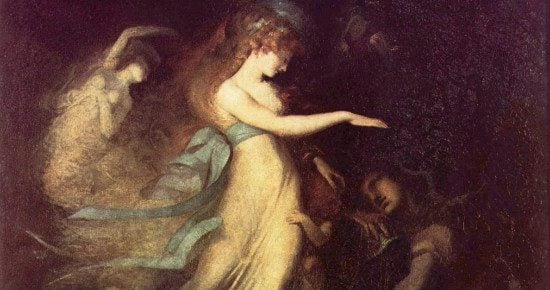
Prince Arthur and the Faerie Queen” by Henry Fuseli. From WikiMedia
What Are the Best Ways to Celebrate Ostara? I think the sabbats should represent what is going on in your back yard. Are trees budding and flowers blooming? Then celebrate that. Is it snowy and cold? They build your ritual around the promise of warmer days or go out and have a snowball fight. There are no right or wrong ways to celebrate.
In my coven we use many of the traditional trappings of Easter for our celebrations. We bake hotcross buns, do stuff with eggs, and celebrate just how green the Earth is this time of year. (The latter is because we currently live in California. In Michigan we used to celebrate Ostara as “the last snow of the year,” which sometimes it was, more often, it wasn’t).
I always find Ostara to be a great time to let my out my inner child, and associate the holiday with new beginnings, spring planting, and personal growth. Since it’s not quite Spring in her full glory yet, it’s also a time of preparation. In keeping with the idea of “Spring cleaning,” Ostara is also a great time to throw out anything that’s not working in your life and find a replacement for it.
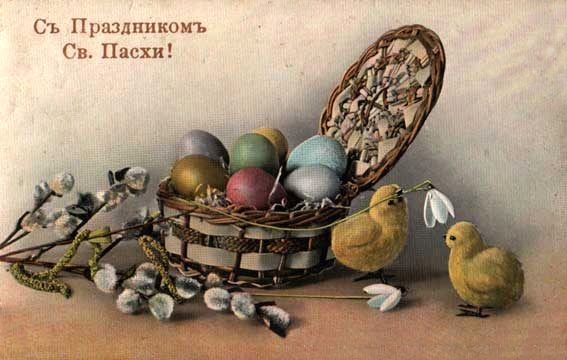
Vintage Russian postcard, courtesy of WikiMedia.
Is There Any Mythology Specifically Associated with Ostara? Many Witches celebrate the first meeting of their deities around this time of year. In the cosmology my wife and I generally use, we celebrate the first meeting of the Maiden Fair and her future lover the Goat Boy on Ostara. I also like to speculate on the first meetings of the Maidens Fair and the Goat Boys.
The classic myth of Demeter and Persephone also works well on Ostara, as does the lesser known myth of Aphrodite, Persephone, and Adonis. If a myth makes sense to you this time of year it’s fair game.
Ishtar is Not Related to Ostara or Easter A meme makes its way through the world this time of year erroneously equating the goddess Ishtar with both Easter and Ostara, it’s not true, so please don’t share it.
Previous Post

March 2, 2018
Five Good Reasons to Be a Pagan
Next Post

March 21, 2018 The Care & Keeping Of Your Coven
Browse Our Archives
Select a Category Editorializing Gateways to Paganism Guest Posts Holiday Histories Led Zeppelin News and Views Occult Pagan Pagan TV Club Paganism polytheism Ramble On Reviews Ritual Strange Days Uncategorized
Select a Month August 2026 March 2026 February 2026 November 2025 September 2025 August 2025 April 2025 August 2024 April 2024 February 2024 December 2023 October 2023 August 2023 June 2023 May 2023 January 2023 October 2022 August 2022 July 2022 June 2022 May 2022 April 2022 March 2022 February 2022 January 2022 December 2021 November 2021 October 2021 September 2021 August 2021 July 2021 June 2021 April 2021 March 2021 February 2021 January 2021 December 2020 November 2020 October 2020 August 2020 July 2020 June 2020 May 2020 April 2020 March 2020 February 2020 January 2020 December 2019 November 2019 October 2019 September 2019 August 2019 July 2019 June 2019 May 2019 April 2019 March 2019 February 2019 January 2019 December 2018 November 2018 October 2018 September 2018 August 2018 July 2018 June 2018 May 2018 April 2018 March 2018 February 2018 January 2018 December 2017 November 2017 October 2017 September 2017 August 2017 July 2017 June 2017 May 2017 April 2017 March 2017 February 2017 January 2017 December 2016 November 2016 October 2016 September 2016 August 2016 July 2016 June 2016 May 2016 April 2016 March 2016 February 2016 January 2016 December 2015 November 2015 October 2015 September 2015 August 2015 July 2015 June 2015 May 2015 April 2015 March 2015 February 2015 January 2015 December 2014 November 2014 October 2014 September 2014 August 2014 July 2014 June 2014 May 2014 April 2014 March 2014 February 2014 January 2014 December 2013 November 2013 October 2013 September 2013 August 2013 July 2013 June 2013 May 2013 April 2013 March 2013 February 2013 January 2013 December 2012 November 2012 October 2012 September 2012 August 2012 July 2012 June 2012 April 2012 October 2011 September 2011 August 2011
Follow Us!
TAKE THE
Religious Wisdom Quiz
Who saw a vision of a flying scroll with curses written on it?
Select your answer to see how you score.
Micah Zechariah Ezekiel Daniel
Related posts from Raise the Horns
What Makes a Good Ritualist? No Idea

Witchcraft Remembrances & Appreciation at Samhaintide
Raymond Buckland & The Big Blue Book
TRENDING AT PATHEOS Pagan

Rock N' Roll-- Morphing into/for a New Generation...
Well, should we be grateful, or is rock n' roll just dead? ...

Ansley Gordon Brings Faith and Fresh Stories to...
For screenwriter and actress Ansley Gordon, Christmas has always been about more...

Chris Pratt on Veterans, Faith, “The Way of...
For Chris Pratt, service is not something that ends when a person...

Chapter 5, Sarah: The Quest for Safety in...
Open and Relational Theology & Social Psychology About this series: This series...

When Worry Gets You Nowhere, How Can Faith...
Sometimes, we think that by worrying, we can somehow predict the future....

The Wasp And I: Meditations on Repentance
How can we enter the power and joy of the repentant self...
view all Pagan blogs
Ad-Free & Subscriber Log-In Subscription Support
- About Us
- 2026 Calendar
- Videos
- Podcasts
- Library of World Religions
- Faith In Media Tracker
- Advertise With Us
- Write for Us
- Privacy Policy
- Terms of Service
- Do Not Sell My Data
- Contact Us
- Radiant Digital
- Manage Newsletter Subscriptions
- Unsubscribe From Notifications
- Sitemap
Copyright 2008-2026, Patheos, part of the Radiant Digital network of media brands. All rights reserved.
Subscription Support Ad-Free & Subscriber Log-In
Follow Patheos