
BuddhistCatholicContemplativeEvangelicalGeneral ChristianHinduJewishLatter-day SaintMuslimNew VisionsProgressive Christian
Beliefs
- Buddhist
- Catholic
- Contemplative
- Evangelical
- General Christian
- Hindu
- Jewish
- Latter-day Saint
- More Voices
- Muslim
- New Visions
- Pagan
- Progressive Christian
Topics
- Religion News
- Food and Religion
- Sports and Religion
- Religious Art
- Religious Music and Entertainment
- Religious Events
- History and Religion
- Style and Religion
- Politics and Religion
- Women in Religion
- Recreation Outdoors and Religion
- Business Finance and Religion
- Careers Workplace and Religion
- Education and Religion
- Family Parenting and Religion
- Health Fitness and Religion
- Home and Religion
- Relationships and Religion
- Technology and Religion
- Travel and Religion
Columnists
- Buddhist Columnists
- Business Finance and Religion Columnists
- Careers Workplace and Religion Columnists
- Catholic Columnists
- Contemplative Columnists
- Education and Religion Columnists
- Evangelists Columnists
- Family Parenting and Religion Columnists
- General Christian Columnists
- Health Fitness and Religion Columnists
- Hindu Columnists
- History and Religion Columnists
- Home and Religion Columnists
- Jewish Columnists
- More Voices Columnists
- Latter Day Columnists
- Muslim Columnists
- New Visions Columnists
- Nonreligious Columnists
- Pagan Columnists
- Politics and Religion Columnists
- Progressive Columnists
- Recreation Outdoors and Religion Columnists
- Relationships and Religion Columnists
- Religion News Columnists
- Religious Art Columnists
- Religious Events Columnists
- Religious Music and Entertainment Columnists
- Sports and Religion Columnists
- Style and Religion Columnists
- Technology and Religion Columnists
- Travel and Religion Columnists
- Women in Religion Columnists
Resource Library
- 2026 Calendar
- Library of World Religions
- The 100 Most Holy Places on Earth
- Patheos Answers
- Podcasts
- Videos
- Faith Leaders Database
- Anglican Episcopalian
- Bahai
- Baptist
- Buddhism
- Christianity
- Confucianism
- Eastern Orthodoxy
- Hinduism
- Holiness and Pentecostal
- ISKCON
- Islam
- Judaism
- Lutheran
- Methodist
- The Church of Jesus Christ of Latter-day Saints
- New Age
- Paganism
- Presbytarian and Reformed
- Protestantism
- Religion Behind the Scenes
- Roman Catholic
- Scientology
- Shia Islam
- Sikhism
- Sufism
- Sunni Islam
- Taoism
- Zen
- See all religions
Research Tools
 Ad-Free & Subscriber Log-In Subscription Support
Ad-Free & Subscriber Log-In Subscription Support
Follow Patheos 

- Trending:
- Forgiveness
- |
- Marriage
- |
- Consciousness
- |
- Death Penalty
- |
- Election
- |
- Halloween

- HOME
- Me and the Blog
- Defining Pagan
- Rituals & Holidays
- All Posts
- Blogroll
- Publications
- FREE NEWSLETTER
- Home
- Pagan
- The 5 Most Important Books in the Modern Witchcraft Revival
The 5 Most Important Books in the Modern Witchcraft Revival
Last updated on: September 27, 2017 at 6:14 pm by Jason Mankey
The 5 Most Important Books in the Modern Witchcraft Revival 2017-09-27T18:14:48-06:00 Jason Mankey
Patheos Explore the world's faith through different perspectives on religion and spirituality! Patheos has the views of the prevalent religions and spiritualities of the world.
THE WITCH-CULT IN WESTERN EUROPE & THE GOD OF THE WITCHES
by Margaret Murray Originally published in 1921 and 1931 respectively
Is it fair to count two books as one, even if they share the same author? Maybe not, but I’m going to anyways because this is my blog and I make the rules. Witch-Cult is by far the more famous book (though far less readable), and probably did more to rehabilitate the word “Witch” than any other book written in English. Murray’s Witches sacrificed babies, held orgies, feasted, danced, and promised their souls to Satan, which doesn’t sound all that positive, but they did so while loving the land, celebrating the earth, and because their religion had been corrupted by persecution from Christians. About the only way I know how to put it is that Murray made her readers possibly want to be Witches, or at least look at them with a more sympathetic eye.
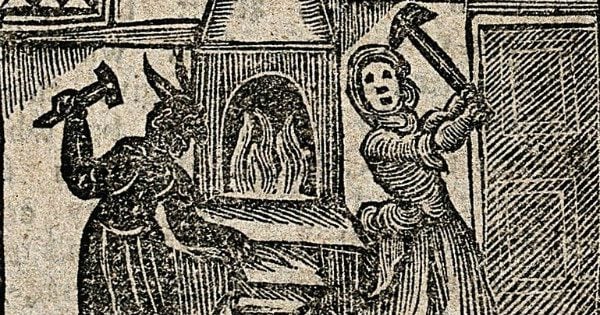
A witch and her devil. From Wikimedia.
In Witch-Cult Murray gives us the lexicon that many Witches still use today. In her work we find words like esbat, coven, familiar, and almost sabbat (she adds an “h” at the end), and she also provides a rudimentary Wheel of the Year to aspiring Witches:
“.. The chief festivals were: in the spring, May Eve (April 30), called Roodmas or Rood Day in Britain and Walpurgis−Nacht in Germany; in the autumn, November Eve (October 31), called in Britain All hallow Eve. Between these two came: in the winter, Candlemas (February 2); and in the summer, the Gule of August (August 1), called Lammas in Britain. To these were added the festivals of the solstitial invaders, Beltane at midsummer and Yule at midwinter; the movable festival of Easter was also added, but the equinoxes were never observed in Britain.”
She’s got everything in there except for the equinoxes, though she uses Beltane as the name for the Summer Solstice.
Witch-Cult is probably best remembered today for the “Murray Hypothesis,” the idea that Witchcraft was an organized religion that existed side by side and in opposition to Christianity for several centuries until the followers of Jesus had had enough. According to Murray the Witchcraft religion was then driven underground and their Horned God was eventually transformed into the Christian Devil. Scholars have never taken the entire Murray thesis seriously, but that doesn’t make her any less influential. Even without the hypothesis her writings on Witchcraft would have had some sort of impact.
I think The God of the Witches is the superior book among the two. It’s far more readable, and makes Murray’s Witches even more lovable. In that book’s first chapter she basically created the composite Horned God most of us know so well today. In one chapter she weds an ancient cave painting to Cernunnos and Pan, and then to Herne the Hunter and Robin Hood. It’s masterful and will literally have you cheering as you read it (even if it’s not quite the historical truth).
ARADIA: OR THE GOSPEL OF THE WITCHES
by Charles Godfrey Leyland Originally published in 1899.
After many years of not believing so, I now think that Leyland’s Aradia is the most influential book in the development of Modern Witchcraft. I’ve come to this conclusion for a number of reasons, but mainly because Leyland provided a ritual text that could be easily adapted by anyone looking to recreate Witch-ritual, and because many of the ideas expressed in Aradia are still a part of most Witchcraft traditions today.
I’ve written about Aradia before, and much of the book’s historical background was explained in that article. If you are unfamiliar with Aradia and too lazy to click the link provided, I’ll try to sum it up in a sentence or two. Leyland was an American living in Italy who met a young woman named Maddalena who told him she was a Witch in a Witch-group. After many years of asking for information about Witchcraft she allegedly gave him some written materials which he then translated into English and published. We don’t have copies of the original material, but we do have copies of Leyland translating the material from Italian into English, so it seems likely to me they existed in some form.
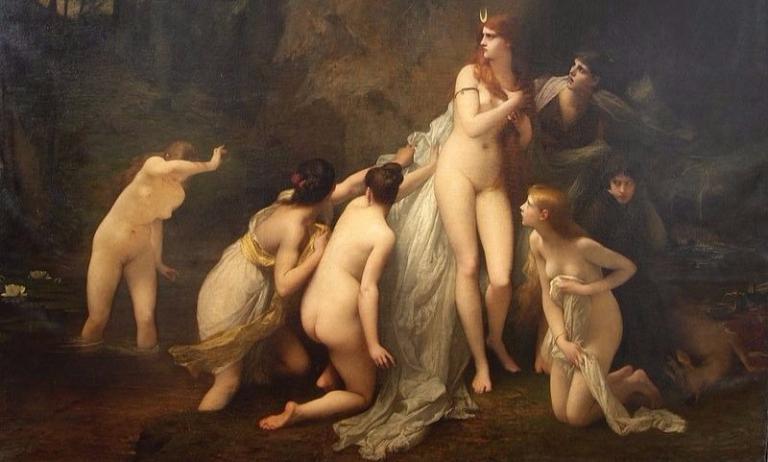
“Diana Surprise” by Jules Joseph Lefebvre. From WikiMedia.
The Witchcraft written about in Aradia was radically different than what had been written about previously, and even what came later. Most Witches in literature worshipped and honored a male god. For instance The leader of Witch ritual in Margaret Murray’s The Witch-Cult in Western Europe was a figure known as the Grand Magister, who was said to be the living embodiment of The Devil. Aradia had three deities: a goddess (Diana), a god (Lucifer in his bright and shining mode), and their daughter Aradia.
Aradia was more than just a child goddess, she was Diana’s avatar on Earth, come down from on high to teach the Witches of Italy how to protect (and avenge) themselves from the Christians who persecuted them. The magick in Aradia is not all harm none sunshine. One especially powerful passage ends with “until the last of your oppressors shall be dead.” It’s a bit different from what many Witches practice today, but it feels like Witchcraft.
And it feels like Witchcraft because many of the words and ideas found in it would end up in the Modern Craft. Doreen Valiente is generally looked at as the writer of The Charge of the Goddess, but many of the words found in Valiente’s Charge come straight from Aradia (something she would have freely admitted to):
“When I shall have departed from this world, whenever ye have need of anything, once in the month, and when the moon is full, ye shall assemble in some desert place, Or in a forest all together join to adore the potent spirit of your queen, my mother, great Diana. She who fain would learn all sorcery yet has not won its deepest secrets, then my mother will teach her, in truth all things as yet unknown. And ye shall all be freed from slavery, and so ye shall be free in everything; and as the sign that ye are truly free, ye shall be naked in your rites, both men and women also: this shall last until the last of your oppressors shall be dead.”
Though Aradia doesn’t contain a full ceremony that we might call “cakes and ale” wine and baked goods in a ritual setting are seen as important. The second chapter of Aradia is called “The Sabbat: Treguenda or Witch-Meeting–How to Consecrate the Supper” and contains lines such as: “You shall make cakes of meal, wine, salt, and honey in the shape of a (crescent or horned) moon . . .” the supper is later described in a way that certainly sounds like many Witch-covens today:
“And thus shall it be done: all shall sit down to the supper all naked, men and women, and, the feast over, they shall dance, sing, make music, and then love in the darkness, with all the lights extinguished: for it is the Spirit of Diana who extinguishes them, and so they will dance and make music in her praise.”
Chapter Eight of Aradia includes an invocation over wine in a drinking horn, a blessing that would not be out of place in my own circle:
“He who would have a good vintage and fine wine, should take a horn full of wine and with this go into the vineyards or farms wherever vines grow, and then drinking from the horn, say . . . .I drink, and yet it is not wine I drink, I drink the blood of Diana, Since from wine it has changed into her blood, And spread itself through all my growing vines, Whence it will give me good return in wines, Though even if good vintage should be mine . . . .”
The Witches of Aradia don’t cast circles or call quarters, but they do a lot of other things that we’d expect Witches to. The importance and influence of Aradia cannot be overstated.
(A small portion of this article was lifted from Witchcraft before Wicca: Three Important Magical Books. Sorry for the repeat, but I did such a great job of expressing my ideas in that one that I couldn’t help myself. Also I’m sorry for so many paintings of half-naked women, finding interesting images free of copyright concerns can be a challenge.)
Previous Post

September 14, 2017
8 Ways to Celebrate the Autumn Equinox/Mabon
Next Post
September 27, 2017 These Things Aren't All True: Falsehoods in the Pagan Community
Browse Our Archives
Select a Category Editorializing Gateways to Paganism Guest Posts Holiday Histories Led Zeppelin News and Views Occult Pagan Pagan TV Club Paganism polytheism Ramble On Reviews Ritual Strange Days Uncategorized
Select a Month August 2026 March 2026 February 2026 November 2025 September 2025 August 2025 April 2025 August 2024 April 2024 February 2024 December 2023 October 2023 August 2023 June 2023 May 2023 January 2023 October 2022 August 2022 July 2022 June 2022 May 2022 April 2022 March 2022 February 2022 January 2022 December 2021 November 2021 October 2021 September 2021 August 2021 July 2021 June 2021 April 2021 March 2021 February 2021 January 2021 December 2020 November 2020 October 2020 August 2020 July 2020 June 2020 May 2020 April 2020 March 2020 February 2020 January 2020 December 2019 November 2019 October 2019 September 2019 August 2019 July 2019 June 2019 May 2019 April 2019 March 2019 February 2019 January 2019 December 2018 November 2018 October 2018 September 2018 August 2018 July 2018 June 2018 May 2018 April 2018 March 2018 February 2018 January 2018 December 2017 November 2017 October 2017 September 2017 August 2017 July 2017 June 2017 May 2017 April 2017 March 2017 February 2017 January 2017 December 2016 November 2016 October 2016 September 2016 August 2016 July 2016 June 2016 May 2016 April 2016 March 2016 February 2016 January 2016 December 2015 November 2015 October 2015 September 2015 August 2015 July 2015 June 2015 May 2015 April 2015 March 2015 February 2015 January 2015 December 2014 November 2014 October 2014 September 2014 August 2014 July 2014 June 2014 May 2014 April 2014 March 2014 February 2014 January 2014 December 2013 November 2013 October 2013 September 2013 August 2013 July 2013 June 2013 May 2013 April 2013 March 2013 February 2013 January 2013 December 2012 November 2012 October 2012 September 2012 August 2012 July 2012 June 2012 April 2012 October 2011 September 2011 August 2011
Follow Us!
TAKE THE
Religious Wisdom Quiz
How many disciples did Jesus choose?
Select your answer to see how you score.
10 13 12 11
Related posts from Raise the Horns

What Makes a Good Ritualist? No Idea

Witchcraft Remembrances & Appreciation at Samhaintide

Raymond Buckland & The Big Blue Book

TRENDING AT PATHEOS Pagan

How to Make a Decision When You Can't...
Main point: It’s much more valuable to stay close to God so...

Archdiocese Hosts Military Marriage Retreat in Germany
RASTATT, Germany — The transient military lifestyle, with its frequent deployments and...

Nearly every morning, I make the drive to Detroit with my high-school-age...

The Real AI Story Is Adoption Without Trust
Artificial intelligence has crossed a political threshold. It is no longer a...

A new article, written by Jeff Lindsay and Gale L. Pooley,...

Swimfan: Forgotten Aughts Pleasures
This is a recovery effort. In 2002, My Big Fat Greek Wedding...
view all Pagan blogs
Ad-Free & Subscriber Log-In Subscription Support
- About Us
- 2026 Calendar
- Videos
- Podcasts
- Library of World Religions
- Faith In Media Tracker
- Advertise With Us
- Write for Us
- Privacy Policy
- Terms of Service
- Do Not Sell My Data
- Contact Us
- Radiant Digital
- Manage Newsletter Subscriptions
- Unsubscribe From Notifications
- Sitemap
Copyright 2008-2026, Patheos. All rights reserved.
Subscription Support Ad-Free & Subscriber Log-In
Follow Patheos